
Junzheng Group announces IPO lottery results! Approximately 80% of new listings in 2026 rose on thei

JuHui Food's heavily criticized prospectus: revenue growth without profit growth due to price-for-volume strategy, with investors exiting en masse just before filing
On June 17, 2026, JuHui Food Technology Co., Ltd. (hereinafter referred to as 'JuHui Food') filed its prospectus with the Hong Kong Exchange, with China Securities International as its sole sponsor.
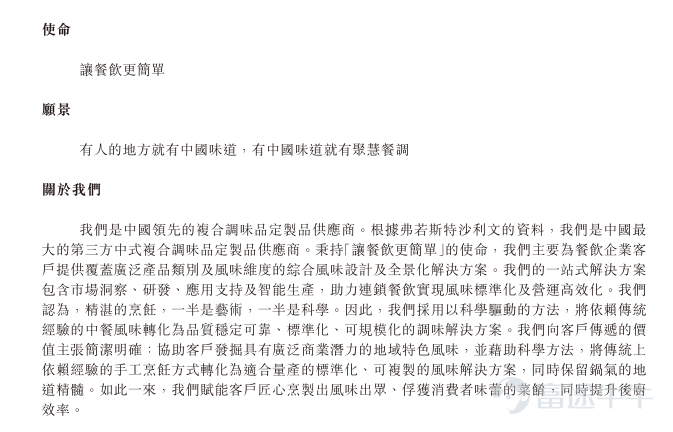
With nearly two decades of deep expertise in customizing seasonings for the catering industry, the company is China’s largest third-party provider of customized Chinese compound seasonings, serving over 130,000 chain restaurant outlets including Haidilao, Laoxiangji, and Xiabu Xiabu. However, according to the full financial information disclosed in the prospectus, multiple underlying concerns lurk behind the company’s expansion.
Meanwhile, a recent report by Securities Times noted that in the summary section of a certain seasoning company’s prospectus filed in June, the first three pages merely described the company as a compound seasoning producer. Furthermore, the prospectus was filled with promotional language such as 'Wherever there are people, there is Chinese flavor; wherever there is Chinese flavor, there is JuHui Seasoning' and 'Great cooking is half art, half science.'

At the recent Hong Kong Exchange Future Tech Summit, Liu Ying, a senior official from the Hong Kong Exchange, pointed out: Some prospectuses of Hong Kong IPO companies not only use exaggerated language but are also obscure and difficult to understand. Specifically, descriptions of business models and operational processes—often inherently straightforward—are rendered unnecessarily complex; core content such as business models and revenue recognition methods is presented in an opaque, redundant, and overly complicated manner.
Liu Ying stated at the conference that certain companies’ prospectuses describe their specific business models and revenue recognition methods in an extremely convoluted way. Given that these companies already operate under unique business and profit-generation models, they should instead clearly and plainly disclose their core operational and revenue logic to the market. However, they fail to articulate these elements directly and transparently, significantly increasing the difficulty for market participants to interpret them. This content proves challenging not only for retail investors but even for professionals within the industry to quickly grasp the company’s true operational and profitability dynamics—a critical pain point in Hong Kong IPO disclosure practices.
Liu Ying cautioned Hong Kong IPO companies that poorly drafted prospectuses severely delay IPO review timelines. When describing business models and revenue recognition methods, companies should avoid excessive jargon and instead adopt plain, accessible language, using simple and clear wording to explain these key aspects.
Product portfolio remains relatively narrow, with continuous price reductions compressing profit margins.
According to an industry report by Frost & Sullivan, China’s compound seasoning market reached RMB 130.2 billion in 2025, with a projected compound annual growth rate (CAGR) of 9.8% from 2025 to 2030. Within this segment, the catering-customized compound seasonings market stood at RMB 24.3 billion in 2025 and is expected to grow at a CAGR of 12.5% over the next five years—significantly outpacing the growth rate of standard seasoning products.
Compared with mature overseas markets, compound seasonings accounted for only 25.50% of China’s total seasoning market in 2025, whereas the corresponding shares in the U.S. and Japan were 54.70% and 53.90%, respectively. Additionally, China’s restaurant chain penetration rate stood at just 22.90% in 2025, far below the U.S. (56.90%) and Japan (53.20%), indicating substantial long-term growth potential in standardized seasoning demand driven by chain restaurants.
According to Tianyancha and the company’s prospectus, JuHui Food’s operating entity traces back to March 2008. As China’s largest third-party customized supplier of Chinese-style compound seasonings, JuHui Food operates under the core mission of 'making foodservice simpler.' The company focuses on meeting the needs of chain restaurants by delivering an integrated, end-to-end seasoning solution that helps brands standardize flavor across outlets and streamline back-of-house operations. Its product portfolio spans diverse foodservice segments—including hotpot, Chinese cuisine, and quick-service restaurants—and has cumulatively served over 130,000 chain restaurant locations.

Retail expert Hu Chuncai noted a clear distinction between B2B seasoning businesses and B2C retail seasoning products. Consumer-facing (B2C) products target individual shoppers whose purchasing decisions are decentralized and often lack professional judgment, making brand influence a key driver of choice. In contrast, B2B clients are professional procurement teams from foodservice enterprises that prioritize product quality, performance, and overall cost-effectiveness. Moreover, the ability to meet clients’ specific requirements and deliver tailored support services carries significant weight. JuHui Food’s competitive edge and pricing power stem precisely from its full-chain R&D capabilities and its network of 30 application centers, which together form a robust customized service system.
During the reporting periods of 2023, 2024, 2025, and Q1 2026, the company recorded revenues of RMB 1.03 billion, RMB 1.136 billion, RMB 1.106 billion, and RMB 297 million, respectively. Corresponding net profits attributable to owners of the parent were RMB 123 million, RMB 153 million, RMB 125 million, and RMB 29.732 million, yielding net profit margins of 12%, 13.5%, 11.3%, and 10%, respectively. Gross margins were recorded at 30.50%, 33.40%, 30.70%, and 30.20%, reflecting fluctuating earnings momentum.
A breakdown of revenue sources reveals limited resilience to economic cycles, as the company’s income is heavily concentrated in a single category of customized compound seasonings, exposing it to pronounced business concentration risk. During the reporting periods, revenue from customized compound seasoning products amounted to RMB 1.003 billion, RMB 1.084 billion, RMB 1.055 billion, and RMB 284 million, consistently accounting for over 95% of total revenue—reaching 95.70% in Q1 2026. Within this custom segment, hotpot seasonings represent the dominant revenue driver, contributing RMB 620 million, RMB 685 million, RMB 669 million, and RMB 182 million across the respective periods, with a consistent share exceeding 60% of total revenue. This heavy reliance means the company’s annual performance is directly tied to the health of the hotpot dining sector and order volumes from leading hotpot chains, with insufficient diversification to hedge against industry-specific volatility.

The core driver behind weakening profitability stems from the company's ongoing price-cutting strategy. During the reporting period, the unit selling price of customized condiments declined year after year. The company has long relied on a 'price-for-volume' approach to maintain order scale, and its weak pricing power over downstream restaurant clients has directly eroded profit margins. The product’s unit price stood at RMB 21.60 per kilogram in 2023, falling to RMB 19.90 per kilogram by 2025—a cumulative decline of 7.87% over two years—and further dropped to RMB 19.30 per kilogram in the first quarter of 2026.
Correspondingly, sales volume continued to rise: 47,700 metric tons in 2023, increasing to 55,400 metric tons in 2025, and reaching 15,300 metric tons in the first quarter of 2026. This growth was entirely driven by price reductions, with no premium achieved through product differentiation.
Inventory build-up has increased, while accounts receivable continue to tie up working capital.
Under the combined impact of the 'price-for-volume' strategy and early procurement of raw materials, the company’s asset turnover efficiency has continuously deteriorated. Both inventory and accounts receivable—two key operating assets—have risen simultaneously, heightening impairment risks and intensifying pressure on working capital.
Raw material costs have consistently accounted for the majority of the company’s total cost structure, meaning fluctuations in input prices directly compress gross margin. According to the prospectus, cost of sales amounted to RMB 716 million, RMB 757 million, and RMB 766 million in 2023, 2024, and 2025, respectively, with corresponding raw material procurement costs of RMB 574 million, RMB 598 million, and RMB 605 million—representing 80.20%, 79.00%, and 79.00% of cost of sales in each respective year. In the first quarter of 2026, cost of sales totaled RMB 207 million, of which RMB 166 million was attributable to raw materials, maintaining a high share of 80.10%.
During the reporting period, raw material inventory stood at RMB 55.30 million, RMB 107 million, RMB 60.83 million, and RMB 59.46 million, respectively. Frequent volatility in upstream agricultural commodity prices has made it difficult for the company to pass on cost increases to downstream restaurant customers through higher product prices, resulting in persistent margin compression from both upstream and downstream pressures.
Inventory-related operational risks are also pronounced. Throughout the reporting period, both the book value of inventory and inventory turnover days rose in tandem, steadily accumulating stockpile risks. Inventory stood at RMB 117 million at the end of 2023, with a turnover period of 46 days; surged to RMB 197 million by end-2024, with turnover days jumping to 76; declined to RMB 127 million by end-2025, yet turnover days remained elevated at 77; and reached RMB 109 million in the first quarter of 2026, with turnover days at 51.
Trade receivables have also shown a year-over-year upward trend, accompanied by expanding provisions for bad debts, continuously tying up the company’s working capital. At each period-end, trade receivables balances were RMB 84.09 million, RMB 80.37 million, RMB 85.75 million, and RMB 95.24 million, reflecting an overall upward trajectory despite some volatility. Corresponding bad debt provisions were RMB 1.23 million, RMB 1.66 million, RMB 3.92 million, and RMB 4.37 million, indicating progressively stricter provisioning.
Beyond profitability and asset turnover, the company’s cash flow structure also exhibits significant weaknesses: operating cash flow is highly volatile, and coupled with a large outflow from the full repurchase of preferred shares prior to listing, the company’s cash and cash equivalents have nearly halved. This IPO carries a strong imperative to replenish working capital.
At the operating cash flow level, net inflows during the reporting period fluctuated significantly, reflecting unstable conversion of profits into cash. Net cash inflow from operating activities was RMB 146 million in 2023, declined to RMB 106 million in 2024, and modestly recovered to RMB 127 million in 2025. Despite annual revenue consistently exceeding RMB 1 billion, net operating cash inflows have remained confined to the RMB 100–150 million range. Combined with the persistent drag from inventory and accounts receivable on working capital, the company’s internal cash generation capacity is insufficient to meet funding needs for capacity expansion and daily operations.
Historically, a round of capital maneuvers further significantly depleted the company's cash reserves. In 2021, the company raised USD 145 million through a Series A preferred share issuance, bringing in multiple financial investors including CPE and Matrix Partners China. Between 2022 and 2025, the company repurchased all preferred shares held by these institutions in tranches, resulting in substantial net outflows from financing activities—RMB 19.09 billion in net outflow in 2024 and RMB 20.07 billion in 2025—all used to return the institutions’ original principal investments, with no exit gains realized by these financial investors.
This full repurchase directly caused a sharp decline in on-balance-sheet cash. The company’s cash and cash equivalents stood at RMB 2.57 billion at the end of 2023 but dwindled to just RMB 1.33 billion by the end of 2025, nearly halving over two years. With weak internal cash reserves and unstable operating cash flows, compounded by persistent funding gaps from capacity expansion and day-to-day operations, a significant portion of the proceeds from this Hong Kong IPO will be allocated to replenish working capital, indirectly highlighting the company’s severe shortfall in internally generated capital.
On the governance front, Ju Hui Food’s equity is highly concentrated among its two controlling shareholders, leaving minority shareholders with little effective check post-listing. Founders Gou Zhongjun and Mr. Wang have entered into a voting agreement and together hold 90.00% of the company’s shares. The remaining 10% is held by Mr. Wu through an offshore BVI entity, BVI-WAZS, with no other financial or strategic institutional shareholders present.
All Series A investors who entered in 2021 had fully exited by 2024–2025, leaving pre-IPO ownership entirely in the hands of the founding team. Following the offering, public shareholders will hold a relatively low stake, making it difficult to establish effective checks and balances at the shareholder or board level. This raises potential governance risks such as unilateral decision-making by controlling shareholders, related-party fund transfers, and improper benefit allocations, leaving minority investors with limited influence. (Produced by Harbor Financial)
Harbor Business Observer, Xiao Xiuni
Risk Disclaimer: The above content only represents the author's view. It does not represent any position or investment advice of Futu. Futu makes no representation or warranty.Read more
Comments
to post a comment