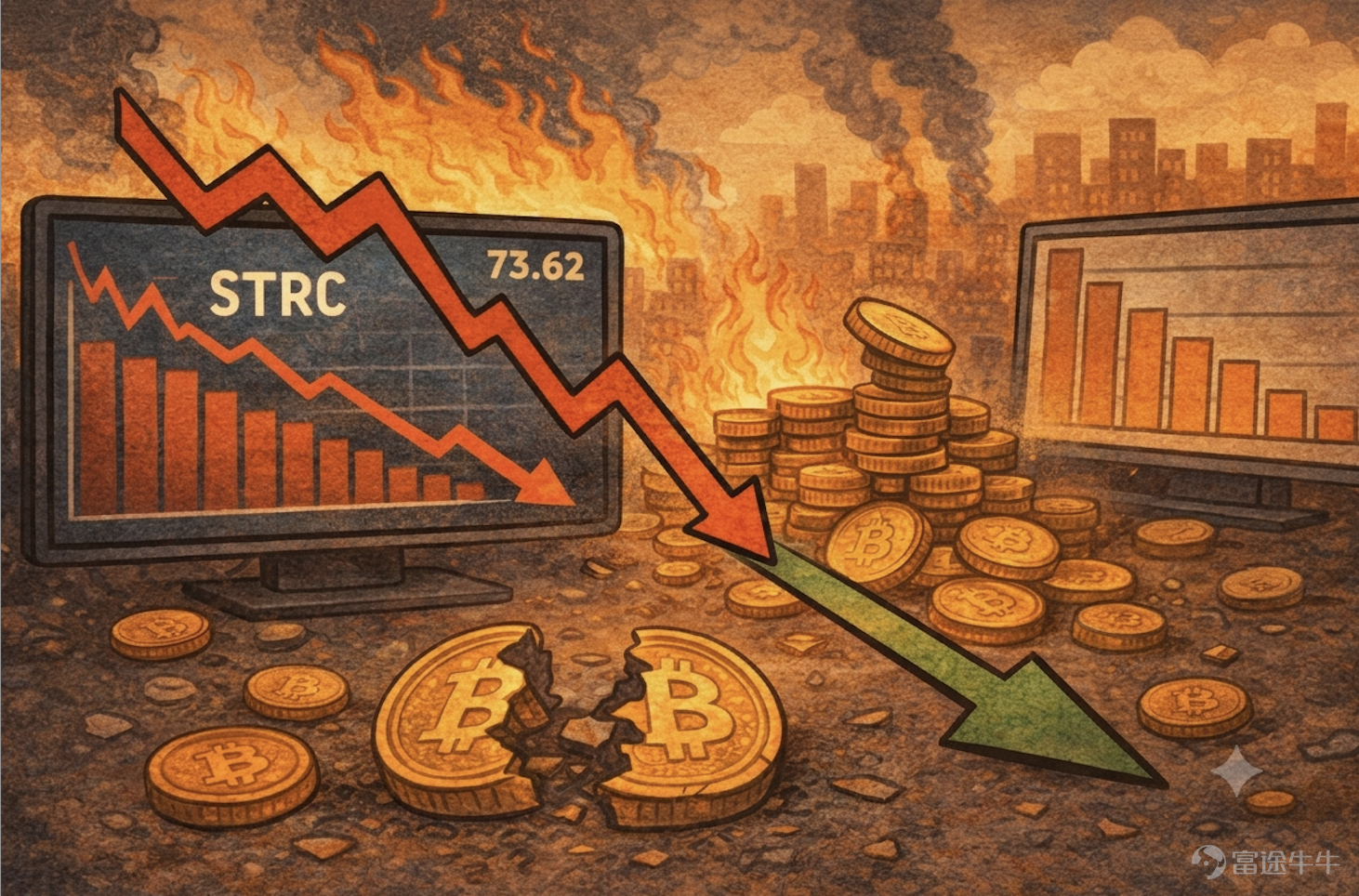

STRC experienced sharp volatility, prompting MSTR to urgently unveil a new framework to reassure investors

Recently, amid the crypto market’s painful correction phase and the negative impact on market sentiment from MSTR’s Bitcoin sales, STRC’s price has persistently fallen below its $100 par value anchor, even briefly sliding to around $74—representing a deep discount of 17.5% to 26% relative to par. STRC’s linkage to MSTR’s common stock manifests in its capital recycling mechanism: when STRC trades near or above par, the company issues new shares through its ATM program to raise capital primarily for purchasing Bitcoin, creating a 'issue preferred shares → buy BTC' loop. Separately, the company maintains an ATM facility for common stock to support general corporate purposes. This model aims to leverage Bitcoin as a core asset to optimize its capital structure.

Source: strategy
This de-anchoring of price is not merely a technical adjustment; against the backdrop of multiple negative factors tied to falling crypto prices, it also reflects Strategy’s emerging financial and credit challenges stemming from its capital management and leveraged expansion.
The primary trigger for secondary market investors selling STRC is the sharp contraction in Strategy’s U.S. dollar cash reserves, which directly undermines the safety cushion for preferred dividend payments. In May 2026, Strategy proactively managed its debt by deploying $1.38 billion in cash to repurchase $1.5 billion in principal amount of zero-coupon convertible senior notes due in 2029. Although this transaction—executed at an approximate 8% discount—appeared favorable on paper, it nearly depleted the company’s entire cash balance.
According to estimates by on-chain analytics firm CryptoQuant, Strategy would need at least $2.8 billion in U.S. dollar reserves to restore its preferred dividend coverage ratio to a relatively safe 24-month level, implying a current liquidity shortfall of $1.4 billion. This coverage gap is the fundamental reason behind the market’s aggressive sell-off of STRC.

Source: blockcast.it
STRC’s discount reflects investors’ risk assessment under current conditions; in the author’s view, this discount stems primarily from multiple interrelated factors:
a) Confidence in using Bitcoin sales to fund dividends:
At the end of May, the company sold a small amount of Bitcoin to fund preferred distributions. Although the amount was limited, this move broke the prior psychological expectation of a 'buy-only' policy. The market is now concerned that if financing windows continue to narrow, selling Bitcoin to cover dividends could shift from an occasional measure to a routine practice—directly impacting investor confidence.
b) Impact of Bitcoin volatility on the margin of safety:
The recent decline in Bitcoin prices has directly impacted the company's overall asset value and net asset value (NAV), thereby compressing STRC's safety cushion. Although the product structure includes certain built-in mechanisms, liquidity management and solvency could face stress in a high-volatility environment—particularly as the positive premium of MSTR’s share price over its Bitcoin net asset value (mNAV) narrows.
c) Questions regarding the long-term sustainability of the credit arbitrage model:

Source: strategy
The cycle of raising capital through high-yield preferred shares to increase Bitcoin holdings relies on market confidence in both the company’s creditworthiness and Bitcoin’s long-term performance. If STRC continues trading at a discount, ATM issuance becomes constrained, narrowing financing channels and potentially triggering a negative feedback loop. While this is not a traditional Ponzi scheme (the company holds real Bitcoin reserves and the instrument is perpetual equity in nature), risks remain: when dividends depend on new financing or asset sales for coverage, the market will repricing the cost of capital.
Recent proactive measures by the company:
In response to current conditions and market panic, the company introduced a new 'Digital Credit Capital Framework' on June 29 to help stabilize sentiment. The framework includes establishing a USD reserve policy of approximately $2.55 billion (targeting coverage for at least 12 months), raising STRC’s dividend yield to 12.00%, authorizing a $1 billion Digital Credit Securities repurchase program (with STRC as the initial priority), a $1 billion authorization for repurchasing MSTR common shares, and a Bitcoin monetization plan (authorizing the sale of a portion of Bitcoin holdings to bolster reserves, fund dividends, and support repurchases).
These initiatives aim to strengthen credit quality, enhance liquidity, optimize capital allocation, and provide more active management tools while maintaining long-term Bitcoin exposure. The company emphasized its intention to flexibly deploy issuances and buybacks based on market conditions, reflecting a shift from one-way capital issuance toward active capital management.

Source: strategy
Strategy is also actively building its cash reserves; according to the company’s 8-K filing as of June 28, its USD reserves reached $2.55 billion, primarily funded through equity sales. For preferred shareholders, the 12% coupon is attractive, but investors’ primary concern remains whether the company can consistently meet its interest obligations. The new framework mandates that cash reserves cover at least 12 months of obligations, which should help reassure holders of perpetual preferred shares.

Image source: Chain News
In summary, STRC’s decoupling has sent a clear signal across the intersecting markets of crypto and traditional finance: even Bitcoin-wrapped assets backed by strong conviction cannot escape the fundamental financial realities of liquidity and debt coverage ratios when faced with rigid, non-equity-convertible perpetual credit liabilities. Strategy must slow its pace of Bitcoin accumulation and urgently rebuild the liquidity buffer on its balance sheet to alleviate current financial pressure. Only after market-driven panic selling subsides can the virtuous cycle between Bitcoin price and capital flows resume.
<关于潘渡>
Pando Limited (“Pando”) is a company licensed by the Hong Kong Securities and Futures Commission to provide digital asset management services. As an active participant in the field of digital asset management, Pando has obtained Type 1, Type 4, and Type 9 licenses issued by the Hong Kong SFC, allowing it to offer a series of regulated digital asset-related services. Additionally, Pando is authorized to issue two actively managed ETF products and two passively managed digital asset ETF products. Through strategic planning, Pando has accumulated extensive experience in digital asset management and is committed to offering diversified investment solutions.
Disclaimer
This content is for reference only. It is neither an invitation nor an offer to buy or sell any securities or other financial instruments. Any information, including facts, opinions, or citations, may be condensed or summarized and is accurate as of the date of writing. Information may change without notice, and Pando Limited (“Pando”) is under no obligation to ensure you are notified of such updates. Investing in the products mentioned in this content involves significant risk of loss and may not be suitable for all investors. Valuations can fluctuate, potentially resulting in the loss of a substantial portion of your investment. If an investment is denominated in a currency other than your base currency, exchange rate fluctuations may adversely affect value, price, or income. You should not participate in such investments unless you fully understand the nature of the transactions and the extent of potential losses. If you do not fully understand these risks, you must seek independent advice from your financial advisor. Under no circumstances should this content be interpreted as an express or implied commitment, guarantee, or suggestion by Pando or from Pando that you will profit or can limit losses in any way. Investors should note that past results do not indicate future performance. Nothing in this content constitutes legal, accounting, or tax advice. Pando assumes no responsibility for any indirect, incidental, special, punitive, or exemplary damages arising from the use or inability to use this advertisement, regardless of whether Pando has been informed of the possibility of such damages occurring, and regardless of the form of action, whether in contract, warranty, tort (including negligence), strict liability, or otherwise. The information provided here is sourced from what we believe to be reliable sources, but we do not guarantee its accuracy or completeness, nor do we assume responsibility for any losses arising from the use of this information. Pando reserves the right to correct any errors found in this content. This content has not been reviewed by the Securities and Futures Commission or any regulatory body in Hong Kong. You should exercise appropriate caution when assessing the value of such information.
This article contains information and analysis regarding Strategy (MSTR), a stock included in the ETF portfolio managed by Pandu Limited. Please note the following: 1. The ETF managed by Pandu Limited holds a position in the aforementioned stock. Therefore, Pandu Limited may have a financial interest in the performance and success of this stock. This should be taken into account when evaluating the information provided herein. 2. The analysis and information presented in this article focus solely on the aforementioned stock and its financial and business performance. It does not constitute a comprehensive review of the ETF portfolio or investment strategy managed by Pandu Limited. 3. Certain statements in this article may be considered forward-looking in nature. However, actual results may differ materially from those expressed or implied in such forward-looking statements, and there can be no assurance that the future performance of the aforementioned stock will meet Pandu Limited’s expectations. 4. Investing in any security, including the aforementioned stock, involves inherent risks. Investors should conduct their own due diligence and carefully consider their investment objectives, risk tolerance, and financial condition before making any investment decisions related to the aforementioned stock or the ETF managed by Pandu Limited. 5. This article is for informational purposes only and should not be construed as investment advice. Pandu Limited advises investors to consult a qualified financial advisor before making any investment decisions.
Virtual Asset Disclaimer
Virtual assets are highly speculative and carry significant risks. Investors should exercise extreme caution when engaging with these products. The legal status of virtual assets remains undefined, which may affect the nature and enforceability of an investor’s rights in such assets. Research reports related to virtual assets have not been reviewed by regulatory authorities, and investors are not protected by investor compensation funds. Virtual assets are not legal tender, and transactions involving them may be irreversible; consequently, losses resulting from fraud or accidental transactions may be irrecoverable. The value of a virtual asset depends on market participants’ continued willingness to exchange it for fiat currency—meaning that if the market for a particular virtual asset disappears, its value could be lost entirely and permanently. There is currently no guarantee that virtual assets will continue to be accepted as a means of payment in the future. The volatility and unpredictability of virtual asset prices relative to fiat currencies can result in substantial losses over short periods. Changes in legislation and regulation may also adversely impact the use, storage, transfer, trading, and valuation of virtual assets. Certain virtual asset transactions may only be deemed completed once recorded and confirmed on a Securities and Futures Commission-licensed platform, which may differ from the time the client initiated the transaction. By their very nature, virtual assets face heightened risks of fraud and cyberattacks. Technical failures may also prevent clients of licensed platforms from executing virtual asset transactions.
Risk Disclaimer: The above content only represents the author's view. It does not represent any position or investment advice of Futu. Futu makes no representation or warranty.Read more

Comments
to post a comment
1