
Google raises its capital expenditure guidance—can it carry the momentum through super earnings week
Market Weekly Report | June 15–21, 2026
*.002 The Fed's Waller made his 'debut' by holding rates steady, but the dot plot unexpectedly shifted toward rate hikes; the U.S.-Iran peace agreement was formally signed on June 19, and the reopening of the Strait of Hormuz drove Brent crude to plunge over 10% for the week. U.S. tech stocks rebounded strongly, with the Nasdaq rising 2.43% for the week and the Philadelphia Semiconductor Index hitting a record high. Hong Kong equities faced pre-holiday liquidity tightening, sending the Hang Seng Index down 3.21% for the week, while southbound capital flows turned net sellers at HK$4.44 billion. Mainland China’s A-share tech sector showed independent strength, with the STAR 50 Index surging nearly 15% for the week.
1. Overview of the Global Macroeconomy
The core theme in global markets this week was"hawkish central banks + geopolitical resolution + tech divergence"— The first FOMC meeting chaired by new Fed Chair Waller held rates steady, but the dot plot shifted, sparking concerns over monetary tightening; the U.S.-Iran peace agreement was signed as scheduled on June 19, and the Strait of Hormuz reopened, triggering a sharp oil price drop and a significant retreat in geopolitical risk premiums; global capital flowed into AI tech leaders under the combination of 'high rates + eased geopolitical tensions.'
In the United States,On June 18 (Beijing time), the Federal Reserve announced its interest rate decision, keeping the target range for the federal funds rate unchanged at 3.50%–3.75% for the fourth consecutive meeting,in line with market expectations, and marking the first unanimous FOMC decision in nine months. This was Waller’s first rate-setting meeting since becoming Chair. The biggest surprise came from the dot plot—of the 19 officials, 9 projected rate hikes this year, with 6 expecting at least two hikes,a complete reversal from prior expectations of rate cuts. Waller deliberately maintained ambiguity about the policy path during the press conference and announced the formation of five working groups to reshape the Fed’s analytical framework, significantly heightening market concerns that 'the next move will be a rate hike.' As a result,U.S. Treasury yields rose sharply, with the 10-year yield climbing to 4.46% (as of June 18) and the 2-year yield rising to 4.19%.。
Geopolitical aspects,The U.S.-Iran peace agreement was formally signed on June 19 (Friday).. Trump announced the full opening of the Strait of Hormuz on June 19 for mine-clearing operations, and Iran pledged it would never possess nuclear weapons. Both sides agreed to an immediate and permanent ceasefire across all fronts. Following the agreement, large commercial vessels have already begun transporting crude oil through the Strait of Hormuz, causing geopolitical risk premiums to dissipate rapidly—this became the key driver behind this week’s sharp oil price drop and improved global risk appetite.
II. Performance of Global Asset Classes
Key theme this week: A mix of Fed hawkishness and geopolitical easing drove U.S. tech stocks to new highs despite broader market headwinds, while oil prices plunged, the dollar strengthened, and U.S. Treasury yields rose.
On the equity side,, U.S. equities posted a 'weak start followed by a strong rebound' performance for the week, led by gains in technology stocks.The S&P 500 rose +0.93% for the week, closing at 7,500.57 points.,The Nasdaq gained +2.43% for the week, closing at 26,517.9 points.,The Dow Jones Industrial Average advanced +0.71% for the week, closing at 51,564.7 points.. Intraday performance diverged significantly during the week—on Tuesday (6/16) and Wednesday (6/17), markets retreated consecutively due to pre-FOMC risk aversion and a hawkish dot plot, with the Nasdaq falling more than 2% cumulatively over the two days; however,on Thursday (6/18), easing geopolitical tensions combined with strong AI sector sentiment propelled the Nasdaq to surge +1.91% in a single day, with the Philadelphia Semiconductor Index and several leading chip stocks all closing at record highs.Amid a high-interest-rate environment, capital continued to concentrate further into high-momentum AI hardware leaders. In Asia-Pacific markets, Chinese tech stocks exhibited resilient and independent strength.The Shanghai Composite Index rose +1.46% for the week, closing at 4,090.48 points.;The ChiNext Index rose 11.02% for the week, closing at 4,252.39 points;The STAR 50 Index gained 14.93% for the week, closing at 1,911.51 points. This week, China’s A-share market showed a clear pattern of 'technology leading gains while traditional sectors lagged'—growth sectors such as precious metals, securities, computing power hardware, non-metallic materials, and memory chips led the gains, whereas insurance, utilities, and airport & shipping stocks weakened.
In commodities, crude oil suffered a historic plunge.Brent crude fell from $87.33 per barrel on June 12 to $77.90 on June 19, plunging approximately 10.8% in a single week;WTI crude dropped from $84.88 to $76.60, declining about 9.8% for the week. The key drivers were the U.S.-Iran deal signing and expectations of the Strait of Hormuz reopening; WTI plunged nearly 5% at the open on June 15.COMEX gold retreated from its highs, falling from $4,238.8 on June 12 to $4,202.7 on June 19. It briefly spiked to $4,380 during the week but pulled back due to a stronger dollar and fading safe-haven demand, ending the week down modestly by about 0.85%.
In bonds,The U.S. 10-year Treasury yield rose to 4.46% (as of June 18), marking a significant increase from last week, the 2-year yield rose to 4.19% and the 30-year yield climbed to 4.90%, reflecting a repricing of tightening expectations following the hawkish dot plot.
In terms of exchange rates,, the US Dollar Index strengthened significantly.The US Dollar Index rose from 99.49 to 100.62, posting a weekly gain of approximately +1.13% and breaking above the 100 mark, primarily supported by the FOMC’s hawkish dot plot and rising US Treasury yields.
III. Weekly Review of the Hong Kong Market
This week, Hong Kong stocks traded only four days (June 15–18; markets closed June 19–21 for the Dragon Boat Festival), exhibiting a"pre-holiday liquidity tightening, technology stocks leading losses, and net capital outflows"pattern. Pressured by the Fed’s hawkish dot plot, rising US Treasury yields, and pre-holiday risk aversion, the Hang Seng Index declined for consecutive sessions.
Index Performance
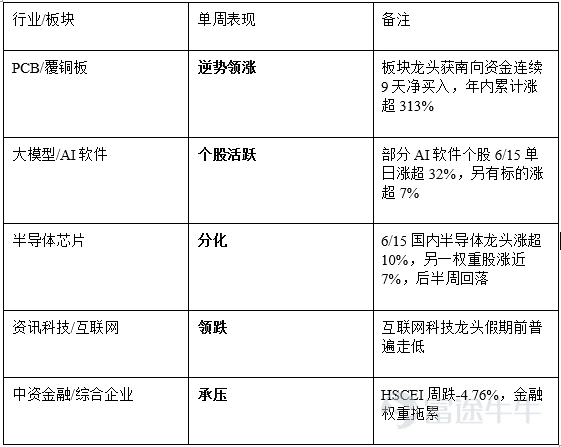
The Hang Seng Index fell -3.21% for the week, closing at 23,924.8 points;The Hang Seng Tech Index dropped -2.14% for the week;The Hang Seng China Enterprises Index fell 4.76% for the week. On June 15, the Hang Seng Index still closed up 0.5% (Zhipu surged over 32%, and chip stocks rose), but then declined for three consecutive days from June 16 to June 18, dropping 1.59% on June 18 alone, with heavyweight tech stocks Alibaba and Xiaomi both falling more than 3%. In terms of style, large-cap blue chips and traditional sectors held up relatively better, while technology and Chinese financial stocks led the declines.
Industry sector gains and losses
Stock Highlights
AI hardware supply chain stocks strengthened against the broader market trend. The leading copper-clad laminate manufacturerbecame the market’s focal point, receiving net southbound inflows for nine consecutive days totaling HK$11.29 billion, with its share price rising 85.6% over the period, as the company implemented its fifth price hike this year, benefiting from a supply-demand imbalance caused by tight supply of electronic fiberglass cloth and surging demand from AI servers and high-speed switches.Some large-model concept stocks surged over 32% in a single day on June 15, while other related stocks rose more than 7%. Meanwhile, major internet tech leaders faced broad pressure ahead of the holiday, falling over 3%.
Capital conditions
Southbound funds recorded a net outflow of HK$4.441 billion this week (June 15–18), marking a clear reversal from previous net inflows and reflecting heightened risk aversion and internal divergence ahead of the holiday. However, flows showed a 'sell large caps, buy thematic plays' pattern—southbound investors significantly increased net purchases of copper-clad laminate, AI hardware, and large-model-related stocks while offloading heavyweight internet names. Year-to-date, southbound funds have still accumulated net inflows exceeding HK$300 billion, and institutions expect them to remain the largest source of incremental capital for Hong Kong equities in the second half of the year.
IV. Outlook for the Market Ahead
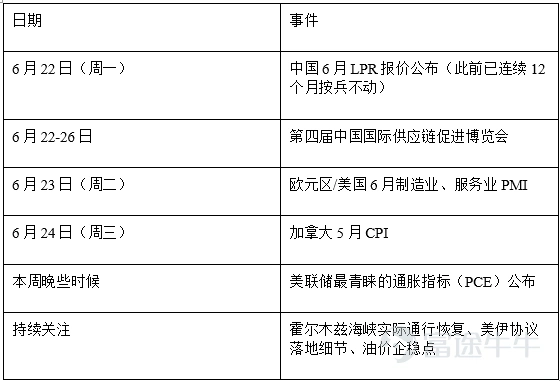
Next week, the market enters"Rebalancing after geopolitical resolution"phase, attention has shifted to the Federal Reserve's preferred inflation gauge (PCE), global PMI data, and the actual pace of restored traffic through the Strait of Hormuz.
Key calendar
Core Thesis
Global markets are entering a period of hedging between "hawkish tightening" and "geopolitical easing". The Fed's Kevin Warsh delivered a surprisingly hawkish debut dot plot signaling rate hikes, pushing U.S. Treasury yields and the dollar higher, which weighed on valuations of global risk assets; however, the U.S.-Iran agreement and reopening of the Strait of Hormuz triggered a weekly oil price plunge of over 10%, rapidly eroding geopolitical risk premiums and marginally alleviating upside inflation pressures—partially offsetting the impact of monetary tightening. Under this combination, global capital is clearly rotating towardhigh-conviction, high-momentum AI hardware leaders—the Philadelphia Semiconductor Index hit a record high, China’s STAR 50 Index surged nearly 15% for the week, and Hong Kong-listed PCB leaders strengthened despite broader market weakness.
For Hong Kong stocks,In the near term, liquidity tightening ahead of holidays and external monetary tightening continue to weigh on markets, with the Hang Seng Index, Hang Seng Tech Index, and Hang Seng China Enterprises Index all posting weekly declines, and southbound capital turning net sellers. However, structural opportunities remain clear—southbound flows have shown a distinct pattern of "selling large-cap weights while buying thematic plays," with concentrated inflows continuing into high-momentum segments such as AI hardware, large language models, and semiconductors. Year-to-date, the Hang Seng Index has fallen nearly 9% and the Hang Seng Tech Index has dropped over 20%, leaving valuations at historic lows. Institutions widely view southbound capital (projected net inflows of HK$310–440 billion in the second half) as the primary source of incremental demand for Hong Kong equities, implying significant upside repair potential for the Hang Seng Tech Index.
A-share tech stocks are poised to sustain their independent rally. As foreign investors increasingly regard China’s AI-related A-share sectors as "valuation bargains" and capital continues concentrating into high-momentum areas, growth indices like the STAR 50 and ChiNext have staged strong independent performances, resonating with the global AI-driven tech rally. However, investors should remain cautious about rotation risks stemming from extreme sectoral divergence.
Allocation strategy
1. The AI hardware supply chain remains the dominant themeCopper-clad laminates, memory chips, and computing hardware are benefiting from surging demand for AI servers and high-speed switches, which has created a supply-demand mismatch and sustained high sector sentiment. Leading A-share and Hong Kong-listed companies in these areas continue to deliver strong performance.
2. Watch for second-order beneficiaries of falling oil pricesBrent crude plunged more than 10% in a single week to around $78 per barrel. If the resumption of shipping through the Strait of Hormuz drives oil prices lower still, it would ease global inflationary pressures, benefiting cost-sensitive sectors such as transportation, airlines, and downstream chemicals.
3. Hong Kong equities’ valuation rebound and southbound fund-driven logic persistHang Seng Tech Index valuations remain near historic lows. Under the structural allocation strategy of southbound funds—selling large-cap stocks while buying thematic plays—AI hardware and large language models remain top priorities.
4. Stay cautious about the persistent headwinds from the Fed’s hawkish dot plotThe dot plot’s shift toward rate hikes has pushed U.S. Treasury yields and the dollar higher, creating temporary volatility for high-valuation growth stocks. Close monitoring of PCE inflation data and subsequent comments from Waller is warranted.
Risk Warning
⚠️ The Fed’s dot plot has turned hawkish, with rate hike expectations continuing to build | Rising U.S. Treasury yields and a stronger dollar are pressuring emerging market valuations | Oil prices rebounded due to the U.S.-Iran agreement falling short of expectations and slow restoration of Strait transit | Risk of rotation from high-flying to lagging stocks amid extreme structural divergence in A-share tech sector | Continued net outflow of southbound capital pressures liquidity in Hong Kong equities
Disclaimer: This report is for internal discussion purposes only and does not constitute investment advice.
Data sources: AlphaPai database and publicly available market data
$CMS Hang Seng Tech Index ETF (03423.HK)$ $BABA-W (09988.HK)$ $TENCENT (00700.HK)$ $XIAOMI-W (01810.HK)$ $NTES (09999.HK)$ $MEITUAN-W (03690.HK)$ $KUAISHOU-W (01024.HK)$ $SMIC (00981.HK)$ $BYD COMPANY (01211.HK)$ $JD-SW (09618.HK)$ $LI AUTO-W (02015.HK)$ $TRIP.COM-S (09961.HK)$ $XPENG-W (09868.HK)$ $BIDU-SW (09888.HK)$ $LENOVO GROUP (00992.HK)$ $HAIER SMARTHOME (06690.HK)$ $JD HEALTH (06618.HK)$ $KINGDEE INT'L (00268.HK)$ $SUNNY OPTICAL (02382.HK)$ $BILIBILI-W (09626.HK)$ $MIDEA GROUP (00300.HK)$ $SENSETIME-W (00020.HK)$ $KINGSOFT (03888.HK)$ $ALI HEALTH (00241.HK)$ $HUA HONG GRACE (01347.HK)$ $TONGCHENGTRAVEL (00780.HK)$ $BYD ELECTRONIC (00285.HK)$ $ASMPT (00522.HK)$ $NIO-SW (09866.HK)$ $HORIZONROBOT-W (09660.HK)$ $TME-SW (01698.HK)$
Risk Disclaimer: The above content only represents the author's view. It does not represent any position or investment advice of Futu. Futu makes no representation or warranty.Read more

Comments
to post a comment
3
2