
Google raises its capital expenditure guidance—can it carry the momentum through super earnings week

A Retrospective and Insights on Buffett's Investments in Oil and Gas Stocks
From PetroChina in 2002, followed by ConocoPhillips, to Occidental Petroleum, ExxonMobil (XOM), Chevron (CVX), and other oil and gas stocks over the past five years, a retrospective look at Berkshire Hathaway’s investment history over the last two decades reveals that oil and gas equities have consistently been one of Buffett’s preferred asset classes. Among these investments, PetroChina delivered exceptionally high returns for Buffett, while the others were relatively high-probability bets with steady but modest gains.
Although Buffett has repeatedly stated he possesses no special ability to forecast oil prices, he has also noted on multiple occasions that returns from investing in oil and gas stocks are highly dependent on expectations of future oil price movements. We might reasonably infer that whenever Buffett initiated or added to positions in oil and gas stocks, he was at least not bearish on oil prices. This article primarily reviews Buffett’s historical investments in oil and gas equities and the lessons they offer. It does not constitute investment advice; please invest at your own risk.
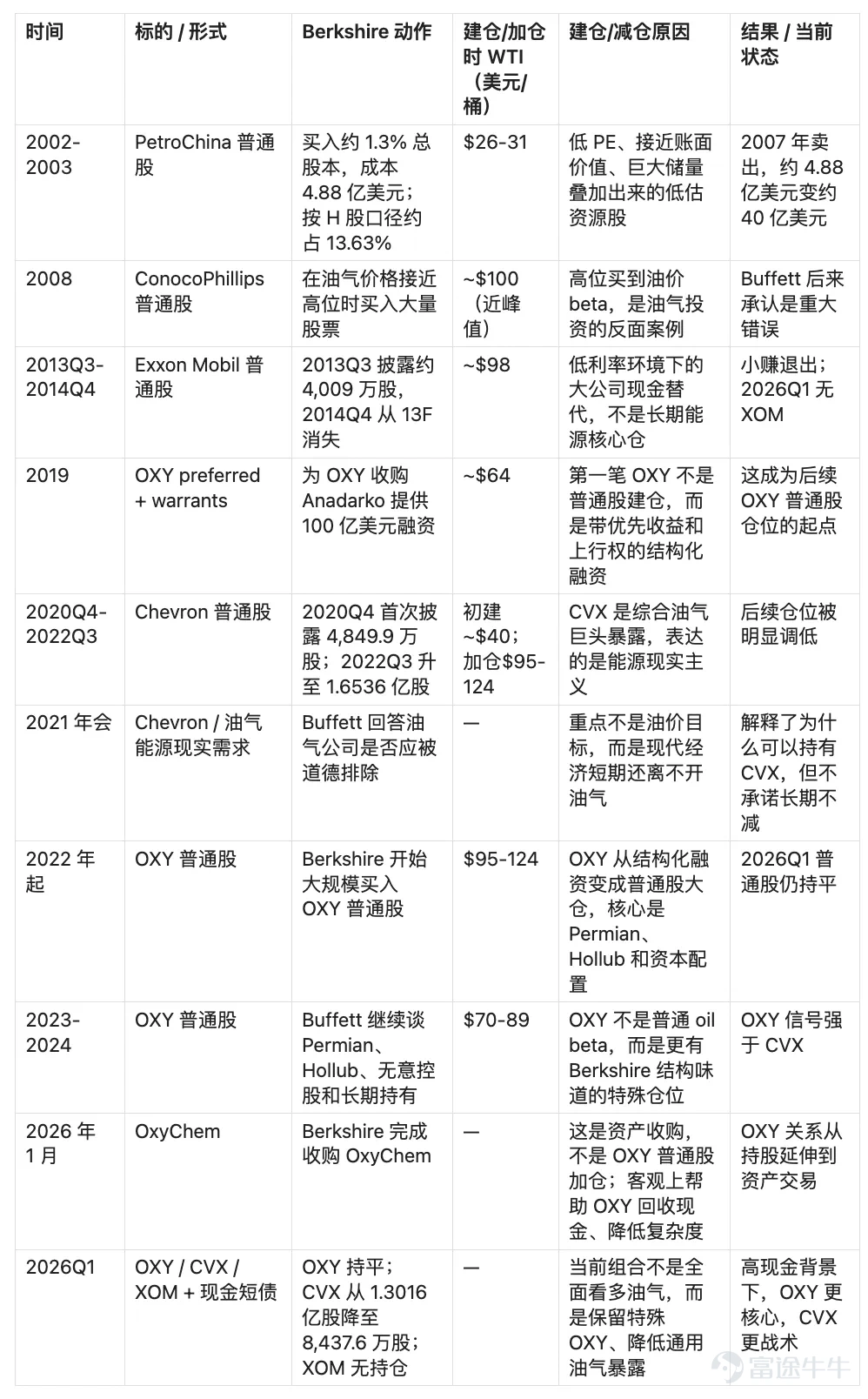
I. Buffett and Berkshire Hathaway’s History of Investing in Oil and Gas Stocks

Source: Created by the author
1. PetroChina: The quintessential undervalued resource stock
Between 2002 and 2003, Berkshire Hathaway acquired approximately 1.3% of PetroChina’s total shares at a cost of USD 488 million.
In his 2007 shareholder letter, Buffett wrote that at the time of purchase, the market valued the entire company at roughly USD 37 billion, whereas he and Munger believed it was worth about USD 100 billion. By 2007, with rising oil prices and strong reserve additions by the company, its market value had climbed to approximately USD 275 billion. Berkshire then sold its stake, realizing proceeds of around USD 4 billion.
Why did PetroChina appear so cheap in 2002–2003? In 2002, its net profit was approximately USD 5.67 billion, implying a price-to-earnings (P/E) ratio of about 6.5x at purchase; in 2003, net profit rose to roughly USD 8.41 billion, resulting in a P/E of only 4.4x. Its price-to-book (P/B) ratio was also attractive: shareholders’ equity stood at USD 38.26 billion in 2002 (about 0.97x P/B) and USD 43.09 billion in 2003 (about 0.86x P/B). What made the investment truly compelling was the confluence of several factors: low P/E, valuation near book value, massive upstream oil and gas reserves, robust cash flow, manageable debt levels—and all this occurred when WTI crude averaged just USD 26.18 per barrel in 2002 and USD 31.08 in 2003, well below the high-price environment seen from 2004 to 2007.
PetroChina resembles what Buffett knows best:a massive resource company being sold by the market at a price far below its intrinsic value, offering high odds.
2. ConocoPhillips: A cautionary tale of buying oil price beta at the top
In 2008, Buffett bought a large stake in ConocoPhillips. In his 2008 shareholder letter, he himself labeled this investment a 'major mistake of commission,' admitting he purchased it when oil and gas prices were near their peak and failed to anticipate the sharp decline in energy prices in the second half of the year. He also wrote that even if oil prices rose in the future, the poor entry point had already cost Berkshire billions of dollars.
How high was oil when he bought? He acquired the position while WTI crude was climbing from the start of the year toward its record monthly peak of approximately $147 (he described his timing as 'near the peak'), with total acquisition costs for the year amounting to roughly $7 billion. In other words, not only was he not bearish on oil prices—he extrapolated them upward from an already elevated level, which was precisely the root of his error.
Why did the price collapse afterward? In the second half of 2008, the global financial crisis triggered a sudden drop in worldwide demand, causing WTI to plunge from around $147 in July to an average of about $41 per month by year-end. By the end of 2008, the position—costing roughly $7 billion—had fallen to a market value of approximately $4.4 billion (an unrealized loss of about $2.6 billion).
Why did he sell instead of holding? He didn’t sell ConocoPhillips because he turned bearish on oil prices. As clearly stated in his 2008 letter, oil was trading at $40–50 when he wrote it, and he 'still believed oil prices were likely to be significantly higher in the future.' He grouped ConocoPhillips alongside Johnson & Johnson and Procter & Gamble as holdings he 'originally intended to keep but was forced to sell'—the sale was driven by the need to maintain ample liquidity during the crisis. Thus, this lesson has two layers: the purchase timing was genuinely wrong (chasing oil beta at the top), but the sale was a liquidity management decision, not a reversal of his oil price outlook.
3. Exxon Mobil (XOM): A high-quality cash substitute in a low-interest-rate environment
In Q3 2013, Berkshire’s 13F filing revealed a substantial position in Exxon Mobil, totaling approximately 40.09 million shares; by Q4 2014, XOM had disappeared from the 13F. At the 2015 annual meeting, Buffett said the trade generated a modest profit, while Munger offered a more direct explanation: in a low-rate environment, considering Exxon’s dividend yield, it could be viewed as 'not a bad cash substitute.'
What were oil prices at the time? When building the position in summer 2013, WTI was trading on a high plateau; by the time of the exit, oil prices were falling from around $106 mid-year to approximately $59 by December (marking the early stage of the 2014–2016 oil crash triggered by OPEC’s production increase and shale oversupply). According to Gregg Warren’s account at the 2015 meeting, Buffett essentially 'sold XOM at cost' amid the oil price decline.
Why sell so quickly—was there something more worthwhile to buy? Both are correct. It was never a core holding from the start, but rather a cash substitute in a low-rate environment; once better uses for the capital emerged, it was swapped out—Buffett’s own words: 'It worked out OK. There were other things we could have done a lot better.' This is effectively a direct admission that there were more compelling allocation opportunities. The timing of the exit (Q4 2014) happened to avoid the subsequent sharp decline, but his stated rationale was capital reallocation, not oil price forecasting. This position provides the weakest support for the inference that 'he wasn’t bearish on oil prices at the time of entry': his reasons for buying XOM were its dividend and liquidity, with a largely neutral stance on oil prices.
Thus, XOM is neither part of the current energy portfolio nor a long-term core oil-and-gas holding. The investment in XOM resembled a short-term cash alternative: a large company with strong liquidity, high dividends, and slightly more return upside than cash.
4. CVX: Integrated oil-and-gas giant, representing pragmatic realism in energy
In Q4 2020, Berkshire’s 13F filing first disclosed a Chevron position of 48,498,965 shares. By Q3 2022, the CVX holding had grown to 165,359,318 shares, near its peak. As of Q4 2025, it still held 130,156,362 shares; by Q1 2026, it dropped to 84,375,856 shares—a single-quarter reduction of approximately 35%.
Oil prices corresponding to each move:
• Initial purchase in Q4 2020 (48.5 million shares): WTI around $40 (post-pandemic lows).
• Build-up to the Q3 2022 peak of 165 million shares: Main accumulation occurred in H1 2022 during the oil price spike of $95–124 (in the same window as the concurrent purchase of Occidental Petroleum common stock).
• Gradual reduction from Q3 2022 to Q4 2025 down to 130 million shares: Oil prices ranged between $60–95, with gradual selling across multiple price levels.
• Sharp 35% cut in Q1 2026 (from 130 million to 84.38 million shares): See below.
Timing of the 2026 reduction: The 35% single-quarter cut appears in the Q1 2026 13F filing (i.e., sales occurred between January and March 2026), not in Q4 2025. Although oil prices were indeed low in Q4 2025 (monthly average ~), the actual large-scale selling happened in the quarter when oil prices rose from around $60 in January to approximately $103 by end-March (a roughly 70% increase within the quarter). Thus, Berkshire did not cut positions due to low oil prices, but rather during an oil price rally. (Berkshire holds less than 10% of CVX, so no Form 4 filings exist; exact sale dates can’t be pinpointed, but the directional intent is clear: it wasn’t forced selling driven by low oil prices.)
More importantly, Chevron’s position changes have largely not been driven by oil price timing: it built positions during low oil prices in 2020, added during high prices in 2022, and then steadily reduced holdings across various oil price levels thereafter. Moreover, during the same oil price peak in Q1 2026, Berkshire left its Occidental Petroleum (OXY) stake untouched while only cutting Chevron. This shows that Chevron served as a tactical position representing 'broad oil & gas beta'—reducing general sector exposure while retaining the unique OXY holding—and was not a signal of bearishness on oil prices.
When Buffett discussed Chevron at the 2021 annual meeting, he didn’t address whether oil prices would rise, but instead answered questions about whether investing in oil & gas companies posed ethical concerns and whether the energy transition would render such companies obsolete. His point was this: while fossil fuels carry externalities, modern economies still cannot abruptly eliminate their reliance on oil and gas in the near term. Therefore, one shouldn’t equate Chevron with a tobacco company or automatically exclude it solely because it operates in oil & gas. Buying CVX provided genuine energy exposure through a large integrated oil & gas company, along with dividends, buybacks, and strong balance sheet quality. Even after clearly reducing the position by Q1 2026, it remained one of Berkshire’s key energy holdings.
5. OXY: The most distinctive holding, evolving from structured financing into a long-term common equity position
The OXY story shouldn’t be viewed starting only from 2022. In 2019, Berkshire first provided $10 billion in financing to support Occidental’s acquisition of Anadarko, receiving 8% preferred shares and warrants in return. This was a classic Berkshire-style deal: when others needed certainty of capital, Berkshire supplied substantial funding—but secured priority returns and upside optionality.
At the 2020 annual meeting, Buffett did not forcefully defend OXY. He acknowledged that investment decisions by oil & gas producers depend heavily on oil prices and admitted that, in hindsight amid the oil price crash, the investment appeared mistaken at that moment.
The turning point came in 2022. At that year’s annual meeting, Buffett said he had read OXY’s investor materials and listened to its earnings calls, and found CEO Vicki Hollub’s comments to 'make nothing but sense,' prompting him to begin buying common stock. Yet he simultaneously emphasized that nobody knows where oil prices will go next year—his exact words included the brief phrase, 'Nobody does.'
At the 2023 meeting, he again highlighted OXY’s Permian Basin positioning and Hollub’s management team, explicitly stating Berkshire had no intention of acquiring control. By the 2024 meeting, he described OXY as a long-term holding. As of Q1 2026, Berkshire’s OXY common share count remained unchanged at 264,941,431 shares. In January 2026, Berkshire also completed the acquisition of OxyChem. This OxyChem deal was an asset purchase, not an increase in OXY common equity; it objectively helped OXY generate cash and reduce complexity, but should not be directly interpreted as Berkshire further increasing its OXY equity stake.
Thus, OXY is not simply an oil price beta play. It is a unique position shaped by transaction structure, resource location, management quality, deleveraging progress, and capital allocation discipline.
The consistent backdrop of oil prices throughout OXY’s entire timeline (and the clearest evidence that 'oil price wasn’t the trigger'):
• 2019 preferred shares + warrants: committed when WTI was around $64 (April); the deal made financial sense at prevailing oil prices at the time.
• 2020 Annual Meeting: WTI May futures briefly plunged to negative $37, and preferred shares looked very distressed, but he left this structure untouched.
• Built a large common stock position in 2022: bought during the March WTI price spike (reaching $123.64—the highest since 2008 and in the second week after Russia’s invasion of Ukraine), paying $48–56 per share for Occidental Petroleum (OXY)—the highest oil price at which he established any of his energy positions.
• Continued adding through 2023–2024 within the median oil price range; the last visible purchase was at $71 oil and OXY trading at $46.80.
• Q1 2026: As oil prices spiked to $103, he held OXY completely unchanged (while Chevron [CVX] cut its stake by 35% during the same period); OXY’s 13F-reported market value rose from approximately $10.9 billion to $17.2 billion, driven entirely by the share price increase to ~$65—not by additional purchases.
Thus, OXY purchases spanned the entire oil price range—from negative values to $124—and his actions (commitments, initial buys, additions, or holding steady) were always driven by structure / Hollub / Permian strategy, not by oil price levels.

Source: Author’s own compilation
III. Current Energy Holdings: High Cash/Short-Term Debt, but OXY/CVX Still Held
As of Q1 2026, Berkshire held $51.478 billion in cash and equivalents, $339.261 billion in short-term U.S. Treasury bills, and approximately $263.096 billion in market value of equities disclosed in its 13F filing. Under this framework, Berkshire’s current equity holdings in energy-related common stocks are:

Source: Author’s own compilation
IV. Several Questions
Beyond summarizing the facts, we must ultimately return to several key questions: Why does Berkshire retain oil and gas stocks despite its high cash position? Under what conditions would Buffett actually buy oil and gas equities? Are these holdings part of the same investment category? Do they align with his investment philosophy? Can this be interpreted as a strategic bullish stance? And how does this relate to stagflation?
1. Berkshire’s equity exposure is low—why does it still hold Occidental Petroleum (OXY) and Chevron (CVX)?
As of Q1 2026, the facts are: Berkshire holds very high levels of cash and short-term debt; its common stock position in OXY is flat, while it has reduced its CVX stake.
OXY and CVX common shares together account for approximately 13.2% of Berkshire’s 13F equity portfolio. Additionally, Berkshire holds OXY preferred shares and warrants, indicating this isn’t merely ‘keeping a small token position.’ A more accurate interpretation is: **Berkshire is not strategically bullish on near-term oil prices, but is instead strategically accepting exposure to a select portion of high-quality oil and gas assets, as well as using them as cash alternatives.**
This ‘strategic’ approach manifests in three ways: First, Berkshire believes the modern economy will not rapidly move away from oil and gas, so integrated majors like CVX still serve real-world demand. Second, OXY is not just a pure play on oil price beta—it combines Permian Basin resources, management under Vicki Hollub, deleveraging progress, the legacy structure of preferred shares and warrants, and potential future asset transactions. Third, maintaining these positions even in a high-cash environment signals they are not just short-term cash substitutes, but among the few tangible assets or cash-flow-generating exposures still deemed suitable for Berkshire’s long-term portfolio.
2. Under what circumstances does Buffett typically hold oil and gas stocks?
Historically, it’s not because he believes he can forecast oil prices. He invests in oil and gas equities only when at least one additional condition is met:
• Like PetroChina: The valuation was so low it could absorb cyclical risk—offering a low P/E ratio, asset prices near book value, and massive proven reserves.
• Like ExxonMobil (XOM): In a low-interest-rate environment, large, stable, highly liquid dividend-paying companies can temporarily serve as cash alternatives.
• Like OXY in 2019: When others needed certainty of capital, Berkshire used preferred shares plus warrants to secure priority returns and upside participation.
• Like CVX: Large integrated oil and gas companies still offer realistic energy exposure and shareholder returns.
3. Do these stocks align with Buffett's consistent style and preferences?
Partially yes, partially no.
Aspects that align with Buffett's preferences:
• Cheap valuation: PetroChina is the clearest example—low P/E, trading near book value, and holding massive reserves.
• Cash returns: Dividends and buybacks from XOM/CVX, and Occidental Petroleum’s (OXY) deleveraging and capital return trajectory.
• Structural protections: OXY’s 2019 preferred shares plus warrants were very Berkshire-like—securing an 8% preferred return upfront while retaining upside optionality.
• Management and capital discipline: OXY later focused not on oil price forecasts, but on Hollub’s capital allocation and its Permian assets.
• Ability to deploy large capital: These are sufficiently large companies or transactions capable of absorbing Berkshire’s substantial capital.
Aspects that do not align with Buffett’s ideal preferences:
• Oil and gas is a commodity business; prices are not determined by the company itself.
• Reserves deplete over time, requiring continuous capital expenditures—unlike light-capital compounding machines such as See's Candy.
• The sector is highly sensitive to cyclicality and political/environmental variables, offering less long-term certainty than assets Buffett is more familiar with, such as consumer goods, insurance float, railroads, and utilities.
• If you buy at the wrong time, the margin of safety can vanish quickly—ConocoPhillips is an example.
Therefore, the conclusion isn't that 'oil and gas stocks align with Buffett's preferences,' but rather: oil and gas stocks temporarily meet his criteria only when price, structure, asset quality, management, or cash returns are sufficiently strong. Without these additional factors, oil and gas stocks themselves are not his ideal type of business.
Risk Disclaimer: The above content only represents the author's view. It does not represent any position or investment advice of Futu. Futu makes no representation or warranty.Read more


Comment (1)
to post a comment
6
7