
Google raises its capital expenditure guidance—can it carry the momentum through super earnings week

Hang Seng Tech Index approaches last year's low as AI newcomers hit trillion-HKD market cap: Is the investment logic for Hong Kong tech stocks undergoing a comprehensive reset?
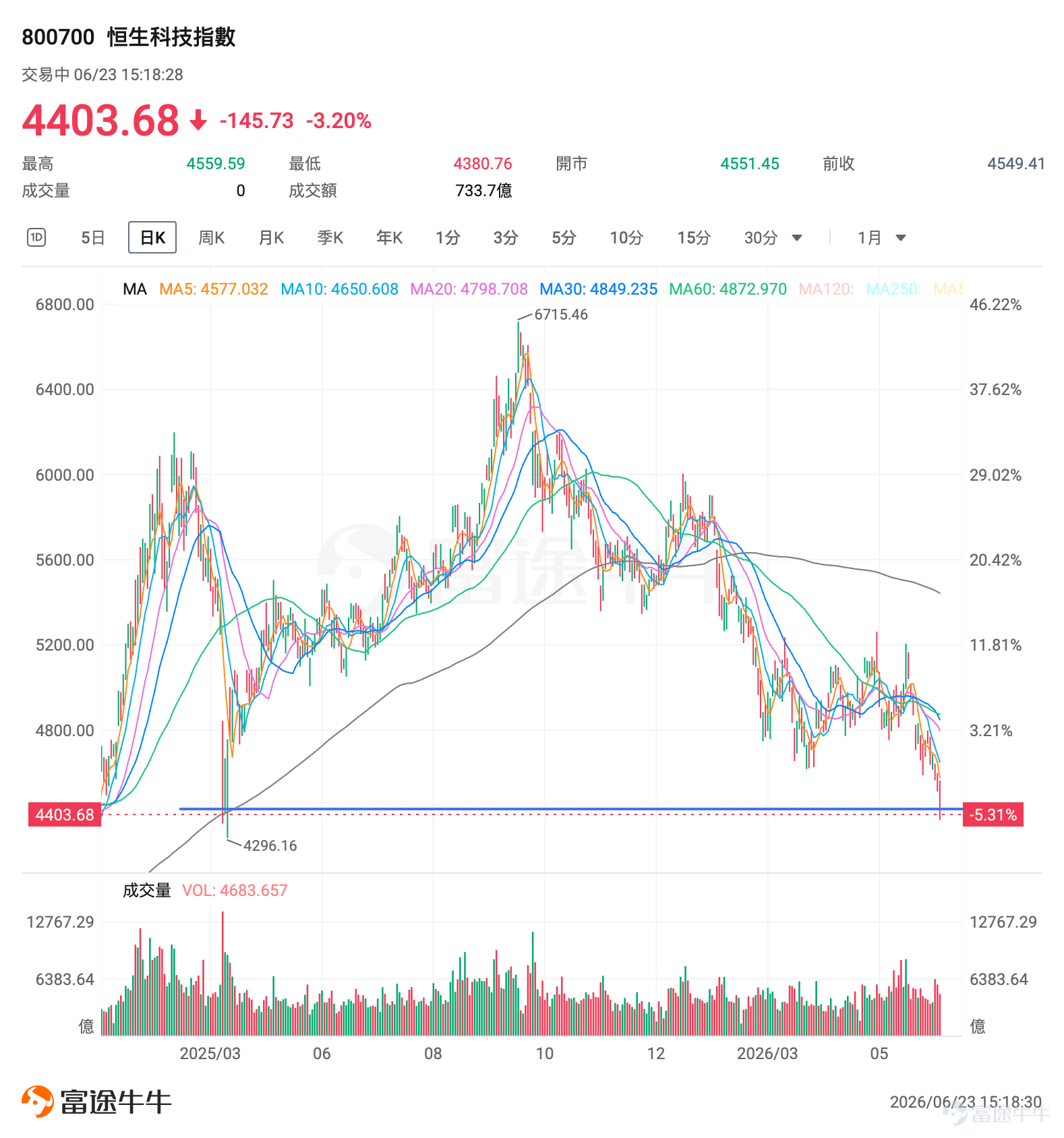
In the first half of 2026, the Hong Kong tech sector has shown an unusually divergent pattern. $Hang Seng TECH Index (800700.HK)$ Amid persistent volatility and declines, the index closed at 4,549.41 on June 22. As of this writing, it has fallen to 4,403.68—just shy of its lowest level seen last year following tariff shocks. It is down more than 20% year-to-date and over 30% from its peak in early October 2025.

Meanwhile, $Z.AI (02513.HK)$ 、 $MINIMAX-W (00100.HK)$ Two major AI large-model companies have delivered standout performances since their IPOs. Zhipu AI’s market capitalization briefly surpassed HKD 1 trillion, emerging as the strongest growth driver in Hong Kong equities this year. MiniMax’s market cap reached HKD 400 billion in March but has recently retreated to around HKD 150 billion.
This extreme divergence—‘weak index, surging individual stocks’—signals a rapid shift in Hong Kong tech investing away from the traditional ‘platform plus consumer internet’ paradigm toward a new ‘AI-driven productivity revolution’ framework.Should investors adjust their strategies accordingly? And how should they trade index futures to navigate this volatility?
Why is the Hang Seng Tech Index under persistent pressure? Structural weaknesses meet macro headwinds
The composition of the Hang Seng Tech Index is at the heart of its weakness. The index tracks the 30 largest technology companies listed in Hong Kong, spanning cloud services, internet, hardware, new energy vehicles, and semiconductors—but traditional internet giants and new energy vehicle firms carry disproportionately high weightings.
Breaking down the top-weighted constituents clearly reveals the sources of drag:The top ten holdings include $SMIC (00981.HK)$ 、 $NTES (09999.HK)$ 、 $TENCENT (00700.HK)$ 、 $MEITUAN-W (03690.HK)$ 、 $BYD COMPANY (01211.HK)$ 、 $XIAOMI-W (01810.HK)$ 、 $BABA-W (09988.HK)$ 、 $JD-SW (09618.HK)$ 、 $BIDU-SW (09888.HK)$ 、 $LENOVO GROUP (00992.HK)$ ,accounting for a combined 70%.These top-weighted companies are primarily traditional internet firms. Although they have ventured into AI, their core businesses continue to face slowing growth, intensifying competition, and profit margin pressures. In the semiconductor space, only SMIC is included; despite being a major chipmaker, it has underperformed smaller AI hardware stocks since the beginning of the year.
$BABA-W (09988.HK)$ 、 $MEITUAN-W (03690.HK)$ 、 $JD-SW (09618.HK)$ 、 $KUAISHOU-W (01024.HK)$ The four major consumer internet platforms together account for approximately 24% of the index weight, $BYD COMPANY (01211.HK)$ 、 $XIAOMI-W (01810.HK)$ 、 $NIO-SW (09866.HK)$ 、 $XPENG-W (09868.HK)$ 、 $LI AUTO-W (02015.HK)$ 、 $LEAPMOTOR (09863.HK)$ while new energy vehicle (NEV) manufacturers collectively represent about 21%,The two traditional sectors combined occupy nearly half of the index, while hard-tech components directly tied to large AI models, computing power, and semiconductors collectively hold less than 30%.

At the fundamental level, both high-weight sectors are simultaneously under pressure.First, consumer internet platforms face dual headwinds: e-commerce and local services have hit traffic growth ceilings, while companies continue to significantly increase capital expenditures on AI large-model R&D, eroding near-term net profits.
Take $BABA-W (09988.HK)$ Take Alibaba as an example: its Q1 2026 earnings showed that after a full year of intensified AI R&D investment and simultaneous heavy subsidies in the instant retail segment, operating profit for the quarter was nearly wiped out. Adjusted EBITDA plummeted 84% year-over-year to RMB 5.102 billion, while operating profit turned negative at minus RMB 848 million. R&D expenses surged 27% year-over-year to RMB 18.957 billion. Alibaba is currently enduring a painful transition phase—sacrificing short-term profits for long-term growth—and its share price fell below the psychological threshold of HKD 100 on June 23.
Second, the NEV sector continues to suffer from an ongoing price war, leading to sustained compression in vehicle gross margins. Repeated disruptions from overseas tariff barriers have further clouded market expectations, driving valuations lower and dragging down overall index performance.
Take $XIAOMI-W (01810.HK)$ Take Xiaomi as an example: its Q1 2026 financial report showed revenue of RMB 99.142 billion, down 10.9% year-over-year, and attributable net profit of RMB 4.723 billion, a sharp 57% year-over-year decline. Its smartphone business—the core revenue driver—is grappling with triple pressures from costs, demand, and competition. Meanwhile, its much-anticipated automotive segment failed to sustain profitability, with Xiaomi’s Smart Electric Vehicles and AI-related innovative businesses reporting an operating loss of RMB 3.1 billion in Q1 2026. Since peaking at approximately HKD 61.45 in July 2025, Xiaomi’s share price has been cut in half.
On the macro front, the Federal Reserve’s uncertain rate-cut trajectory continues to exert liquidity pressure on Hong Kong-listed growth stocks. Recurring US-Iran geopolitical risks since the start of the year, share lock-up expirations at certain companies, and insufficient offsetting buying from southbound capital flows—despite net inflows—have further amplified index volatility.
While inclusion of AI leaders serves as a long-term catalyst for index optimization, it is unlikely to reverse the index's near-term downtrend.
To address the Hang Seng Tech Index’s shortcomings of 'overweight consumer exposure and insufficient hard tech,' on June 8, 2026, $Hang Seng TECH Index (800700.HK)$ pure-play AI large model companies were included for the first time $Z.AI (02513.HK)$ and $MINIMAX-W (00100.HK)$ , while simultaneously removing $KINGDEE INT'L (00268.HK)$ 、 $KINGSOFT (03888.HK)$ , an event widely viewed by the market as a landmark step in the Hang Seng Tech Index’s transformation toward AI-driven productivity.
From a single-stock perspective, Zhipu AI has recently staged an independent bull run. $Z.AI (02513.HK)$ Listed in January at an issue price of HK$116.2, its intraday high reached HK$2,980 on June 22, pushing its market capitalization above the HK$1 trillion mark.

In an April research report, Morgan Stanley estimated that if these two companies had been included in the index at the beginning of the year, the Hang Seng Tech Index’s year-to-date decline would have narrowed by approximately 5 percentage points, clearly demonstrating the positive contribution of AI-related constituents to the index.
However, in the short term, the impact of this rebalancing on the index is limited, primarily constrained by extremely low free-float weights.As of this writing, Zhipu AI’s weight stands at just 1.25%, and MiniMax’s at only 0.34%—even with continued share price doubling, their upward impact on the Hang Seng Tech Index remains negligible.
Two additional medium- to long-term constraints also exist:
First, MiniMax employs a dual-class share structure, meaning it won’t be eligible for inclusion in the Stock Connect program until as early as August, preventing near-term inflows from southbound capital.
Second, both Zhipu AI and MiniMax face lock-up expirations on July 7 and 8, respectively. At that time, Zhipu’s cornerstone investors’ 5.83% stake will become tradable; MiniMax will see approximately 44.29% of shares held by early investors and 5.34% by cornerstone investors—nearly 50% in total—unlock simultaneously. This will multiply the number of freely tradable shares in the market, putting pressure on the valuation premium derived from scarcity and amplifying short-term stock price volatility and index fluctuations.
From an industry cycle perspective, the core significance of this inclusion lies not in providing short-term index support, but in completing a fundamental shift in the index’s underlying logic:For the first time, the Hang Seng Tech Index has included pure-play, native AI large-model companies in its core constituent pool. Going forward, quarterly rebalancing will progressively increase the weightings of firms focused on AI computing power, multimodal large models, and robotics, gradually diluting the representation of traditional internet platforms over the long term.
Investor Takeaway: Transitioning from 'Buying the Index' to the 'Stock-Picking Era'
The divergence between the Hang Seng Tech Index and new AI leaders stems from a fundamental difference in valuation logic. The Hang Seng Tech Index is still perceived by the market as a blend of traditional tech names, emphasizing near-term earnings realization; meanwhile, AI newcomers command a 'productivity revolution' premium, with investors tolerating high losses and instead focusing on model capabilities, token consumption volume, ecosystem development, and future monetization potential.
Therefore, investors urgently need to adjust their investment mindset—but this shift should be rational, not driven by chasing rallies or panic selling.
The limitations of the traditional approach are becoming increasingly evident: overweighting the Hang Seng Tech Index or related giant ETFs often leads to underperformance due to drag from index heavyweights, significantly lagging the broader market in this era of AI-driven divergence. The old logic that 'buying platform stocks equals buying Chinese tech growth' has clearly weakened.
In terms of asset allocation, investors may consider the following approaches:
1. Reduce exposure to traditional consumer internet names:Gradually increase allocations to pure-play AI leaders, computing infrastructure providers, application-layer companies, and core Hong Kong and U.S.-listed equities across the AI supply chain.
2. Use indices as core portfolio holdings: Current valuations are in a historically low range, and with AI-related components gradually being included, it is suitable for staged, contrarian positioning as a diversified core holding. However, clear stop-loss or rebalancing rules should be established.
3. Accumulate on dips: The AI sector is highly competitive; business models of firms like Zhipu and MiniMax still require time to validate. Valuations remain elevated with high volatility, and the wave of share lock-up expirations in July could cause short-term price disruptions. However, their long-term growth ceiling significantly exceeds that of traditional giants, making pullbacks potentially better opportunities for long-term positioning. Position sizes should be kept at reasonable levels, aligned with one’s risk tolerance.
4. Use stock index futures for efficient risk management:
In a diverging market, $HTI Futures (JUL6) (HTImain.HK)$ 、 $MHI Futures (JUL6) (MHImain.HK)$ futures contracts have become essential risk management and investment tools for professional investors.
Intraday trend-following speculationWhen the index shows weak consolidation or a clear downward channel, investors may moderately short futures to capture beta declines; go long when technical rebound signals emerge (e.g., key moving average crossovers, policy tailwinds materializing, or surging trading volume). However, leverage amplifies both gains and losses, so strict stop-loss discipline is essential—this approach suits experienced short-term traders.
Dynamic HedgingInvestors holding an index ETF or a tech stock portfolio may consider shorting futures to hedge against downside risk when the index breaks below a key moving average, and closing the futures position once the index rebounds above the moving average. This strategy can significantly reduce portfolio drawdowns but comes at the cost of sacrificing some upside potential. Investors can dynamically adjust their hedge ratio based on their current holdings.
Overall, Hong Kong-listed tech stocks have entered an era of stock-picking. Passive index investing can still serve as a stable core holding, but actively selecting high-quality AI-related names is necessary to effectively capture structural alpha.
 Fellow investors, where do you think the Hang Seng Tech Index currently stands in its cycle?
All commodity futures, at a glance on one page,Click to start trading futures >>
Track underlying market movements in real time and seize investment opportunities!

Disclaimer
The above information does not represent Futu's views in any way and is provided for reference only; it does not constitute any investment advice. Futures trading involves substantial risk of loss, which can be very significant—in certain circumstances, losses may exceed the initial margin deposited. Market conditions may prevent stop-loss, limit orders, or other contingency instructions from being executed. Investors should thoroughly research and understand futures contracts before trading and carefully consider whether such transactions are suitable given their financial situation and investment objectives. Futures trading entails high risk and may not be appropriate for all investors. Before engaging in any futures trading strategy, investors should fully understand the associated risks and assess their own risk tolerance.
Risk Disclaimer: The above content only represents the author's view. It does not represent any position or investment advice of Futu. Futu makes no representation or warranty.Read more


Comments (15)
to post a comment
31
58