
SK Hynix, Microsoft, and Meta all report earnings! Could the AI sector get another boost? What to in

Wall Street Brief (June 17): U.S. equities rotated sharply on Tuesday, with the Nasdaq posting a significant pullback while the Dow Jones rose against the trend, reflecting a modest uptick in short-term risk-off sentiment; oil prices continued to plunge, defensive sectors such as financials gained strength, and technology stocks came under clear pressure.
Summary: U.S. equity market leadership rotated markedly on Tuesday. The S&P 500 declined 0.57%, the Nasdaq fell 1.15%, the Dow Jones Industrial Average rose 0.64%, and the Russell 2000 dropped 0.87%. Performance divergence among the four major indices was evident—the Dow defied the broader trend to close higher, while the Nasdaq suffered the largest loss. Capital rotated out of technology and growth stocks that had led gains the prior day and flowed into defensive sectors like financials. The VIX climbed to 16.41, up 1.30% on the day, signaling a slight rebound in short-term risk-aversion sentiment. Overall, this shift appears more like profit-taking and portfolio rebalancing at elevated levels rather than systemic de-risking. The key pricing driver of the session was the market’s continued digestion of details surrounding the preliminary U.S.-Iran agreement, which sent crude oil down nearly 5% again. Financials led sector gains, while tech stocks faced notable pressure. Across major asset classes, the 10-year U.S. Treasury yield fell 1.31%, gold rose 0.51%, crude oil dropped 4.99%, Bitcoin declined 0.64%, and the U.S. dollar index slipped 0.11%.

I. Major Events
1. More details of the U.S.-Iran deal released; oil prices continue to plummet
Markets continued to digest additional details of the preliminary U.S.-Iran agreement, including the potential for Iran to resume higher oil exports in the future, driving another sharp drop in crude oil prices. The rapid decline in oil prices further cooled inflation expectations, weighing on the energy sector, while capital continued rotating into relatively defensive areas such as financials and utilities.
2. China's May retail sales unexpectedly weakened
China's retail sales in May unexpectedly weakened, indicating insufficient momentum in consumer recovery. Following the release of this data, Chinese ADRs came under broad pressure, with internet and platform companies posting more pronounced declines. This further widened the divergence among U.S. equity indices on the day and cooled risk appetite tied to Chinese demand.
II. Major Trends
From an intraday perspective, Tuesday’s move was not a broad-based weakening but rather a clear style rotation. The Dow Jones rose 0.64%, while the S&P 500 fell 0.57%, the Russell 2000 dropped 0.87%, and the Nasdaq declined 1.15%. Capital rotated out of technology and growth sectors and flowed back into large-cap, financial, and defensive assets.
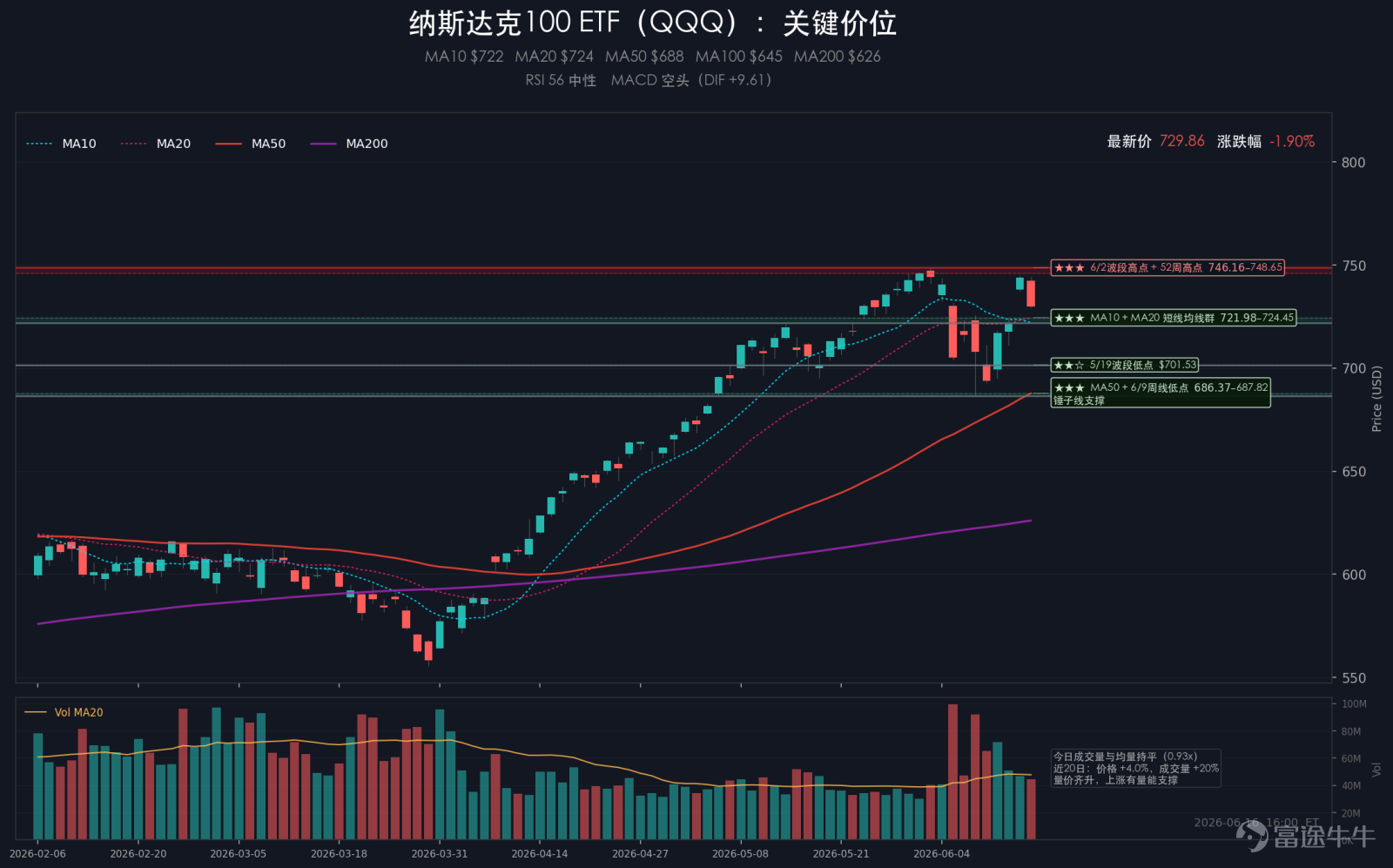
Over a three-month horizon, the medium-term outperformance of growth styles remains intact. QQQ gained 21.72% over three months, significantly outpacing DIA’s 11.22% gain; SPYG rose 16.31%, continuing to beat SPYV’s 8.19% increase. The recent tech pullback appears more like a short-term cooling-off rather than a reversal of the medium-term trend.
Over a two-week horizon, short-term leadership has already shifted. DIA rose 1.44% over two weeks, while QQQ slid into a 2.18% decline. The previously strongest tech-driven theme is now consolidating, while large-cap and financial stocks are showing greater resilience. Among market leaders, big tech names still face near-term pressure. MAGS fell 3.98% over two weeks, indicating that large-cap tech stocks are still unwinding crowded positions, and the market has not yet returned to broadly chasing tech exposure.
III. Market Sentiment
The VIX closed at 16.41, up 1.30% on the day, reflecting a modest pickup in short-term hedging demand. The CNN Fear & Greed Index dropped to 39 from the previous session’s 42, signaling a cooling in risk appetite, though the market has not yet entered a clearly defensive posture.
Option market structure remains relatively constructive. The CBOE total put/call ratio stood at 0.70, with the index options put/call at 0.82 and the equity options put/call at 0.62. Despite the equity pullback, option flows have not shown signs of panic, suggesting this is more of a high-level portfolio rotation rather than a systemic flight to safety.
IV. Market Scan
1. Index ETFs:On Tuesday, the four major indices’ corresponding ETFs diverged sharply: the Dow-tracking DIA strengthened against the broader trend, while SPY (S&P 500) retreated, IWM (Russell 2000) weakened, and QQQ (Nasdaq-100) posted the steepest loss. Market leadership has clearly rotated away from tech and growth toward large-cap and defensive sectors.
2. Sector Performance:The Financial Select Sector SPDR Fund (XLF) led gains with a 1.47% rise, while the Technology Select Sector SPDR Fund (XLK) was the weakest performer, down 2.79%. Sector rotation was evident, as banks and financial heavyweights absorbed capital flows while tech saw concentrated profit-taking. At the sub-industry level, gold miners (GDX) surged 2.31%—the top performer—while semiconductors (SMH) plunged 4.81%, DRAM stocks fell 4.15%, solar (TAN) dropped 3.38%, and oil services (OIH) declined 2.20%. AI-related optical communications and optical modules weakened across the board, and even within AI storage, divergence emerged, with only Western Digital (WDC), Seagate (STX), and Pure Storage (PSTG) holding up against the trend.
3. The Magnificent Seven Tech Stocks:Among the Magnificent Seven tech stocks, Meta Platforms (META) gained 1.13%, making it the relative outperformer, while Netflix (NFLX) slumped 3.61%—the worst performer—and NVIDIA (NVDA) fell 2.37%. Tech heavyweights broadly cooled off, failing to extend the prior session’s broad-based recovery.
4. U.S.-Listed Chinese Stocks:Chinese ADRs faced broad pressure overall. JD.com (JD) fell just 1.05%, making it relatively resilient, while Futu (FUTU) dropped 4.11%, Tencent Music (TME) declined 3.47%, Baidu (BIDU) slid 3.45%, NetEase (NTES) fell 3.27%, Bilibili (BILI) lost 3.08%, the KraneShares CSI China Internet ETF (KWEB) declined 2.78%, and PDD Holdings (PDD) slipped 2.35%. Investor sentiment toward Chinese consumer spending and platform economy stocks has turned notably cautious.
5. Cryptocurrencies:Bitcoin declined 0.64%, and crypto-related stocks also came under significant pressure. MSTR fell 6.35%, CRCL dropped 4.38%, and RIOT edged up just 0.15%. High-beta segments broadly cooled off, with the crypto chain failing to show any independent strength.
$S&P 500 Index (.SPX.US)$ $SPDR S&P 500 ETF (SPY.US)$ $NASDAQ 100 Index (.NDX.US)$ $Invesco QQQ Trust (QQQ.US)$ $Dow Jones Industrial Average (.DJI.US)$ $State Street® SPDR® Dow Jones Industrial Average® ETF Trust (DIA.US)$ $Russell 2000 Index (.RUT.US)$ $iShares Russell 2000 ETF (IWM.US)$ $Roundhill Magnificent Seven ETF (MAGS.US)$ $USD (USDindex.FX)$ $U.S. 10-Year Treasury Notes Yield (US10Y.BD)$ $iShares 20+ Year Treasury Bond ETF (TLT.US)$ $XAU/USD (XAUUSD.CFD)$ $SPDR Gold ETF (GLD.US)$ $CBOE Volatility S&P 500 Index (.VIX.US)$ $CME-Bitcoin RR Futures (JUL6) (BTCmain.US)$ $iShares Ethereum Trust ETF (ETHA.US)$ $NVIDIA (NVDA.US)$ $Tesla (TSLA.US)$ $Meta Platforms (META.US)$ $Amazon (AMZN.US)$ $Alphabet-C (GOOG.US)$ $Microsoft (MSFT.US)$ $Apple (AAPL.US)$
Risk Disclaimer: The above content only represents the author's view. It does not represent any position or investment advice of Futu. Futu makes no representation or warranty.Read more


Comments
to post a comment
5