
ASML Holding and Taiwan Semiconductor both reported strong earnings—when will the semiconductor sell

Market volatility has intensified recently—how should we interpret the two main underlying themes?

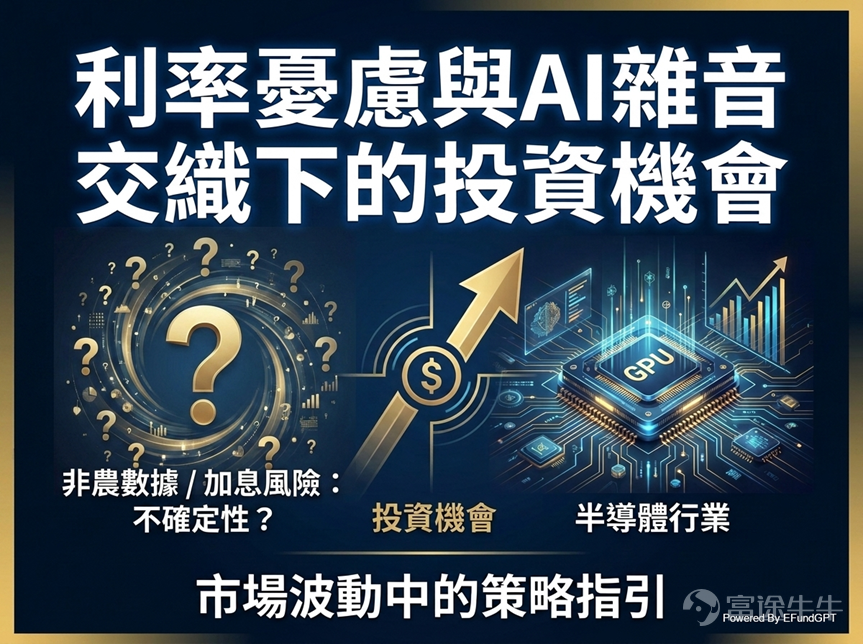
(The above graphic was generated by EfundGpt)
Global equity markets have weakened noticeably recently, and the selloff intensified further after the U.S. nonfarm payrolls data was released last Friday. U.S. stocks saw $S&P 500 Index (.SPX.US)$ and $NASDAQ 100 Index (.NDX.US)$ one of the rarer declines this year; however, given that $Dow Jones Industrial Average (.DJI.US)$ the drop was relatively modest, market action suggests this correction is more of a 'beta-driven sell-off」, the market is more concerned about certain systemic risks. As for Hong Kong equities, which have been weak year-to-date, regardless of $Hang Seng Index (800000.HK)$ or $Hang Seng TECH Index (800700.HK)$ , they remain weak to this day. This time, we will break down the market’s two main themes to help investors interpret the latest market environment.
First, the market is again worried about the trajectory of U.S. interest rates. Non-farm payroll data indicate that the U.S. economy remains quite resilient, with no significant signs of weakening in the labor market. Inflationary pressures have once again drawn investor attention to whether the Federal Reserve might need to keep rates higher for longer. As of June 9, interest rate futures on the CME suggest the market has started to consider the possibility of a rate hike by year-end.It is possiblerate hikes.

(Source: CME FedWatch Tool, as of June 9, 2026)
What troubles the market most is not simply that 'the economy is too strong,' but rather that stagflation risks have not fully dissipated—growth has not shown clear signs of slowing, yet inflationary pressure could heat up again due to rising energy and transportation costs.
Second,recently there have been some mixed signals emerging from the AI supply chain,causing short-term skepticism toward the previously overcrowded growth narrative.
According to financial statements from major tech giants, $Microsoft (MSFT.US)$ 、 $Alphabet-C (GOOG.US)$ 、 $Meta Platforms (META.US)$ and $Amazon (AMZN.US)$ they spent $410 billion on capital expenditures last year, and their latest earnings reports indicate this figure is expected to surge directly to $670 billion this year. However, last week a JPMorgan research report noted that the commencement and construction progress of certain data center projects are slower than market expectations. Meanwhile, last week the market also noticed that NVIDIA’s new product features reduced memory configurations compared to initial plans. Upon this news, investors naturally grew concerned that the pace of AI infrastructure investment might be slowing down—and even began questioning whether the high-growth story behind AI-related stocks is reaching an inflection point. These two factors combined have become the primary triggers for the recent market correction.
However, from a fundamental perspective, there may be no need at this stage to be overly pessimistic about the outlook for risk assets.
Market Interpretation – Negative News Is Gradually Being Digested
First, the market may have previously overinterpreted NVIDIA’s recent product configuration adjustments; this does not necessarily indicate weakening demand. A more reasonable interpretation is that the core bottleneck remains tight memory supply, and the company’s configuration changes are primarilyaimed at helping customers reduce TCO (Total Cost of Ownership), while preserving flexibility for future upgrades. In other words, this is not a story of declining demand; rather, it reflects strong ongoing demand, with customers opting to deploy platforms upfront and incrementally upgrade configurations later. Viewed this way, these changes underscore the continued stickiness of AI computing demand, rather than a reversal in industry fundamentals.

(Source: Bloomberg, as of June 9, 2026, U.S. unemployment rate)
Secondly, although the nonfarm payroll data triggered a repricing of market expectations regarding interest rate hikes, the underlying macroeconomic backdrop it reflects is actually one of relative resilience in the U.S. economy. The unemployment rate has remained around 4.3%, indicating no significant deterioration in the labor market. As forthe source of job gains in the most recent month, part of the increase was concentrated in travel-related sectors, possibly linked to major sporting events like the World Cup and seasonal demand.This implies that what the market is truly concerned about right now may not be an economic slowdown, but rather whether inflation could rebound again due to external factors while the economy still shows resilience. At this stage, the primary drivers of rate-hike risks remain sharp increases in energy and transportation prices—two key indicators reflecting geopolitical risks.
Regarding AI infrastructure, recent reports suggest that some project timelines are lagging behind schedule—a concern that is not entirely unfounded. After all, in a high-interest-rate environment, capital expenditure pressure on large-scale infrastructure, data centers, power systems, and supporting facilities is indeed substantial, and project payback periods can easily be extended, weighing on construction and investment progress. In the short term, these factors will inevitably affect market sentiment.
But more importantly, these pressures are still largely driven by the direction of interest rates, which remain elevated due to stagflation risks. These stagflation risks, in turn, stem largely from geopolitical factors—particularly disruptions in energy prices. In other words, if geopolitical risks gradually ease in the future and pressures on energy and shipping subside, inflation expectations could cool down, market concerns about further rate hikes would correspondingly diminish, and risk appetite would naturally have room to recover.
This is also whyinterpreting the interest rate futures market at this stage requires caution. Interest rate futures reflect the market’s latest pricing of the policy path based on the current environment. However, if the key variables driving rate hike expectations are external factors—such as geopolitics and energy prices—then a moderation in these factors could lead to a swift reassessment of the entire interest rate outlook. Currently, the market is pricing in the possibility of 'escalating risks,' but this logic remains highly variable and may not be suitable for linear extrapolation.

It is worth noting that some marginally positive signals are beginning to emerge from certain market observations. For example, prediction markets like Polymarket show that a segment of participants expects the Strait of Hormuz to gradually return to normal by year-end. If such risks indeed ease going forward, it would theoretically alleviate pressures on energy supply, shipping costs, and overall inflation expectations. While these signals may not be sufficient to immediately reverse market sentiment, they do suggest that the most pessimistic stagflation narrative may not necessarily continue to deteriorate.
Overall, recent market declines appear to be an emotional adjustment triggered collectively by valuation pressures, interest rate concerns, and short-term noise in the AI sector, rather than signaling a broad-based deterioration in fundamentals. Demand for AI itself has not yet shown any material reversal; the current situation likely reflects supply constraints and adjustments in investment timing. On the macro front, we still need to monitor whether energy prices, transportation costs, and geopolitical developments will further fuel inflation expectations.
in the coming period, $U.S. 10-Year Treasury Notes Yield (US10Y.BD)$ whether it breaks above 4.7% and hits a new 52-week high will be a critical market watchpoint. If long-end yields continue rising, it implies the market still believes inflationary and high-rate pressures will persist, and volatility in risk assets may not be over yet. Conversely, if bond yields do not spiral further out of control and geopolitical risks gradually ease, market risk appetite could stabilize, and the current correction may not evolve into a deeper, fundamental weakening.
Market conditions may remain turbulent in the near term, but what matters more right now is distinguishing between emotional exaggerations and genuine shifts in fundamentals. As things stand, the market is repricing uncertainty, but it may not yet have entered a phase of structural deterioration.
Investment Strategy
Although near-term market sentiment remains influenced by rate expectations and AI-related noise, the structural growth thesis of the tech sector remains intact from a medium- to long-term perspective. In particular, AI computing infrastructure—serving as the core engine of global technological advancement—relies fundamentally on its semiconductor supply chain, which remains the most critical link in the entire ecosystem. Amid the current market correction, valuations of select high-quality Asian semiconductor companies have pulled back, offering investors a potential entry window.
Against this backdrop,iShares E Fund Asia Semiconductor ETF (03486.HK) deserves investors’ close attention. As an ETF focused on the Asian semiconductor industry, $EFund A SEMICON ETF (03486.HK)$ it primarily invests in competitive semiconductor companies across Asia, covering key segments such as wafer foundry, memory, power semiconductors, advanced packaging and testing, and AI-related chip design.
According to Bloomberg data, as of June 8, SK Hynix—one of the ETF’s holdings with a weight exceeding 5%— $HUA HONG GRACE (01347.HK)$ 、 $ASMPT (00522.HK)$ 、 $Taiwan Semiconductor (TSM.US)$ 、 $SMIC (00981.HK)$ and $LENOVO GROUP (00992.HK)$ posted gains ranging from 2% to 9% on June 9.
Compared to investing in a single market or individual stock,iShares E Fund Asia Semiconductoroffers a convenient, diversified exposure to the Asian semiconductor sector, helping investors capture long-term growth opportunities driven by rising AI computing demand while mitigating volatility risks associated with any single region or company. Amid the ongoing global expansion of AI-related capital spending, Asia’s strategic position as the world’s most critical semiconductor manufacturing hub remains solid, underscoring its long-term investment value.
Important Information
The issuer of this content is E Fund Asset Management (Hong Kong) Co., Ltd. This content is for reference only and does not constitute an invitation or recommendation to invest in fund units. This content is for display purposes only and should not be shown to any person for whom such display would be illegal. Investment involves risks, and you may lose a significant portion of your principal. Before investing, investors should carefully read the fund prospectus (including the "Risk Factors" section) to understand the investment risks associated with the fund. This content has not been reviewed by the SFC.
The E Fund (Hong Kong) Solactive Asia Semiconductor Select Index ETF (the “Sub-Fund”) is a sub-fund of the E Fund ETF Trust. The E Fund ETF Trust is an umbrella unit trust established under the laws of Hong Kong. The Sub-Fund is a passively managed ETF as defined under Chapter 8.6 of the Unit Trusts and Mutual Funds Code issued by the Securities and Futures Commission (“SFC”). Units of the Sub-Fund (“Units”) are traded on The Stock Exchange of Hong Kong Limited (“HKEX”) like stocks. The investment objective is to provide investment returns that closely track the performance of the Solactive Asia Semiconductor Select Index (the “Index”), before fees and expenses.
As the Sub-fund’s investments are concentrated in securities of companies primarily engaged in specific sectors within the Hong Kong and East Asian semiconductor industries, it may be particularly affected by certain factors, thus exposing the Sub-fund to industry and geographic concentration risks. Therefore, its net asset value may be more volatile compared to broadly diversified funds.
For important notices and disclaimers regarding the above fund, please visit E Fund Hong Kong’s website.https://www.efunds.com.hk/tc/products/53/important/
Risk Disclaimer: The above content only represents the author's view. It does not represent any position or investment advice of Futu. Futu makes no representation or warranty.Read more


Comments
to post a comment
6
3