
US Stocks' 'Black Friday' Nightmare! What Is the Market Actually Correcting? A Deep Dive into the Fundamentals and Response Strategies
Last Friday, U.S. equity markets experienced one of their sharpest single-day sell-offs in recent years, abruptly dousing the two-month-long AI rally with cold water.
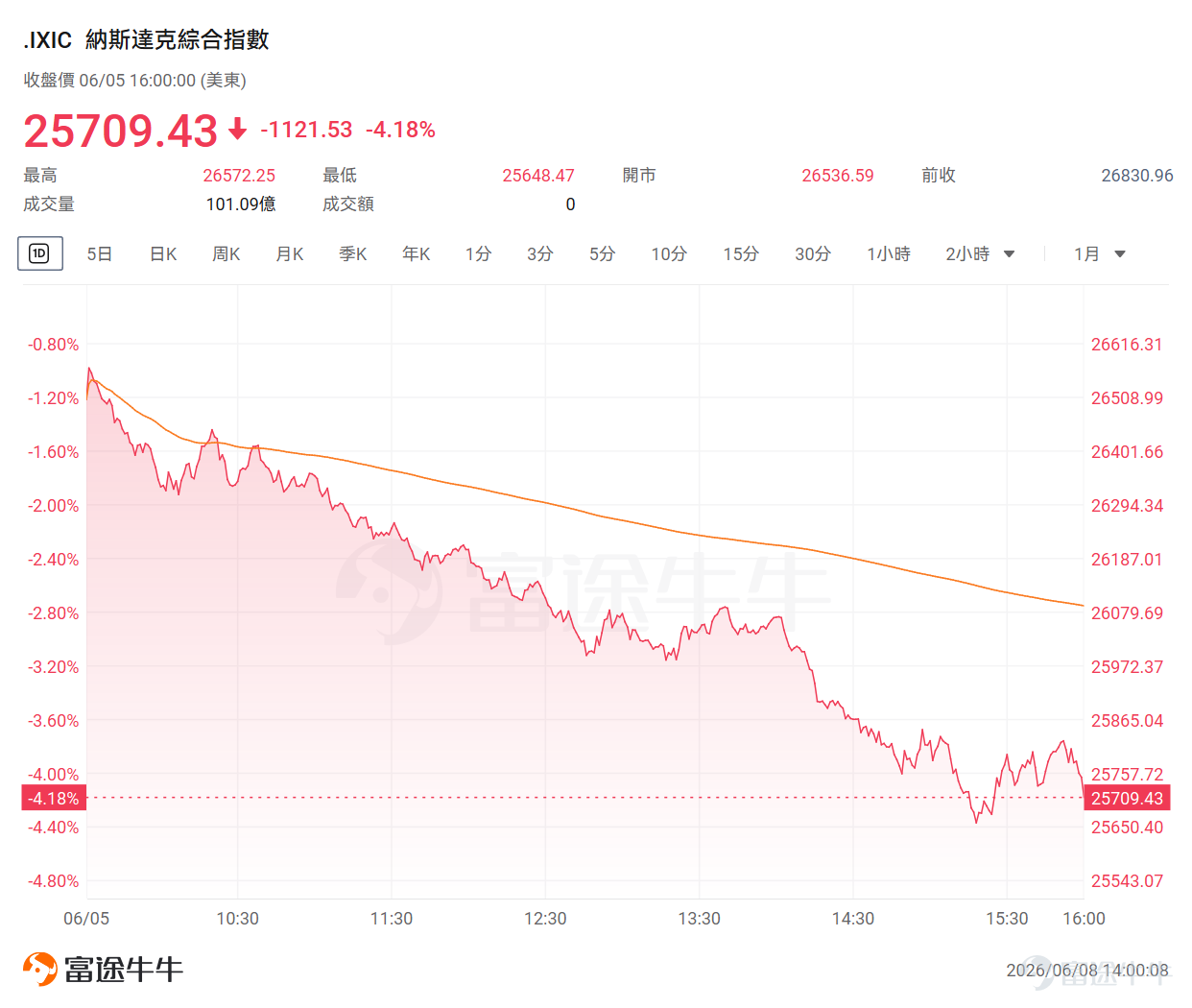
The tech sector was hit first and hardest, $Nasdaq Composite Index (.IXIC.US)$ plunging 4.18% in a single day—the worst performance since April 2025; $PHLX Semiconductor Index (.SOX.US)$ tumbled even more dramatically by 10.3%, marking its largest single-day drop since March 2020. In just one day, U.S.-listed chip stocks shed approximately $1.3 trillion in market value.

Looking back at this tumultuous week, the market was struck by a double whammy of sector-specific and macroeconomic headwinds.On the sector front, $Broadcom (AVGO.US)$ disappointing earnings initially ignited the semiconductor sector’s pullback. Subsequently, ongoing market discussions about $NVIDIA (NVDA.US)$ the CPU-side memory configuration of Vera Rubin NVL72 systems continued to gain traction, forcing investors to reassess the outlook for related memory demand; compounded by Anthropic’s public warning about 'AI失控 risk,' which further dampened investor sentiment toward tech stocks.
But what truly delivered a fatal blow to the market was unexpectedly strong macroeconomic data.May’s nonfarm payroll employment rose by 172,000, and the unemployment rate remained steady at 4.3%. As soon as this better-than-expected report was released, market expectations for another Fed rate hike this year surged sharply, with implied probabilities of a rate hike briefly approaching 70%—becoming the heaviest bearish catalyst weighing on the broader market.
Yet, what is the real story behind this sharp sell-off?Is the current US stock market decline really just as simple as the surface-level narrative of 'strong economic data fueling heightened rate hike expectations'? Does this signal the end of the current bull market? Next, we’ll provide fellow investors with an in-depth breakdown to uncover the true drivers behind the market moves!
What exactly is the market adjusting for behind this 'Black Friday'?
Industrial Securities stated, on June 5, US stocks experienced a 'Black Friday,' with tech stocks undergoing widespread corrections. The triggers were twofold: first, weaker-than-expected earnings from Broadcom, a leading AI chipmaker in the US; second, robust US nonfarm payroll data that intensified expectations of liquidity tightening.
Although this market correction appears to stem from shifts in macroeconomic and sector-specific fundamentals, it is essentially driven by investor behavior, with impacts leaning more toward sentiment and market structure.Previously crowded positioning amplified the volatility triggered by negative news, causing the market to overstate the actual impact of these events. At its core, this move reflects profit-taking by some investors amid adverse news and a structural 'rebalancing' within portfolios built up during prior periods of crowded trades.Therefore, this round of adjustment does not reflect a fundamental shift in the core drivers supporting the market rally; rather, it stems mostly from sentiment-driven noise, with effects primarily structural in nature.
First, U.S. equity markets did not experience a panic-driven broad-based sell-off on Friday; instead, market action resembled a long-anticipated 'rebalancing.'The hardest-hit sectors were primarily technology and consumer discretionary—both highly sensitive to liquidity and having rallied significantly since April—while staples, utilities, real estate, healthcare, and financials posted gains against the broader downtrend.
Second, looking at the nonfarm payroll data itself, it was also influenced by one-off event-driven distortions, casting doubt on its sustainability; thus, market expectations for rate hikes this year still have room for further revision.Although May’s U.S. nonfarm payroll figures significantly exceeded consensus estimates in aggregate, the composition was highly uneven—primarily driven by leisure/hospitality and government hiring. The former was distorted by front-loaded Memorial Day-related seasonal adjustments and one-time effects from early World Cup preparations, raising questions about its sustainability.
Moreover, the labor force participation rate and unemployment rate held steady in May, while year-over-year wage growth continued to ease—suggesting that underlying labor market momentum may still be relatively weak. Looking ahead, the durability of strong employment data is questionable. With U.S.-Iran geopolitical tensions notably de-escalating, inflation faces some upside pressure, but the magnitude is likely manageable and insufficient to justify a rate hike. Therefore, the Fed’s optimal course remains to stay on hold and maintain a wait-and-see stance; a rate hike is not the base case scenario. Current market pricing implying rate hikes this year leaves room for further downward revision.
Therefore, this U.S. market correction reflects more a structural rebalancing needed to unwind previously crowded trades triggered by negative news, rather than a systemic risk stemming from a fundamental shift in the market’s core narrative. The resulting volatility will likely be more sentiment-driven and sector-specific.
Coincidentally,Chen Yixin, macro analyst at Guolian Minsheng Securities, believes thatthe recent U.S. equity pullback appears on the surface to stem from strong nonfarm payrolls exacerbating market concerns about liquidity tightening, but in essence represents a prudent unwinding of richly valued assets.
At a deeper level, this U.S. market correction reflects a shift in investor focus from capital expenditures (Capex) toward free cash flow.It’s not just that Broadcom’s earnings missed expectations. In the past, institutions bet heavily on rapid Capex growth, fundamentally because they firmly believed that 'the more you invest, the higher the barriers to entry.' Now, however, the market is reckoning with how high depreciation erodes free cash flow. With insufficient near-term cash flow realization on the numerator side, this latest U.S. equity pullback has been primarily led by tech stocks.

When macro data hits red lines, elevated positions may undergo a 'stampede-style' unwinding.The stronger-than-expected May nonfarm payroll pushed the 10-year U.S. Treasury yield back above 4.5%, compressing forward P/E ratios across the market and triggering systematic quant CTA and algorithmic strategies to unwind semiconductor (SOX) positions. The 10% chip sector drawdown on June 5 wasn’t merely driven by tightening monetary expectations—it reflected a 'stampede' among previously overcrowded leveraged longs as liquidity taps tightened.
After this sell-off, is AI optimism reaching its endgame—or is this merely a mid-cycle pause in a bull market?
Amid sharp selling pressure, panic is the market’s natural instinct, but historical data often helps restore rationality.
Reviewing the Nasdaq’s recovery patterns following each significant decline since late 2022 reveals a highly instructive trend:Each deep dip has almost always served as蓄力 for the next leap upward.According to statistics, during its recent notable corrections, the Nasdaq averaged a drawdown of approximately 11.4%, with a median correction duration of about 27 days. More strikingly, once the market bottomed out, the Nasdaq demonstrated remarkable resilience—posting an average rebound of 11.3% within the following month, with a median gain approaching 14%.
The implicit message behind these figures is clear: within a long-term upward trend, such sharp, indiscriminate sell-offs typically represent the market releasing profit-taking pressure and undergoing aggressive position rotation.

Regarding market structure, the core concern is whether this correction will significantly impact the global AI rally or signal its definitive end. According to Industrial Securities, looking ahead, a series of upcoming global liquidity events—including U.S. CPI data releases, central bank meetings in the U.S., Europe, and Japan, and SpaceX’s IPO—combined with an earnings 'vacuum period,'High volatility in tech stocks may persist, and the market could use this as an opportunity for a structural 'rebalancing.'
However, regarding the current AI-driven rally, the firm emphasized:"The denominator side often creates buying opportunities, while the numerator side ultimately determines the rally’s endpoint."Recent and upcoming market concerns stem largely from denominator-side factors—such as positioning crowding, liquidity, and sentiment—but these won’t terminate a major structural trend. In fact, the resulting volatility often creates buying opportunities. The July earnings season will serve as another catalyst for the global AI rally, as it brings validation of fundamentals (numerator) and industry trends.
For U.S. equities, the current market environment closely resembles late July 2024:At that time, concerns over Google Cloud and ad revenue missing expectations marked a turning point for the previously crowded Magnificent 7 trade. This was followed by a reversal in yen carry trades, which worsened global financial conditions, compounded by weaker-than-expected U.S. nonfarm payrolls and a rise in the unemployment rate triggering the 'Sahm Rule,' fueling recession fears and further deepening the market correction. Markets bottomed and rebounded after the Bank of Japan and the Fed Chair delivered dovish comments in August, and especially after the Fed’s surprise 50-basis-point rate cut in September eased recession concerns. More importantly, once the October earnings season began, renewed data confirmation of tech sector strength propelled the Nasdaq to new all-time highs.
Currently, two key points stand out: first, the recently overshot liquidity expectations themselves will likely exhibit 'reflexivity' going forward; second, once positioning crowding eases, the July earnings season will act as another catalyst for the AI rally.
Guolian Minsheng Securities believes that while the long-term hardware narrative underpinning technological innovation is far from over, the near-term earnings vacuum has left investors in a state of confusion due to a lack of empirical evidence. Additionally, with the market currently in a 'vacuum period' for physical capacity expansion, there are near-term concerns about insufficient profit realization from upstream segments.Further upside in U.S. equities may require additional release of potential risks.
And how large a drawdown in U.S. equities can the U.S. government tolerate?Guolian Minsheng Securities believes that, on one hand, if the paper wealth effect reverses, the 'invisible hands' of the White House and the Federal Reserve may act earlier. On the other hand, the negative drag of falling asset prices on consumption could be greater than the positive boost from rising prices. In summary,The firm believes a 10% pullback in U.S. equities could be the trigger point for U.S. government intervention, and a decline of around 20% might represent the limit of the market correction.
What other risks should investors remain vigilant about going forward?
Although the broader context suggests this AI-driven bull market has not yet ended, Guolian Minsheng Securities cautions that ina market with relatively limited liquidity, concentrated fundraising by tech giants may be gradually eroding the remaining liquidity in U.S. equities.
Google’s massive refinancing and mega-IPOs like SpaceX could create a short-term capital suction effect. Given standard lock-up periods of 90–180 days, a significant wave of share unlocks could hit the market toward the end of Q3 or in Q4. More fundamentally, the shift by big tech firms from 'asset-light' models to 'high-leverage, compute-intensive' capital-heavy strategies makes their earnings and cash flows potentially more sensitive to interest rates.

Another gray rhino completely overlooked by the market is the micro-level 'anti-AI backlash.'The return-on-investment ratio for AI spending in the U.S. is continuously declining in 2025–2026, reflecting to some extent growing resistance from small and medium-sized enterprises (SMEs) to purchasing AI services. This could trigger a transmission chain: SMEs cut AI service expenditures → AI vendors see declining ROI on investments → AI vendors reduce capital expenditures (Capex) → market pricing paradigms for AI shift accordingly.

How should investors respond?
Faced with the interplay of macro variables and micro risks in the near term, investors should avoid both blind optimism—recklessly trying to catch a falling knife—and extreme panic that leads to surrendering hard-won positions at distressed prices. Based on the above in-depth analysis, fellow investors can adjust their strategies along the following four dimensions:
1. Avoid panic selling; preserve cash 'ammunition' and wait for right-side signals
Amid the dual pressures of the corporate earnings 'vacuum period' and liquidity disruptions (such as the capital-draining effect of mega IPOs), high volatility in the tech sector is expected to persist for some time. Rather than rushing to blindly bottom-fish on the unstable 'left side' of a downtrend, it’s wiser to stay patient and maintain cash reserves at a healthy level—ready to act when opportunities arise or retreat if risks escalate. Consider waiting for pre-market stabilization or clearer macroeconomic signals on interest rate cuts from employment and inflation data before taking action. A good hunter always knows how to wait.
2. Upgrade stock selection criteria: shift focus from 'investment spending' to 'cash flow'
As analysts have noted, market sentiment is undergoing a profound shift—from favoring companies based solely on capital expenditure (Capex) expansion to rigorously scrutinizing their ability to generate 'free cash flow.' Going forward, when selecting AI and semiconductor stocks, investors must be more selective. Focus on core leaders that not only possess technological moats but have already demonstrated monetization capabilities in their financial reports, with profit growth sufficient to cover high depreciation costs. For marginal概念股 that merely ride the AI narrative without delivering tangible near-term earnings, consider trimming positions on rallies.
3. Strictly manage leverage to avoid being wiped out in a 'pre-dawn stampede'
The sharp single-day selloff in the chip sector was largely driven by a cascade of forced liquidations triggered by crowded leveraged long positions and quantitative CTA strategies. With the Fed's rate-cut path still uncertain and U.S. Treasury yields prone to volatile swings, relying excessively on margin financing or highly leveraged derivatives is akin to reaching into fire for chestnuts. Carefully review and reduce your leverage ratio to ensure your account can withstand stress tests during extreme market moves—so you’re not forced out just before the real 'golden pit' emerges.
In summary, this 'Black Friday' resembles a healthy check-up and expectation reset for AI-related exuberance, rather than the death knell of the bull market. For long-term-oriented investors, 'macro liquidity shocks (the denominator) often create buying opportunities, while corporate earnings (the numerator) ultimately determine the market’s destination.' While prudently guarding against potential 'gray rhino' risks, we can view this major shakeout as a rare opportunity to sift through the sand for gold and accumulate genuinely high-quality assets at attractive levels. Stay steady—you’ll need solid footing to ride confidently through the next leg of the AI wave.
Risk Disclaimer: The above content only represents the author's view. It does not represent any position or investment advice of Futu. Futu makes no representation or warranty.Read more


Comments (7)
to post a comment
51
104