
What to Watch in US Stocks | NVIDIA's Annual Shareholder Meeting Is Here—Why Even Beginners Should T

Hot Takes in 5 Minutes | Aiming for an Epic 10-Week Winning Streak! Hesitant to Jump Into US Stocks? Try This Approach
Lately, whenever you open your phone, aren’t you seeing it everywhere?"US stocks are up again" "The S&P has hit another record high"Have you heard the news?
People in your social media feed are posting their gains, colleagues in your work group are discussing AI stocks—you’re itching to jump in but hesitant to act—"It’s already gone up so much; if I buy in now, won’t I just be left holding the bag?"
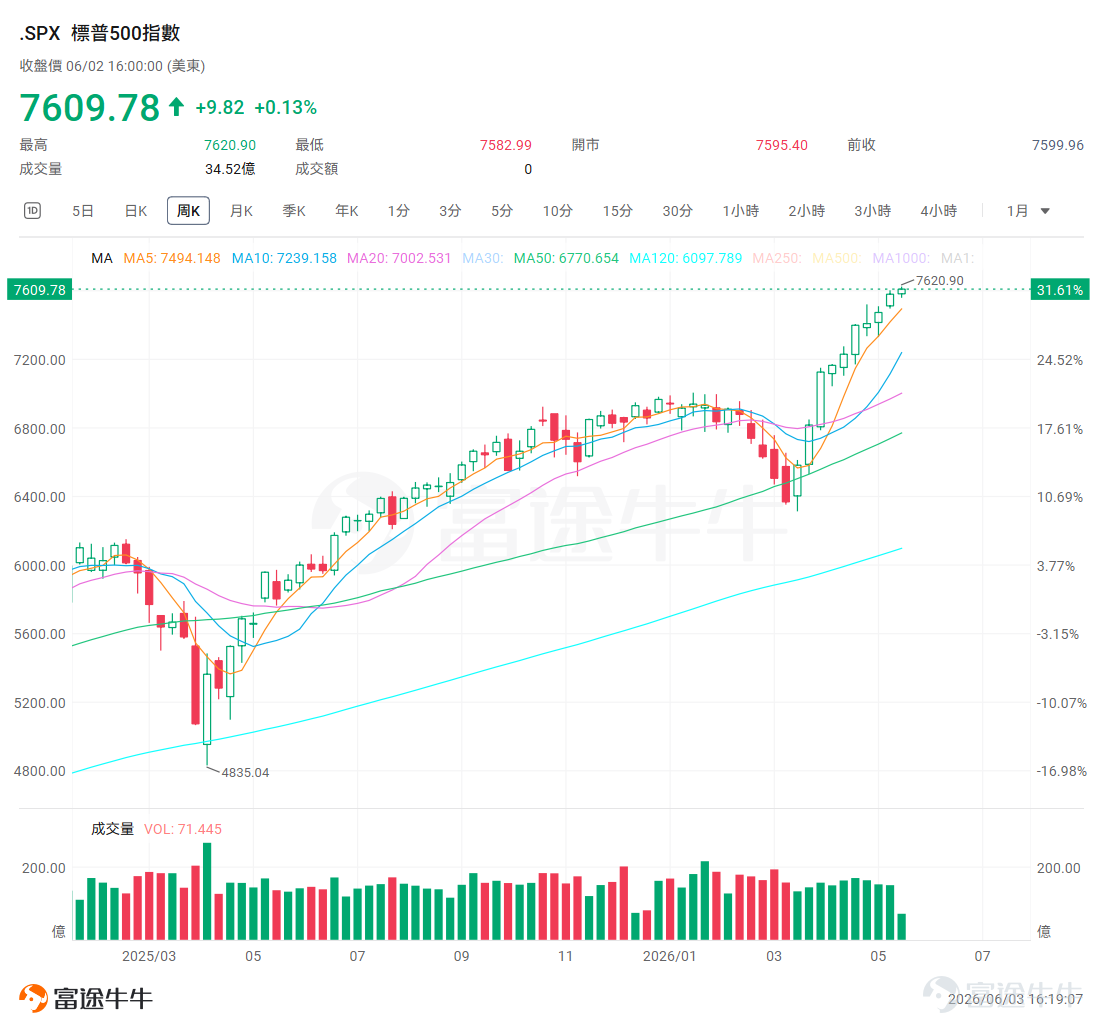
As of last week’s close, $S&P 500 Index (.SPX.US)$ it has rebounded nearly 20% from its April low, marking nine consecutive weeks of gains.Since 1985, such a streak of weekly gains has occurred only a handful of times. If it closes higher again this week, that would make it ten straight weeks! $Nasdaq Composite Index (.IXIC.US)$ 、 $Dow Jones Industrial Average (.DJI.US)$ Major indices like the Nasdaq have also been hitting new highs recently.

What’s fueling such a strong rally?
Keep in mind, this rally didn’t happen on a smooth upward path.
Geopolitical tensions are still flaring up. Just yesterday (June 2), the U.S. and Iran exchanged fire again. Although Trump stated that 'negotiations are accelerating,' both sides are simultaneously fighting and talking. Normally, this kind of situation should scare off investors.
Yet the market simply isn’t buying it. Why? Because two stronger bullish catalysts are propping it up:
First, the AI supply chain is genuinely generating profits.
In June, AI remains the market’s core driving theme. This isn’t about speculative hype or empty promises—From upstream computing chips to downstream real-world applications, the entire AI supply chain is operating at a high level of activity, with earnings being tangibly delivered.
Take a look at these recent stocks:
$Marvell Technology (MRVL.US)$ : At a conference, Jensen Huang directly named it the 'next trillion-dollar company,' and its stock surged 33% that day, marking the biggest single-day gain in the company’s history.
$Palo Alto Networks (PANW.US)$ : AI has introduced new cybersecurity threats, prompting enterprises to rush to purchase solutions, reversing the previously weak narrative for software stocks.
$Micron Technology (MU.US)$ : This might be the most explosive comeback story in this AI rally. Its stock just broke through on Monday$1000The major threshold was breached again on Tuesday, hitting a new all-time high, with market capitalization officially surpassing $1.2 trillion. It has gained nearly tenfold over the past year.
Second, earnings season has reassured the market.
As earnings season nears its end, results have consistently exceeded expectations, with the technology and financial sectors standing out particularly. Strong earnings growth means that 'stock prices have risen but aren't overvalued,' encouraging investors to keep adding exposure.
In short:Bombs are going off in the Middle East, but money is being made in AI. When earnings growth is strong enough, geopolitical risks get priced in by the market.
Haven’t gotten on board yet—what should you do?
Many novice investors feel this way:
"I didn’t buy at the beginning of the year; now it’s up 20%—it’s too expensive, I dare not buy." "What if it drops right after I buy in?" "I’ll wait a bit longer—maybe until there’s a pullback."
To be honest, this mindset is completely normal. But here’s a hard truth—
Historically, U.S. stocks have been making new highs 80% of the time.
That 'bargain price' you’re waiting for might never come. Or if it does, you’ll likely be even more afraid to buy—because by then, it will almost certainly be after a sharp crash, and your fear will only grow.
Then what should we do?
The answer is two words:Fixed investment.
Dollar-cost averaging, short for 'regular fixed-amount investing.'
In simpler terms:Invest a fixed amount of money at regular intervals, buying regardless of market ups and downs.
For example:
Invest $500 weekly in an S&P 500 index fund ( $SPDR S&P 500 ETF (SPY.US)$ 、 $Vanguard S&P 500 ETF (VOO.US)$ )
It's that simple—you don't need to predict market movements, read candlestick charts, or monitor the market constantly.
Why is this suitable for people who feel it’s 'too expensive to buy now'?
From 2004 to 2026, over a span of more than 22 years, the S&P 500 indexdeclined in only 5 of those years. In other words, if you randomly pick any year to invest, there's a 76% chance you'll make a profit that same year.
But the problem is, no one can accurately predict which years will see gains and which will see losses.
The beauty of dollar-cost averaging lies in the following:
(1) Cost averaging
When prices rise, you buy fewer shares; when prices fall, you buy more shares.Over time, your average cost gets 'smoothed out,' avoiding the tragedy of 'going all-in at the peak.'
(2) Overcoming human behavioral biases
Human instinct drives us to chase gains and flee losses—buying aggressively when markets rise and selling in panic when they fall. Dollar-cost averaging enforces discipline, removing emotion from investment decisions.
(3) No need for market timing
"The market is too expensive at 7,600 points right now"—this concern isn't relevant for dollar-cost averaging. Since you're not investing a lump sum all at once but rather in installments, even if there's a short-term pullback, you’ll actually acquire more shares at lower prices.
Niu Niu's monthly investment feature is designed precisely for scenarios like this:

Just four steps to set up automatic fixed-amount purchases each month. For example, investing $300 per month300 USD worth of $Vanguard S&P 500 ETF (VOO.US)$ , without needing to monitor the market or time your entries—let time create space and let compounding work for you.
You can get started with as little as $10,no need to go all-in at once; the system automatically deducts funds each month, helping you avoid the emotional pitfalls of chasing gains or selling in panic; you can adjust, pause, or cancel your contribution amount anytime—it’s entirely under your control.
Those who truly make significant money don’t rely on a single all-in bet—they succeed through consistent, disciplined participation.Niu Niu’s monthly investment feature is the easiest tool to turn your 'long-term bullish outlook' into 'long-term holding.'
Dollar-cost averaging isn't a magic bullet—keep these points in mind:
After highlighting so many benefits, it’s also important to mention a few caveats:
(1) Dollar-cost averaging is not a short-term strategy
If you only plan to invest for three months, you won’t see the benefits of dollar-cost averaging. Set a minimum horizon of one to two years—ideally three to five years.
(2) Choose the right investment target
Dollar-cost averaging into individual stocks carries relatively higher risk. It’s better to invest inbroad-market index fundssuch as ETFs tracking the S&P 500 or Nasdaq 100. These represent a basket of top-tier companies, which helps diversify risk.
(3) Don’t easily stop when prices fall
The biggest reason many people fail at dollar-cost averaging is this: they stick with it when markets rise but panic and stop when markets drop. In reality, market dips are precisely your best opportunity to 'buy low.' Remember:The essence of dollar-cost averaging is staying consistent—regardless of market ups and downs.
(4) Use spare cash
Money used for regular investment must be idle cash that you won't need in the short term. Don't use next month's rent for regular investments, and never borrow money to invest regularly.
Risk Disclaimer: The above content only represents the author's view. It does not represent any position or investment advice of Futu. Futu makes no representation or warranty.Read more


Comment (1)
to post a comment
32
26