
Micron reports earnings after the market close on Wednesday—could the sharp pullback present a buyin

Micron's Record-Shattering Day Sets Up One of the Most Charged Options Trading of the Year: Options Chatte
Micron Technology $Micron Technology (MU.US)$ did something yesterday that almost no company on earth gets to do twice: it became a trillion-dollar company for the first time — in a single session. Shares surged 19.3%, closing at a record $895.88, the stock's biggest one-day gain in nearly fifteen years. In one afternoon, Micron leapfrogged Walmart $Walmart (WMT.US)$ and Eli Lilly $Eli Lilly and Co (LLY.US)$ in market value and added somewhere between $144 and $163 billion to its market cap — roughly the equivalent of building a company the size of Charles Schwab $Charles Schwab (SCHW.US)$ from scratch.
Now the options market has its own answer to that move. And it's pointing straight at $900.
What Triggered the Surge
The catalyst was UBS, which nearly tripled its price target on Micron — raising it from $535 to $1,625 — citing AI-driven demand, structural supply tightness, and Micron's growing pricing power in the market for high-bandwidth memory. That analyst call confirmed what Micron's own management has been saying: the company has locked in price and volume agreements for 100% of its calendar year 2026 HBM production, including next-generation HBM4. Demand is so far ahead of supply that Micron says it can only fulfill 50 to 67% of requests from several of its largest customers in the medium term. This is a story about a company that is capacity-constrained because it cannot make its product fast enough to meet orders already in hand — and the market re-rated it accordingly.
The longer-term numbers tell the same story in sharper relief. Micron shares are up over 200% year-to-date, and over 800% over the past twelve months — one of the most violent re-ratings of a large-cap name the market has seen in a generation, driven entirely by the AI infrastructure buildout and Micron's central role supplying the memory that powers it.
The $900 Gravitational Pull
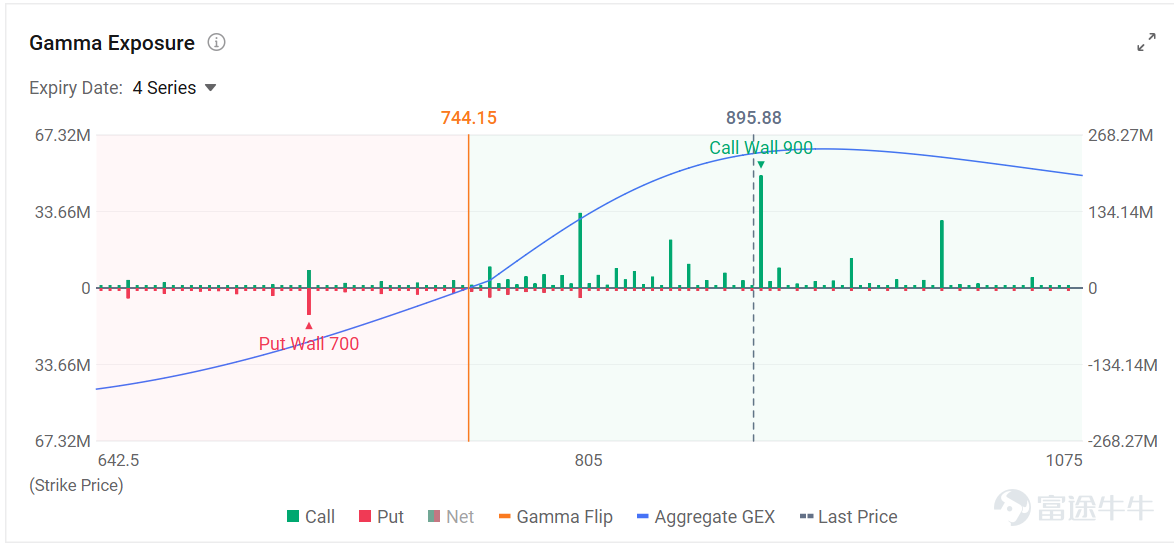
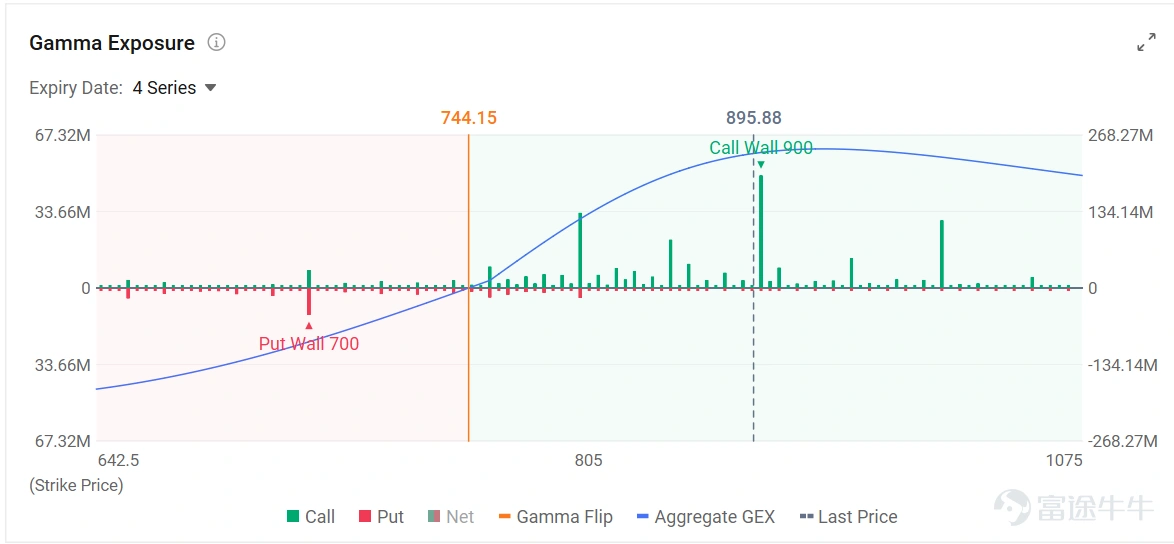
The options market has developed a clear focal point for this week: the $900 call strike, expiring this Friday. Volume in those contracts has been exceptionally heavy, creating a massive concentration of open interest at exactly the level sitting just $4 above yesterday's close.
That concentration sets up a textbook gamma pull. Market makers who sold those $900 calls have been steadily buying shares to hedge their exposure as the stock approaches the strike from below. As Micron inches toward $900, that mechanical buying intensifies — dealers are obligated to increase their hedge as delta rises — creating a self-reinforcing bid that draws the stock toward the strike like a magnet.
With Friday's expiry approaching, this dynamic is at its most acute. Each dollar closer to $900 triggers additional dealer buying. The stock closed at $895.88. The distance to the call wall is less than half a percent.
IV at the Ceiling — The Double-Edged Metric
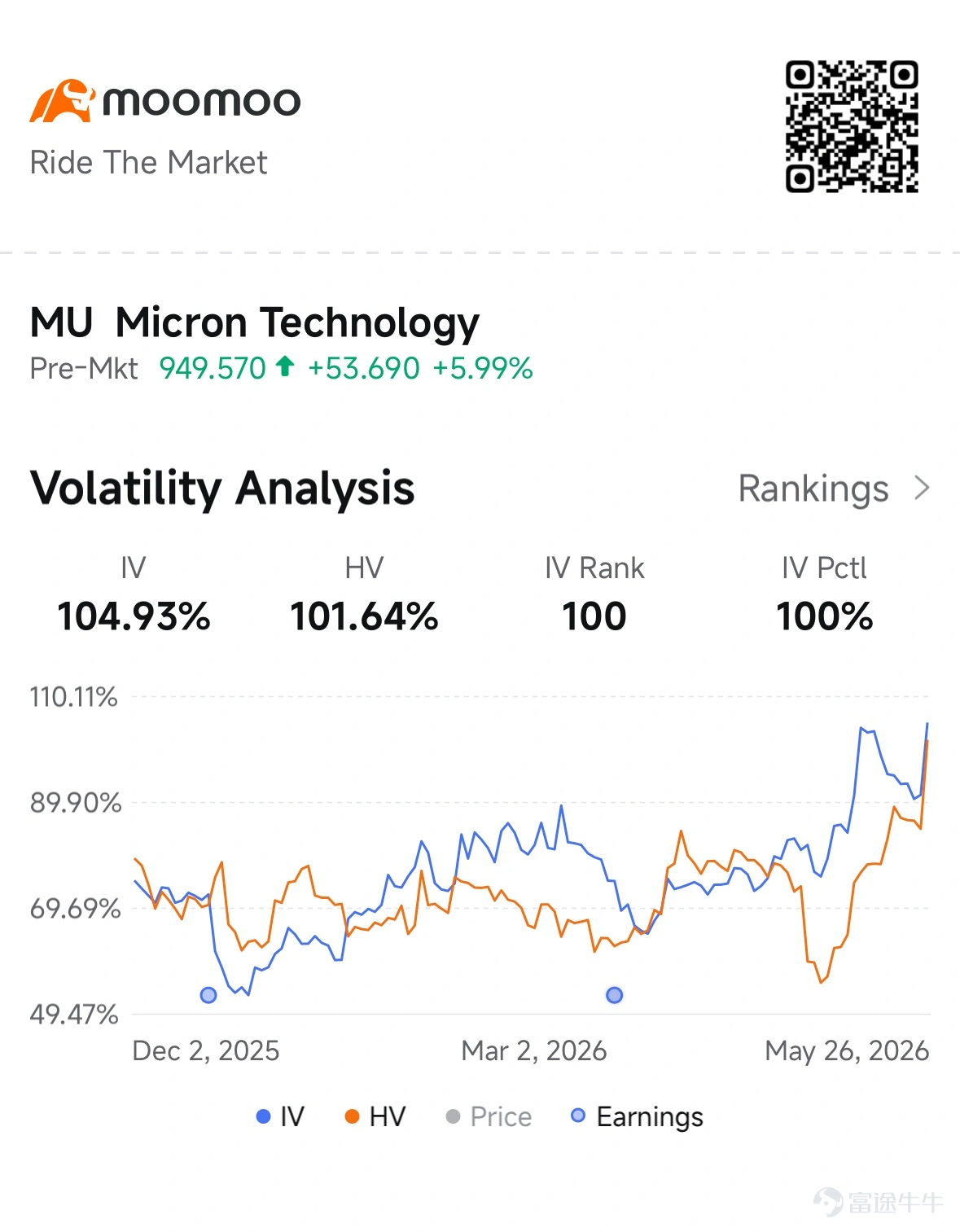
Here is where the setup becomes more nuanced for options traders. Implied volatility on Micron is currently running at 104% — and unlike Rocket Lab's 101% reading last week, which sat at the 90th percentile with room to expand, Micron's IV is at the 100th percentile. That means options are as expensive today as they have been at any point in the past year. There is no historical precedent in recent memory for MU options to be more expensive than they are right now.
For call buyers riding the $900 gravitational pull, this is critical context. The premium baked into every contract reflects maximum uncertainty — peak fear and peak greed simultaneously. When a stock moves as dramatically as Micron did yesterday, the options market responds by pricing in the possibility of another move of similar magnitude. That possibility is real. But it comes at the highest possible cost. The put/call ratio of 0.8 confirms the directional lean: for every 10 puts traded, there are roughly 12.5 calls. Bulls are firmly in control of the sentiment picture. The crowd is positioned for continuation, not reversal.
After Friday — The IV Cliff
The more important question for options holders is what happens after this week's expiry resolves. If Micron reaches $900 by Friday close, the $900 calls expire in the money and the gamma dynamic dissipates. The mechanical buying that pulled the stock to the strike ends. Open interest at that level drops to near zero. The upward pressure that $900 created in the days before expiry simply ceases to exist. And IV at the 100th percentile has only one direction to travel once the event that justified it passes: down. Options buyers who enter at 104% implied volatility and hold through Friday's close face the same volatility crush that has caught traders off guard repeatedly this earnings season.
The stock could move sideways and options buyers would still lose premium value as IV normalizes. The setup favors the stock reaching $900 before Friday. It does not automatically favor options buyers who pay today's peak premium to participate in that last leg.
The Bigger Picture
Micron's position in the AI supply chain is structurally sound. A company that is sold out of its most important product for the entire calendar year, operating in a market where the second-largest customer can only be served at 50 to 67% of requested volume, does not face demand risk in the near term. The UBS target of $1,625 implies further upside even after yesterday's historic move.
But options markets operate on a different clock than equity markets. The $900 call wall, IV at its annual ceiling, and a put/call ratio showing maximum bullish conviction all speak to a single-week setup that may already have discounted the most obvious path forward. The gravitational and the cost of playing it has never been higher.
Risk Disclaimer: The above content only represents the author's view. It does not represent any position or investment advice of Futu. Futu makes no representation or warranty.Read more

Comments
to post a comment
2