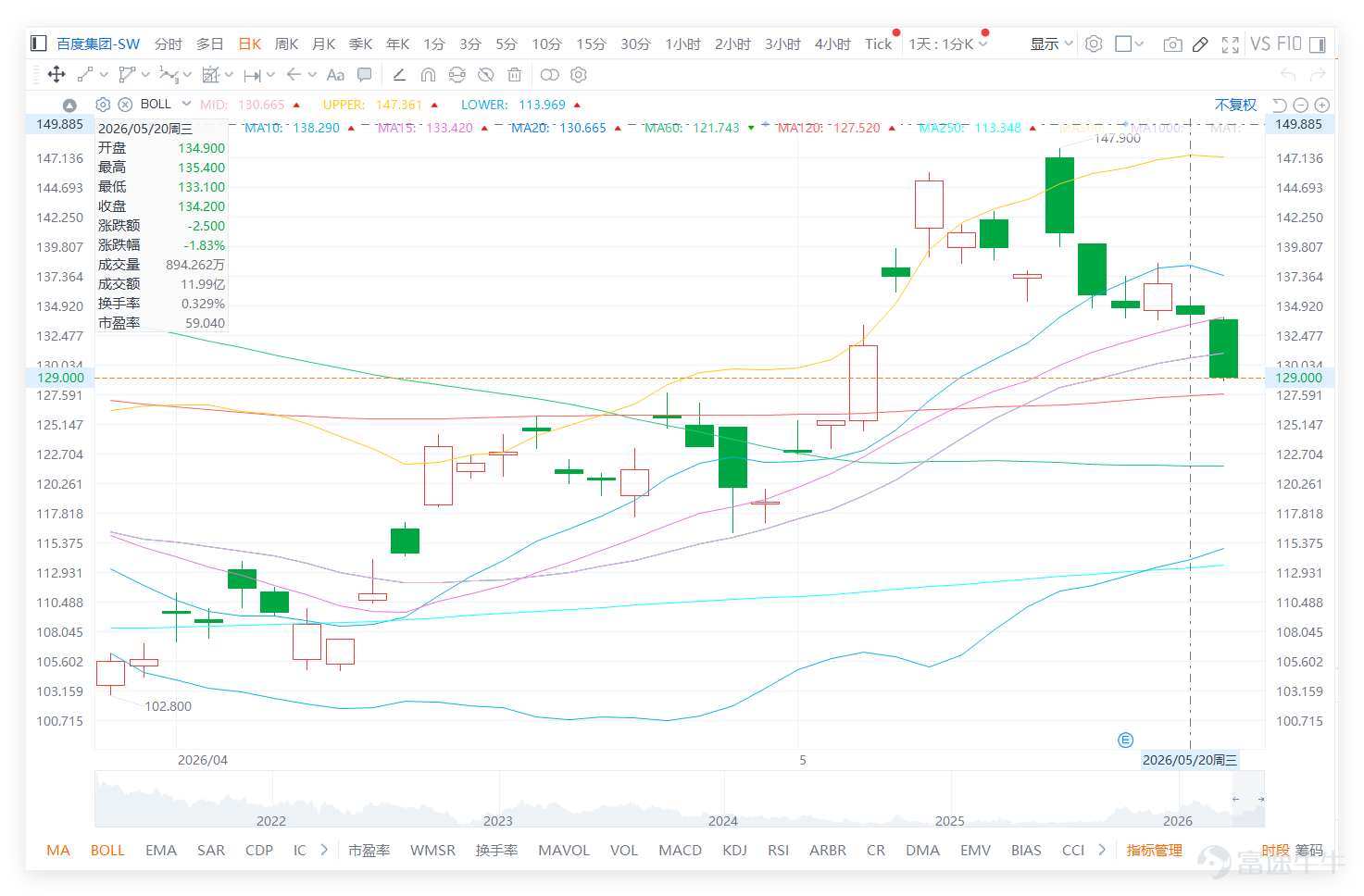

Baidu broke below the dual support levels at RMB 133 and RMB 130.6, falling through RMB 129. A rebound would require reclaiming RMB 130.6.
$BIDU-SW (09888.HK)$ On the previous day (20th), it closed at RMB 134.200, down RMB 2.500 or 1.83% for the day. The stock reached a daily high of only RMB 135.400, still failing to break back above the 10-day moving average at RMB 138.290, indicating that the strength of the short-term rebound has not yet been fully confirmed. However, the closing price of RMB 134.200 remained above both the 20-day moving average (RMB 130.665) and the 30-day moving average (RMB 125.623), suggesting the medium-to-short-term structure hasn’t deteriorated significantly. Nonetheless, the 10-day moving average overhead continues to act as resistance, keeping the current move limited to a corrective bounce rather than a genuine strengthening trend.

Baidu (technical signal: 'Buy'—recovery rally). Compared with peers, $TENCENT (00700.HK)$ Closed at HK$455.20 (RSI around 39, technical buy), $BABA-W (09988.HK)$ Closed at HK$131.90 (RSI around 50, technical buy), $MEITUAN-W (03690.HK)$ Closed at HK$82.85 (RSI around 48, technical buy). This indicates that large-cap tech stocks as a group are in a 'low-level recovery' phase. Although Baidu has rebounded, it remains constrained by the lack of broad-based capital inflow into the sector, making it difficult for the stock to break through key resistance levels in the short term.

Comment sentiment clearly falls into three categories. The first group consists of bullish investors or those waiting for a rebound, who believe that if the broader Hong Kong market stabilizes, large-cap tech stocks like Baidu and Alibaba could become attractive rebound plays. Some investors described Baidu as 'too resilient,' while others expressed direct optimism about its upward momentum and even proposed relatively high target prices. These comments reflect that some capital still views Baidu as a value-recovery option among major tech names—particularly when the Hang Seng Index stabilizes and trading volumes in Hong Kong improve, prompting the market to reassess whether Baidu has room for catch-up gains.
However, bullish sentiment has not yet gained overwhelming dominance. The reason is simple: although Baidu rebounded yesterday, trading volume did not show significant confirmation. Volume was approximately 8.943 million shares, markedly lower than during the previous sharp rally phase—indicating a rebound on low volume. Such low-volume rebounds often leave short-term investors hesitant, as prices may rise without sufficient buying conviction, casting doubt on the sustainability of the uptrend. This also explains why some investors remain cautious about confirming Baidu’s strength despite the recent price recovery.
The second category of comments reflects bearish sentiment and disappointment. Some investors stated outright that they have already sold their positions, while others questioned whether AI-related revenue can translate into actual profits, arguing that Baidu has weakened. A few even expressed extremely pessimistic target prices, suggesting the stock still has room to fall. Although these remarks are strongly worded, they reflect waning market patience with Baidu's AI narrative. Baidu initially attracted market attention thanks to its AI story, but as the share price failed to sustain upward momentum and trading volume declined, investors began doubting whether this narrative alone could justify its valuation.
Among bearish comments, ‘no volume, can’t sustain gains’ most closely reflects yesterday’s technical focus. Baidu wasn’t entirely weak yesterday—it simply lacked a convincing upward move. The stock held above the Bollinger Bands midline at HK$130.665, indicating it hasn’t broken below a key short-to-medium-term support level. However, insufficient rebound volume and failure to breach the 10-day moving average at HK$138.290 have made it difficult for the market to confirm the start of a new uptrend. In other words, Baidu isn’t clearly weakening—but it hasn’t yet proven it’s turning stronger either.
The third type of comment expresses观望 (wait-and-see) attitudes or questions. Investors are primarily concerned with two issues: whether HK$133 can hold, and why yesterday’s trading volume was so low. Some investors directly noted, ‘HK$133 must hold,’ which aligns closely with the technical support level at HK$133.100. This level currently serves as Baidu’s most critical short-term defense line. If the price holds above HK$133.100, Baidu still has room to continue its recovery above the Bollinger Bands midline; if it breaks below HK$133.100, it could retest the midline support at HK$130.665, weakening the rebound structure.
Regarding the low volume issue, technical indicators already provided clear signals yesterday. Baidu rose by 1.83%, yet trading volume showed no notable expansion—suggesting the rebound has not yet attracted substantial follow-through buying. For short-term traders, this isn’t the most ideal kind of rally. A genuinely strong reversal typically requires both a breakout above key resistance and accompanying volume expansion. Currently, Baidu has only partially completed the first step: the price remains above the Bollinger midline, but it hasn’t yet broken through the 10-day moving average, nor has volume meaningfully increased.
Technically, Baidu closed yesterday at HK$134.200. The nearest support level is at HK$133.100, followed by the Bollinger Bands midline and the 20-day moving average at HK$130.665, with the next major support at the 30-day moving average of HK$125.623. As long as HK$133.100 holds, the short-term recovery structure remains intact. Even if the price pulls back but holds above HK$130.665, the trend wouldn’t be considered fully bearish—only the pace of rebound would slow. The real warning signal would be a break below HK$130.665, as that would indicate the price has moved back below the Bollinger midline, signaling clearer weakness.
On the resistance side, yesterday’s intraday high of HK$135.400 now acts as immediate short-term resistance, but the true make-or-break level is HK$138.290—the location of the 10-day moving average and the key threshold determining whether Baidu can regain short-term strength. If the stock breaks above HK$138.290, it would indicate that near-term pressure has been absorbed, potentially allowing the price to continue recovering toward the upper Bollinger Band at HK$147.361. Conversely, if multiple rebound attempts fail to surpass HK$138.290, the market will likely treat this zone as a supply area, making further rallies prone to rejection.
Regarding the Bollinger Bands, the midline sits at HK$130.665, the upper band at HK$147.361, and the lower band at HK$113.969. Baidu’s closing price of HK$134.200 yesterday remained above the midline—a technically positive sign indicating the stock hasn’t fallen back into the bottom of the weak zone and still retains conditions for upward recovery. However, since the current price remains significantly below the upper band and faces intermediate resistance at HK$138.290, overly optimistic near-term targets should be avoided. Unless Baidu first breaks through HK$138.290, HK$147.361 should be viewed as a subsequent target rather than an immediate one.
The Relative Strength Index (RSI) stands at approximately 47.779, placing it in a neutral-to-weak zone without showing clear strength. This aligns with market sentiment: investors haven’t completely abandoned Baidu, but they also lack sufficient confidence to aggressively buy in. The RSI hasn’t dropped to extreme oversold levels, meaning the stock isn’t severely undervalued; yet it also hasn’t risen back into the strong zone, indicating insufficient upward momentum. Therefore, what Baidu needs most right now is a confirmed breakout—not just a single-day rebound.
Combining comment sentiment with technical analysis, Baidu’s short-term risk-reward profile is currently neutral. Bulls should monitor whether the HK$133.100 support holds firm and whether the price can reclaim HK$138.290. Bears, meanwhile, should watch for continued low-volume rallies—if the stock fails to break above HK$138.290 and subsequently breaks below HK$133.100, the trend would likely turn bearish again. At this stage, the most reasonable assessment is that Baidu still has room for recovery, but a confirmed bullish reversal has yet to materialize.
For retail investors, the biggest mistake right now would be chasing the stock at mid-range levels. The current price around HK$134 is close to both the HK$133.100 support and the critical HK$138.290 resistance—a position requiring confirmation in either direction. For those looking to go long, a more reliable signal would be holding above HK$133.100 followed by a breakout above HK$138.290. For those waiting to buy on dips, they should watch for a test of HK$130.665 with signs of buying support. Until a breakout occurs, Baidu remains a recovery candidate—not a strong performer.
Overall, Baidu's rebound yesterday is a positive signal, but not a trend reversal signal. The stock price remains above the middle Bollinger Band, indicating the downtrend hasn't fully resumed; however, the rebound occurred on lower volume, failed to break above the 10-day moving average, and the RSI remains neutral to weak—suggesting insufficient short-term momentum to confirm an uptrend. The next key levels to watch aren’t HK$250 or HK$70, but whether HK$133.100 can hold as support and whether HK$138.290 can be broken to the upside. Until these two levels yield clear outcomes, Baidu will likely remain in a mixed pattern of rebounds and consolidation.
Latest Update (Morning of May 21):
Baidu (09888) last traded at HK$129.20, down approximately 3.73%, breaking below the critical support level of HK$133. Baidu failed to hold the HK$133 support line, damaging its short-term rebound structure and now requiring retesting of the middle Bollinger Band support at HK$130.66.
Reply to some investors' views:
@小 九 哥: Short-term pressure persists, but the current price hasn’t broken below the middle Bollinger Band support yet, so we cannot yet conclude a full bearish shift.
@一入股市深似海。: HK$100 is a more distant downside target; technically, near-term focus should first be on support levels at HK$133.100 and HK$130.665.
@飛龍在天27: Share buybacks may improve market sentiment, but short-term price action still needs to break above HK$138.290 to confirm renewed capital inflows.
Based on the above analysis, the strategies for deployment can be divided into the following main approaches:
Key deployment considerations: In the short term, monitor whether support at HK$133.100 holds. If it holds, a rebound trade can be attempted. A breakout above HK$138.290 would create conditions for strengthening momentum and a potential test of HK$147.361. If HK$133.100 is breached, the price could retest the middle Bollinger Band support at HK$130.665.
Strategy 1 | Hold above HK$133.100, play for a short-term rebound
$UBBAIDU@EC2609A.C (28166.HK)$ | Strike price HK$140 | Effective leverage 4.7x | Strike price close to the first rebound target, suitable for a balanced rebound play after support holds; focus on whether the stock can reclaim above HK$135.400
$BIBAIDU@EC2606B.C (20464.HK)$ | Strike price HK$132.98 | Effective leverage 9.0x | Strike price near current price, offering more direct sensitivity—ideal for quick in-and-out trades targeting short-term bounces while support remains intact
$HSBAIDU@EC2607A.C (20356.HK)$ | Strike price HK$132.88 | Effective leverage 7.6x | Also near the current price but with lower leverage than more aggressive alternatives—suitable for participating in rebounds while allowing some room for minor volatility
Strategy 2 | Break above HK$138.290, enter on initial signs of strength
$UBBAIDU@EC2606B.C (26832.HK)$ | Strike price HK$145.98 | Effective leverage 10.0x | Strike price near the upper target zone at HK$147.361; suitable for chasing a rebound after breaking above HK$138.290, offering higher flexibility—but only deploy after breakout confirmation
$MSBAIDU@EC2606B.C (26830.HK)$ | Strike price HK$145.98 | Effective leverage 10.6x | Also targets the HK$147 area, but with higher leverage; suitable for capturing a quick upside move shortly after a breakout—do not deploy prematurely before the breakout occurs
$UBBAIDU@EC2610A.C (27686.HK)$ | Strike price HK$151.21 | Effective leverage 4.6x | Higher strike price and longer tenor; suitable for expecting an extended rebound after a breakout, but not intended for those seeking maximum intraday leverage
Strategy 3 | Break below HK$133.100, follow the bearish momentum
$UBBAIDU@EP2607B.P (24276.HK)$ | Strike price HK$131.7 | Effective leverage 5.5x | Strike price close to the midline support at HK$130.665; suitable for betting on a retest of the midline after breaking below HK$133.100, focusing on capturing short-term bearish continuation
$BPBAIDU@EP2607B.P (24542.HK)$ | Strike price HK$131.9 | Effective leverage 5.5x | Strike price slightly above the midline support; suitable for initiating the first leg of a short position after confirmed breakdown—do not deploy prematurely while the price still holds above HK$133.100
$MSBAIDU@EP2607B.P (24501.HK)$ | Strike price HK$131.7 | Effective leverage 5.5x | Also targets the HK$130–HK$132 range; suitable for bearish positioning without choosing deep out-of-the-money products—the key is to enter only after the price breaks below support
For more market analysis, stay tuned to Jenny's daily updates on 'Hong Kong Stock Warrants'!
Reminder: This article does not constitute any investment advice.
This article is for reference only and does not constitute any investment advice. Market data, opinions, and analysis contained herein may change at any time without prior notice. We are not responsible for any loss or damage caused by reliance on the information in this article. Technical analysis only shows whether certain technical conditions are met; asset performance should be comprehensively evaluated using other sources of information, and trading decisions should not be made solely based on this article. Please note that past performance is not indicative of future results.
#HKStocks #Baidu #Real-TimeAnalysis #WarrantSelection #WarrantGuide #DerivativesHedging #HKWarrantsJenny #Blue-ChipStocks #TechnicalAnalysis
Risk Disclaimer: The above content only represents the author's view. It does not represent any position or investment advice of Futu. Futu makes no representation or warranty.Read more

Comment (1)
to post a comment
1
1