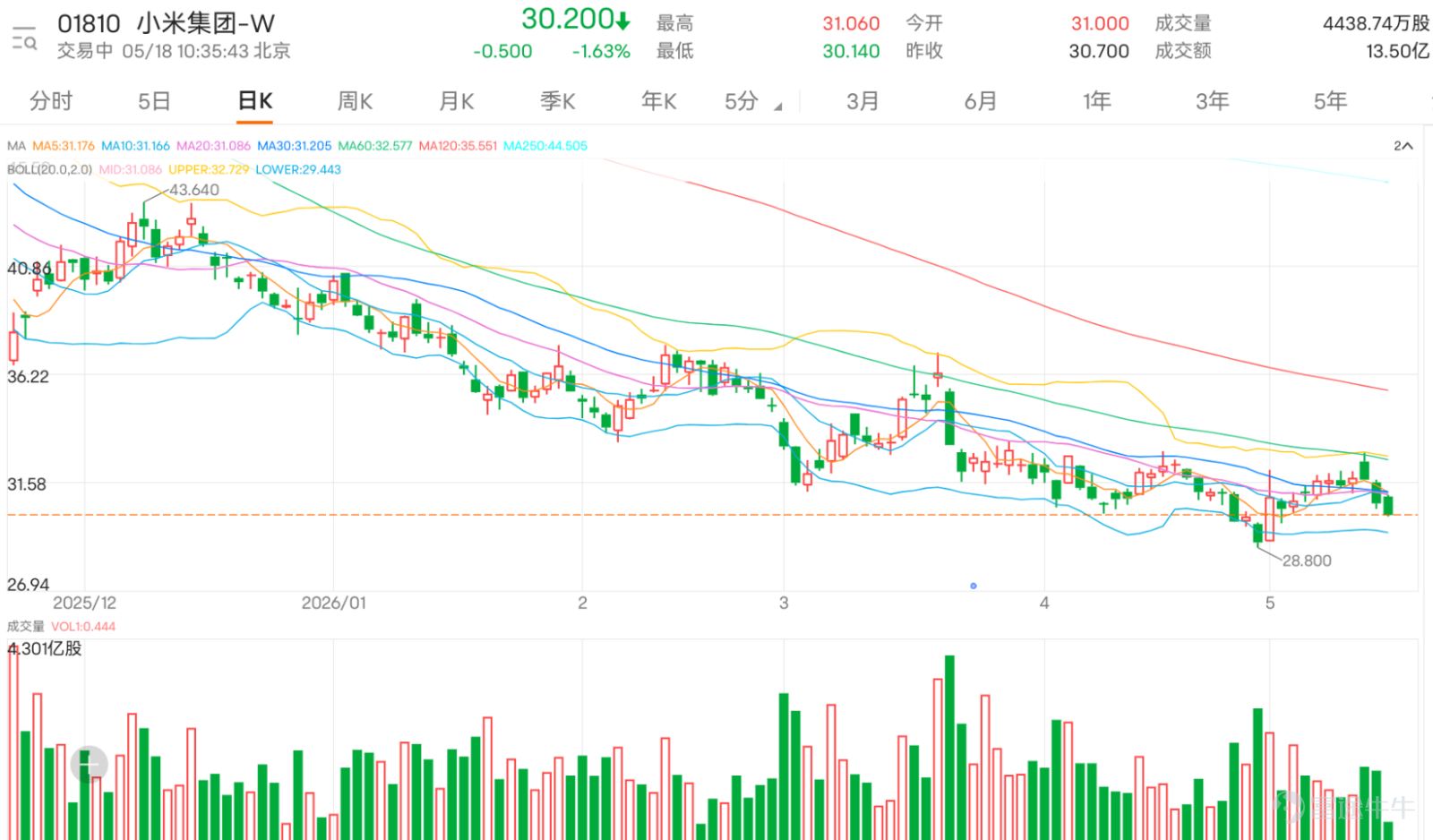

Xiaomi announces a new HK$20 billion share buyback program—will the stock price get a boost?

Xiaomi's 30-yuan defense line is being tested again, and the rebound amid an ongoing downtrend looks more like an escape route.
$XIAOMI-W (01810.HK)$ Currently trading at HKD 30.20, both the daily and weekly charts show a strong sell signal. The short-term trend is bearish, and the technical structure has clearly not yet recovered. The current price is below the 50-day moving average of HKD 32.43 and also significantly below the 200-day moving average of HKD 42.70, reflecting continued heavy pressure on both medium-short term and medium-long term outlooks. Although there are still voices in the market looking to 'buy the dip,' no clear signs of a technical recovery are evident at this point. Any rebound should temporarily be considered a weak pullback rather than the start of a new upward trend.
Investor sentiment is clearly divided. The bullish side focuses on three main points: First, some believe there is value for a short-term rebound near HKD 30. Second, they expect a wave of upward movement before this week or the earnings report. Third, they hope the share price will return above HKD 31, potentially leading to a V-shaped rebound. Comments such as 'buy again at 29', 'V back up to 31', 'buying the dip,' and 'a bargain' frequently appear, indicating that retail investors are still interested in buying at lower levels.
However, bearish sentiment is more direct and closer to the current technical trend. Bearish comments focus on themes such as “the downtrend has not stopped,” “strong short selling,” “most people are dumping,” and “every rise is an opportunity to exit.” This reflects a lack of confidence in Xiaomi's short-term support, with some investors believing that southbound funds are repeatedly trading based on high-low price differences, making it harder for the stock to form a stable upward trend.
The most critical support level now is HKD 29.56. If Xiaomi falls below HKD 29.56, it may trigger more stop-loss selling and downward pressure in the short term. On the other hand, if HKD 29.56 holds, the stock price may stabilize around HKD 30, waiting for a rebound to occur.
In terms of resistance, the first short-term hurdle is at HKD 31.84, while the more significant moving average pressure lies at HKD 32.43. Since the 50-day moving average is at HKD 32.43 and the current price remains below that level, even if Xiaomi rebounds above HKD 31, it does not necessarily indicate a true strengthening. Only by breaking through HKD 31.84 again and further challenging HKD 32.43 will market confidence have a chance to improve.
The Relative Strength Index (RSI) is approximately 45.21, which is in the neutral range and not yet at an extremely oversold level, indicating that although the stock price has dropped, it may not technically be at an extremely cheap level. The ADX is around 21.62, showing that the trend strength is not extreme, but both the daily and weekly charts are signaling strong sell signals, suggesting that the bearish side still dominates. The ATR is about 1.14, reflecting that there is still considerable short-term volatility; entering positions at lows or using high leverage could easily lead to being shaken out by intraday fluctuations.
The most common questions in the market right now are whether it's possible to accumulate shares at HKD 29, whether HKD 30 can hold, and whether there will be a rebound before the earnings report. Based on the current technical structure, Xiaomi is not entirely without a chance of rebounding, but any rebound needs to break through HKD 31.84 to be convincing. If it only bounces from around HKD 30 but fails to return above HKD 32.43, technically it would still be considered weak.
Overall, Xiaomi should not be treated as a low-position counterattack stock at this stage. The short-term strategy should focus on playing the downside during rebounds or following the downtrend on a breakdown. Unless the stock price recaptures the HKD 31.84 to HKD 32.43 zone, each rebound is likely to be seen as an opportunity for reduction or playing the downside. If it breaks below HKD 29.56, it would signal further confirmation of weakness, with short-term risks significantly increasing.
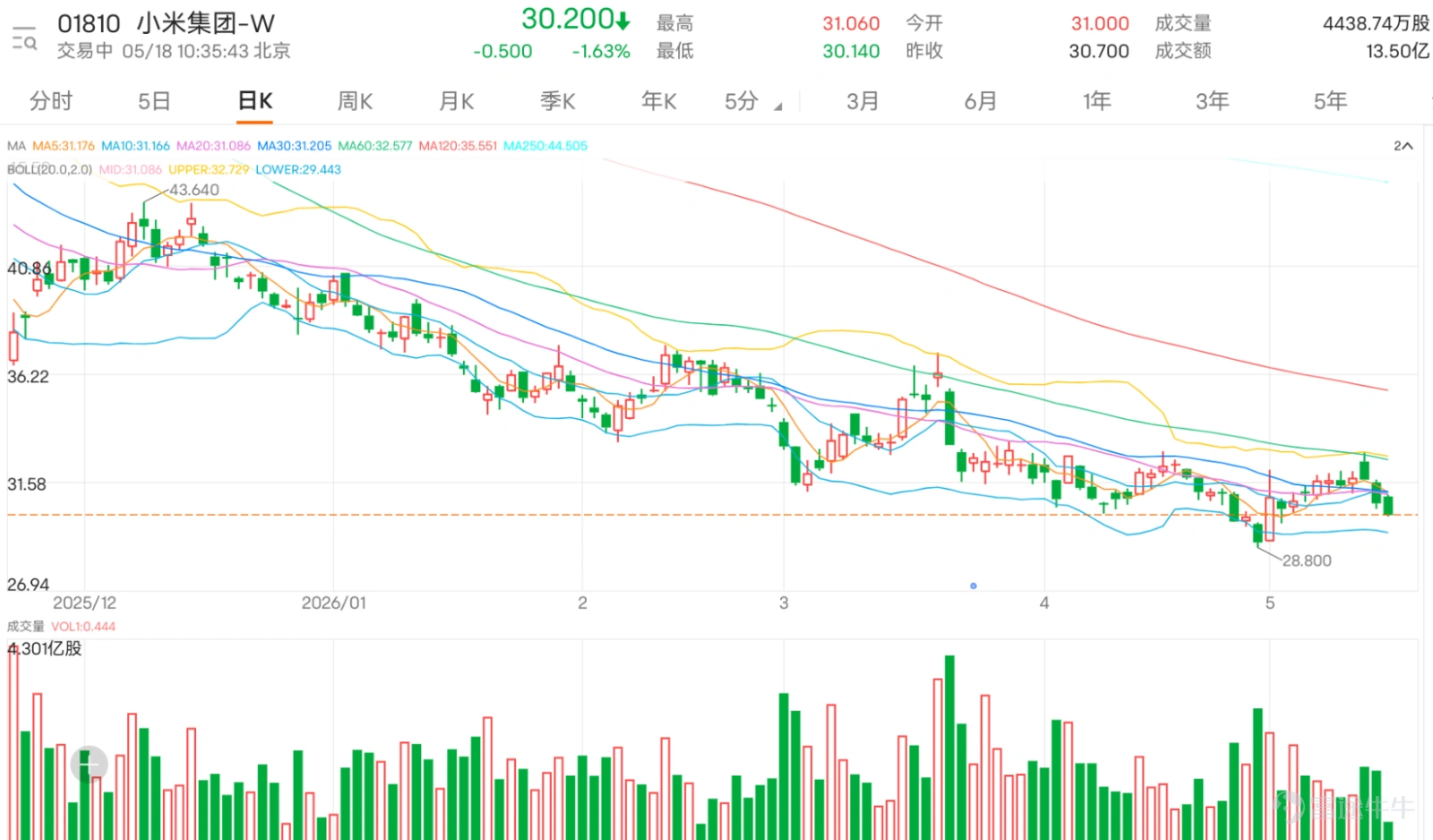
Key Strategy: Xiaomi’s support level is at HKD 29.80, resistance level at HKD 32. If the price stays above HKD 29.80, there is room to bet on a rebound and recovery; breaking through HKD 32 could lead to a retest of the HKD 35 area. However, a break below HKD 29.80 might intensify short-term weakness.
Strategy One | Buy on Pullback
$UBXIAMI@EC2612A.C (13135.HK)$ | Strike Price HKD 37.15 | Actual Leverage 5.1x | Moderately out-of-the-money, suitable for gradual accumulation once the stock price stabilizes. $UBXIAMI@EC2610C.C (28164.HK)$ | Strike Price HKD 39.80 | Actual Leverage 6.6x | Higher sensitivity, ideal for amplifying gains during a short-term rebound. $UBXIAMI@EC2712A.C (25395.HK)$ | Strike price 35.9 yuan | Actual leverage 2.9x | Longer duration, suitable for those optimistic about medium-term recovery trends
Strategy Two | Breakout Momentum Chase
$UBXIAMI@EC2609E.C (28195.HK)$ | Strike price 37.01 yuan | Actual leverage 7.1x | Higher upside momentum after breaking through 32 yuan, suitable for trend-following strategies $UBXIAMI@EC2609D.C (27868.HK)$ | Strike price 41.82 yuan | Actual leverage 7.3x | High leverage, suitable for capturing accelerated breakout moves $UBXIAMI@EC2610A.C (27408.HK)$ | Strike price 48.02 yuan | Actual leverage 6.8x | Suitable for those optimistic about AI-related smartphone and automotive concepts driving capital inflows again
Strategy Three | Deploy on Support Breakdown
$UBXIAMI@EP2608A.P (26121.HK)$ | Strike price 28.16 yuan | Actual leverage 6.4x | Close to current price, suitable for capturing short-term downside after breaking support levels $UBXIAMI@EP2612A.P (28168.HK)$ | Strike price 24.98 yuan | Actual leverage 4.1x | Longer time value, suitable for medium-term defensive strategies $UBXIAMI@EP2611A.P (28716.HK)$ | Strike price 23.88 yuan | Actual leverage 4.9x | Suitable for deploying bearish swing trades if the downtrend is expected to continue
@OK 哥: Selling pressure remains heavy; it's crucial to stabilize near 30 yuan first, otherwise market confidence will be hard to restore.
@蔡C3: Near 29 yuan approaches the 29.56 yuan support level; if buying at a dip, pay attention to risks if this level is breached.
@meimeicat: The first step to reversing back above 31 yuan is to regain stability near 31.84 yuan.
@pica_dThe risk of抄底 (buying the dip) is currently quite high, as both the daily and weekly charts still show strong sell signals.
@小小张公子Even if there's a rebound ahead of earnings, watch whether it can break above HK$31.84 and HK$32.43.
Feel free to share your insights in the comment section. For more market analysis, please continue following ‘Hong Kong Stock Warrants Jenny’ for daily updates!
Reminder: This article does not constitute any investment advice.
This article is for reference only and does not constitute any investment advice. Market data, opinions, and analysis contained herein may change at any time without prior notice. We are not responsible for any loss or damage caused by reliance on the information in this article. Technical analysis only shows whether certain technical conditions are met; asset performance should be comprehensively evaluated using other sources of information, and trading decisions should not be made solely based on this article. Please note that past performance is not indicative of future results.
#HKStocks #LiveAnalysis #WarrantPick #WarrantGuide #DerivativesHedging #HKWarrantsJenny #Xiaomi #1810 #BlueChipStocks #TechnicalAnalysis$Hang Seng Index (800000.HK)$$Hang Seng TECH Index (800700.HK)$
Risk Disclaimer: The above content only represents the author's view. It does not represent any position or investment advice of Futu. Futu makes no representation or warranty.Read more

Comments
to post a comment
2
1