English
Back
Open Account
The Big Four's performance diverges after results! Who is the real winner in AI?

Futubull Options Sir
joined discussion ·

Earnings Options Strategy | Apple's Q2 2026 Earnings Report on the Horizon: Tim Cook's 'Final Exam' – How Strong is the Growth?

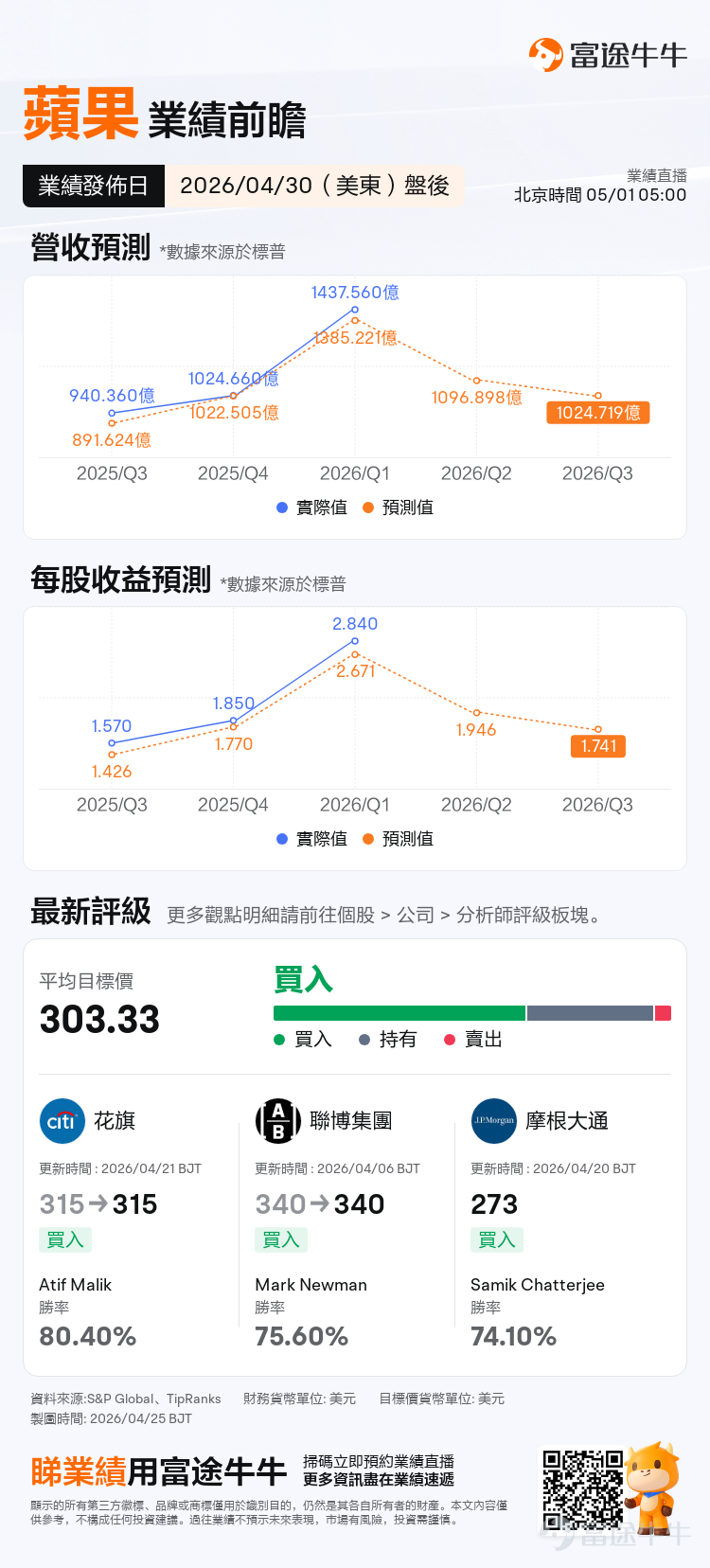
After the market close on April 30, 2026, $Apple (AAPL.US)$ Apple will announce its financial results for the second quarter of fiscal year 2026 (January-March 2026).
This will be the last full quarterly earnings report under Tim Cook's leadership—starting September 1, he will officially hand over the CEO position to John Ternus, the Senior Vice President of Hardware Engineering.
This earnings report has attracted significant attention. According to惯例, Apple’s Q2 (the first quarter of the calendar year) is usually its off-season for sales. However, from the consensus expectations on Wall Street, this rule has been completely broken. Institutional consensus expects revenue of $109.69 billion, a year-over-year increase of 15.03%; earnings per share (EPS) of $1.95, representing an approximate 18% increase.
This forecast suggests that Apple has returned to a track of 'high growth'.JPMorgan even provided a more aggressive prediction, suggesting that driven by the iPhone 17, revenue could reach $112.7 billion.
After the market close on April 30, 2026, $Apple (AAPL.US)$ Apple will announce its financial results for the second quarter of fiscal year 2026 (January-March 2026). This will be the last full quarterly earnings report under Tim Cook's leadership—starting September 1, he will officially hand over the CEO position to John Ternus, the Senior Vice President of Hardware Engineering. This earnings report has attracted significant attention. According to惯例, Apple’s Q2 (the first quarter of the calendar year) is usually its off-season for sales. However, from the consensus expectations on Wall Street, this rule has been completely broken. Institutional consensus expects revenue of $109.69 billion, a year-over-year increase of 15.03%; earnings per share (EPS) of $1.95, representing an approximate 18% increase.  This forecast suggests that Apple has returned to a track of 'high growth'.JPMorgan even provided a more aggressive prediction, suggesting that driven by the iPhone 17, revenue could reach $112.7 billion. So, apart from whether revenue and earnings per share meet expectations, what are the other key highlights in Apple's Q2 2026? 1. Analysis of the five core highlights of Apple's Q2 2026 earnings report: A crucial test during the transition and handover period. The five key highlights of this earnings report include: whether the recovery momentum in the Chinese market can be sustained, whether gross margins can remain stable amid rising memory prices, whether the moat of high-margin services remains solid, the progress of AI strategy implementation, and the strategic impacts of the CEO transition...
So, apart from whether revenue and earnings per share meet expectations, what are the other key highlights in Apple's Q2 2026?
1. Analysis of the five core highlights of Apple's Q2 2026 earnings report: A crucial test during the transition and handover period.
The five key highlights of this earnings report include: Whether the recovery trend in the Chinese market can be sustained, whether gross margins can withstand pressure from rising memory prices, whether the moat of the high-margin services business remains solid, the progress of AI strategy implementation, and whether there will be strategic continuity following the CEO transition. Answers to these questions will directly influence market expectations for Apple.
1. Can the recovery in the Chinese market be sustained?
China is Apple's second-largest market, accounting for approximately 15%-20% of global revenue. Over the past two years, the biggest concern in the market has been Apple's potential slowdown in China.However, this year's data shows that in the Chinese market during the first nine weeks of 2026, the overall smartphone market contracted by approximately 4% year-over-year. In contrast, Apple iPhone sales surged by about 23% against the trend.This growth was driven by significant discounts on e-commerce platforms, the continued eligibility of the iPhone 17 base model for national subsidies, and consumer demand for upgrading to high-end Pro models.
During the earnings call, management is highly likely to disclose detailed revenue figures for Greater China. If Apple’s revenue contribution from China exceeds expectations, it will directly validate the 'China recovery' narrative.
2. Gross Margin and Cost Control: Can the pressure from rising memory prices be offset through supply chain negotiations?
The real focus of Apple's earnings report lies in whether its earnings per share can exceed expectations. Currently, the biggest concern in the market stems from the cost side—rising memory prices.
The surge in memory (DRAM, NAND) prices has become an industry consensus. Citi analysts issued a warning as early as March, estimating that the sharp increase in memory prices could lead to a decline of approximately 1.4% in Apple’s gross margin.
Apple CEO Tim Cook previously stated during the earnings call that memory costs had a 'minimal impact' in Q1, while in Q2, the impact was 'slightly greater but already factored into the guidance range.'Apple leverages economies of scale, long-term supply chain lock-in agreements, and a premium product mix (increased proportion of Pro/Pro Max models) to offset these challenges.
3. Services Business: Can the high-margin competitive advantage continue?
Services(App Store, Apple Music, iCloud, payments, advertisements, etc.)is Apple's most stable growth engine, with a gross margin exceeding 70%, far higher than the 37% for the product business.
The market focus is on whether the services business can maintain double-digit growth and whether the high-margin moat remains solid.With the global iPhone installed base surpassing 1.8 billion units, the number of paying subscribers continues to grow, alongside increasing penetration of services like Apple TV+ and Apple Pay, ensuring strong growth prospects for the services segment. However, there is a risk that sluggish global consumer spending could slow subscription renewals.
4. How will Apple’s AI strategy under Apple Intelligence be implemented?
The AI strategy is the core focus of current market attention and a key variable determining Apple's medium- to long-term valuation.Previously, Apple launched Apple Intelligence, emphasizing on-device AI and an upgraded Siri, while partnering with $Alphabet-C (GOOG.US)$ Gemini to address deficiencies in its self-developed large language models.
During this earnings call, management will focus on three key AI developments: the timeline for Siri upgrades and rollout of personalized features; practical applications and user feedback for on-device AI on the iPhone and iPad; and commercial details of the partnership with Google Gemini, including the impact of AI functionalities on users' willingness to upgrade their devices.
Additionally, investors are expected to look for clues regarding Apple’s AI roadmap at the WWDC developers conference in June and expectations around AI features in foldable iPhones.If Tim Cook or John Ternus releases an AI feature demo ahead of schedule or confirms the Siri upgrade timeline, market sentiment will receive a significant boost. Conversely, if they only provide vague statements like 'progress is going well,' the AI narrative may face a temporary cooling-off period.
5. CEO Transition: How will the market interpret Tim Cook passing the baton to John Ternus?
On April 20, Apple officially announced that Tim Cook will assume the role of Executive Chairman starting September 1, 2026, with John Ternus taking over as CEO. Ternus, who has long been in charge of hardware engineering, is a key figure behind the iPhone and Mac product lines and is considered the 'most reliable internal successor.'
This transition has been designed as a smooth handover, with Cook continuing to be deeply involved in strategic decision-making. The market's core focus is on two major issues: first, the details of the management transition—will Ternus participate in earnings calls, and how will strategic responsibilities be adjusted; second, the continuity of strategy—whether core strategies such as AI investment, premiumization, and supply chain positioning will be altered, and whether a hardware-focused approach can drive Apple to achieve another round of product breakthroughs.
Morgan Stanley believes this leadership change represents 'evolution rather than revolution,' with no drastic shifts expected in core strategy, though validation through earnings statements is still required.
II. Earnings Season Options Strategy:
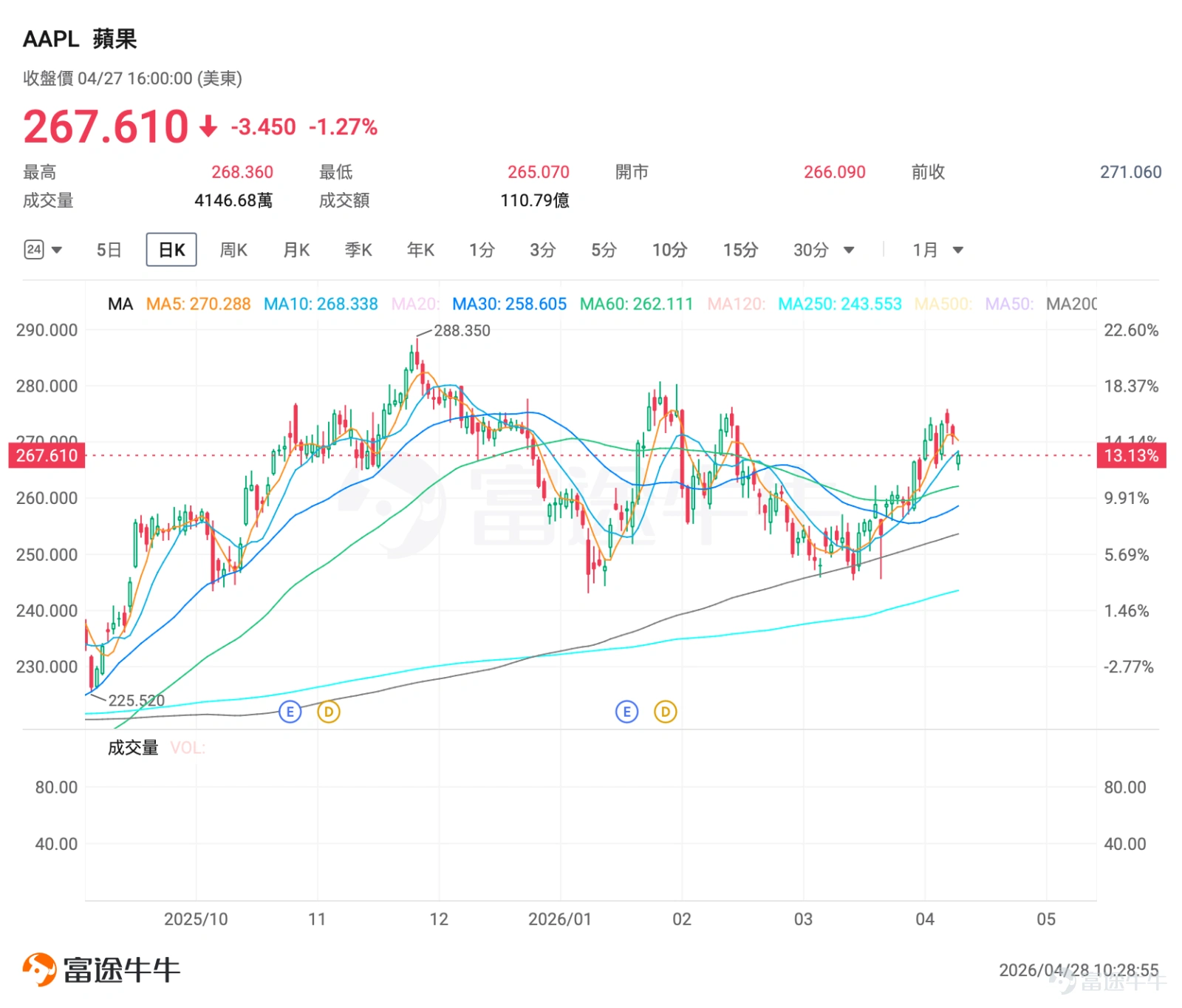
Apple’s stock price is currently fluctuating around $270, with the market betting on two catalysts—the continued recovery in the Chinese market and the implementation of Apple Intelligence’s AI strategy—whether these can translate into real revenue and EPS exceeding expectations.
After the market close on April 30, 2026, $Apple (AAPL.US)$ Apple will announce its financial results for the second quarter of fiscal year 2026 (January-March 2026). This will be the last full quarterly earnings report under Tim Cook's leadership—starting September 1, he will officially hand over the CEO position to John Ternus, the Senior Vice President of Hardware Engineering. This earnings report has attracted significant attention. According to惯例, Apple’s Q2 (the first quarter of the calendar year) is usually its off-season for sales. However, from the consensus expectations on Wall Street, this rule has been completely broken. Institutional consensus expects revenue of $109.69 billion, a year-over-year increase of 15.03%; earnings per share (EPS) of $1.95, representing an approximate 18% increase.  This forecast suggests that Apple has returned to a track of 'high growth'.JPMorgan even provided a more aggressive prediction, suggesting that driven by the iPhone 17, revenue could reach $112.7 billion. So, apart from whether revenue and earnings per share meet expectations, what are the other key highlights in Apple's Q2 2026? 1. Analysis of the five core highlights of Apple's Q2 2026 earnings report: A crucial test during the transition and handover period. The five key highlights of this earnings report include: whether the recovery momentum in the Chinese market can be sustained, whether gross margins can remain stable amid rising memory prices, whether the moat of high-margin services remains solid, the progress of AI strategy implementation, and the strategic impacts of the CEO transition...
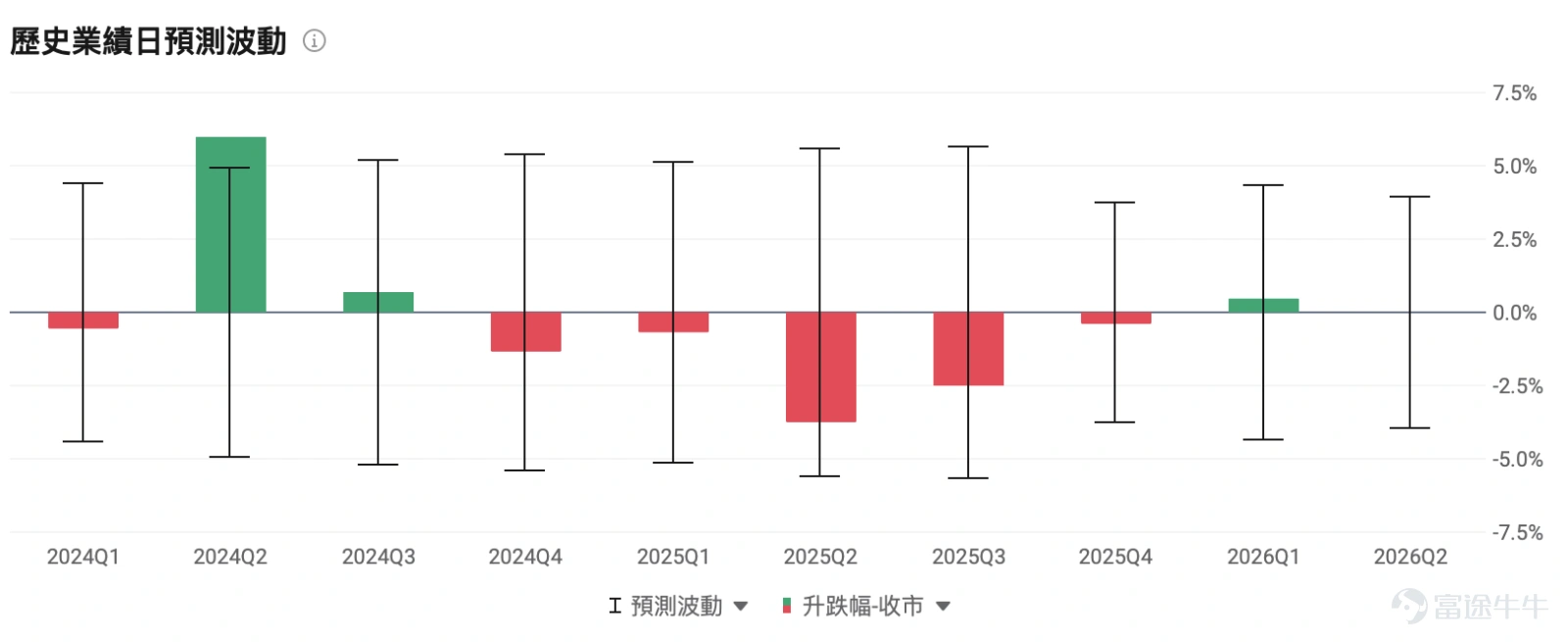
Around earnings releases, Apple’s stock volatility typically rises significantly.Based on current options data, the implied stock price movement for Apple on earnings day is ±3.92%.
After the market close on April 30, 2026, $Apple (AAPL.US)$ Apple will announce its financial results for the second quarter of fiscal year 2026 (January-March 2026). This will be the last full quarterly earnings report under Tim Cook's leadership—starting September 1, he will officially hand over the CEO position to John Ternus, the Senior Vice President of Hardware Engineering. This earnings report has attracted significant attention. According to惯例, Apple’s Q2 (the first quarter of the calendar year) is usually its off-season for sales. However, from the consensus expectations on Wall Street, this rule has been completely broken. Institutional consensus expects revenue of $109.69 billion, a year-over-year increase of 15.03%; earnings per share (EPS) of $1.95, representing an approximate 18% increase.  This forecast suggests that Apple has returned to a track of 'high growth'.JPMorgan even provided a more aggressive prediction, suggesting that driven by the iPhone 17, revenue could reach $112.7 billion. So, apart from whether revenue and earnings per share meet expectations, what are the other key highlights in Apple's Q2 2026? 1. Analysis of the five core highlights of Apple's Q2 2026 earnings report: A crucial test during the transition and handover period. The five key highlights of this earnings report include: whether the recovery momentum in the Chinese market can be sustained, whether gross margins can remain stable amid rising memory prices, whether the moat of high-margin services remains solid, the progress of AI strategy implementation, and the strategic impacts of the CEO transition...
According to options trading data, the put/call ratio is 0.42.This indicates that the trading volume of call options far exceeds that of put options, with the market generally betting that Apple's stock price will rise further after the earnings report.The current IV30.26% and IV percentile at 61% indicate a position slightly above the middle range of historical levels.
After the market close on April 30, 2026, $Apple (AAPL.US)$ Apple will announce its financial results for the second quarter of fiscal year 2026 (January-March 2026). This will be the last full quarterly earnings report under Tim Cook's leadership—starting September 1, he will officially hand over the CEO position to John Ternus, the Senior Vice President of Hardware Engineering. This earnings report has attracted significant attention. According to惯例, Apple’s Q2 (the first quarter of the calendar year) is usually its off-season for sales. However, from the consensus expectations on Wall Street, this rule has been completely broken. Institutional consensus expects revenue of $109.69 billion, a year-over-year increase of 15.03%; earnings per share (EPS) of $1.95, representing an approximate 18% increase.  This forecast suggests that Apple has returned to a track of 'high growth'.JPMorgan even provided a more aggressive prediction, suggesting that driven by the iPhone 17, revenue could reach $112.7 billion. So, apart from whether revenue and earnings per share meet expectations, what are the other key highlights in Apple's Q2 2026? 1. Analysis of the five core highlights of Apple's Q2 2026 earnings report: A crucial test during the transition and handover period. The five key highlights of this earnings report include: whether the recovery momentum in the Chinese market can be sustained, whether gross margins can remain stable amid rising memory prices, whether the moat of high-margin services remains solid, the progress of AI strategy implementation, and the strategic impacts of the CEO transition...
Based on current market expectations and Apple's fundamentals, investors with different risk appetites and market views can choose from various option strategies:
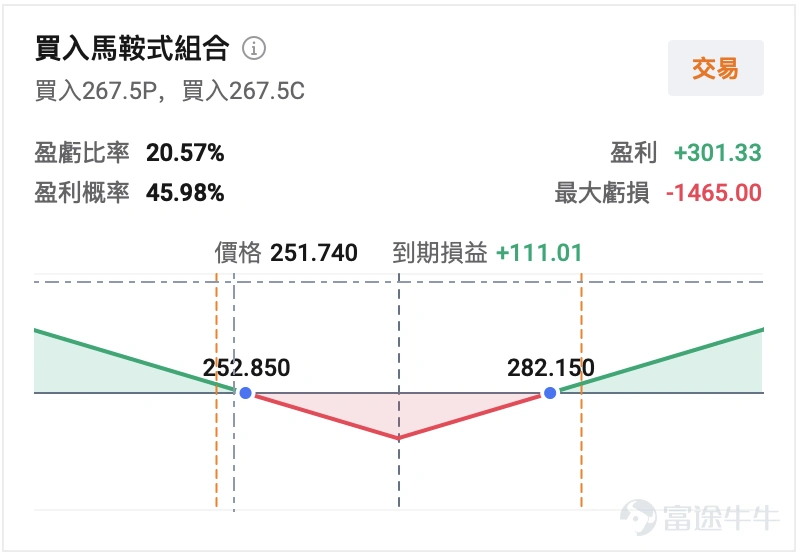
1. Buy a straddle (neutral volatility strategy, suitable for expecting large fluctuations but uncertain direction)
If investors believe that the combination of 'CEO transition' and 'AI-related developments' will trigger significant volatility but are unsure of the direction, they can simultaneously buy both Call and Put options with the same expiration date but different strike prices. The profit condition is a significant deviation of the stock price from the current level, while the risk lies in the possibility that if the stock price moves within a narrow range, both premiums could expire worthless.
After the market close on April 30, 2026, $Apple (AAPL.US)$ Apple will announce its financial results for the second quarter of fiscal year 2026 (January-March 2026). This will be the last full quarterly earnings report under Tim Cook's leadership—starting September 1, he will officially hand over the CEO position to John Ternus, the Senior Vice President of Hardware Engineering. This earnings report has attracted significant attention. According to惯例, Apple’s Q2 (the first quarter of the calendar year) is usually its off-season for sales. However, from the consensus expectations on Wall Street, this rule has been completely broken. Institutional consensus expects revenue of $109.69 billion, a year-over-year increase of 15.03%; earnings per share (EPS) of $1.95, representing an approximate 18% increase.  This forecast suggests that Apple has returned to a track of 'high growth'.JPMorgan even provided a more aggressive prediction, suggesting that driven by the iPhone 17, revenue could reach $112.7 billion. So, apart from whether revenue and earnings per share meet expectations, what are the other key highlights in Apple's Q2 2026? 1. Analysis of the five core highlights of Apple's Q2 2026 earnings report: A crucial test during the transition and handover period. The five key highlights of this earnings report include: whether the recovery momentum in the Chinese market can be sustained, whether gross margins can remain stable amid rising memory prices, whether the moat of high-margin services remains solid, the progress of AI strategy implementation, and the strategic impacts of the CEO transition...
2. Bull call spread (moderately bullish, suitable for optimism about dual drivers from China and AI)
If investors are optimistic about a recovery in sales in China and the AI narrative but believe that memory cost pressures limit the potential upside, a bull call spread would be a more prudent choice than simply buying Calls. This involves purchasing Calls with a lower strike price while selling Calls with a higher strike price, paying a net premium. The maximum gain is limited, but so is the risk.
After the market close on April 30, 2026, $Apple (AAPL.US)$ Apple will announce its financial results for the second quarter of fiscal year 2026 (January-March 2026). This will be the last full quarterly earnings report under Tim Cook's leadership—starting September 1, he will officially hand over the CEO position to John Ternus, the Senior Vice President of Hardware Engineering. This earnings report has attracted significant attention. According to惯例, Apple’s Q2 (the first quarter of the calendar year) is usually its off-season for sales. However, from the consensus expectations on Wall Street, this rule has been completely broken. Institutional consensus expects revenue of $109.69 billion, a year-over-year increase of 15.03%; earnings per share (EPS) of $1.95, representing an approximate 18% increase.  This forecast suggests that Apple has returned to a track of 'high growth'.JPMorgan even provided a more aggressive prediction, suggesting that driven by the iPhone 17, revenue could reach $112.7 billion. So, apart from whether revenue and earnings per share meet expectations, what are the other key highlights in Apple's Q2 2026? 1. Analysis of the five core highlights of Apple's Q2 2026 earnings report: A crucial test during the transition and handover period. The five key highlights of this earnings report include: whether the recovery momentum in the Chinese market can be sustained, whether gross margins can remain stable amid rising memory prices, whether the moat of high-margin services remains solid, the progress of AI strategy implementation, and the strategic impacts of the CEO transition...
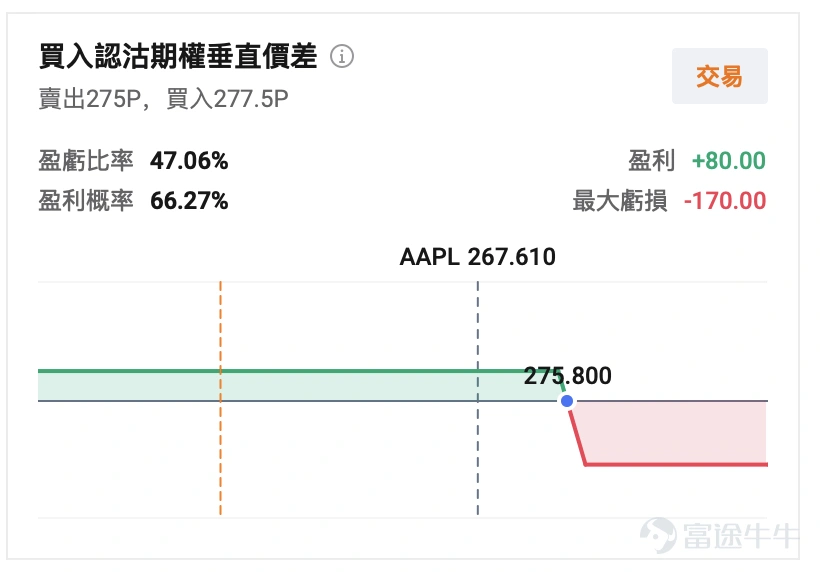
3. Bear put spread (moderately bearish, suitable for concerns over margin pressure)
If investors are concerned that unexpected memory costs or risks associated with initial CEO transitions might lead to a pullback in Apple’s stock price, they may consider using a bear put spread to hedge against potential downside risks. This involves buying Puts with a higher strike price while selling Puts with a lower strike price. The maximum loss in this strategy is the net premium paid, while the maximum gain equals the difference between the strike prices minus the net premium, with limited profit potential.
After the market close on April 30, 2026, $Apple (AAPL.US)$ Apple will announce its financial results for the second quarter of fiscal year 2026 (January-March 2026). This will be the last full quarterly earnings report under Tim Cook's leadership—starting September 1, he will officially hand over the CEO position to John Ternus, the Senior Vice President of Hardware Engineering. This earnings report has attracted significant attention. According to惯例, Apple’s Q2 (the first quarter of the calendar year) is usually its off-season for sales. However, from the consensus expectations on Wall Street, this rule has been completely broken. Institutional consensus expects revenue of $109.69 billion, a year-over-year increase of 15.03%; earnings per share (EPS) of $1.95, representing an approximate 18% increase.  This forecast suggests that Apple has returned to a track of 'high growth'.JPMorgan even provided a more aggressive prediction, suggesting that driven by the iPhone 17, revenue could reach $112.7 billion. So, apart from whether revenue and earnings per share meet expectations, what are the other key highlights in Apple's Q2 2026? 1. Analysis of the five core highlights of Apple's Q2 2026 earnings report: A crucial test during the transition and handover period. The five key highlights of this earnings report include: whether the recovery momentum in the Chinese market can be sustained, whether gross margins can remain stable amid rising memory prices, whether the moat of high-margin services remains solid, the progress of AI strategy implementation, and the strategic impacts of the CEO transition...
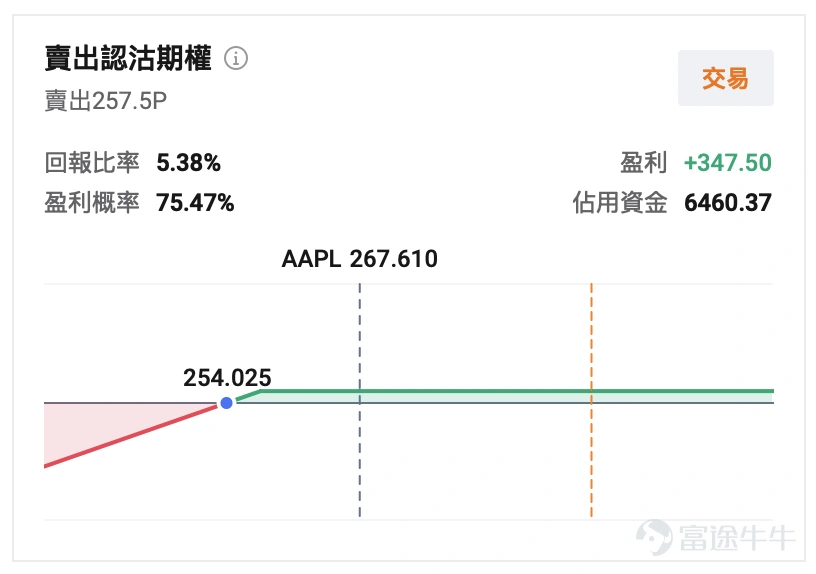
4. Cash-secured put selling (long-term allocation):
If you believe in Apple's long-term competitive advantage but want to enter at a more favorable price, investors can consider selling out-of-the-money cash-secured put options. If the share price does not fall after the earnings report, the premium can be earned; if the share price falls, the investor can buy the underlying stock at a lower strike price for long-term holding.
After the market close on April 30, 2026, $Apple (AAPL.US)$ Apple will announce its financial results for the second quarter of fiscal year 2026 (January-March 2026). This will be the last full quarterly earnings report under Tim Cook's leadership—starting September 1, he will officially hand over the CEO position to John Ternus, the Senior Vice President of Hardware Engineering. This earnings report has attracted significant attention. According to惯例, Apple’s Q2 (the first quarter of the calendar year) is usually its off-season for sales. However, from the consensus expectations on Wall Street, this rule has been completely broken. Institutional consensus expects revenue of $109.69 billion, a year-over-year increase of 15.03%; earnings per share (EPS) of $1.95, representing an approximate 18% increase.  This forecast suggests that Apple has returned to a track of 'high growth'.JPMorgan even provided a more aggressive prediction, suggesting that driven by the iPhone 17, revenue could reach $112.7 billion. So, apart from whether revenue and earnings per share meet expectations, what are the other key highlights in Apple's Q2 2026? 1. Analysis of the five core highlights of Apple's Q2 2026 earnings report: A crucial test during the transition and handover period. The five key highlights of this earnings report include: whether the recovery momentum in the Chinese market can be sustained, whether gross margins can remain stable amid rising memory prices, whether the moat of high-margin services remains solid, the progress of AI strategy implementation, and the strategic impacts of the CEO transition...
Summary
Apple’s Q2 2026 earnings report is at a triple critical juncture of performance validation, strategy implementation, and management transition. The sustainability of China market recovery, gross margin resilience, service business strength, progress on AI strategy execution, and the impact of the CEO transition will directly determine the quality of results and stock price movement.
In the face of this upcoming report card, do fellow investors believe that Apple can once again break through its ceiling?
Finally, here's a small perk for fellow Futubull investors, welcome to claim it.Options Beginner Pack
*This event is exclusive to invited HK users. Click to learn more.Detailed event rules>>

After the market close on April 30, 2026, $Apple (AAPL.US)$ Apple will announce its financial results for the second quarter of fiscal year 2026 (January-March 2026). This will be the last full quarterly earnings report under Tim Cook's leadership—starting September 1, he will officially hand over the CEO position to John Ternus, the Senior Vice President of Hardware Engineering. This earnings report has attracted significant attention. According to惯例, Apple’s Q2 (the first quarter of the calendar year) is usually its off-season for sales. However, from the consensus expectations on Wall Street, this rule has been completely broken. Institutional consensus expects revenue of $109.69 billion, a year-over-year increase of 15.03%; earnings per share (EPS) of $1.95, representing an approximate 18% increase.  This forecast suggests that Apple has returned to a track of 'high growth'.JPMorgan even provided a more aggressive prediction, suggesting that driven by the iPhone 17, revenue could reach $112.7 billion. So, apart from whether revenue and earnings per share meet expectations, what are the other key highlights in Apple's Q2 2026? 1. Analysis of the five core highlights of Apple's Q2 2026 earnings report: A crucial test during the transition and handover period. The five key highlights of this earnings report include: whether the recovery momentum in the Chinese market can be sustained, whether gross margins can remain stable amid rising memory prices, whether the moat of high-margin services remains solid, the progress of AI strategy implementation, and the strategic impacts of the CEO transition...
Disclaimer
This content does not constitute any offer, solicitation, recommendation, opinion, or guarantee for any securities, financial products, or instruments. The risk of loss in trading options can be substantial. In some cases, your losses may exceed the initial margin amount deposited. Even if you have set contingent orders, such as 'stop-loss' or 'limit' orders, they may not necessarily prevent losses. Market conditions may render these orders unexecutable. You may be required to deposit additional margin within a short period. If you fail to provide the required amount within the specified time, your open positions may be liquidated. However, you will still be responsible for any deficit balance in your account. Therefore, before trading, you should study and understand options and carefully consider whether such trading is suitable for you based on your financial situation and investment objectives. If you trade options, you should be familiar with the procedures upon exercising options and at expiration, as well as your rights and obligations when exercising options and at expiration.
Risk Disclaimer: The above content only represents the author's view. It does not represent any position or investment advice of Futu. Futu makes no representation or warranty.Read more
Thumbs Up
8
212K Views
Report
Comments (2)
Write a Comment...
2
8
20