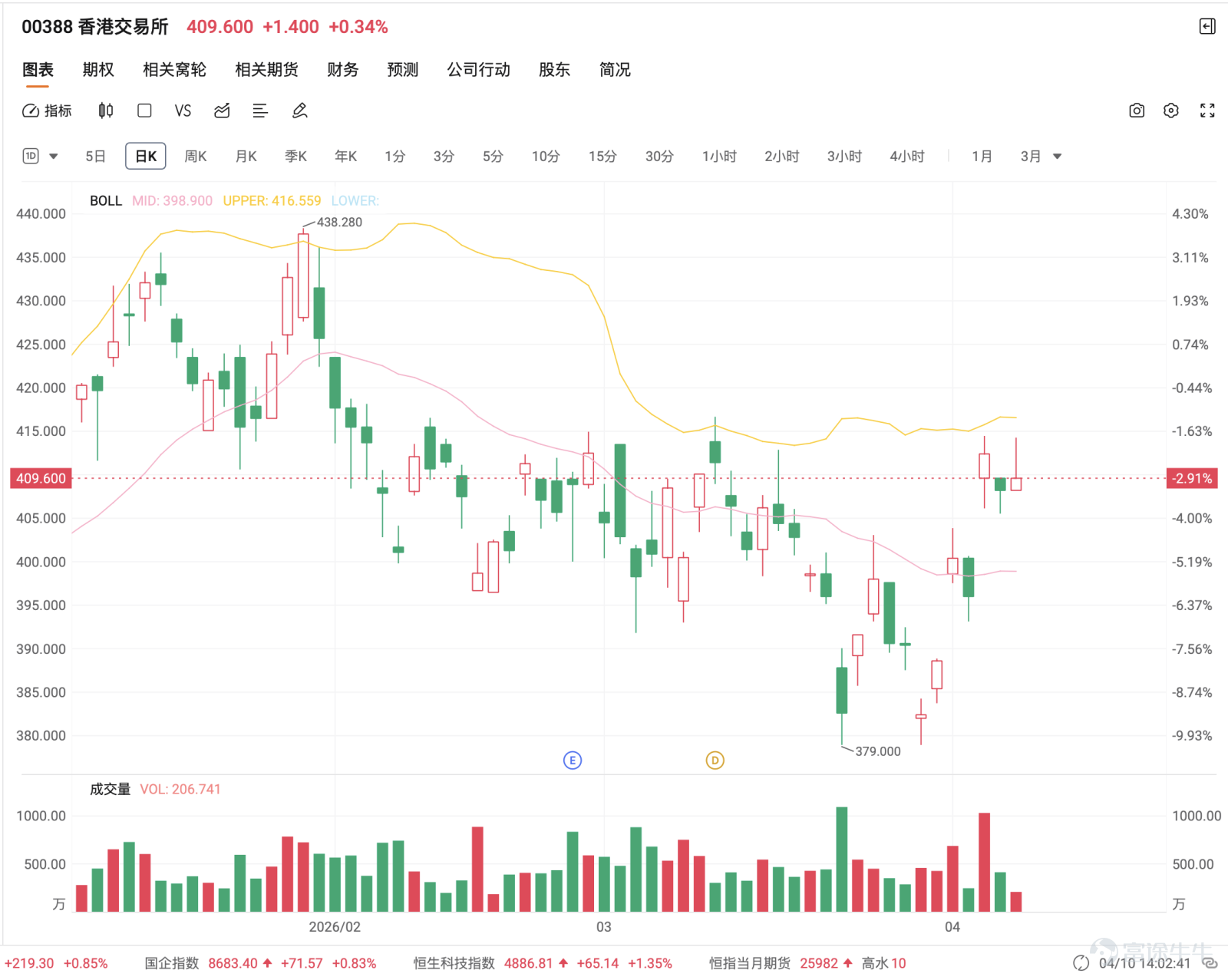

After the rise, Hong Kong Exchange (00388) has retraced to around HKD 408. Is this a consolidation before the continuation of the rebound, or another 'one-night-stand rebound'?
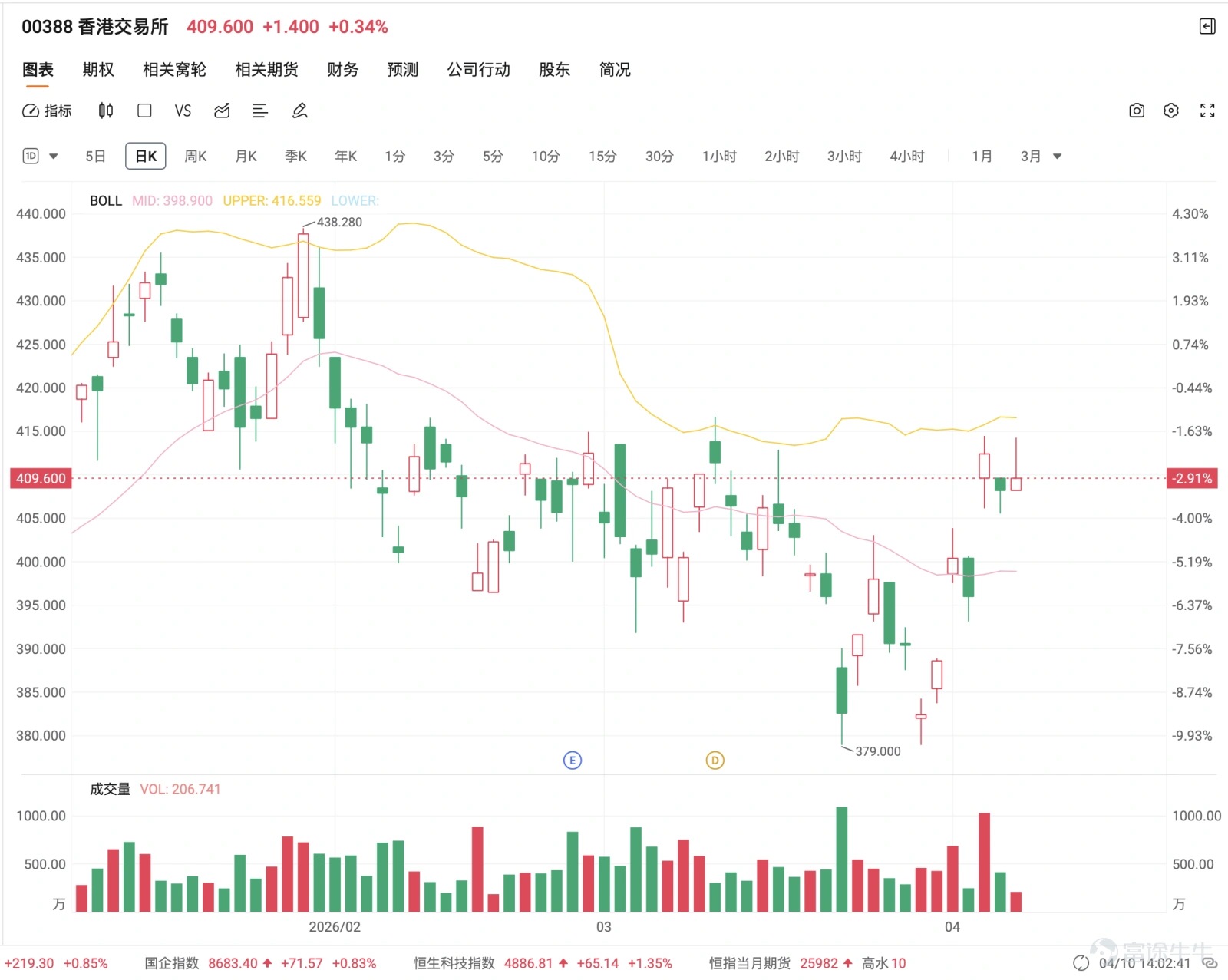
Hong Kong Exchange (00388) closed at HKD 408.200 yesterday (9th), up HKD 4.200 on the day with an increase of 1.02%. The highest point during the day was HKD 409.600, and the lowest was HKD 405.600, opening price was HKD 412.400, with a turnover of approximately HKD 1.678 billion. Judging from the recent daily chart trend, after rebounding from a low of HKD 379.000, the Hong Kong Exchange briefly returned above HKD 410 but failed to stabilize at higher levels afterwards, reflecting that the market remains cautious about it. The core issue for this stock now is not whether it will rebound, but whether it can hold steady after rebounding, and whether it can break through the resistance zone between HKD 412 and HKD 416.
Technically, Hong Kong Exchange is currently in consolidation after the rebound. The 5-day moving average is approximately HKD 401.120, the 10-day line is about HKD 395.860, the 20-day line is about HKD 398.924, and the 30-day line is about HKD 400.936. The share price is now back above these short-to-medium term moving averages, indicating that the short-term structure has significantly improved compared to its lower levels. The 60-day line is about HKD 409.228, and the current price is just below it, indicating that the area near HKD 408 to HKD 410 has started entering the mid-term resistance zone. The 120-day line is about HKD 410.314, and the 250-day line is about HKD 403.205, further showing that the current price is within a dense moving average zone, making seesaw movements likely. The Bollinger Band midpoint is about HKD 398.924, the upper band is about HKD 416.642, and the lower band is about HKD 381.306. The current price is close to the upper band but hasn't broken through, which is a typical pressured position after a rebound. RSI is approximately between 51 and 62, neutral leaning towards strong, but not extremely bullish, indicating that Hong Kong Exchange currently has a rebound foundation but hasn't formed a unilateral breakthrough.
In terms of support levels, the first key level to watch is HKD 408, followed by HKD 405.6. If that breaks, the next level is HKD 401.2, and then HKD 395.9. For resistance levels, the short-term focus is HKD 410.6, followed by HKD 412.6, and then HKD 416.6 and a higher level of HKD 420. Therefore, the upward conditions for Hong Kong Exchange are clear: First, it needs to hold above HKD 408 and HKD 405.6; second, it must regain HKD 410.6; third, if it can break through HKD 412.6 to HKD 416.6, this rebound will have the potential to continue further. Conversely, the downside risk is also quite direct: if it breaks below HKD 405.6 and falls back below HKD 401.2, market voices calling for gap filling will quickly increase.
From investor comments, sentiment towards Hong Kong Exchange in the market is actually quite divided. On the bearish side, for example, @日日輸爆廠@日日輸爆廠 believes it looks like 'a large player unloading pattern,' while @支持別人就是支持自己 @支持別人就是支持自己has repeatedly mentioned 'quick exit' and 'the sooner you exit, the better.' These views reflect lingering doubts about the sustainability of Hong Kong stocks' rebound. Such concerns are not without reason, as Hong Kong Exchange itself is heavily influenced by overall market turnover and sentiment. As long as there is still skepticism about Hang Seng Index's rebound, it will naturally be difficult for Hong Kong Exchange to perform independently.
This is also why @HotKitchenTrader @熱廚房炒家uses the term 'rebound one-night stand' to describe it, which resonates strongly. Because the current chart perfectly reflects this situation: there's a rebound, emotions run high, and some chasing of prices, but when it comes to the resistance zone between 412 and 416 dollars, it can't fully break through. If it fails to make a breakthrough later, the market will naturally see it as a temporary rise; if it does break through, it might upgrade from a 'one-night-stand rebound' to a real recovery.
Another set of comments is closer to technical analysis. For instance, @YourStrengthIsYourFreedom @你的強大就是你的自由says 'up one day, down the next,' while @gƖƋħǾŃðǏŃðǏ mentions 'why can’t it pass 412, waiting for 413 but instead falling.' These two statements both point to the same fact: 412 to 413 dollars is indeed the most crucial short-term pressure zone for the Hong Kong Exchange right now. The market isn’t completely inactive, but buying becomes noticeably conservative at this level. This also explains why @FinancialSignal’s decision to sell at 413 dollars makes sense from a short-term trading perspective.
However, more positive voices shouldn’t be ignored either. Like @11970998 @11970998saying 'essentially in sync with the broader market,' and @ModelVersionAndyLau @型版古天樂believing that 'staying above 400 suggests a bottoming-out and upward rebound.' These views have technical backing. Because the Hong Kong Exchange is currently holding above several short-to-medium term moving averages, and around 400 dollars has formed a relatively important support zone. In other words, as long as the region near 400 to 401 dollars doesn’t collapse, it still qualifies as part of a rebound structure after stabilizing from lower levels, rather than another unilateral pullback.
Many people are also asking about target levels. For example, @SupportingOthersIsSupportingYourself asks, 'Can it reach the previous high of 414.90?' while @BigMouthFund directly says, 'This rebound is targeting 420.' These targets aren’t random, because technically 414 to 420 dollars is indeed the natural area where the Hong Kong Exchange would face resistance if this rebound continues pushing higher. However, the sequence matters: first break 412.6 dollars, then look at 416.6 dollars, and only after that consider 420 dollars. If it can’t even pass the first hurdle, looking directly at 420 would seem too hasty.
Overall, the most accurate positioning for the Hong Kong Exchange right now is a stock that has rebounded from lower levels and is consolidating near a resistance zone. The advantage is that the share price has returned above short-to-medium term moving averages, and there is solid support around 400 dollars. The problem, however, is that every time it approaches 412 to 416 dollars, it encounters pressure, indicating that the market hasn’t fully trusted this rebound to last. For short-term investors, the key isn’t guessing whether it will drop again tomorrow, but watching if 408 dollars can hold, if 412.6 dollars can break through, and if 416.6 dollars can stabilize further. If it holds firm and breaks through, this rebound may have a chance to push toward 420 dollars; otherwise, it will remain what everyone talks about — bouncing and retreating, retreating and waiting again.
Key points for strategy: The short-term support level is at 405 yuan; hold steady for a rebound continuation, chase after breaking through 410 to 412 yuan; if 405 yuan is breached, switch to put warrants.
UBS Group 26034 | Exercise price 419.08 yuan | Actual leverage 4.5 times | Exercise price close to current price, suitable for holding above 405 yuan to bet on the first leg of rebound.
DBS 22806 | Exercise price 419.08 yuan | Actual leverage 4.3 times | Balanced rhythm, suitable for stable short-term deployment near the support level.
UBS Group 27304 | Exercise price 518.5 yuan | Actual leverage 8.3 times | Higher elasticity, suitable for following up after breaking through 410 to 412 yuan.
Citi 25147 | Exercise price 550 yuan | Actual leverage 10.2 times | Direct reaction, suitable for betting on extended rebounds after a breakout.
Bank of China 21944 | Exercise price 359.8 yuan | Actual leverage 12.6 times | Moderately high-elasticity put warrant, suitable for betting on initial pullbacks after losing the 405 yuan support.
Huatai 22000 | Exercise price 359.8 yuan | Actual leverage 12.7 times | Direct reaction, suitable for counter-deployment after the support level is breached.
Risk Disclaimer: The above content only represents the author's view. It does not represent any position or investment advice of Futu. Futu makes no representation or warranty.Read more

Comments
to post a comment
1