
Good news from the Middle East! Trump says a U.S.-Iran deal is largely finalized

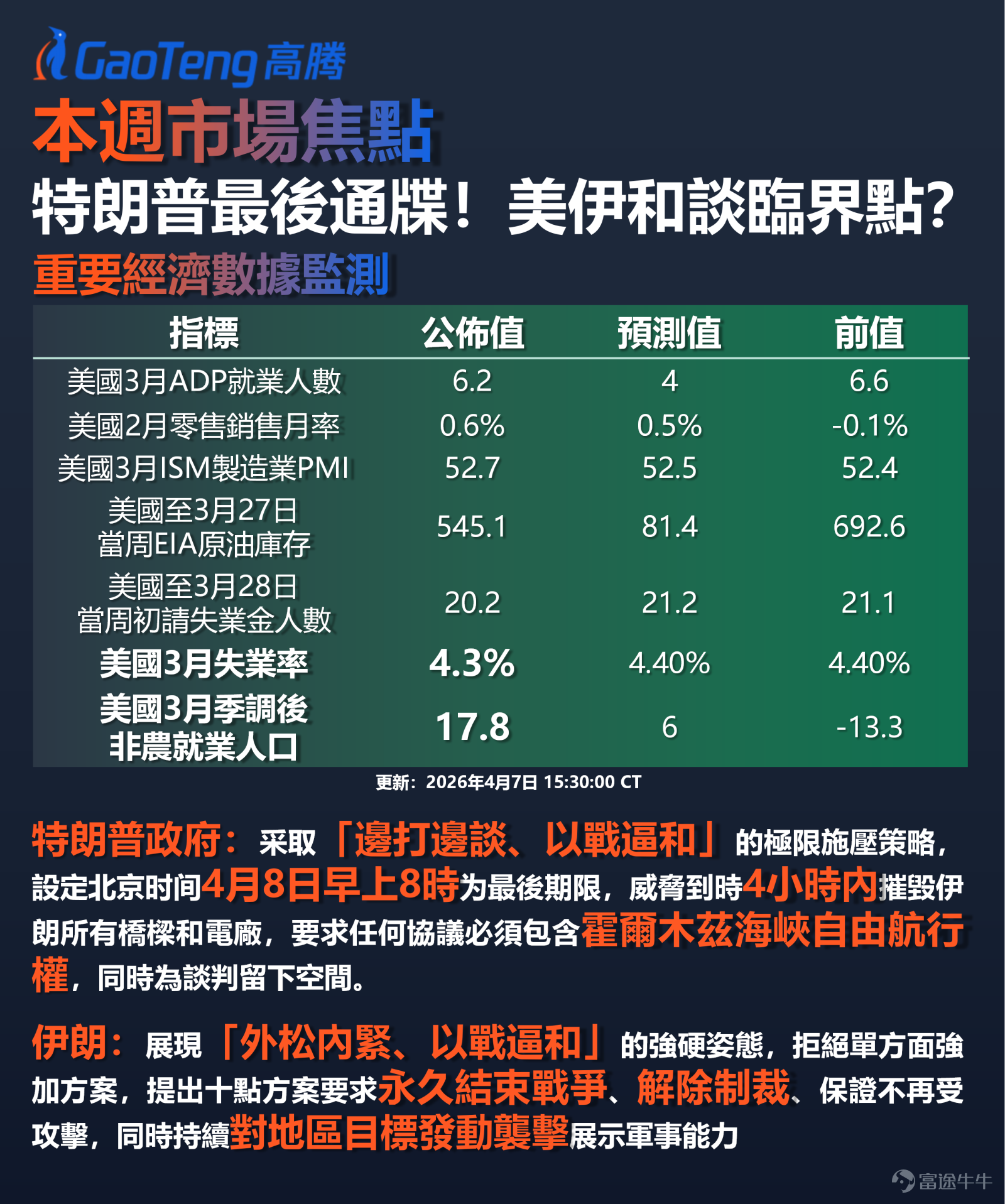
Tense·Market Focus This Week | Trump's Ultimatum! Critical Point for US-Iran Talks?
Trump’s extreme pressure! Could oil prices break through previous highs?
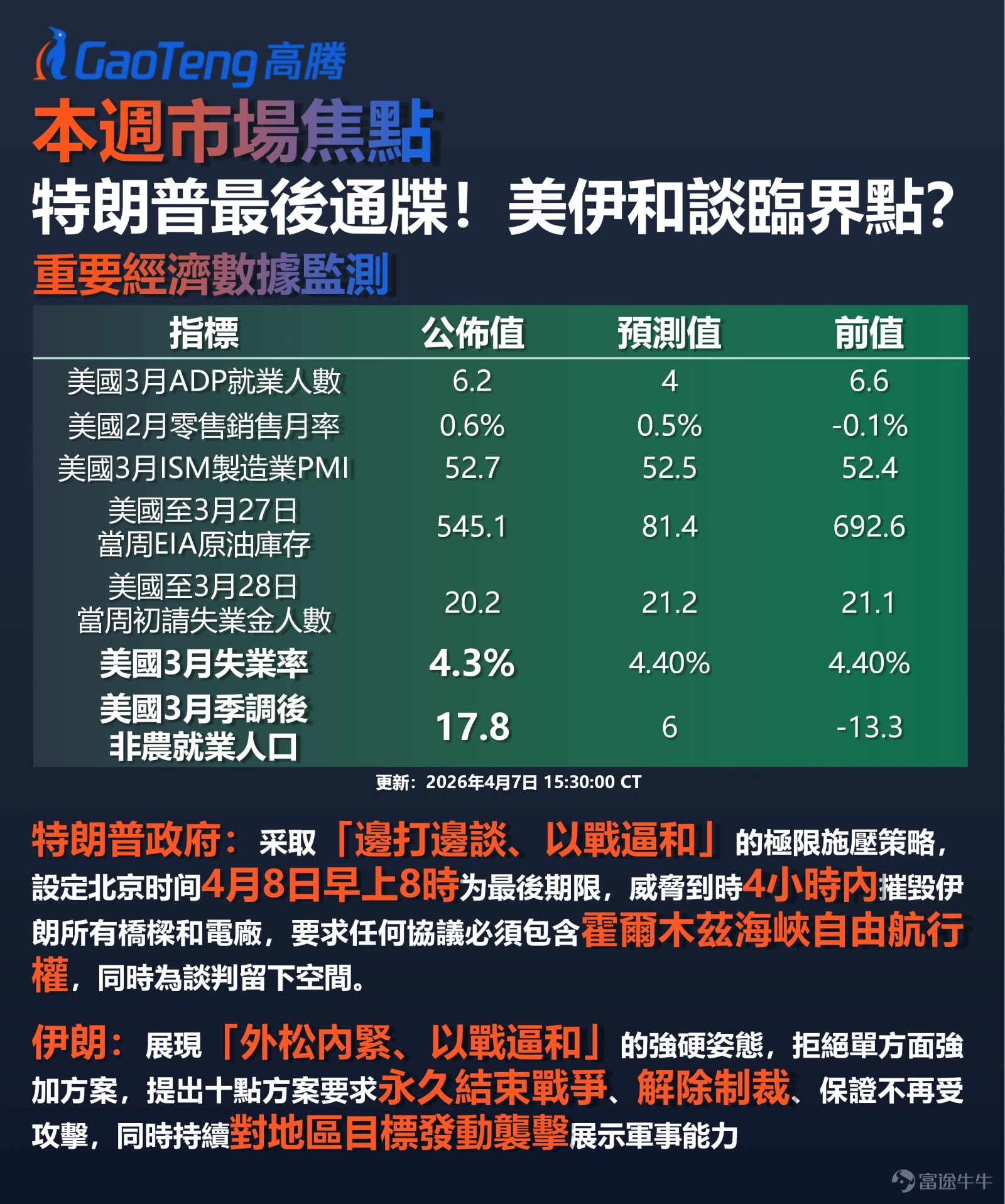
US President TrumpIssued to Iran this Tuesday (April 7th)Ultimatumsetting the deadline as Eastern Time8:00 PM on April 7 (i.e., 8:00 AM Beijing time on April 8, with Beijing time being 12 hours ahead of Eastern Time)as the final deadline to reach an agreement, threatening that if no Hormuz Strait agreement is reached, the US military will destroy all of Iran's bridges and power plants within4 hours, and warned that "the entire country might be wiped out by tomorrow night"" This extreme pressure strategy marks the entry of US-Iran negotiations intoa critical juncture, where any lack of compromise from either side could lead to a sharp escalation in conflict.
Trump explicitly stated that any Iran agreement must include the freedom of navigation through the Strait of Hormuz, which he called 'a very important priority.' He threatened that within a four-hour window from 8 PM to midnight Eastern Time on April 7, every bridge in Iran would be completely destroyed, and every power plant would be entirely incapacitated, engulfed in flames and explosions, never to be usable again. In response to questions about potential war crimes related to attacking civilian infrastructure, Trump replied "I am not at all concerned about committing war crimes", and retorted, "Allowing a sick nation, a nation with a leadership that has gone insane, to possess nuclear weapons — that is the real war crime."
Notably, Trump also proposed the idea of the US collecting 'tolls' in the Strait of Hormuz, stating, "Iwould rather have the US collect tolls in the Strait of Hormuzthan let Iran do it." This statement shows that the U.S. not only demands free passage through the strait but also seeks to convert its geopolitical advantage into economic gain. However, Trump simultaneously noted, "We don't want that situation to happen," leaving some room for negotiation.
The White House viewed Iran's firm response as a "negotiation tactic" rather than outright rejection. According to Axios, a U.S. official said they are in communication with the Iranians regarding amendments and redrafting. If Trump sees potential for an agreement, he may delay military action against Iran. Trump’s advisors told mediators that the president needs to see positive signs from Iran to consider postponement, adding that "we are currently at acritical moment in negotiations, where anything could happen."
Iran's Response and Ten-Point Plan
In response to Trump'sUltimatum, Iran demonstrated a hardline stance of 'outwardly relaxed but internally vigilant, using war to force peace,' while proposing aten-point planthrough intermediaries such as Pakistan, attempting to gain political initiative under military pressure.
According to reports from Iranian state media, Iran proposed aten-point planon Monday aimed at ending the conflict with the US and Israel. The proposal, conveyed by Pakistan, includes guarantees that Iran will not be attacked again, an end to Israeli strikes on Hezbollah in Lebanon, andthe lifting of all sanctions. In exchange, Iran will lift its effective blockade of the Strait of Hormuz, a key shipping lane.
Iran also proposed charging approximately2 million US dollarsin fees, to be split with Oman across the Strait. According to the plan, Iran will use the proceeds to rebuild infrastructure destroyed by attacks from the US and Israel, rather than directly demanding compensation. This proposal shows Iran's attempt to monetize its geopolitical advantages while avoiding an outright admission of defeat. However, Iran's Foreign Ministry stated that Iran has received messages relayed by the US through intermediaries, including Pakistan, but the US demands are "neither extreme nor entirely logical"」。
On the military front, Iran continues to launch attacks on regional targets. At 7 a.m. local time, citing unnamed sources, Iranian reports indicated that an explosion occurred at the Jubail Industrial Zone in northeastern Saudi Arabia, where US capital is involved, following widespread strikes. The Jubail Industrial Zone is one of the world’s major petrochemical production bases, with an annual output of about60 million tonsof petrochemical products, accounting for6% to 8%of global total production. The zone hosts multiple large-scale petrochemical enterprises and projects, including the Sadara project involving Dow Inc. This attack demonstrates Iran’s capability to strike US economic interests in the Middle East, serving as a firm response to Trump’s threats.
The Fars News Agency reported, citing a spokesperson for the Iranian Armed Forces, that the strait would remain closed to the US and Israel in the long term.Kazem Garibabadi, Deputy Foreign Minister of IranIn an interview with Sputnik, it was stated that Iran is drafting an agreement with Oman to monitor ships passing through the Strait, which will require shipowners to pay tolls to Iran. The strait is legally international waters, and any attempt by Iran to control navigation will face opposition from Western powers and Gulf Arab states.
International Community's Mediation and Concerns
As the deadline approaches, the international community has intensified its mediation efforts to try to prevent further escalation of the conflict. Pakistan, Egypt, and Turkey are pushing for a potential ceasefire agreement lasting about45 daysto stop the US threat to strike Iran's energy infrastructure and possible retaliatory actions by Iran against regional countries.
The UK convened an online meeting of more than 40 US allies on Thursday to discuss diplomatic engagement with Iran and possible sanctions if it does not agree to open the Strait of Hormuz. According to informed sources, the coalition made it clear that the US must include a solution for the Strait of Hormuz in its ceasefire negotiations with Iran. The coalition’s military planners will meet next week to discuss how to deploy naval assets after the war to assist in patrolling the strait and clearing mines.
Saudi Foreign Minister Abdulatif bin Rashid Al-Zayanistated that the UN Security Council would likely vote on Friday on a resolution supporting measures to reopen the Strait of Hormuz. The UAE is calling on the UN to authorize a range of measures, including the use of force, to restore oil and gas transportation through the strait. Ukrainian President Volodymyr Zelenskyy posted on social media that Ukraine is willing to support security operations in the strait.
UN Secretary-General António Guterrescalled for ensuring freedom of navigation and protecting civilians as well as infrastructure, including nuclear facilities. He told reporters on Thursday that he would send an envoy to seek peace, urging the US and Israel to end the conflict while also calling on Iran to stop attacking neighboring countries. According to statistics from government organizations and the US-based Human Rights Activist News Agency, the conflict has so far caused over5000 peopleDeaths occurred, with nearly three-quarters of them in Iran.
Possible future developments
"Scenario One: A Temporary Ceasefire Is Reached"
With mediation from Pakistan and other parties, the two sides may reach a temporary ceasefire agreement before the deadline. The United States might suspend airstrikes in exchange for Iran freezing its nuclear activities, while Iran could open the Strait of Hormuz in return for partial sanctions relief. President Trump has statedWe don't want that situation to happen, leaving room for negotiation. The White House views the Iranian response as a bargaining tactic and is currently in discussions on amendments and redrafting. Such an agreement would be unstable and fragile, akin to"Ceasefire, Not Peace"。
Historical Analogy: The 2024 Gaza Ceasefire Agreement—a temporary truce brokered under international pressure—failed to resolve the underlying conflicts, but it did provide both sides with a much-needed respite.
"Scenario Two: Brief Escalation of Conflict Followed by Negotiation"
If Iran does not make concessions before the deadline, Trump may order limited strikes on Iran's infrastructure to demonstrate resolve. Two sources said a large-scale US-Israeli bombing plan targeting Iran’s energy facilities is ready if Trump gives the order. After the strike, both sides may return to the negotiating table, with Iran making greater concessions under pressure. This"Fight and talk at the same time"approach aligns with Trump's"use war to force peace"The strategy.
Historical reference: 2019 US-Iran tensions – after the US assassination of Soleimani, Iran retaliated; both sides chose restraint after a brief escalation, avoiding full-scale war.
"Scenario Three: Rapid Conflict Escalation"
If Trump really orders destruction of all bridges and power plants in Iran within4 hours, or if Iran launches large-scale attacks on key facilities in Saudi Arabia, the UAE, and other countries, the conflict could escalate rapidly. Iran has warned it will attack critical infrastructure in Middle Eastern countries hosting US military bases, potentially drawing Saudi Arabia, the UAE, and others into a regional war. Traffic through the Strait of Hormuz has already plummetedover 90%compared to pre-war levels. If this situation persists for months, it would trigger a global energy crisis.
Historical reference: The 1991 Gulf War – Iraq burned Kuwaiti oil wells, causing a global oil supply disruption, soaring oil prices, and plunging the global economy into recession.
"Key"US Eastern Timenode
– April 7th at 8 PM (Beijing time April 8th at 8 AM)The deadline set by Trump!!!
- April 7th at 12 midnight: The point in time Trump threatened to complete total destruction
- April 9th: Rumored end date of the US target
US Economic Data and Fed Policy
As geopolitical risks escalate, US economic data presents a complex situation, leaving the Fed facing 'stagflation-style' dilemmas.
"March Nonfarm Employment"Rebound exceeds expectations: The US seasonally adjusted nonfarm payroll employment increased in Marchby 178,000 people, far exceeding market expectations of 60,000. The previous value was revised from a decrease of 133,000 to a decrease of 92,000. The unemployment rate dropped to4.3%, lower than the expected 4.4%. This data shows that the labor market remained resilient in the early stages of the conflict, but economists warn that this rebound may be temporary, and the war will delay the mild improvement originally expected for the labor market this year.
“ADP Employment and ISM Manufacturing PMISlightly exceeding expectations in the rebound: The US ADP employment number for March increased by62,000 people, better than the expected 40,000. The US ISM Manufacturing PMI for March recorded52.7, higher than the expected 52.5, indicating an expansion in manufacturing activity. However, these figures only reflect the impact of about two weeks at the start of the conflict; the true extent of the shock will need to be gradually verified through data over the coming months.
The Federal Reserve is facinga stagflation dilemma”:John Williams, President of the New York Fedstated that against the backdrop of supply chain disruptions caused by the Middle East war,the current interest rate level is in an appropriate position. He forecasts that inflation will reach2.75%, partly due to rising energy prices.Chicago Fed President GoolsbeeHe warned that the economy is suffering from an oil price shock, which has driven up prices just as the inflationary impact of last year's tariff hikes has yet to fade. This ‘untimely timing"This causes him concern."
The International Monetary Fund (IMF) stated that, although U.S. inflation is expected to return to the Federal Reserve's 2% target in the first half of 2027, policymakers have very limited room for interest-rate cuts this year. IMF staff project that the Fed will implement only one rate cut by the end of 2026, with the benchmark interest rate reaching3.25% to 3.5%the target range. Currently, this rate stands at3.50% to 3.75%。
Adjustments to Trump's Tariff Policy
This week, the Trump administration adjusted national-security tariffs on imports of steel, aluminum, and copper. Under the new framework, if the total content of steel, aluminum, or copper is less than15%goods will be effectively exempt from metal tariffs; content exceeding15%The derivative products will enjoy the reduced25%The tariff is levied on the total value of imported goods, rather than solely on the metal content. Bulk-grade steel and aluminum products—goods that are almost entirely composed of metal—will continue to be subject to this tariff.50%Tariffs. This adjustment aims to simplify compliance procedures but may lead to higher tariff costs for some imported goods.
Market movements this week
This week, oil prices fluctuated amidst TrumpUltimatumand hopes for peace talksfluctuate violently. On Thursday, U.S. oil prices closedfor the first time since 2022above $ per barrel$110, while Brent crude futures closed slightly above $ per barrel$109. Global fuel prices continue to rise, with European diesel prices surpassing$200 per barrel. Despite the market being closed on Friday due to the Good Friday holiday, most traders quickly unwound their bearish positions after Trump's prime-time speech. If military escalation occurs over the weekend, oil prices may again test$115previous highs.
– Gold $Gold Futures (JUN6) (GCmain.US)$ :Safe-haven buyingpushes gold prices,Price surged then pulled back
Gold prices continue to be supported amid rising geopolitical risks.Safe-haven buyingsupported, but as Trump sent optimistic signals, gold prices retreated from their highs, showing signs ofSafe-haven buyingprofit-taking. This kind offluctuate violentlyconfirms the characteristics of a 'news-driven market' – investor sentiment swings back and forth between 'hope for a ceasefire' and 'war risks'.
- Stock Market: Mixed data,increased volatility
Last week, the S&P 500 index $S&P 500 Index (.SPX.US)$showed mixed performance, after dipping on Monday to6316.91Last Tuesday saw a rebound2.91%and the price has now been maintained up to last Wednesday's high6609.67nearby. The Nasdaq index $Nasdaq Composite Index (.IXIC.US)$ surged last week4.44%. The S&P 500 Volatility Index $CBOE Volatility S&P 500 Index (.VIX.US)$ Plummet23.12%, indicating that the market'spanic sentiment has eased somewhat. However, there is still widespread concern in the market that if energy prices continue to rise, it could not onlyoffset the effects of tax cutsbut also bring about additional challengesDividend, and will furtherweakenof the next few monthsHousehold consumption capacity。
– U.S. dollar:Safe-Haven CurrenciesFeature emergence
US Dollar $USD (USDindex.FX)$During this week's escalation of geopolitical risks, it has demonstrated the typical «Safe-Haven Currencies"Key feature—when geopolitical risks escalate, global capital flows into U.S. dollar assets. At the same time, stronger-than-expected nonfarm payrolls in March and renewed inflation concerns have also…"Provided fundamental support for the U.S. dollar.。
Risk Disclaimer: The above content only represents the author's view. It does not represent any position or investment advice of Futu. Futu makes no representation or warranty.Read more


Comment (1)
to post a comment
6
4