
AI agents ignite CPU demand! Who are the big winners?

Daily Options Selling Strategies | Intel's consecutive gains facing resistance? SanDisk rebounds and resumes upward trend? Don't panic, learn these two options strategies to profit even in volatile markets!
 While most investors are reveling in the high leverage of options buying, the real 'smart money' is quietly collecting time value.In this issue, we focus on two core selling strategies: covered calls and cash-secured puts,teaching you how to enhance returns by 'selling options' in a high-volatility market.
Market Barometer: Current range-bound market making it hard to profit? — The 'golden window' for selling strategies.
The recent US stock market has been somewhat 'stuck in limbo,' particularly tormenting:
– Strong economy but high interest rates.:Last Friday, the US March non-farm payroll exceeded expectations; the economy isn't in recession, but inflation remains volatile, causing repeated delays in Federal Reserve rate cuts.,Higher interest rates will persist for longer.。
– Geopolitical tensions high, volatility elevated:The situation in the Middle East is tense, with oil prices surging.Market anxiety is high.The VIX index has remained at elevated levels above 20.high volatility but no clear direction,the S&P 500 is stuck in a choppy range near the 6600 level, with unpredictable developments in the Middle East.
As of April 6, 2026, $SPDR S&P 500 ETF (SPY.US)$ the implied volatility (IV) percentile for options stands at 83%.For options traders, high IV means that option premiums (time value) are relatively expensive.
![[Cool Guy]While most investors are reveling in the high leverage of options buying, the real 'smart money' is quietly collecting time value.In this issue, we focus on two core selling strategies: covered calls and cash-secured puts,teaching you how to enhance returns by 'selling options' in a high-volatility market. Market Barometer: Current range-bound market making it hard to profit? — The 'golden window' for selling strategies. The recent US stock market has been somewhat 'stuck in limbo,' particularly tormenting: – Strong economy but high interest rates.:Last Friday, the US March non-farm payroll exceeded expectations; the economy isn't in recession, but inflation remains volatile, causing repeated delays in Federal Reserve rate cuts.,Higher interest rates will persist for longer.。 – Geopolitical tensions high, volatility elevated:The situation in the Middle East is tense, with oil prices surging.Market anxiety is high.The VIX index has remained at elevated levels above 20.high volatility but no clear direction,the S&P 500 is stuck in a choppy range near the 6600 level, with unpredictable developments in the Middle East. As of April 6, 2026, $SPDR S&P 500 ETF (SPY.US)$ the implied volatility (IV) percentile for options stands at 83%.For options traders, high IV means that option premiums (time value) are relatively expensive. In the current market environment, where the direction of US stocks is hard to predict and holding stocks carries the risk of pullbacks, selling options can be used inversely by taking advantage of 'time as a friend'.By simply holding stocks or preparing cash and selling out-of-the-money Calls/Puts, you can immediately receive premiums. Even if the stock price moves sideways, Th...](https://nnqimage.futunn.com/sns_client_feed/900090/20260407/web-1775546649289-EoxaQn767z.png/big?area=1&is_public=true&imageMogr2/ignore-error/1/format/webp)
In the current market environment, where the direction of US stocks is hard to predict and holding stocks carries the risk of pullbacks, selling options can be used inversely by taking advantage of 'time as a friend'.By simply holding the underlying stock or preparing cash and selling out-of-the-money Calls/Puts, you can immediately collect the premium. Even if the stock price moves sideways, Theta decay ensures daily 'passive gains.' In the case of a minor decline, the premium can cushion costs. And if the option is exercised, it effectively locks in profits in advance or allows for buying at a lower cost.
The option selling strategy may not be as exciting as the option buying strategy, but it can steadily help investors 'collect rent' in today’s 'high volatility, low certainty' market.As an options seller, the investor plays the role of an 'insurance company.' Although there is a risk of single payouts (sharp market movements), collecting premiums has become the most certain profit model under statistical probabilities and with sufficient margin protection.
Buy-side (directional betting):You need to pay first, and only if you bet on the right direction and the stock surges will you make a profit. If you guess wrong or the market moves sideways, you'll lose everything, with a low success rate.
Seller (receiving rent):Receive the premium (cash) upfront. No need to guess tomorrow’s rise or fall. You can profit from a sideways market, slight increase, or slight decrease. As long as the stock price doesn’t surge or plummet before expiration, this money is safely in your pocket.
Covered Call – A 'rent collection tool' for stockholders
Applicable Scenarios: Long-term optimistic about a particular US stock but believe that the stock price will consolidate or experience mild gains in the short term, without violent upward movements.
Attention:Avoid selling call options when significant positive news (such as earnings reports or policy catalysts) is about to be released for the underlying asset, to prevent being assigned and missing out on a substantial rally; if the underlying asset plunges, the premium income may not fully cover the losses from holding the position, so be prepared to cut losses (e.g., by selling holdings or rolling the option expiration date).
Intraday strategy example:
For example, sell one $Intel (INTC.US)$ May 1, 2026, $60.00 Call, while simultaneously buying/holding 100 shares $Intel (INTC.US)$ 。
![[Cool Guy]While most investors are reveling in the high leverage of options buying, the real 'smart money' is quietly collecting time value.In this issue, we focus on two core selling strategies: covered calls and cash-secured puts,teaching you how to enhance returns by 'selling options' in a high-volatility market. Market Barometer: Current range-bound market making it hard to profit? — The 'golden window' for selling strategies. The recent US stock market has been somewhat 'stuck in limbo,' particularly tormenting: – Strong economy but high interest rates.:Last Friday, the US March non-farm payroll exceeded expectations; the economy isn't in recession, but inflation remains volatile, causing repeated delays in Federal Reserve rate cuts.,Higher interest rates will persist for longer.。 – Geopolitical tensions high, volatility elevated:The situation in the Middle East is tense, with oil prices surging.Market anxiety is high.The VIX index has remained at elevated levels above 20.high volatility but no clear direction,the S&P 500 is stuck in a choppy range near the 6600 level, with unpredictable developments in the Middle East. As of April 6, 2026, $SPDR S&P 500 ETF (SPY.US)$ the implied volatility (IV) percentile for options stands at 83%.For options traders, high IV means that option premiums (time value) are relatively expensive. In the current market environment, where the direction of US stocks is hard to predict and holding stocks carries the risk of pullbacks, selling options can be used inversely by taking advantage of 'time as a friend'.By simply holding stocks or preparing cash and selling out-of-the-money Calls/Puts, you can immediately receive premiums. Even if the stock price moves sideways, Th...](https://nnqimage.futunn.com/sns_client_feed/900090/20260407/web-1775546649301-rDI1sBeC2T.jpeg/big?area=1&is_public=true&imageMogr2/ignore-error/1/format/webp)
Suitable for: Heavy position $Intel (INTC.US)$ And no plans to add to the position in the short term.
Operation: Hold the position unchanged, and sell an out-of-the-money call option expiring on May 1, 2026, with a strike price of $60.
- Strategy Advantages:
Ease Anxiety: Received $107.5 premium, reducing the cost basis of the position.
Dealing with 'Stagnant Growth': Even if the stock price moves sideways or declines slightly, profits can still be made through time decay, with a 25-day return rate of approximately 2.16%, eliminating panic from minor drops.
Target Price Exit:When the stock price rises to the strike price of $60, sell the position at $60 to lock in profits.
- Profit and Loss Analysis:
![[Cool Guy]While most investors are reveling in the high leverage of options buying, the real 'smart money' is quietly collecting time value.In this issue, we focus on two core selling strategies: covered calls and cash-secured puts,teaching you how to enhance returns by 'selling options' in a high-volatility market. Market Barometer: Current range-bound market making it hard to profit? — The 'golden window' for selling strategies. The recent US stock market has been somewhat 'stuck in limbo,' particularly tormenting: – Strong economy but high interest rates.:Last Friday, the US March non-farm payroll exceeded expectations; the economy isn't in recession, but inflation remains volatile, causing repeated delays in Federal Reserve rate cuts.,Higher interest rates will persist for longer.。 – Geopolitical tensions high, volatility elevated:The situation in the Middle East is tense, with oil prices surging.Market anxiety is high.The VIX index has remained at elevated levels above 20.high volatility but no clear direction,the S&P 500 is stuck in a choppy range near the 6600 level, with unpredictable developments in the Middle East. As of April 6, 2026, $SPDR S&P 500 ETF (SPY.US)$ the implied volatility (IV) percentile for options stands at 83%.For options traders, high IV means that option premiums (time value) are relatively expensive. In the current market environment, where the direction of US stocks is hard to predict and holding stocks carries the risk of pullbacks, selling options can be used inversely by taking advantage of 'time as a friend'.By simply holding stocks or preparing cash and selling out-of-the-money Calls/Puts, you can immediately receive premiums. Even if the stock price moves sideways, Th...](https://nnqimage.futunn.com/sns_client_feed/900090/20260407/web-1775546649137-ekp9JB3ZdW.jpeg/big?area=1&is_public=true&imageMogr2/ignore-error/1/format/webp)
![[Cool Guy]While most investors are reveling in the high leverage of options buying, the real 'smart money' is quietly collecting time value.In this issue, we focus on two core selling strategies: covered calls and cash-secured puts,teaching you how to enhance returns by 'selling options' in a high-volatility market. Market Barometer: Current range-bound market making it hard to profit? — The 'golden window' for selling strategies. The recent US stock market has been somewhat 'stuck in limbo,' particularly tormenting: – Strong economy but high interest rates.:Last Friday, the US March non-farm payroll exceeded expectations; the economy isn't in recession, but inflation remains volatile, causing repeated delays in Federal Reserve rate cuts.,Higher interest rates will persist for longer.。 – Geopolitical tensions high, volatility elevated:The situation in the Middle East is tense, with oil prices surging.Market anxiety is high.The VIX index has remained at elevated levels above 20.high volatility but no clear direction,the S&P 500 is stuck in a choppy range near the 6600 level, with unpredictable developments in the Middle East. As of April 6, 2026, $SPDR S&P 500 ETF (SPY.US)$ the implied volatility (IV) percentile for options stands at 83%.For options traders, high IV means that option premiums (time value) are relatively expensive. In the current market environment, where the direction of US stocks is hard to predict and holding stocks carries the risk of pullbacks, selling options can be used inversely by taking advantage of 'time as a friend'.By simply holding stocks or preparing cash and selling out-of-the-money Calls/Puts, you can immediately receive premiums. Even if the stock price moves sideways, Th...](https://nnqimage.futunn.com/sns_client_feed/900090/20260407/web-1775546649325-yyF6AyG75r.jpeg/big?area=1&is_public=true&imageMogr2/ignore-error/1/format/webp)
- News and Technical Analysis:
On the news front,In early April, Intel announced a $14.2 billion repurchase of Apollo Global Management’s 49% stake in Fab 34, a key advanced manufacturing facility in Ireland, gaining full control over this core European site. According to Bloomberg, Intel will fund the transaction using cash on hand and approximately $6.5 billion in newly issued bonds.
After the announcement, the market interpreted it as a positive signal of the company's increased confidence in its business outlook, especially against the backdrop of the ongoing surge in AI infrastructure investment, driving a significant rise in the stock price. Additionally, the company is advancing a three-phase CPU price hike plan, with the third round of adjustments set to begin in May.
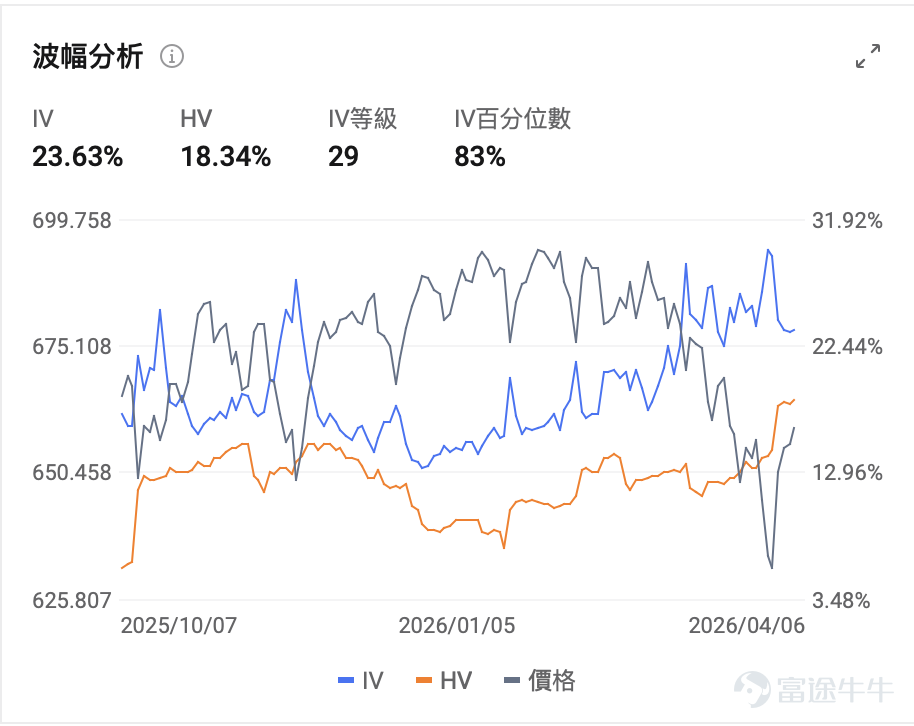
From a technical perspective,The current stock price is $50.78 (close on April 6), with a cumulative increase of 17.74% over the past five trading days, showing strong upward momentum in the short term, and the moving average system is in a bullish alignment. The MACD remains bullish but momentum has weakened, with trading volume significantly increasing recently, exceeding $6 billion in daily turnover within the week. In the short term, support lies in the range of $47-48, while resistance levels are at the previous high of $54.6 and the psychological level of $55. Short-term profit-taking due to overbought conditions is likely, resulting in probable consolidation, but the medium-to-long-term uptrend remains intact, with opportunities after a pullback.
Overall, positive news about capacity pricing increases and buybacks has driven Intel’s long-term outlook, although it faces some earnings lulls and pressure from overbought corrections in the short term. Rather than agonizing over whether to sell the stock to realize gains, investors could lower their cost basis by collecting option premiums. If the stock rebounds to the option strike price, they can then sell the shares.
Cash Secured Put – The 'Fishing Master' of building positions at lower prices
Applicable Scenarios:You have idle US dollars and want to buy your desired stock at a certain psychological price point, but you think the current price is too high, or you're willing to wait for the market to offer a better discount.
Attention:Ensure the account holds sufficient cash as collateral to avoid forced liquidation due to insufficient funds; avoid selling put options when the underlying asset is about to release significant negative news (such as an earnings shock) to prevent being forced to buy the underlying asset at a higher-than-market price.
Intraday strategy example:
For example, sell 1 contract $SanDisk (SNDK.US)$20260417 610.00P, estimated margin requirement:$61000($610 × 100)
![[Cool Guy]While most investors are reveling in the high leverage of options buying, the real 'smart money' is quietly collecting time value.In this issue, we focus on two core selling strategies: covered calls and cash-secured puts,teaching you how to enhance returns by 'selling options' in a high-volatility market. Market Barometer: Current range-bound market making it hard to profit? — The 'golden window' for selling strategies. The recent US stock market has been somewhat 'stuck in limbo,' particularly tormenting: – Strong economy but high interest rates.:Last Friday, the US March non-farm payroll exceeded expectations; the economy isn't in recession, but inflation remains volatile, causing repeated delays in Federal Reserve rate cuts.,Higher interest rates will persist for longer.。 – Geopolitical tensions high, volatility elevated:The situation in the Middle East is tense, with oil prices surging.Market anxiety is high.The VIX index has remained at elevated levels above 20.high volatility but no clear direction,the S&P 500 is stuck in a choppy range near the 6600 level, with unpredictable developments in the Middle East. As of April 6, 2026, $SPDR S&P 500 ETF (SPY.US)$ the implied volatility (IV) percentile for options stands at 83%.For options traders, high IV means that option premiums (time value) are relatively expensive. In the current market environment, where the direction of US stocks is hard to predict and holding stocks carries the risk of pullbacks, selling options can be used inversely by taking advantage of 'time as a friend'.By simply holding stocks or preparing cash and selling out-of-the-money Calls/Puts, you can immediately receive premiums. Even if the stock price moves sideways, Th...](https://nnqimage.futunn.com/sns_client_feed/900090/20260407/web-1775546649174-G43K5MsL3I.jpeg/big?area=1&is_public=true&imageMogr2/ignore-error/1/format/webp)
Suitable for: Those with ample cash who believe in the storage investment thesis but don’t want to chase highs.
– Operating logic:Use idle funds as collateral and sell put options.
- Strategy Advantages:
Hedge against depreciation:$1230 in gains generated over 11 days, with an annualized return rate as high as 70.01%, putting idle cash to work.
Overcoming 'acrophobia': Instead of agonizing over whether to buy now, set a lower purchase price than the current one (buy SNDK at $610). If the stock falls to this level, it’s cheaper than buying directly; if it doesn’t fall, you still earn the premium.
- Profit and Loss Analysis:
![[Cool Guy]While most investors are reveling in the high leverage of options buying, the real 'smart money' is quietly collecting time value.In this issue, we focus on two core selling strategies: covered calls and cash-secured puts,teaching you how to enhance returns by 'selling options' in a high-volatility market. Market Barometer: Current range-bound market making it hard to profit? — The 'golden window' for selling strategies. The recent US stock market has been somewhat 'stuck in limbo,' particularly tormenting: – Strong economy but high interest rates.:Last Friday, the US March non-farm payroll exceeded expectations; the economy isn't in recession, but inflation remains volatile, causing repeated delays in Federal Reserve rate cuts.,Higher interest rates will persist for longer.。 – Geopolitical tensions high, volatility elevated:The situation in the Middle East is tense, with oil prices surging.Market anxiety is high.The VIX index has remained at elevated levels above 20.high volatility but no clear direction,the S&P 500 is stuck in a choppy range near the 6600 level, with unpredictable developments in the Middle East. As of April 6, 2026, $SPDR S&P 500 ETF (SPY.US)$ the implied volatility (IV) percentile for options stands at 83%.For options traders, high IV means that option premiums (time value) are relatively expensive. In the current market environment, where the direction of US stocks is hard to predict and holding stocks carries the risk of pullbacks, selling options can be used inversely by taking advantage of 'time as a friend'.By simply holding stocks or preparing cash and selling out-of-the-money Calls/Puts, you can immediately receive premiums. Even if the stock price moves sideways, Th...](https://nnqimage.futunn.com/sns_client_feed/900090/20260407/web-1775546649153-WaxFezG3F9.jpeg/big?area=1&is_public=true&imageMogr2/ignore-error/1/format/webp)
![[Cool Guy]While most investors are reveling in the high leverage of options buying, the real 'smart money' is quietly collecting time value.In this issue, we focus on two core selling strategies: covered calls and cash-secured puts,teaching you how to enhance returns by 'selling options' in a high-volatility market. Market Barometer: Current range-bound market making it hard to profit? — The 'golden window' for selling strategies. The recent US stock market has been somewhat 'stuck in limbo,' particularly tormenting: – Strong economy but high interest rates.:Last Friday, the US March non-farm payroll exceeded expectations; the economy isn't in recession, but inflation remains volatile, causing repeated delays in Federal Reserve rate cuts.,Higher interest rates will persist for longer.。 – Geopolitical tensions high, volatility elevated:The situation in the Middle East is tense, with oil prices surging.Market anxiety is high.The VIX index has remained at elevated levels above 20.high volatility but no clear direction,the S&P 500 is stuck in a choppy range near the 6600 level, with unpredictable developments in the Middle East. As of April 6, 2026, $SPDR S&P 500 ETF (SPY.US)$ the implied volatility (IV) percentile for options stands at 83%.For options traders, high IV means that option premiums (time value) are relatively expensive. In the current market environment, where the direction of US stocks is hard to predict and holding stocks carries the risk of pullbacks, selling options can be used inversely by taking advantage of 'time as a friend'.By simply holding stocks or preparing cash and selling out-of-the-money Calls/Puts, you can immediately receive premiums. Even if the stock price moves sideways, Th...](https://nnqimage.futunn.com/sns_client_feed/900090/20260407/web-1775546649143-Pq9P2f7bdW.jpeg/big?area=1&is_public=true&imageMogr2/ignore-error/1/format/webp)
- News and Technical Analysis:
On the news front,On March 26, SanDisk plummeted over 11% in a single day following Google's announcement of a KV cache compression algorithm with zero loss. The entire storage sector suffered heavy losses. However, the company’s fundamentals remain strong, with its Q2 2026 earnings report surpassing expectations across the board. Explosive demand from AI data centers, rising NAND flash memory prices, and optimized product mix are driving high growth. On an industry level, Samsung announced another 30% price hike for DRAM in Q2 (both HBM and general products), extending the super cycle in storage. The company’s stock has resumed its upward trajectory in recent sessions. Overall, the news is long-term positive but short-term volatility has increased, while the core AI storage narrative remains intact.
From a technical perspective,The current share price is $724.63 (closing price on April 6), having surged over 200% since the beginning of 2026, placing it firmly in an uptrend channel. Between late March and early April, the stock experienced violent fluctuations. The MACD shows signs of reverting to positive territory, with strong support near the 30-day moving average at $650. Resistance levels are observed at the previous high of $777.6 and the psychological thresholds of $780-$800. In the short term, due to significant prior gains and intense bulls vs. bears tug-of-war, the stock is likely to remain range-bound at elevated levels.
Overall, backed strongly by the AI storage cycle, product price increases, and robust earnings growth, SanDisk’s long-term logic is relatively clear. However, in the short term, it has been significantly affected by negative news regarding Google's algorithm updates. Rather than chasing the upside, it may be better to sell out-of-the-money put options around the support zone to collect premiums and make idle funds work. Even if the price falls to lower levels, one can build positions at a lower cost.
Risk control tips
Although the seller strategy has a high probability of success, investors must still manage risks effectively:
– Position management is key:The biggest risk for sellers lies in black swan events. It is recommended thatNo more than 20% of total capital should be allocated as margin for any single position. Never sell options beyond your capacity to handle them just for the sake of greedy premium collection.
– Timely rolling of covered call options:When the covered call option becomes deeply in-the-money (stock price far exceeds strike price),if you remain bullish on the underlying stock, you should decisively 'roll' the position— that is, buy to close the current option while simultaneously selling an option with a further expiration date and a higher strike price, avoiding the forced liquidation of the underlying stock at a low price.
– Cash-secured put options warn of 'left-tail risk':For cash-secured puts,If the stock price crashes due to deteriorating fundamentals (rather than a normal pullback),Don't hold on stubbornly.At this point, it's advisable to cut losses or 'roll down' to gain time, waiting for volatility to normalize.
Case Selection Criteria
Open Futubull >> Market >> Options >> Seller Zone >> Filter; Common screening criteria for Cash Secured Put and Covered Call strategies: IV Percentile > 40%; Total option volume > 60,000 contracts; Days to expiration 0-45 days; Daily option volume/open interest > 500 contracts; ROI > 2%; Annualized ROI > 30%. Cash Secured Put: OTM Probability > 60%; Covered Call: OTM Probability > 70%;
Underlying selection rule: For each strategy, select the underlying asset with the highest probability of profit. Probability refers to the likelihood that the option contract will not be exercised, i.e., the out-of-the-money probability. The higher the probability, the lower the chance of assignment, and the greater the likelihood of earning steady option premiums. Data source: Futubull, information as of the closing price of the previous trading day; All data and information in the Option Seller Zone are for reference only and do not constitute any investment advice.
Finally, Futu News brings a small perk for fellow investors. Fellow investors are welcome to claim it.Options Beginner Pack*This event is exclusive to invited HK users. Click to learn more.Detailed event rules>>
Market conditions are complex and volatile,Options strategyOverwhelmed by choices? Futubull helps you build a portfolio in three steps.Options strategymaking investing simple and efficient from now on!![[Cool Guy]While most investors are reveling in the high leverage of options buying, the real 'smart money' is quietly collecting time value.In this issue, we focus on two core selling strategies: covered calls and cash-secured puts,teaching you how to enhance returns by 'selling options' in a high-volatility market. Market Barometer: Current range-bound market making it hard to profit? — The 'golden window' for selling strategies. The recent US stock market has been somewhat 'stuck in limbo,' particularly tormenting: – Strong economy but high interest rates.:Last Friday, the US March non-farm payroll exceeded expectations; the economy isn't in recession, but inflation remains volatile, causing repeated delays in Federal Reserve rate cuts.,Higher interest rates will persist for longer.。 – Geopolitical tensions high, volatility elevated:The situation in the Middle East is tense, with oil prices surging.Market anxiety is high.The VIX index has remained at elevated levels above 20.high volatility but no clear direction,the S&P 500 is stuck in a choppy range near the 6600 level, with unpredictable developments in the Middle East. As of April 6, 2026, $SPDR S&P 500 ETF (SPY.US)$ the implied volatility (IV) percentile for options stands at 83%.For options traders, high IV means that option premiums (time value) are relatively expensive. In the current market environment, where the direction of US stocks is hard to predict and holding stocks carries the risk of pullbacks, selling options can be used inversely by taking advantage of 'time as a friend'.By simply holding stocks or preparing cash and selling out-of-the-money Calls/Puts, you can immediately receive premiums. Even if the stock price moves sideways, Th...](https://nnqimage.futunn.com/sns_client_feed/900090/20260407/web-1775547064222-Yw3MFHPqok.webp/big?area=1&is_public=true&imageMogr2/ignore-error/1/format/webp)
Options Risk Warning
An option is a contract that grants the holder the right, but not the obligation, to buy or sell an asset at a fixed price on a specific date or at any time before that date. The price of an option is influenced by various factors, including the current price of the underlying asset, the strike price, time to expiration, and implied volatility. Implied volatility reflects the market’s expectations for the level of volatility in the option over a future period. It is a data point derived inversely from the Black-Scholes option pricing model and is generally regarded as an indicator of market sentiment. When investors anticipate greater volatility, they may be more willing to pay a higher price for options to hedge risks, resulting in higher implied volatility. Traders and investors use implied volatility to assess the attractiveness of option prices, identify potential mispricings, and manage risk exposure.
Disclaimer
This content does not constitute any offer, solicitation, recommendation, opinion, or guarantee of any securities, financial products, or tools. The risk of loss in trading options can be substantial. In some cases, losses may exceed the initial margin deposited. Even if you set contingent orders such as 'stop-loss' or 'limit' orders, these may not prevent losses. Market conditions may make such orders unexecutable. You may be required to deposit additional margin within a short period. If you fail to provide the required amount within the specified time, your open positions may be liquidated. However, you will still be responsible for any shortfall in your account. Therefore, before trading, you should study and understand options and carefully consider whether such trading is suitable for you based on your financial situation and investment objectives. If you trade options, you should be familiar with the procedures for exercising options and the rights and obligations upon exercise and expiration. Options trading carries extremely high risks and is not suitable for all investors. Investors should carefully readCharacteristics and Risks of Standardized Options。
Editor/Doris
Risk Disclaimer: The above content only represents the author's view. It does not represent any position or investment advice of Futu. Futu makes no representation or warranty.Read more


Comments (2)
to post a comment
35
28