
The US-Iran peace talks present conflicting narratives! What’s next for oil prices?

Tengsi's Last Week Insights | US-Iran Situation Reverses! What’s the Outlook for the Bull Market?
Market Dilemmas Amidst Rising Tensions
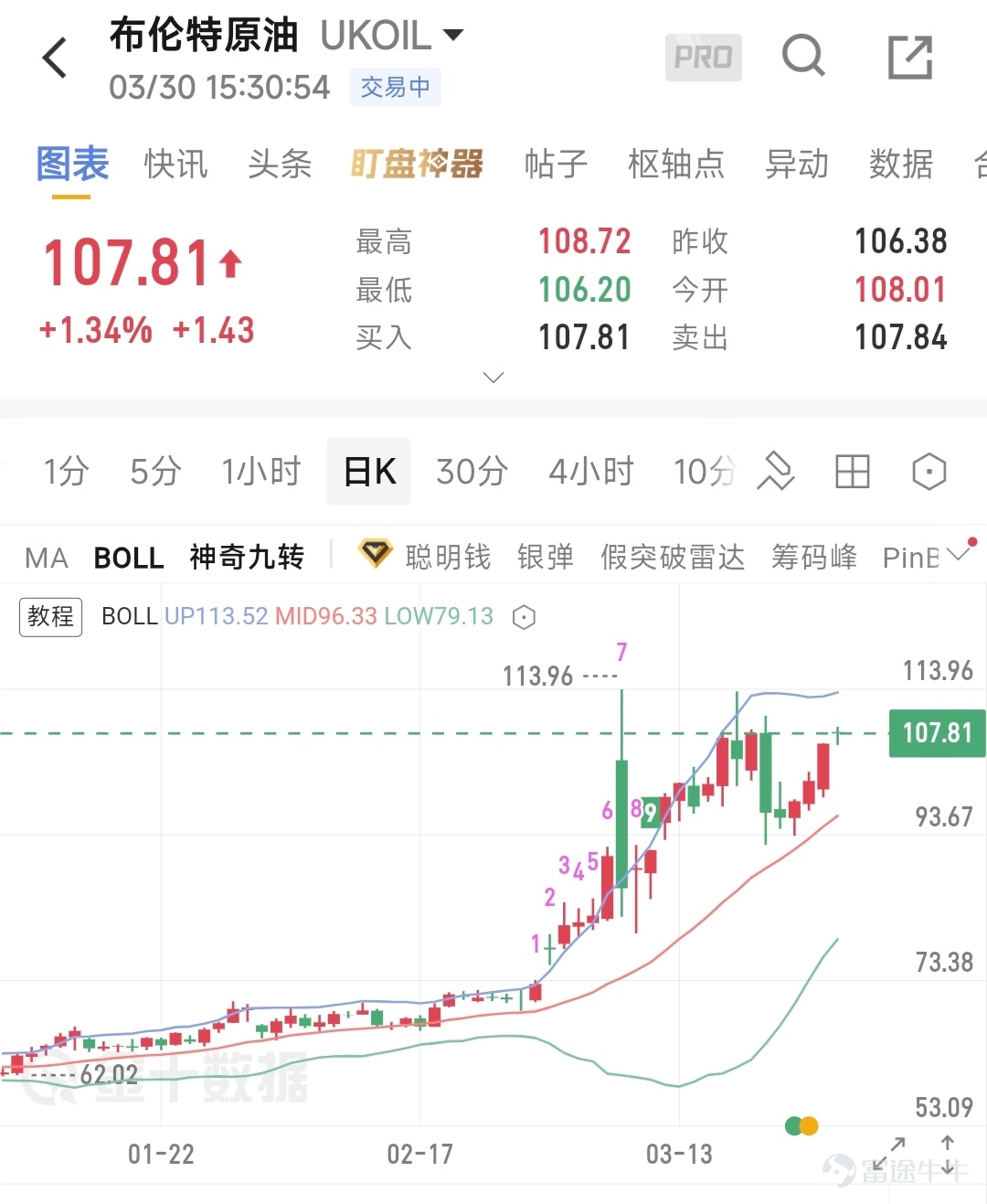
As Brent crude oil prices breached the psychological threshold of $100 per barrel, and gold prices violently fluctuated near the historic high of $4,600, global investors are navigating a turbulent period shrouded by geopolitical clouds. The unpredictable situation between the US and Iran, statements from the Trump administration about targeting Iran’s energy infrastructure, and market sentiment swinging between hopes for a ceasefire and fears of war risks have collectively created an investment landscape filled with high uncertainty.
Quantitative Global Multi-Asset ETF Strategy Fund Manager at Gaoteng InternationalGavin@高騰國際 GavinIn the latest internal discussion, he provided an in-depth analysis of the current market situation. He acknowledged this as a classic“news-driven market”— where investor sentiment swings dramatically with every headline, and asset prices no longer merely reflect fundamentals but are pushed to extremes by the pendulum of fear and greed.
Oil Prices at the $100 Mark: Feast or Trap?
The crude oil market is undoubtedly the core battleground of this geopolitical storm. Behind Brent crude's breakthrough above $100 lies deep market concerns over potential supply disruptions in the Middle East. Gavin pointed out that,Oil prices and energy stocksAlreadyhave priced in a significant portion of therisks brought by war,risk premium,and may continue to maintain avolatile high-levelpattern.
"If oil prices really do$100AboveContinue running"Energy stocks will indeed benefit from improved earnings expectations in the short term," Gavin analyzed, "but investors must remain vigilant.""High oil prices erode demand"The reflexivity effect." When oil prices are too high, global economic growth will inevitably be dragged down, which in turn suppresses crude oil demand. This is an unavoidable economic law.
Gavin particularly emphasized that the United States and other non-oil exporting countries do not wish to see oil prices too high. Considering that the U.S. is facing midterm elections this year, the rising inflation expectations will force the Federal Reserve to reduce the number of rate cuts, fiscal spending pressures will intensify, and it may even fall into a stagflation predicament.Washington has ample motivation to vigorously suppress oil prices.。
For investors looking to participate in the energy sector, Gavin agrees with the view of phased allocation to upstream exploration and production ETFs, but cautions against chasing highs. Meanwhile, sectors highly sensitive to oil prices, such as airlines and chemicals, should be firmly avoided.If you already hold crude oil-related products, you can continue to hold them, but avoid chasing highs or adding positions. Gradually reduce crude oil-related positions as the conflict develops.

Source: Jinshi Data
Gold Falters: The Dimming Moment of the Safe-Haven Halo
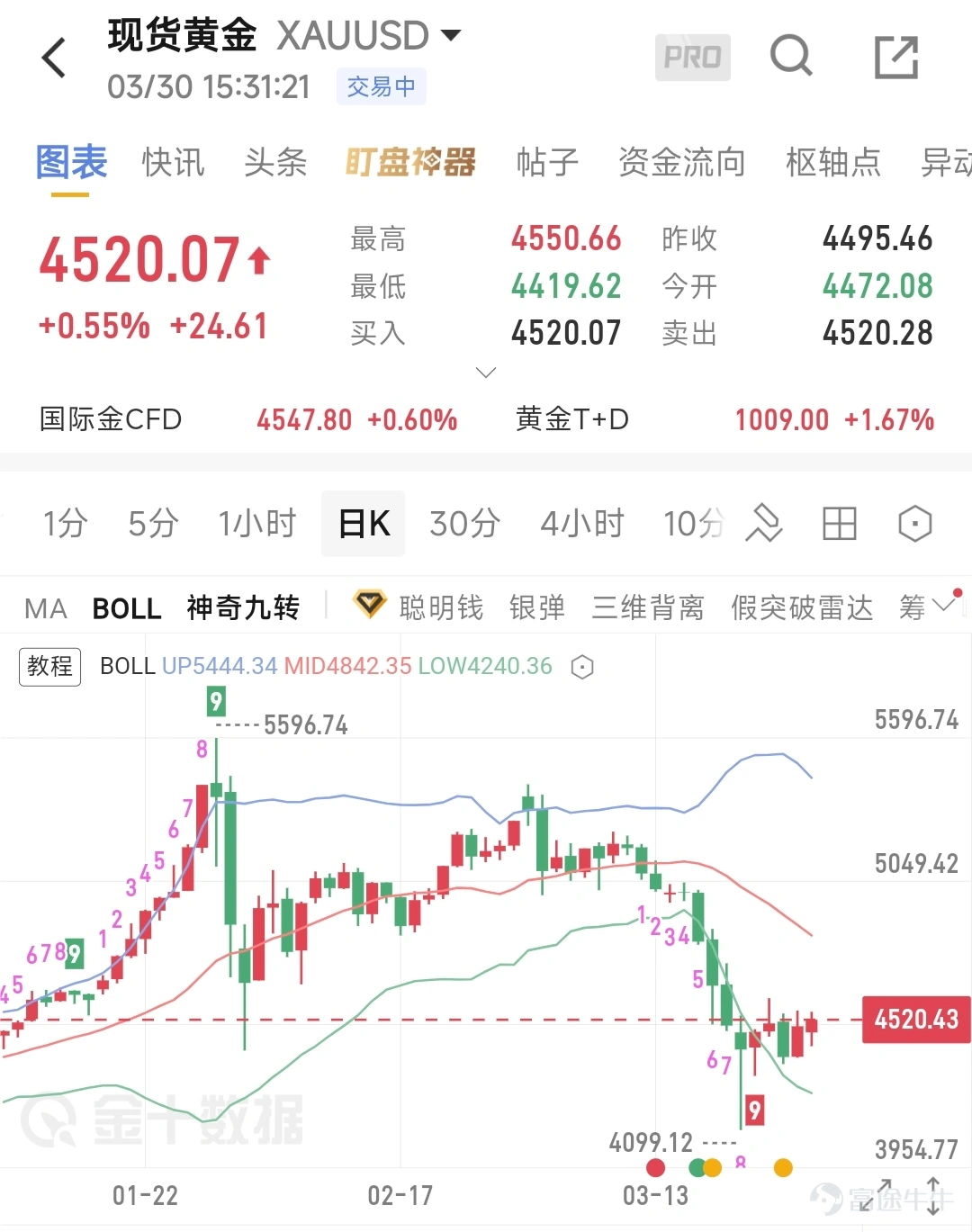
Contrary to conventional wisdom, gold has not played its expected safe-haven role in this round of US-Iran-Israel tensions. Although the gold price briefly broke through $4,600, it soon retreated, showing clear signs of overheating. Gavin explained that gold's failure this time is due to a combination of factors: inflation expectation pressures, persistently high real interest rates, a strong dollar, excessive accumulation of profit-taking positions from earlier gains, and crowded trading conditions.If the CFTC non-commercial net long position ratio exceeds 35%, and SPDR Gold ETF holdings diverge from price,, these are all signals that require vigilance.Overheating signals。
‘$4,600 is already an extreme high. If there’s a surge followed by a pullback due to geopolitical triggers, there will be a short-term technical adjustment need.’ Gavin frankly stated that at this stage, holding a large position in gold is not advisable.‘Waiting for a turning point in oil prices may present a better entry opportunity.’
However, Gavin also noticed a subtle shift:Last Friday, gold did not follow other risk assets in falling, which might suggest that the market focus isshifting from geopolitical conflicts to macro narratives of recession or even stagflation.Investors need to closely track market changes and oil price trends, flexibly adjusting their portfolios.
Source: Jinshi Data
Survival Rules in a News-Driven Market: The Art of Defense Amid Volatility
Facing the current characteristics of a 'news-driven market,' Gavin proposed a systematic response framework. The primary principle isto reduce portfolio volatility,compressing single position exposure to 60% to 70% of normal levels. This is not a passive retreat but a way to preserve strength amid the storm.
"It is still more appropriate to mainly hold cash and short-term bonds for now,"Gavin repeatedly emphasized this core viewpoint. This defensive stance should not be easily changed until the situation becomes clear. If the situation escalates sharply, referring to the trend during the 2019 Persian Gulf crisis, global stock markets may pull back by 8% to 15%. At that time, the direction of allocation adjustment should be increasing exposure to 10-year US Treasuries, US dollar cash, and gold; reducing allocations to emerging markets, European stocks, and cyclical sectors.
"If the situation escalates, there may still be room for the stock market to fall, butthe market may also start pricing in a recession." Gavin reminded,it is impossible to predict the exact magnitude of the market decline at this point,but if the market starts pricing in a recession or stagflation,there is still room for the stock market to decline.。
Key Timing: Strategic Choices on April 6th and 9th
Trump previously announced that the date for striking Iran's energy infrastructure has been postponed toEastern Time April 6at 8:00 PM, and April 9 is also considered another key timing node by the market. How should investors position themselves around these time points?
Gavin provided a clearEastern Time strategy:
Before April 6, maintain a defensive stance and increase cash holdings to 30%-40%; between April 6 and 9, if news flow remains stable,试探性 positions can be taken in oversold assets with small capital; after April 9, decide on increasing positions based on how clear the situation becomes.
“At this time, one should observe more and act less, holding cash and watching,”Gavin reiterated,“Do not chase highs in oil-related products.”Before major uncertainties are resolved, patience is more valuable than impulsive action.
The interest rate dilemma under the shadow of stagflation
If persistently high oil prices lead to a 'second acceleration' in U.S. inflation, the Federal Reserve may extend the period of high interest rates and could delay rate cuts until the second half of 2026. In this scenario,U.S. dollar money market fundsyields will remain in the range of3.75% to 4%for an extended period, offering considerableallocation value。
The yield on money market funds will stay elevated for some time due to these factors, unless the conflict eases and inflation is brought under control; only then will there be a noticeable decline in interest rates, causing money market fund yields to fall further," Gavin explained.
In a high-interest-rate environment, which is better: money market funds or bond funds? Gavin’s answer is clear:Money market fundsdue to their strong liquidity, lack of duration risk, and yields linked to short-term interest rates,have more advantages in the current environmentBond funds should only be considered for allocation after the 10-year US Treasury yield breaks through 4.8%.
"Currently, money market funds and short-term bonds are still safer,"Gavin advised,"Wait for the conflict to ease before considering long-term bond products."
Different investors' coping strategies
For conservative investors, Gavin offered concise and powerful advice:"It is not advisable to try to catch the bottom; the current uncertainty premium is too high."He suggested that conservative investors maintain over 50% of their portfolio in cash or money market funds, waiting for the situation to become clearer or for the VIX to fall below 20 before gradually building positions."Hold cash, watch more and act less."This is the best strategy for this type of investor.
For investors who already hold gold or energy-related assets, Gavin suggeststo maintain a core position in gold, but take profits on 50% of the gains; for the energy sector, it is recommended to keep upstream assets and consider taking profits on mid- and downstream refining-related investments.Investors who already own gold can consider maintaining a certain position; those holding energy-related assets may consider either continuing to hold or reducing their positions—it is not advisable to add more.
The next step for global multi-asset quantitative ETF strategies
Discussing the operational approach for the next three months regarding the global multi-asset quantitative ETF strategy he manages, Gavin stated that currentlya possible strategyis to reduce volatility, increase momentum factor weighting, overweight energy, utilities, and healthcare, underweight technology and discretionary consumption; geographically, increase allocation to the US and decrease exposure to Europe and emerging markets. 'By controlling the position size, we aim to reduce strategy volatility,and opportunistically increase exposure to sectors that have seen larger declines.。」
If an extreme scenario occurs — the prolonged closure of the Strait of Hormuz causing an oil price shock between $120 to $150 — what role will money market funds play in a cash enhancement portfolio strategy?
Gavin believes that money market funds will serve as liquidity anchor assets, providing stable returns while remaining readily available to capture oversold opportunities. In this scenario,the yield of US dollar money market funds canrise further to 4% to 5%, making them"safe havens + yield enhancers"playing a dual role.
「Money market fundshave always been the core allocation in cash enhancement portfolios and one of the primary sources of income for the portfolio, serving asa great stabilizerin the current environment of extreme market volatility," Gavin concluded.
Epilogue: Waiting for Dawn in the Midst of Chaos
The evolution of the US-Iran situation remains unpredictable, and market volatility is far from over. Gavin’s insights provide investors with a clear navigation map: maintain a defensive stance amidst the storm, using cash and short-term bonds as a shield, patiently waiting for clarity; cautiously observe around key时间节点前后謹慎觀察,不貿然出擊;對於已持有的能源頭寸,順勢而為但不貪戀。
“Uncertainty is the eternal backdrop of the market,” Gavin concluded, “but we can choose to focus on what we can control within that uncertainty—managing position sizes, maintaining liquidity, and adhering to discipline. When the dust settles, opportunities will naturally emerge.”
In this volatile spring, perhaps the best investment strategy is learning to wait.
![Last week’s focus:[Share Link: Tensix·This Week's Market Focus | US-Iran Tensions Flaring Up! Is the Oil Price Rally Not Over Yet?] Market Dilemmas Amidst Rising Tensions As Brent crude oil prices breached the psychological threshold of $100 per barrel, and gold prices violently fluctuated near the historic high of $4,600, global investors are navigating a turbulent period shrouded by geopolitical clouds. The unpredictable situation between the US and Iran, statements from the Trump administration about targeting Iran’s energy infrastructure, and market sentiment swinging between hopes for a ceasefire and fears of war risks have collectively created an investment landscape filled with high uncertainty. Quantitative Global Multi-Asset ETF Strategy Fund Manager at Gaoteng InternationalGavin@高騰國際 GavinIn the latest internal discussion, he provided an in-depth analysis of the current market situation. He acknowledged this as a classic“news-driven market”— where investor sentiment swings dramatically with every headline, and asset prices no longer merely reflect fundamentals but are pushed to extremes by the pendulum of fear and greed. Oil Prices at the $100 Mark: Feast or Trap? The crude oil market is undoubtedly the core battleground of this geopolitical storm. Behind Brent crude's breakthrough above $100 lies deep market concerns over potential supply disruptions in the Middle East. Gavin pointed out that,Oil prices and energy stocksAlreadyhave priced in a significant portion of therisks brought by war,risk premium,and may continue to maintain avolatile high-levelpattern. "If oil prices really do$100AboveContinue runningEnergy stocks will indeed benefit in the short term from improved profit expectations," Gavin noted...](https://nnqimage.futunn.com/sns_client_feed/12486530/20260330/web-1774861734456-TwejppMsgf.png/big?area=1&is_public=true&imageMogr2/ignore-error/1/format/webp)
Risk Disclaimer: The above content only represents the author's view. It does not represent any position or investment advice of Futu. Futu makes no representation or warranty.Read more

Comments
to post a comment
2