US launches "economic offensive" against Iran; will oil prices see renewed volatility?

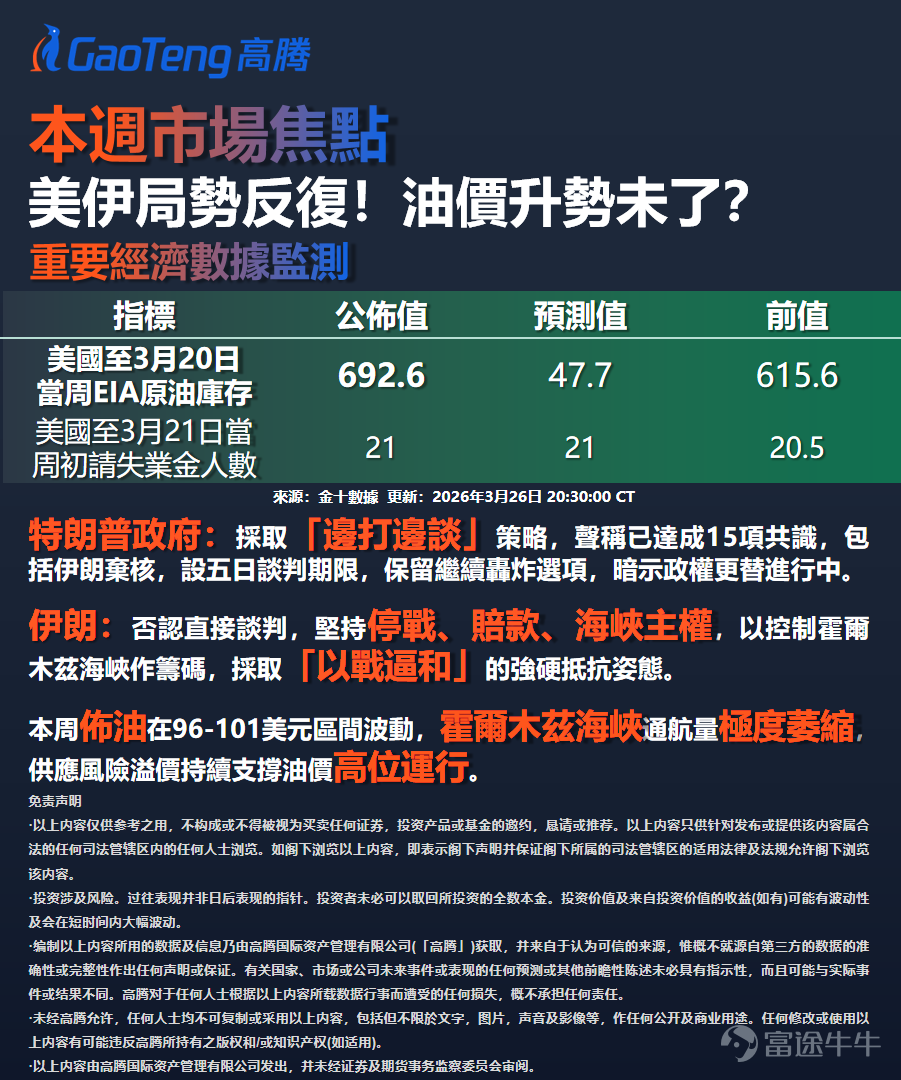
Tensix·This Week's Market Focus | US-Iran Tensions Flaring Up! Is the Oil Price Rally Not Over Yet?

The Trump Administration’s Maximum Pressure Campaign
The Trump administration demonstrated in this US-Iran conflict a"Fight and negotiate simultaneously, using conflict to force peace"composite strategy, aiming to securenegotiating leverage with Iran throughmilitary pressure to gainthe upper hand. He has repeatedly publicly claimed that "Iran wants to reach an agreement", attempting toShapeThe US takes the initiative,Iran passively seeks peacethe image of.
In specific demands, the US has demonstrated three core objectives: First,Zero nuclear capability—Demanding Iran dismantle its existing nuclear facilities, halt all uranium enrichment activities, and have the US 'take over' the already enriched uranium stockpile; second,Economic blockade—Explicitly stating “Do not imagine Iran will receive any income from any oil-related fields,” aiming to cut off Iran’s economic lifeline; third,Geopolitical control—Proposing co-management of the Strait of Hormuz with the US, presenting it as a 'big gift' from Iran.
Trump is highly optimistic about the prospects of the war, evenClaiming 'This war has already been won'and 'The US military has freedom of movement above Tehran.' He hinted that 'regime change' is underway, stating that Iran no longer has effective leadership. However, he set a five-day negotiation deadline while reserving the option to 'continue bombing if talks fail',using maximum pressure to secure maximum concessions。
Notably, domestic attitudes in the US toward the war are divided. Republican lawmakerNancy Maceangrily walked out of the war briefing,vowing to reject additional war fundingand questioned, 'Which war have we won in the past 70 years?' Such internal fractures could constrain the Trump administration's military options.
Iran’s stance towards the US and the war
In response to US pressure, Iran has adopted'Externally relaxed but internally tight, using war to force peace'denying negotiations, rejecting unilateral solutions, and insisting on resistance to the end.
Iran’s top decision-making level repeatedly emphasized that 'there have been no direct or indirect negotiations between the US and Iran,' while the Foreign MinisterAlagzhiclearly stated 'through mediatorsthrough mediatorsanddoes not implyengaging in negotiationswith the United States”。Iran's Ambassador to Japanfurther pointing out that 'the US cannot unilaterally impose a peace plan on Iran,' stressing that 'unilateral imposition is unacceptable'". This statement is both a political response domestically and a negotiation strategy internationally.
On the battlefield level, Iran has shifted from defense to offense. The Revolutionary Guard claimed 'full control over the Strait of Hormuz' and warned that 'if the enemy takes ground action, other fronts will be opened.'IranAlso proposed for the first timeCorrectVessels passing through the straitwill be charged a toll, attempting to monetize its geopolitical advantage.
Iran's ceasefire conditions are stringent and clear, hoping for a completeend to aggression and assassinations, ensuring the war does not recur,war reparationsAll fronts and resistance organizations have ended the warApprovalIran’s stance on the Strait of HormuzSovereignty. Among these, 'war reparations' and 'recognition of strait sovereignty' are core demands, indicating Iran's attempt to turn military resistance into political and legal gains.
Pakistani officials revealed,Iran harbors 'enormous distrust' towards the USand is uncertain about reaching an agreement. This distrust stems from the precedent of the US unilaterally withdrawing from the Iran nuclear deal in 2018, andwhich keeps Tehran wary of any 'Trump-style agreements'。
Possible future developments
– Limited agreement reached
Both parties may reach a temporary ceasefire agreement under the mediation of multiple parties, including Pakistan. The US might suspend bombings in exchange for Iran freezing its nuclear activities, while Iran could open the Strait of Hormuz in return for partial sanctions relief.However, such an agreement would be unstable and fragile, akin to 'a ceasefire rather than peace'.
– Prolonged conflict
If Iran insists on its 'five key conditions' and the US refuses to compromise, the conflict may escalate to the nextprolonged low-intensityphase. Iran will continue to harass US military presence in the Middle East through its proxy network, while the US maintains a dual-track pressure strategy of 'targeted eliminations' and sanctions. Traffic through the Strait of Hormuz has plummeted over 90% compared to pre-war levels, and if this situation persists for months, it will undoubtedly have significant repercussions.trigger a global energy crisis。
– Escalation of tensions
IfTrump administrationReally deploy ground forcesCapture Khark Island, orIsraelSuccessAssassinationIran's coreLeader, the conflict could escalate sharply. Iran has warned it will attack key facilities in Middle Eastern countries hosting US military bases, which may draw Saudi Arabia, the UAE, and others into aRegional war。
– Key time node
The 'five-day deadline' set by Trump
The rumored US target end date of April 9
Possible decision window for a ground invasion over the weekend
The next 48-72 hours will be decisive.
Market movements this week
– Fluctuating conditions drive gold prices to spike then retreat
On March 25, the gold price reached a high of $4,602.49, reflecting extreme uncertainty over US-Iran negotiations. However, as Trump released optimistic signals, the gold price retreated from its peak, indicating profit-taking by risk-averse buyers. This sharp volatility confirms the characteristics of a 'news-driven market'—Investor sentiment swings back and forth between 'hope for a ceasefire' and 'war risks'。
– Risk premium supports Brent crude oil in stabilizing
On March 24, oil prices briefly broke through the $101 mark. Despite pulling back later, they rebounded above $98 on March 25, showing that concerns over potential supply disruptions in the Strait of Hormuz have not dissipated. The Iranian Revolutionary Guard Corpscontrols the strait and plans to impose tollsThe news provided solidOil pricesProvided solid support.SupportIf a ground invasion were to break out over the weekend, oil prices might once again surge towards previous highs.
– Haven demand supports the strengthening of the US dollar.
US dollarapproaching the key resistance level of 99.665 on March 25th. This movement reflects typical'safe-haven currency'characteristics — when geopolitical risks rise, global funds flow into US dollar assets. Additionally, stronger-than-expected US January PPI and renewed inflation concerns have also provided fundamental support for the dollar. If the US-Iran conflict escalates, the dollar may test the 100 mark; if an agreement is reached, the dollar might retrace its gains.


Risk Disclaimer: The above content only represents the author's view. It does not represent any position or investment advice of Futu. Futu makes no representation or warranty.Read more


Comments
to post a comment
4
1