
Circle plunges! Draft provisions of the CLARITY Act revealed

Rumors about the CLARITY Act triggered a plunge! Circle plummeted by 20%, what’s next and how should we position ourselves?
While the market was still basking in optimism over the easing of tensions in the Middle East, the US stock crypto sector faced an unexpected sell-off on March 24. Stablecoin giant $Circle (CRCL.US)$ plunged 20%, $Coinbase (COIN.US)$ also saw a significant drop, but the price of BTC did not fluctuate noticeably.
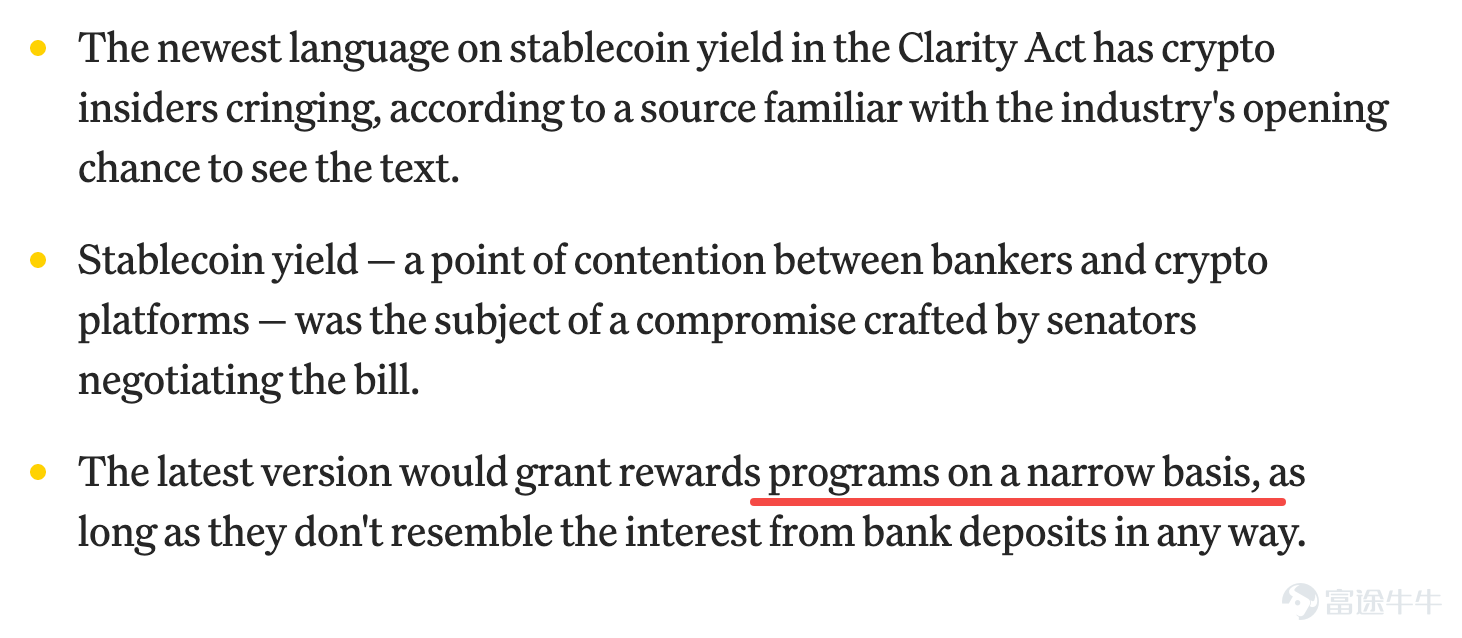
The trigger for all this was the latest developments in legislative maneuvering surrounding the US Digital Asset Market Clarity Act (hereinafter referred to as the CLARITY Act).
Another twist in the red line for stablecoin returns?
The CLARITY Act was originally seen as the “stabilizing force” establishing the legal status of US stablecoins, but with rumors of the latest clause revisions,regulators imposed severe restrictions on stablecoin rewards and interest-bearing functions, causing market expectations to reverse by 180 degrees.。
According to reports from the Senate Banking Committee and Reuters, the deeper reason for the bill's legislative hurdles lies in strong lobbying from traditional banks. Banks are generally concerned that allowing stablecoin issuers to indirectly pay users interest through yield-generating products or reward programs would lead to large-scale deposit outflows, potentially destabilizing the financial system.
On March 24, the latest reports revealed that regulators are inclined to impose strict restrictions on interest-bearing rewards for stablecoins,which should not resemble bank deposit interest ratesThis implies that stablecoin issuers may be prohibited in the future from providing any form of interest compensation to ecosystem partners, distribution channels, or even their own users.

Why did Circle suffer the biggest drop?
Affected by these rumors, Circle's decline was significantly greater than that of Coinbase, reflecting the fundamental differences in their business models.
Circle is a highly elastic pure-play in stablecoins, essentially an 'interest margin-driven' company. According to its Q4 2025 earnings report, the surge in USDC circulation generated reserve revenue as high as $733 million.Circle’s growth logic heavily depends on the efficiency of USDC distribution and reserve interest.Once regulators cut off the pathway to stimulate distribution via 'yield rewards,' Circle’s growth engine will directly stall.
Moreover, the growth rate of USDC's circulation has recently shown signs of marginal slowdown, raising market concerns about its future growth potential. Circle's earnings report showed that the USDC circulation scale at the end of Q4 2025 was $75.3 billion; as of March 23, 2026,Circle's official website shows that the circulating supply of USDC is approximately $78.5 billion。
If we take a rough look at the end-of-quarter figures, the circulating supply of USDC grew by about 20.2% from the end of Q2 2025 to the end of Q3, but only increased by about 2.2% from the end of Q3 to the end of Q4. Since entering the first quarter of 2026, as of March 23, it has grown by about 4.2% compared to the end of 2025. This indicates that after experiencing a very strong expansion in the second half of 2025, the slope of supply growth for USDC has significantly slowed down. This does not mean that USDC has stopped growing, but rather that the 'continuously high-growth momentum' the market was accustomed to is starting to become less stable.

At the same time, the latest move by Tether, the largest issuer of stablecoins, has sparked market speculation. Tether announced that an accounting firm with a 'Big Four' background will conduct an audit covering assets, liabilities, and reserves. As the audit progresses and financing rumors heat up, the market has begun to trade on a possibility — if USDT significantly improves transparency in the future, or even moves toward more regulated capital operations, such as an IPO, Circle’s valuation logic as the 'only compliant and scarce asset' would be weakened.
If the market begins to suspect that the expansion of USDC's circulating supply is entering a deceleration phase, then Circle will transition from the logic of 'high growth + high interest rate double boost'to the logic of 'slower growth + rising policy uncertainty,'which naturally puts downward pressure on valuations.
Why is Coinbase relatively resilient?
From an investment perspective, although both Circle and Coinbase are affected by stablecoin policies, they should no longer be simply categorized as the same type of 'crypto concept stocks.' Circle is fundamentally closer to being a direct reflection of the regulatory benefits and flexibility of stablecoin systems, with its earnings and valuations highly correlated to the circulating supply of USDC. Coinbase, on the other hand, is a platform company whose business includes not just stablecoin revenue but also segments like spot trading, derivatives, custody, and subscription services.
In Q4 2025, Coinbase generated about $727 million in subscription and service revenue, of which approximately $364 million came from stablecoin-related income. Stablecoins have become an important buffer against trading cycle volatility, but they are not the entirety of Coinbase's business. This means that under the same policy news, Circle is more prone to valuation resets, while Coinbase resembles an asset that is 'short-term pressured but still dependent on mid-term cryptocurrency regulatory tailwinds.'
The former is suitable for event-driven trading, while the latter is better suited for medium-term positioning. What the market is now trading on is not just whether stablecoins will continue to grow, but whose business model can better withstand the triple pressures of tightening regulatory boundaries, changing competitive dynamics, and slowing growth trajectories.
Options Strategy: 'Limited Risk' is Currently More Suitable for Expressing Views
For options investors, the least suitable approach at this stage is to aggressively bet heavily on a single direction. The reason is simple: the legislative text has not been fully finalized yet, and Tether's audit progress introduces new competitive variables. Both Circle and Coinbase will continue to be driven by ongoing news developments. At this stage, what matters most is not 'how accurately you bet,' but 'don't get hurt too badly if you're wrong.'
1) If you believe that Circle's recent decline is an overreaction, consider a bull call spread.
Suitable for investors who think the market has prematurely priced in the most pessimistic scenario, and that the final legislative text may not be as severe as current rumors suggest. Specifically, it is more appropriate to use a bull call spread by buying a lower strike price call option while simultaneously selling a higher strike price call option, rather than directly purchasing a naked long Call. This approach retains upside potential while controlling option costs in the currently high volatility environment.
For Circle, this type of strategy is better suited for covering the next phase of legislative progress rather than betting on an extremely short-term horizon. This is because what impacts the stock price now is not a specific confirmed date, but continuous policy negotiations.

2) If you believe that slower USDC growth combined with tighter regulations could push Circle lower, consider a bear put spread.
Suitable for investors who think this sell-off has not fully reflected both fundamental and valuation pressures, especially as the market gradually realizes that USDC supply growth has slowed from its steep trajectory. In this case, instead of directly buying put options, it is more cost-effective to use a bear put spread.
Circle is more suitable than Coinbase for expressing directional views because it is more sensitive to the circulation scale of USDC, the boundaries of stablecoin rewards, and the premium associated with regulatory compliance, and its share price also exhibits higher elasticity.
3) If you remain optimistic about the gradual clarification of the U.S. crypto regulatory framework in the medium term, a multi-expiration strategy on Coinbase would be more appropriate.
Suitable for investors who believe short-term sentiment will fluctuate but are optimistic about platform-based infrastructure benefiting once regulations become clearer. In this scenario, Coinbase is more suitable than Circle for considering bullish calendar spreads or similar multi-expiration combinations—buying longer-dated call options while selling near-term options—to reduce the impact of near-term news-driven volatility on overall positions. The rationale is that while Coinbase’s stablecoin revenue is important, it is not everything; after regulatory clarity, its broader benefits will shine through.
4) For those who already hold Circle or Coinbase spot positions, protective strategies take higher priority.
For investors who already have spot positions, a more pragmatic approach at this stage is typically not to add leverage to average down but to first manage the tail risk.
More common methods include:
- Buying protective put options to add downside insurance to the holdings;
- Implementing a collar strategy, which involves holding the spot position while buying protective puts and selling out-of-the-money calls to partially hedge costs.
This strategy is particularly suitable for Circle holders because the uncertainties they face come not only from legislative clauses but also from possible valuation reassessments following increased transparency from Tether.

5) It is currently not advisable to prematurely adopt 'selling volatility' as the main strategy.
Although after policy disruptions, implied volatility of options tends to rise, making 'selling volatility' appear more profitable, such strategies currently carry significant risks. The reason is that information is still in a phase of heavy release, and stock prices could again experience gaps due to factors like bill text details, regulatory explanatory notes, and Tether audit progress. For most investors, it's now more prudent to prioritize strategies with limited directionality and controllable losses rather than exposing oneself to consecutive large fluctuations.
Ultimately, the recent declines of Circle and Coinbase are not merely due to sudden market concerns about the CLARITY Act; the stablecoin sector is simultaneously facing three issues: tightening regulatory boundaries, changing competitive dynamics, and a slowdown in growth trajectory. For Circle, these three factors combined have far greater destructive power than any single variable alone; for Coinbase, although it will also be affected, its mid-term logic remains more intact.
What the market is now concerned about is not just the room for stablecoin returns, but also re-pricing how much Circle's 'compliance scarcity' card is still worth. This is the core clue for judging the divergence between Circle and Coinbase stock prices going forward.
Risk Disclaimer: The above content only represents the author's view. It does not represent any position or investment advice of Futu. Futu makes no representation or warranty.Read more


Comments (9)
to post a comment
22
63