
Xiaomi announces a new HK$20 billion share buyback program—will the stock price get a boost?

Preview Infographic | Xiaomi's Earnings Report is Coming! Smartphone Gross Margin Faces Major Test; Automobiles and AI Remain Key Highlights
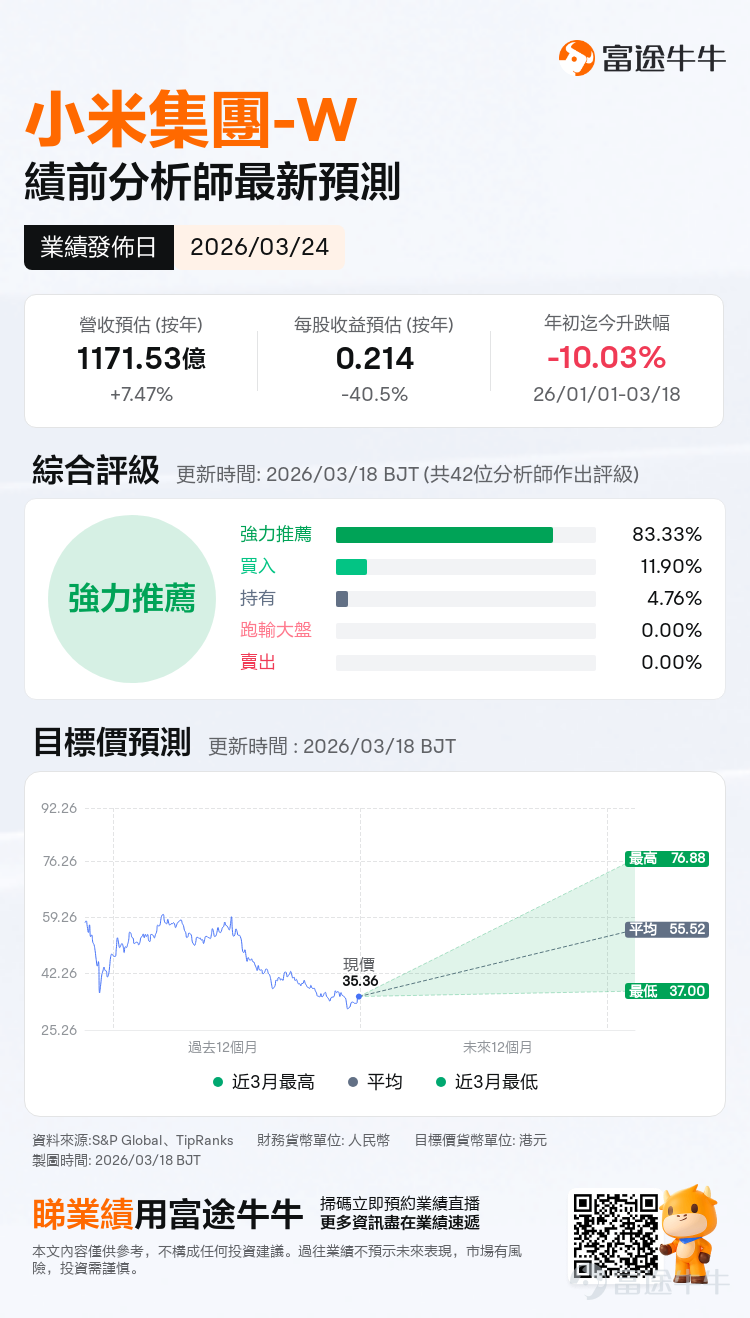
After almost consistently strong performance in the first three quarters, $XIAOMI-W (01810.HK)$ Xiaomi will release its Q4 2025 and full-year earnings on Tuesday, March 24. As the earnings announcement approaches, market focus has shifted from growth rates to quality, with attention centered on whether the decline in Q4's single-quarter profit margin is a short-term fluctuation or the beginning of a downward revision to the company’s 2026 profitability outlook.
In response to recent sustained pressure on its share price, Xiaomi's earnings report needs to address whether it can maintain the logic of parallel expansion across its 'smartphone + automobile + AI' core strategies amid rising smartphone costs, intensifying automotive competition, and increased AI investment.
Market expectations at a glance
Xiaomi’s revenue for the first three quarters of 2025 is projected to reach 340.37 billion yuan, up 32.5% year-over-year, with adjusted net profit at 32.82 billion yuan, a 73.5% increase year-over-year, showing very impressive growth. Based solely on the first three quarters, Xiaomi’s adjusted profit for 2025 has already significantly exceeded that of the entire year of 2024.
Consensus market expectations show Xiaomi’s Q4 revenueis expected to reach 117.15 billion yuan, up 7.47% year-over-year, with earnings per share at 0.214, down 40.5% year-over-year.This implies that Xiaomi’s profit margin for Q4 will likely come under significant pressure, with the specific extent of the decline and when the company expects stabilization becoming crucial factors influencing post-earnings stock performance.

Three key highlights: gross margin, automobiles, and AI
1) Smartphone business: Rising storage costs, is the gross margin entering a stress-testing period?
The smartphone business remains the foundation of Xiaomi's profit pool and is also the most critical defense line in this earnings report. According to IDC forecasts, global smartphone shipments are expected to decline by 12.9% to 1.12 billion units in 2026, the lowest in over a decade, mainly due to soaring prices of DRAM, NAND, and other memory components, which have driven up the overall cost of devices.
The Chinese smartphone market as a whole is under pressure, with Android manufacturers facing a dilemma between 'raising prices to protect margins' or 'offering discounts to maintain sales volume.' For Xiaomi, this means that one of the core focuses for Q4 and 2026 will be whether premiumization can sufficiently offset rising costs and whether an increase in ASP (average selling price) can sustain smartphone gross margins.

From a medium- to long-term perspective, the smartphone business is no longer just about shipment volumes for Xiaomi but rather about ASP, brand power, and being an entry point to the ecosystem. In 2024, Xiaomi’s smartphone ASP rose to RMB 1,138.2, hitting a record high. By Q3 2025, Xiaomi’s share of high-end smartphone sales in mainland China increased to 24.1%, with a market share of 18.9% in the RMB 4,000–6,000 price range. This indicates that Xiaomi’s ability to continue supporting profits in its smartphone business will not depend on whether it can sell a few million more units but onwhether it can steadily move into higher price segments and capture more market share.。
2) Automobile Business: Transitioning from explosive growth to steady expansion.
The automobile segment still represents the largest valuation upside for Xiaomi. In Q3 2025, Xiaomi's 'smart electric vehicles and AI-driven innovative businesses' revenue reached RMB 29 billion, with nearly 110,000 new vehicle deliveries in the quarter, marking the first time the segment achieved positive operating profits in a single quarter. Market sentiment towards Xiaomi’s automotive division has shifted to focus on whether it can achieve better-than-expected market share in the future.
Ahead of the earnings report, markets turned cautious again, primarily due to changes in the pace of new energy vehicle rollouts at the start of 2026. On March 19, Xiaomi launched its new SU7 model, priced starting at RMB 219,900, with 15,000 pre-orders locked in within 34 minutes. However, short-term order data was relatively lackluster. For the market, Xiaomi's automotive business has entered a more intense phase of product iteration and price competition. Facing fierce competition in the new energy vehicle sector,the key question remains: at what level can Xiaomi Auto sustain its growth rate and for how long?。
3) AI Investment: New Model and Three-Year Commitment of 60 Billion Yuan
In recent days, another main narrative for Xiaomi's repricing in the capital markets is AI. On March 19, Lei Jun stated that Xiaomi plans to invest at least 60 billion yuan in the AI sector over the next three years. The Xiaomi MiMo team previously confirmed that 'Hunter Alpha,' which had sparked discussions among developers and was mistakenly thought to be DeepSeek’s new model, is actually an early test version of Xiaomi's MiMo-V2-Pro. It is evident that Xiaomi is positioning itself towardsa 'foundational AI model + Agent scenario participant'approach.

However, when it comes to financial reports, the key for AI is not about 'having a story' but rather about 'costs and execution timelines.' If the 60 billion yuan is largely reflected in R&D and computing power investments, this would directly weigh on short-term profitability. However, if Xiaomi can enhance user stickiness and payment capacity through HyperOS, AIoT, vehicle systems, and smart assistants, AI could become a source of valuation premium. In other words, what the market wants to hear is not just 'continued investment in AI,' but how these AI investments integrate into Xiaomi's existing mobile, automotive, and IoT business ecosystems, and when they will start translating into revenue, ARPU, or stronger ecosystem barriers.
This represents one of the most crucial aspects of Xiaomi's future business logic: its AI narrative isn't just about building a large-scale model, but transforming AI into an operating system capability for a full 'human-vehicle-home ecosystem.' As of Q3 2025, Xiaomi has reached 741.7 million global monthly active users, with its AIoT platform connecting over 1.0355 billion devices. In mainland China, Xiaomi Home exceeds 18,000 stores, with around 300 overseas new retail outlets. The significance of these figures lies in the fact that once Xiaomi’s AI successfully operates at both the device and ecosystem levels, potential monetization models won’t be limited to subscription fees; they could manifest in hardware premiums, ecosystem stickiness, and service revenues.
The conclusion of this Q4 2025 earnings report can be summarized as follows: If the Q4 adjusted net profit remains above market expectations, the decline in smartphone gross margins is manageable, the automotive business maintains near breakeven or achieves slight profitability, and management provides a clearer path to commercialization for AI investments, then short-term market concerns will ease. Conversely, if profits fail to hold up, this earnings report may mark the beginning of a phase where Xiaomi enters a period of valuation digestion.
What truly determines Xiaomi's stock price in the next phase may not be the earnings report itself, but whether the market believes Xiaomi can achieve three things simultaneously by 2026:continued premiumization of smartphones, stabilization and profitability of automobile production, and AI transitioning from an investment phase to an ecosystem payoff phase.If all three of these conditions are met simultaneously, Xiaomi still has the potential to return to fundamental validation-driven revaluation. But before that, Xiaomi must first win the Q4 battle to defend profitability.
Risk Disclaimer: The above content only represents the author's view. It does not represent any position or investment advice of Futu. Futu makes no representation or warranty.Read more


Comments (8)
to post a comment
20
66