
The US-Iran peace talks present conflicting narratives! What’s next for oil prices?

Energy substitution effect highlighted? Coal stocks may boom amid US-Iran conflict; these Hong Kong and US-listed companies are worth watching.
The escalation of the US-Iran conflict has triggered a crisis of potential blockade in the Strait of Hormuz, posing another supply chain shock to the global energy market. Against this macro backdrop,the strategic value of coal as an important alternative to oil and gas is being reassessed by investors.
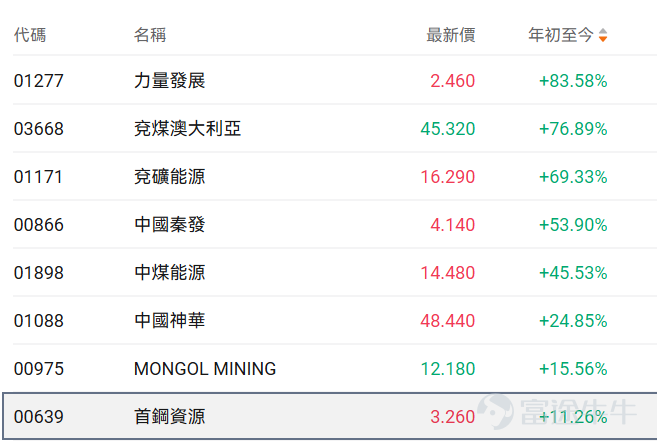
Recently, the coal sector in the Hong Kong stock market has shown strong performance, repeatedly hitting new highs. Among them, this year, $YANCOAL AUS (03668.HK)$ 、 $YANKUANG ENERGY (01171.HK)$ 、 $CHINA QINFA (00866.HK)$and$CHINA COAL (01898.HK)$ leading stocks surged with cumulative gains exceeding 40%; sector leader $CHINA SHENHUA (01088.HK)$ also steadily climbed, recording over a 24% increase.
Why has the geopolitical crisis become a catalyst for the surge in coal prices? This article will provide fellow investors with an in-depth analysis of the underlying capital logic and comprehensively review which quality coal stocks in the Hong Kong and US markets are worth focusing on for investment.
Why has the geopolitical crisis become a catalyst for the surge in coal prices?
In terms of news, the surge in oil and gas prices under the US-Iran conflict has triggered an energy substitution effect.Oriental Securities released a research report stating that the transmission in the coal market is reflected in the rise in fuel costs leading to higher shipping fees, and the surge in natural gas prices prompting some regions to increase coal-fired power generation as a substitute for expensive natural gas, which is expected to drive a counter-seasonal rise in coal prices.
Specifically, the transmission of geopolitical conflicts to the coal market mainly follows three logical paths:
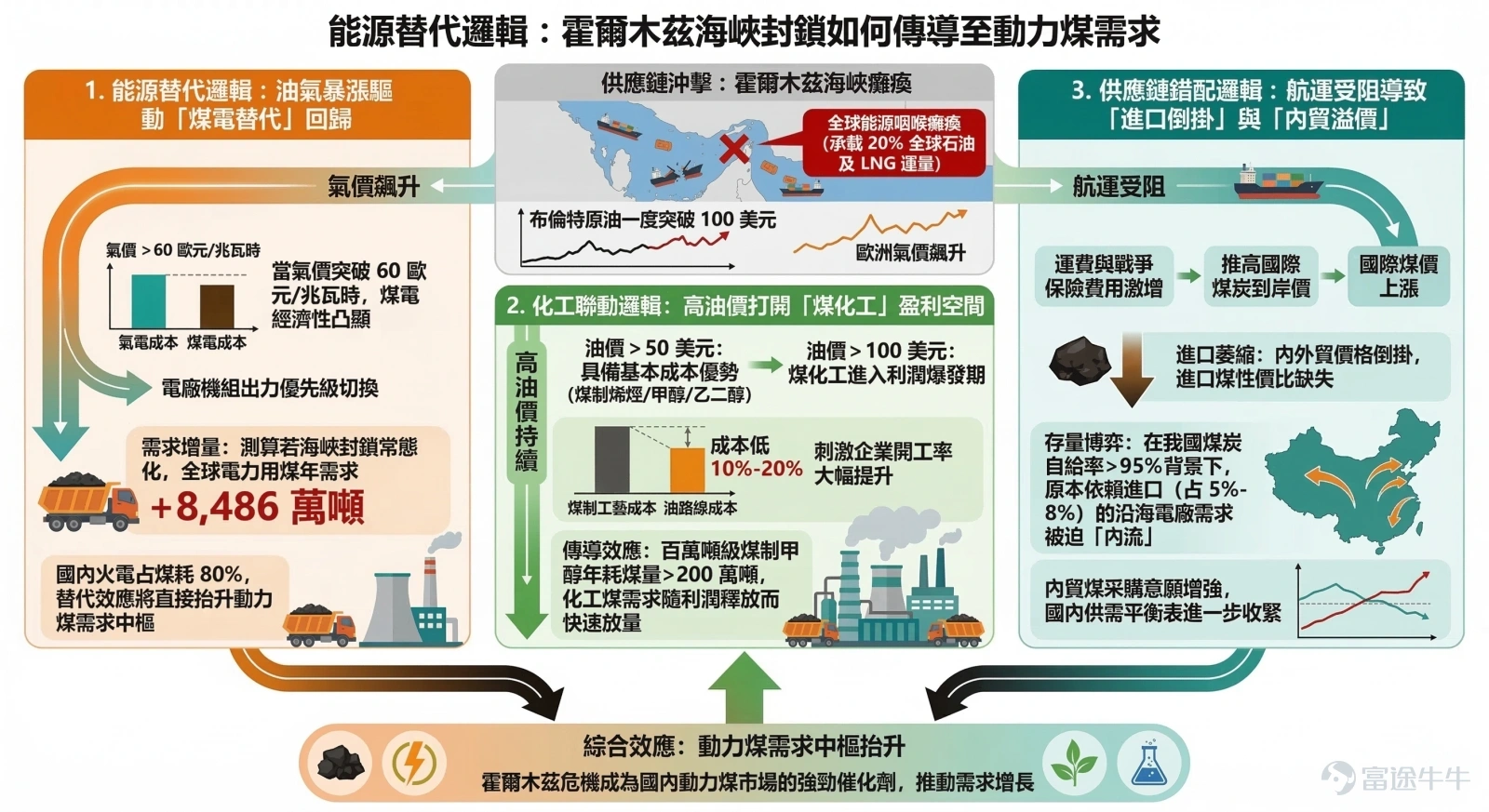
1. Energy Substitution Logic: The surge in oil and gas prices drives the return of 'coal-for-electricity' substitution
Supply Shock: The Strait of Hormuz, which acts as a global energy chokepoint (carrying 20% of oil and LNG traffic), has become paralyzed. Brent crude oil once broke through $100 per barrel, and European gas prices subsequently soared.
Economic Switch:When gas prices exceed €60 per megawatt-hour,the economics of coal power becomes prominent, and the priority of power plant unit output switches accordingly.
Demand Increase:It is estimated that if the blockade of the strait becomes normalized, global annual coal demand for electricity will increase by 84.86 million tons. Domestic thermal power accounts for 80% of coal consumption; the substitution effect will directly raise the demand center for thermal coal.
2. Chemical linkage logic: High oil prices open up profit potential for 'coal chemical' industry
Cost threshold:Oil price > $50: Coal-to-olefins/methanol/ethylene glycol has basic cost advantages; Oil price > $100: Coal chemical enters a period of explosive profit growth.
Competitive Advantages: Under the current oil price backdrop, coal-based production costs are 10%-20% lower than oil-based routes, driving a significant rise in corporate operating rates.
Transmission effect: A million-ton coal-to-methanol plant consumes over 2 million tons of coal annually; chemical coal demand rapidly increases as profits are unlocked.
3. Supply chain mismatch logic: Shipping disruptions lead to 'import inversion' and 'domestic trade premium'
Cost Analysis: Conflicts have caused a surge in shipping fees and war insurance costs, pushing up international coal CIF (cost, insurance, freight) prices.
Import contraction: The rise in international coal prices has led to an inversion between domestic and foreign trade prices, resulting in the loss of cost-effectiveness for imported coal.
Zero-sum game: Against the backdrop of China’s coal self-sufficiency rate being over 95%, the demand from coastal power plants, which originally relied on imports (accounting for 5%-8%), has been forced to shift domestically. The willingness to purchase domestic coal has increased, further tightening the domestic supply-demand balance.
What companies in the Hong Kong and US stock markets are worth paying attention to?
Fellow investors have compiled a list of coal stocks in the Hong Kong and US stock markets as follows:
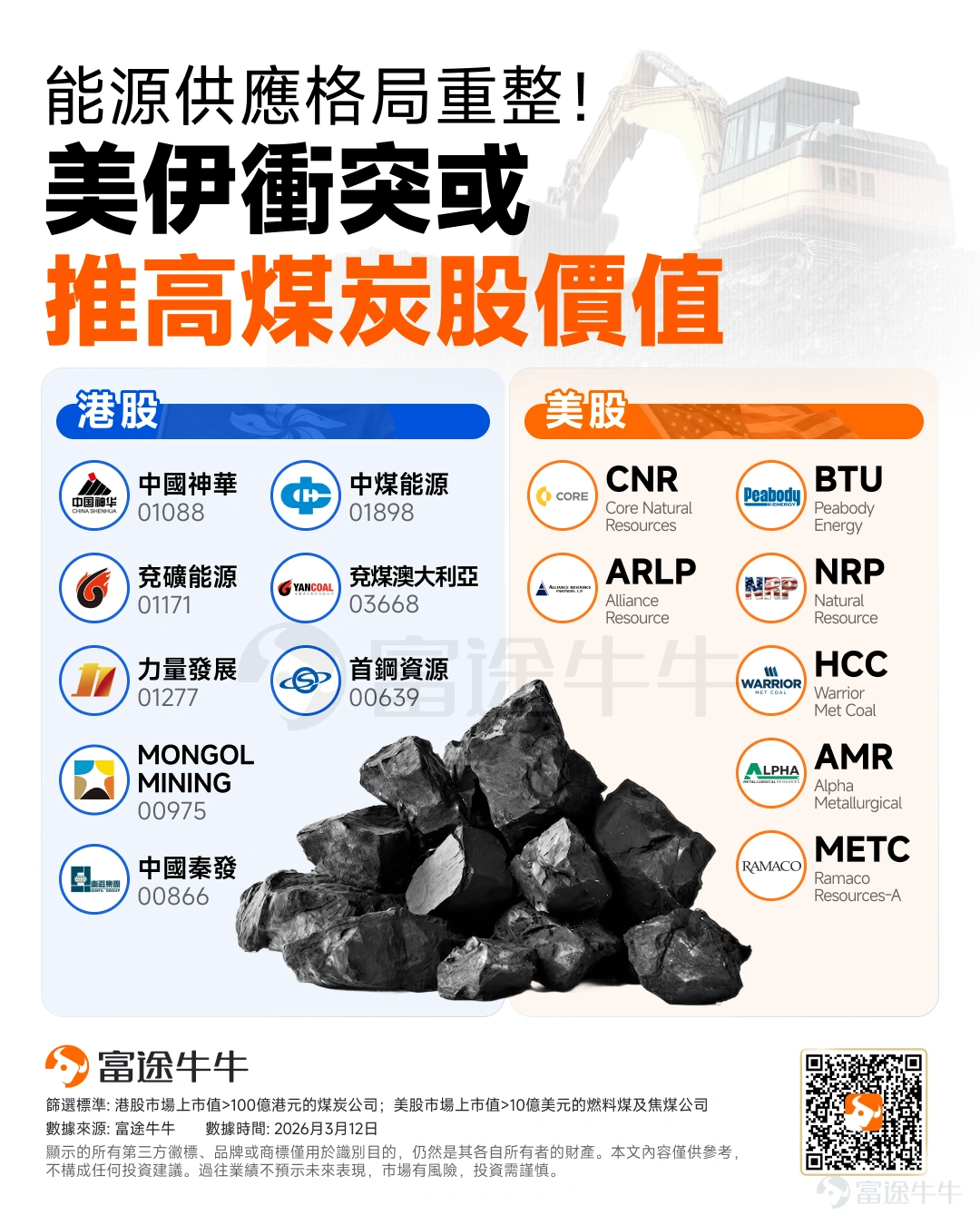
Hong Kong-listed coal companies
Hong Kong-listed coal stocks typically possess defensive attributes such as 'high dividends, low valuation.' When conflicts like those between the US and Iran cause global energy prices to rise, these companies benefit both from the upward support in domestic coal prices and directly gain from surging international coal prices if they have overseas operations.
1. Industry giants and defensive holdings
$CHINA SHENHUA (01088.HK)$ : The largest coal publicly listed company in China and globally. Its moat lies in its integrated industrial chain encompassing 'coal, electricity, rail, port, and shipping.' During external energy crises, it ensures strong profit stability, making it the top choice for capital preservation and high dividend yields.
$CHINA COAL (01898.HK)$ : China's second-largest coal enterprise. Compared to Shenhua, its core coal business is purer and more sensitive to fluctuations in coal prices. If global energy prices soar and drive up domestic coal price expectations, its performance elasticity will be very significant.
2. Leading companies with international pricing power and overseas assets
$YANKUANG ENERGY (01171.HK)$ & $YANCOAL AUS (03668.HK)$ These two are closely linked (Yanzhou Coal is the parent company of Yancoal Australia). Under the logic of the US-Iran conflict, these two companies are among the most direct beneficiaries. Yancoal Australia is the largest pure-play coal producer in Australia, with products directly targeting regions highly dependent on energy imports such as Japan, South Korea, Taiwan, and Southeast Asia. If there is a disruption in Middle Eastern oil and gas supplies, these regions will immediately rush to purchase Australian coal for power generation, directly pushing up the Newcastle thermal coal index, leading to explosive profit growth for Yancoal.
3. Niche sectors and regional players
$KINETIC DEV (01277.HK)$ & $CHINA QINFA (00866.HK)$ This category includes small- to medium-cap thermal coal enterprises. When industry prosperity is high and coal prices rise across the board, these companies, due to their smaller market capitalization, often experience astonishing upward price elasticity, making them favored targets for high-return speculation in the market.
$SHOUGANG RES (00639.HK)$ Its core business involves premium coking coal (used in steel smelting rather than power generation). Although it is not directly used for electricity generation, under the broad backdrop of global energy inflation, commodities often exhibit interconnectivity effects. An overall rise in coal valuations will also drive up coking coal stocks.
$MONGOL MINING (00975.HK)$ A Mongolian coking coal producer. If maritime energy routes are disrupted by war, major countries like China will rely more heavily on overland energy imports, providing the company with significant geopolitical premiums.
US-listed coal companies
US-listed coal companies are extremely sensitive to international energy prices. In recent years, Western countries have strongly promoted environmental protection and coal phase-outs, resulting in very low capital expenditures in coal mining. Once a Middle East conflict causes an oil and gas shortage, Europe and America (especially Europe) will have no choice but to restart coal-fired power generation, which will immediately create a severe supply-demand imbalance. US-listed coal stocks often experience a double benefit known as the 'Davis Double Play.'
Moreover, as AI-related power shortages become increasingly severe, the Trump administration’s policies fully support the 'restart of coal power,' and coal consumption in the US has shown its first significant rebound in ten years.
1. Thermal coal — Focused on electricity generation needs and AI computing power consumption expectations
Thermal coal is mainly used for thermal power generation. Amid heated market discussions about AI data centers driving massive electricity demand in a supercycle, the long-term cash flow and energy security value of such companies are being reassessed.
$Peabody Energy (BTU.US)$ : The U.S. is also home to the world's largest private coal company. It has extensive coal mining assets both in the U.S. and Australia. Its Australian thermal coal assets make it a direct beneficiary of Asia’s energy transition, while its domestic assets can be exported to Europe, serving as a bellwether for the global coal cycle.
$Core Natural Resources (CNR.US)$ : A key underground coal miner in the U.S. The company produces high-calorie thermal coal, with significant exports to Europe and India. If Middle Eastern oil and gas supplies to Europe are disrupted, Europe will inevitably increase imports of U.S. thermal coal, leading to a substantial rise in CNR’s export profits.
$Alliance Resource (ARLP.US)$ & $Natural Resource (NRP.US)$ : These companies primarily operate through royalty and mineral leasing models. Their defining characteristics include extremely strong cash flow and high dividend payout ratios. Amidst the shadow of war and inflation, investors tend to seek assets with predictable returns; these coal stocks offering double-digit dividend yields will attract haven-seeking capital.
2. Metallurgical Coal/Coking Coal —— Focused on Steel Smelting and Infrastructure Development
Metallurgical coal is an indispensable core raw material for steel production, and its price trend is highly correlated with global infrastructure construction and manufacturing recovery (especially demand from emerging markets such as India).
$Warrior Met Coal (HCC.US)$ 、 $Alpha Metallurgical (AMR.US)$ 、 $Ramaco Resources-A (METC.US)$ : These three companies are mainly producers of metallurgical coal (used for steelmaking).
Although the initial shortage caused by the U.S.-Iran conflict would be in thermal coal (for power generation), when thermal coal prices soar, some high-calorie metallurgical coal may be repurposed for electricity generation, causing a subsequent shortage in metallurgical coal as well.
Moreover, conflicts often come with accelerated arms production and potential post-war infrastructure expectations, which would support steel demand, thereby maintaining high profitability for these U.S. metallurgical coal giants.
Summary
In summary, the escalation of the U.S.-Iran conflict is not just a short-term geopolitical disturbance but also a catalyst triggering the restructuring of the global energy supply chain and a shift in pricing logic. Under the triple resonance of 'return to coal-power substitution,' 'expansion in coal chemical profitability,' and 'premiums driven by shipping disruptions boosting domestic trade,' coal's value as a strategic alternative energy source is being strongly repriced by the market.
In terms of specific investment strategy:
Hong Kong stock coal sectorWith the defensive attribute of 'high dividend, low valuation,' combined with the high profit elasticity of some leading overseas assets, it offers a robust choice that is flexible for both offense and defense.
US stock coal sectorIs more sensitive to international energy pricing. Driven by the potential restart of coal power in Europe and the US, as well as the high electricity consumption of AI computing in the US, it has strong potential for both earnings and valuation growth.
Facing a complex macro situation and inflation concerns, investors can flexibly allocate this round of energy cycle dividends, intertwined with geopolitical crises and supply-demand mismatches, based on their risk appetite and capital attributes.
Risk Disclaimer: The above content only represents the author's view. It does not represent any position or investment advice of Futu. Futu makes no representation or warranty.Read more


Comment (1)
to post a comment
39
50