
Oracle's earnings boost the AI cloud sector, has the turning point arrived?

Options Trading Spotlight | Oracle's Explosive Earnings Propel Pre-Market Surge of 11%! Is This a Turning Point for AI Cloud?
This article is from the 'Options风口Strategy' column, which aims to stand at the forefront of investment trends, interpret opportunities in these trends, and teach everyone how to seize these opportunities with options. If you're interested, welcome.Click hereUpon joining the learning platform, you will receive notifications when subsequent columns are updated.
*The following content is for educational purposes only and does not constitute investment advice. The information provided is time-sensitive, with data as of the pre-market opening on March 11, 2026. Please exercise caution when interpreting.
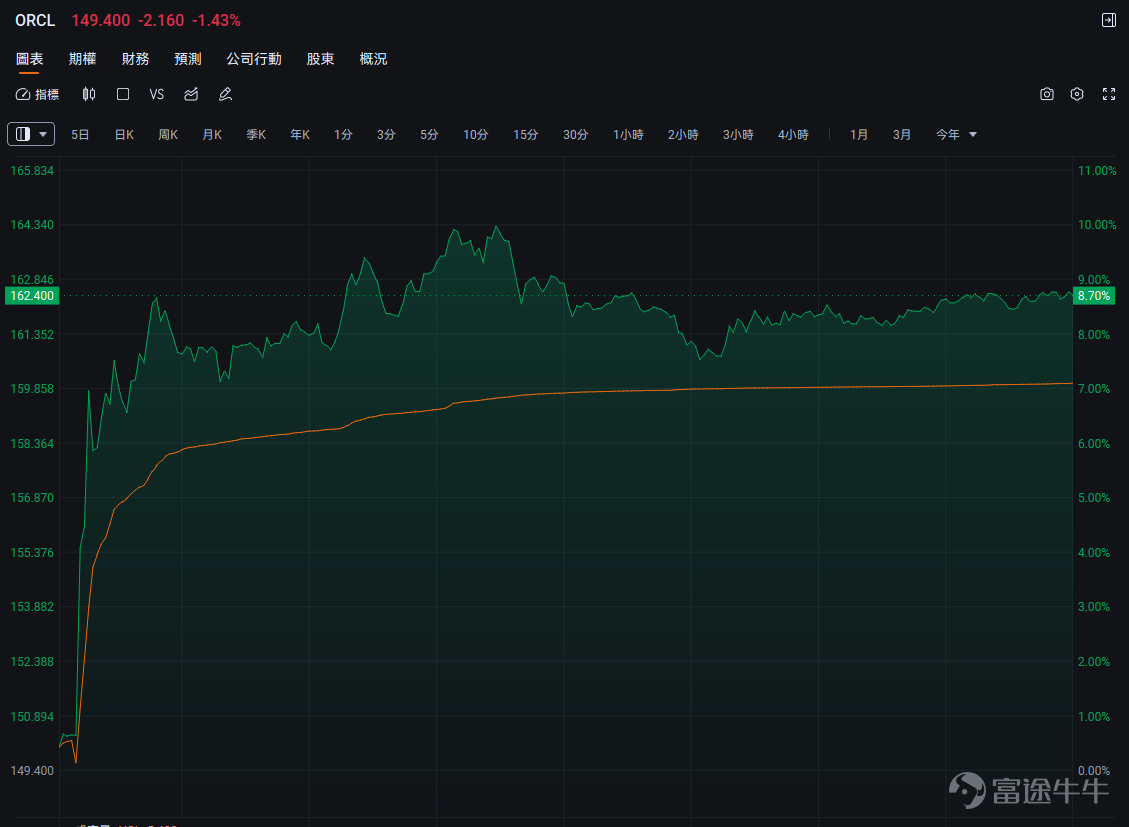
After the market closed on March 10, $Oracle (ORCL.US)$ Oracle released explosive third-quarter results for the fiscal year 2026. Following the earnings announcement, Oracle's stock price quickly turned positive during after-hours trading, with gains expanding to approximately 10%. On the morning of March 11 before the US market opened, the upward momentum continued to expand, exceeding 11% at one point.
![This article is from the 'Options风口Strategy' column, which aims to stand at the forefront of investment trends, interpret opportunities in these trends, and teach everyone how to seize these opportunities with options. If you're interested, welcome.[Share Link: Click here]Upon joining the learning platform, you will receive notifications when subsequent columns are updated. *The following content is for educational purposes only and does not constitute investment advice. The information provided is time-sensitive, with data accurate as of the pre-market open on March 11, 2026. Please exercise caution when interpreting. After the market close on March 10, $Oracle (ORCL.US)$ Oracle released its explosive Q3 2026 earnings results. Following the announcement, Oracle's stock price quickly reversed course during after-hours trading, surging by approximately 10%. On March 11, in pre-market trading, the upward momentum continued to expand, exceeding 11% at one point. This is not only a strong rebound but could also represent a pivotal shift in market sentiment towards the AI cloud computing industry. Below, we will delve deeper intothe core signals of this earnings report, analyze the outlook it reveals for the cloud business sector, and explore how to leverage options to capture key investment opportunities.。 Oracle’s Explosive Earnings: AI Orders Ignite Growth Engine $Oracle (ORCL.US)$ This earnings performancecomprehensively surpassed market expectations: Revenue reached $17.19 billion, a year-over-year increase of 22%, significantly surpassing analysts' expectations of $16.89 billion. The growth rate showed a notable improvement from 14% in the second fiscal quarter. On a Non-GAAP basis...](https://nnqimage.futunn.com/sns_client_feed/999908/20260311/web-1773222851486-BDtdQXIGsz.png/big?area=2&is_public=true&imageMogr2/ignore-error/1/format/webp)
This is not only a strong rebound but may also represent a key turning point in the market’s attitude toward the AI cloud computing industry. Below, we will take a deep dive intointerpreting the core signals of these earnings, analyzing the prospects of the cloud business industry they reveal, and discussing how to use options to capitalize on the investment opportunities presented.。
Oracle's Explosive Earnings: AI Orders Ignite Growth Engine
$Oracle (ORCL.US)$ This earnings performancecomprehensively exceeded market expectations: Revenue reached $17.19 billion, an increase of 22% year-over-year, significantly surpassing analysts' expectations of $16.89 billion. This marks a notable acceleration compared to the 14% growth seen in the second fiscal quarter. Earnings per share (EPS) under Non-GAAP measures came in at $1.79, up 21% year-over-year and higher than the market consensus of $1.70. This represents the first time in fifteen years that Oracle has achieved growth rates exceeding 20% for both revenue and Non-GAAP EPS in a single quarter.
![This article is from the 'Options风口Strategy' column, which aims to stand at the forefront of investment trends, interpret opportunities in these trends, and teach everyone how to seize these opportunities with options. If you're interested, welcome.[Share Link: Click here]Upon joining the learning platform, you will receive notifications when subsequent columns are updated. *The following content is for educational purposes only and does not constitute investment advice. The information provided is time-sensitive, with data accurate as of the pre-market open on March 11, 2026. Please exercise caution when interpreting. After the market close on March 10, $Oracle (ORCL.US)$ Oracle released its explosive Q3 2026 earnings results. Following the announcement, Oracle's stock price quickly reversed course during after-hours trading, surging by approximately 10%. On March 11, in pre-market trading, the upward momentum continued to expand, exceeding 11% at one point. This is not only a strong rebound but could also represent a pivotal shift in market sentiment towards the AI cloud computing industry. Below, we will delve deeper intothe core signals of this earnings report, analyze the outlook it reveals for the cloud business sector, and explore how to leverage options to capture key investment opportunities.。 Oracle’s Explosive Earnings: AI Orders Ignite Growth Engine $Oracle (ORCL.US)$ This earnings performancecomprehensively surpassed market expectations: Revenue reached $17.19 billion, a year-over-year increase of 22%, significantly surpassing analysts' expectations of $16.89 billion. The growth rate showed a notable improvement from 14% in the second fiscal quarter. On a Non-GAAP basis...](https://nnqimage.futunn.com/sns_client_feed/999908/20260311/web-1773222851702-Tn2zHDHM1J.png/big?area=2&is_public=true&imageMogr2/ignore-error/1/format/webp)
Importantly,Oracle's total cloud revenue surged 44% year-over-year to $8.9 billion, accounting for more than half of total revenue for the first time in history. This marks that Oracle, the veteran tech giant originally known for its traditional database business, has now completed its transformation into a cloud company.
In particular, as a direct reflection of AI computing demand, Oracle’s Infrastructure-as-a-Service (IaaS) revenue skyrocketed 84% to $4.9 billion, accelerating from the previous quarter’s 68% growth rate. This also significantly outpaced the 13% year-over-year growth in cloud applications (SaaS), driven primarily by providing AI computing services to clients such as OpenAI, Meta, and xAI. Amidst the backdrop of tight AI training and inference computing resources, market demand for Oracle's underlying computing power is exploding.
In addition to the current quarter’s performance, key metrics reflecting future revenues and the guidance provided by the company were also core reasons behind the sharp rise in share price during after-hours trading.
This quarter, Oracle’s Remaining Performance Obligations (RPO) soared to $553 billion, a staggering 325% increase year-over-year, far exceeding analyst expectations of $470.7 billion. This growth was mainly driven by large-scale AI contracts, with many of these contracts involving upfront payments from clients or clients providing their own GPUs for Oracle to use.
This means Oraclehas locked in high growth for the coming years, offering extremely high visibility and certainty for its financial performance. It also ensures stable cash flow without needing additional financing to fulfill contracts, easing market concerns about the company bearing massive capital expenditures. To some extent, this also dispelled doubts about an AI bubble.
Previously, investor concerns centered around Oracle’s debt incurred to expand its AI infrastructure and its persistently negative free cash flow. Beyond the prepayment model alleviating capital expenditure worries, Oracle disclosed that $30 billion of its previously announced $50 billion financing plan has been successfully completed, with the order book being oversubscribed. The company expects no need for further bond issuance through the 2026 calendar year, undoubtedly providing reassurance to the market.
Based on strong business momentum, Oracle hasraised its revenue guidance for fiscal year 2027 to $90 billion., this target is significantly higher than the market analysts' consensus expectation of $86.6 billion, showcasing management's strong confidence in the long-term trend of AI cloud demand.
Cloud Computing Industry Outlook: AI-Driven Structural Bull Market
Oracle's earnings report demonstrates that the demand for AI cloud infrastructure is real, quantifiable, and rapidly converting into revenue. This is not only a positive for Oracle alone but also provides robust support for the entire cloud computing industry chain.
From an overall industry perspective, the deep integration of AI and cloud has become an irreversible trend, driving the entire industry into a structural bull market.
In the past, the core of cloud services was helping enterprises move to the cloud, solving storage and basic computing problems; growth was steady but limited in speed. Now, the widespread adoption of large AI models has caused an exponential surge in enterprises' demand for computing power, making cloud infrastructure, as the core carrier of computing power, the primary growth engine.
According to industry forecasts, by 2026, the global cloud service market will exceed $650 billion, with AI-related spending accounting for over 60%, and the compound annual growth rate expected to remain around 20% for the next three to five years.
More notably, current industry bottlenecks have shifted from chip shortages to data centers with high power supply and liquid cooling capabilities — providing clear demand-driven direction for the expansion of the cloud industry, ensuring sustained high levels of activity.
Against this backdrop, the market structure exhibits a dual-driven momentum of 'traditional giants holding firm while new forces rise.' Traditional vendors leverage their advantages in technology, customer base, and capital to maintain dominance, while emerging players like CoreWeave, NEBIUS, and IREN are quickly breaking through in the AI-native computing sector with differentiated positioning, fostering healthy competition.
![This article is from the 'Options风口Strategy' column, which aims to stand at the forefront of investment trends, interpret opportunities in these trends, and teach everyone how to seize these opportunities with options. If you're interested, welcome.[Share Link: Click here]Upon joining the learning platform, you will receive notifications when subsequent columns are updated. *The following content is for educational purposes only and does not constitute investment advice. The information provided is time-sensitive, with data accurate as of the pre-market open on March 11, 2026. Please exercise caution when interpreting. After the market close on March 10, $Oracle (ORCL.US)$ Oracle released its explosive Q3 2026 earnings results. Following the announcement, Oracle's stock price quickly reversed course during after-hours trading, surging by approximately 10%. On March 11, in pre-market trading, the upward momentum continued to expand, exceeding 11% at one point. This is not only a strong rebound but could also represent a pivotal shift in market sentiment towards the AI cloud computing industry. Below, we will delve deeper intothe core signals of this earnings report, analyze the outlook it reveals for the cloud business sector, and explore how to leverage options to capture key investment opportunities.。 Oracle’s Explosive Earnings: AI Orders Ignite Growth Engine $Oracle (ORCL.US)$ This earnings performancecomprehensively surpassed market expectations: Revenue reached $17.19 billion, a year-over-year increase of 22%, significantly surpassing analysts' expectations of $16.89 billion. The growth rate showed a notable improvement from 14% in the second fiscal quarter. On a Non-GAAP basis...](https://nnqimage.futunn.com/sns_client_feed/999908/20260311/web-1773222853769-FtfS0FdOWH.png/big?area=2&is_public=true&imageMogr2/ignore-error/1/format/webp)
1. Traditional Cloud Vendors: Each Has Its Moat
$Amazon (AMZN.US)$ Amazon’s AWS remains the absolute leader in global cloud infrastructure, with a market share exceeding 30%. Its biggest advantage lies in economies of scale — it not only maintains deep collaboration with NVIDIA to ensure GPU supply but also launched its own AI chip, Trainium, to reduce costs. Additionally, it provides core computing power for leading companies like OpenAI and Meta, ensuring strong earnings stability.
$Microsoft (MSFT.US)$ Azure's uniqueness lies in its ecosystem integration. It fully incorporates AI capabilities such as Copilot and GPT into cloud services and office suites, creating extremely high customer stickiness. Revenue from Azure's AI-related services is growing at over 30%, supported by Microsoft's deep technological accumulation, offering growth certainty that is no less than its competitors.
$Alphabet-C (GOOG.US)$ The fastest-growing player in the cloud space leverages the deep integration of its self-developed TPU chips with the Gemini large model to build a unique technical barrier. Morgan Stanley predicts its revenue growth could exceed 50% by 2026, with a backlog of orders reaching $158 billion, gradually narrowing the gap with the top two players.
$Oracle (ORCL.US)$ This earnings breakout marks the completion of its transformation into a cloud company. Its core advantage lies in the combination of 'AI computing power and enterprise-grade data services'—in highly compliance-driven industries like finance and retail, its database heritage brings strong customer stickiness. Coupled with an innovative model of 'customer prepayment + self-provided GPUs,' it has locked in future high growth for years to come with $553 billion in remaining performance obligations, making it one of the most successful examples of AI transformation among traditional companies.
2. The Rise of New Forces: Differentiation Pathways
$CoreWeave (CRWV.US)$ It is the 'scale first mover.' As NVIDIA's core ally, it focuses on AI computing power leasing, having built a vast customer network. However, the pure leasing model has shallow moats and relies on high-cost financing, showing relatively weaker risk resistance in the face of GPU price volatility.
$NEBIUS (NBIS.US)$ It represents the 'technology-driven' approach. With a full-stack technology team inherited from Yandex, it possesses R&D capabilities comparable to traditional giants, enjoying a technical premium in complex model training scenarios. Its goal is to create the world’s fourth AI cloud, but aggressive expansion has raised concerns about its cash burn rate.
$IREN Ltd (IREN.US)$ It is the 'resource-based player.' Its core moat lies in controlling gigawatt-level power interconnection permits—a scarce physical resource with monopolistic properties amid tight power supply for computing centers. Having signed contracts with Microsoft to lock in base business, it shows the highest growth certainty, though primarily using a wholesale model, meaning its revenue explosiveness may not match the previous two.
3. Investment Perspective: Understand Positioning and Act within Limits
Traditional giants are defined by 'stability'—mature technology, robust clientele, and strong capital, enabling them to bear high capital expenditures. They are the ballast in structural bull markets, suitable for medium- to long-term positioning. New forces, on the other hand, focus on being 'nimble'—free from historical baggage, they concentrate on native AI computing power, offering high elasticity and potential but also higher risks, making them suitable for investors who can tolerate volatility.
Additionally, it is important to note that the high growth of the cloud industry comes with high competition and high volatility. Common challenges include high capital expenditure, chip supply chain bottlenecks, and global regulatory differences. Investors should remain rational, control positions, and act according to their own risk tolerance.
Leverage options strategies to strategically position for long-term AI cloud opportunities with confidence.
In the current market environment, characterized by 'long-term optimism and short-term volatility,' options may serve as a flexible allocation tool. Their key value lies in flexibility — they allow investors to take leveraged positions when optimistic, hedge risks during uncertain times, and capture time value when the overall trend is clear but timing remains unpredictable.
For the two types of core targets within the cloud industry, consider the following strategic approaches:
1. For traditional giants (e.g., Oracle, Microsoft, Amazon, Google): Use conservative options strategies that prioritize stability.
Traditional giants have high earnings certainty and relatively moderate stock price fluctuations, making them suitable for more conservative options strategies.
If you expect moderate stock price increases and want to control costs: Consider a Bull Call Spread strategy using out-of-the-money call options.Purchase one at-the-money or slightly out-of-the-money call option while simultaneously selling another further out-of-the-money call option, offsetting part of the cost with the premium received from selling. This strategy sacrifices unlimited upside potential but significantly reduces entry costs, making it ideal for investors with reasonable expectations for gains who do not wish to commit excessive capital.
The profit and loss characteristics of this strategy at expiration can be referenced in the diagram below, intended solely for educational purposes and does not constitute any investment advice:
![This article is from the 'Options风口Strategy' column, which aims to stand at the forefront of investment trends, interpret opportunities in these trends, and teach everyone how to seize these opportunities with options. If you're interested, welcome.[Share Link: Click here]Upon joining the learning platform, you will receive notifications when subsequent columns are updated. *The following content is for educational purposes only and does not constitute investment advice. The information provided is time-sensitive, with data accurate as of the pre-market open on March 11, 2026. Please exercise caution when interpreting. After the market close on March 10, $Oracle (ORCL.US)$ Oracle released its explosive Q3 2026 earnings results. Following the announcement, Oracle's stock price quickly reversed course during after-hours trading, surging by approximately 10%. On March 11, in pre-market trading, the upward momentum continued to expand, exceeding 11% at one point. This is not only a strong rebound but could also represent a pivotal shift in market sentiment towards the AI cloud computing industry. Below, we will delve deeper intothe core signals of this earnings report, analyze the outlook it reveals for the cloud business sector, and explore how to leverage options to capture key investment opportunities.。 Oracle’s Explosive Earnings: AI Orders Ignite Growth Engine $Oracle (ORCL.US)$ This earnings performancecomprehensively surpassed market expectations: Revenue reached $17.19 billion, a year-over-year increase of 22%, significantly surpassing analysts' expectations of $16.89 billion. The growth rate showed a notable improvement from 14% in the second fiscal quarter. On a Non-GAAP basis...](https://nnqimage.futunn.com/sns_client_feed/999908/20260311/web-1773222850836-HxTetbzAXb.jpeg/big?area=2&is_public=true&imageMogr2/ignore-error/1/format/webp)
If you are confident in long-term value and aim to profit from market volatility or acquire stocks at a lower price: Consider a Cash-secured Put strategy.Hold cash and sell put options with a strike price below the current stock price. If the stock price does not fall below that level by expiration, keep the premium; if it falls, buy the stock at your desired price — akin to collecting rent while waiting for discounts.
The profit and loss characteristics at expiration for this strategy can be referenced in the diagram below, for educational purposes only and not as investment advice:
![This article is from the 'Options风口Strategy' column, which aims to stand at the forefront of investment trends, interpret opportunities in these trends, and teach everyone how to seize these opportunities with options. If you're interested, welcome.[Share Link: Click here]Upon joining the learning platform, you will receive notifications when subsequent columns are updated. *The following content is for educational purposes only and does not constitute investment advice. The information provided is time-sensitive, with data accurate as of the pre-market open on March 11, 2026. Please exercise caution when interpreting. After the market close on March 10, $Oracle (ORCL.US)$ Oracle released its explosive Q3 2026 earnings results. Following the announcement, Oracle's stock price quickly reversed course during after-hours trading, surging by approximately 10%. On March 11, in pre-market trading, the upward momentum continued to expand, exceeding 11% at one point. This is not only a strong rebound but could also represent a pivotal shift in market sentiment towards the AI cloud computing industry. Below, we will delve deeper intothe core signals of this earnings report, analyze the outlook it reveals for the cloud business sector, and explore how to leverage options to capture key investment opportunities.。 Oracle’s Explosive Earnings: AI Orders Ignite Growth Engine $Oracle (ORCL.US)$ This earnings performancecomprehensively surpassed market expectations: Revenue reached $17.19 billion, a year-over-year increase of 22%, significantly surpassing analysts' expectations of $16.89 billion. The growth rate showed a notable improvement from 14% in the second fiscal quarter. On a Non-GAAP basis...](https://nnqimage.futunn.com/sns_client_feed/999908/20260311/web-1773222851806-nx9eAA2ig2.jpeg/big?area=2&is_public=true&imageMogr2/ignore-error/1/format/webp)
2. For new forces (such as CoreWeave, NEBIUS, IREN): Use flexible option strategies as a primary approach.
New forces have high flexibility and volatility, suitable for investors with strong risk tolerance who wish to capture explosive market movements.
If you want to bet on event-driven large fluctuations: consider a Long Straddle by purchasing a straddle combination.Stock prices of new forces often experience significant fluctuations due to earnings, major contracts, or technological breakthroughs, but the direction is hard to predict. In such cases, you can simultaneously buy call and put options with the same quantity and strike price. As long as the fluctuation is large enough, there are profit opportunities whether the price rises or falls. This strategy has a higher cost and is suitable for positioning before significant events.
The profit and loss characteristics at expiration for the Long Straddle strategy can be referenced in the diagram below, for educational purposes only and not as investment advice:
![This article is from the 'Options风口Strategy' column, which aims to stand at the forefront of investment trends, interpret opportunities in these trends, and teach everyone how to seize these opportunities with options. If you're interested, welcome.[Share Link: Click here]Upon joining the learning platform, you will receive notifications when subsequent columns are updated. *The following content is for educational purposes only and does not constitute investment advice. The information provided is time-sensitive, with data accurate as of the pre-market open on March 11, 2026. Please exercise caution when interpreting. After the market close on March 10, $Oracle (ORCL.US)$ Oracle released its explosive Q3 2026 earnings results. Following the announcement, Oracle's stock price quickly reversed course during after-hours trading, surging by approximately 10%. On March 11, in pre-market trading, the upward momentum continued to expand, exceeding 11% at one point. This is not only a strong rebound but could also represent a pivotal shift in market sentiment towards the AI cloud computing industry. Below, we will delve deeper intothe core signals of this earnings report, analyze the outlook it reveals for the cloud business sector, and explore how to leverage options to capture key investment opportunities.。 Oracle’s Explosive Earnings: AI Orders Ignite Growth Engine $Oracle (ORCL.US)$ This earnings performancecomprehensively surpassed market expectations: Revenue reached $17.19 billion, a year-over-year increase of 22%, significantly surpassing analysts' expectations of $16.89 billion. The growth rate showed a notable improvement from 14% in the second fiscal quarter. On a Non-GAAP basis...](https://nnqimage.futunn.com/sns_client_feed/999908/20260311/web-1773222851371-4sOOvR1oYy.jpeg/big?area=2&is_public=true&imageMogr2/ignore-error/1/format/webp)
If you're optimistic about recent upward potential, consider buying medium-term call options instead of purchasing the underlying stock directly.Buying out-of-the-money call options directly allows leveraging potential stock price increases with relatively small premium costs. If the stock price rises sharply as expected, the return multiple will far exceed buying the stock outright; if the stock price falls or oscillates, the maximum loss is limited to the premium paid, avoiding ongoing losses like holding the stock.
The profit and loss characteristics at expiration for this strategy can be referenced in the diagram below, for educational purposes only and not as investment advice:
![This article is from the 'Options风口Strategy' column, which aims to stand at the forefront of investment trends, interpret opportunities in these trends, and teach everyone how to seize these opportunities with options. If you're interested, welcome.[Share Link: Click here]Upon joining the learning platform, you will receive notifications when subsequent columns are updated. *The following content is for educational purposes only and does not constitute investment advice. The information provided is time-sensitive, with data accurate as of the pre-market open on March 11, 2026. Please exercise caution when interpreting. After the market close on March 10, $Oracle (ORCL.US)$ Oracle released its explosive Q3 2026 earnings results. Following the announcement, Oracle's stock price quickly reversed course during after-hours trading, surging by approximately 10%. On March 11, in pre-market trading, the upward momentum continued to expand, exceeding 11% at one point. This is not only a strong rebound but could also represent a pivotal shift in market sentiment towards the AI cloud computing industry. Below, we will delve deeper intothe core signals of this earnings report, analyze the outlook it reveals for the cloud business sector, and explore how to leverage options to capture key investment opportunities.。 Oracle’s Explosive Earnings: AI Orders Ignite Growth Engine $Oracle (ORCL.US)$ This earnings performancecomprehensively surpassed market expectations: Revenue reached $17.19 billion, a year-over-year increase of 22%, significantly surpassing analysts' expectations of $16.89 billion. The growth rate showed a notable improvement from 14% in the second fiscal quarter. On a Non-GAAP basis...](https://nnqimage.futunn.com/sns_client_feed/999908/20260311/web-1773222851149-zeveKZHSXx.jpeg/big?area=2&is_public=true&imageMogr2/ignore-error/1/format/webp)
If you want more inspiration regarding options strategies, you can easily get it on the mobile app or the new desktop version by following these steps!
![This article is from the 'Options风口Strategy' column, which aims to stand at the forefront of investment trends, interpret opportunities in these trends, and teach everyone how to seize these opportunities with options. If you're interested, welcome.[Share Link: Click here]Upon joining the learning platform, you will receive notifications when subsequent columns are updated. *The following content is for educational purposes only and does not constitute investment advice. The information provided is time-sensitive, with data accurate as of the pre-market open on March 11, 2026. Please exercise caution when interpreting. After the market close on March 10, $Oracle (ORCL.US)$ Oracle released its explosive Q3 2026 earnings results. Following the announcement, Oracle's stock price quickly reversed course during after-hours trading, surging by approximately 10%. On March 11, in pre-market trading, the upward momentum continued to expand, exceeding 11% at one point. This is not only a strong rebound but could also represent a pivotal shift in market sentiment towards the AI cloud computing industry. Below, we will delve deeper intothe core signals of this earnings report, analyze the outlook it reveals for the cloud business sector, and explore how to leverage options to capture key investment opportunities.。 Oracle’s Explosive Earnings: AI Orders Ignite Growth Engine $Oracle (ORCL.US)$ This earnings performancecomprehensively surpassed market expectations: Revenue reached $17.19 billion, a year-over-year increase of 22%, significantly surpassing analysts' expectations of $16.89 billion. The growth rate showed a notable improvement from 14% in the second fiscal quarter. On a Non-GAAP basis...](https://nnqimage.futunn.com/sns_client_feed/999908/20260311/web-1773222852698-lTdWN0CjbO.png/big?area=2&is_public=true&imageMogr2/ignore-error/1/format/webp)
Alright, that's it for today. Welcome.Click hereJoin the learning journey, and you’ll receive notifications when new updates are posted in subsequent columns. If you have specific content suggestions, your input is highly welcomed!
Finally, here’s a small perk for fellow investors—welcome to claim it!Options Beginner's Package(*This promotion is available exclusively to HK invited users; click to learn more.Event Details Rules >>)
Risk Disclaimer: The above content only represents the author's view. It does not represent any position or investment advice of Futu. Futu makes no representation or warranty.Read more


Comments (5)
to post a comment
50
73