
Raising 'lobsters' drives up computing power demand! Where are the investment opportunities?

Q&M Dental's 'Lobster Raising' ignites a new AI craze! How many Hong Kong stock opportunities are hidden in OpenClaw's core storyline?
In the 2026 capital market, 'AI' is undoubtedly the keyword with the most transformative magic power.
Recently, a red 'little lobster' has completely ignited this technological frenzy. This open-source AI agent, named OpenClaw, has been affectionately nicknamed by developers for its iconic lobster logo and is currently sparking a phenomenal global trend. In just four months, its GitHub star count skyrocketed past the 270,000 mark, surpassing legendary open-source projects like Linux and React.
As the 'lobster raising'-style application ecosystem rapidly multiplies within the community,This unstoppable wave has quickly swept through and reached the Hong Kong stock market.
The latest research report from Everbright Overseas indicates that OpenClaw’s open-source breakout marks the AI industry's transition from 'dialogue interaction' to the new Agent era of 'autonomous execution'; coupled with better-than-expected earnings across the AI chain in U.S. stocks,Hong Kong technology stocks are returning to the main AI growth narrative.
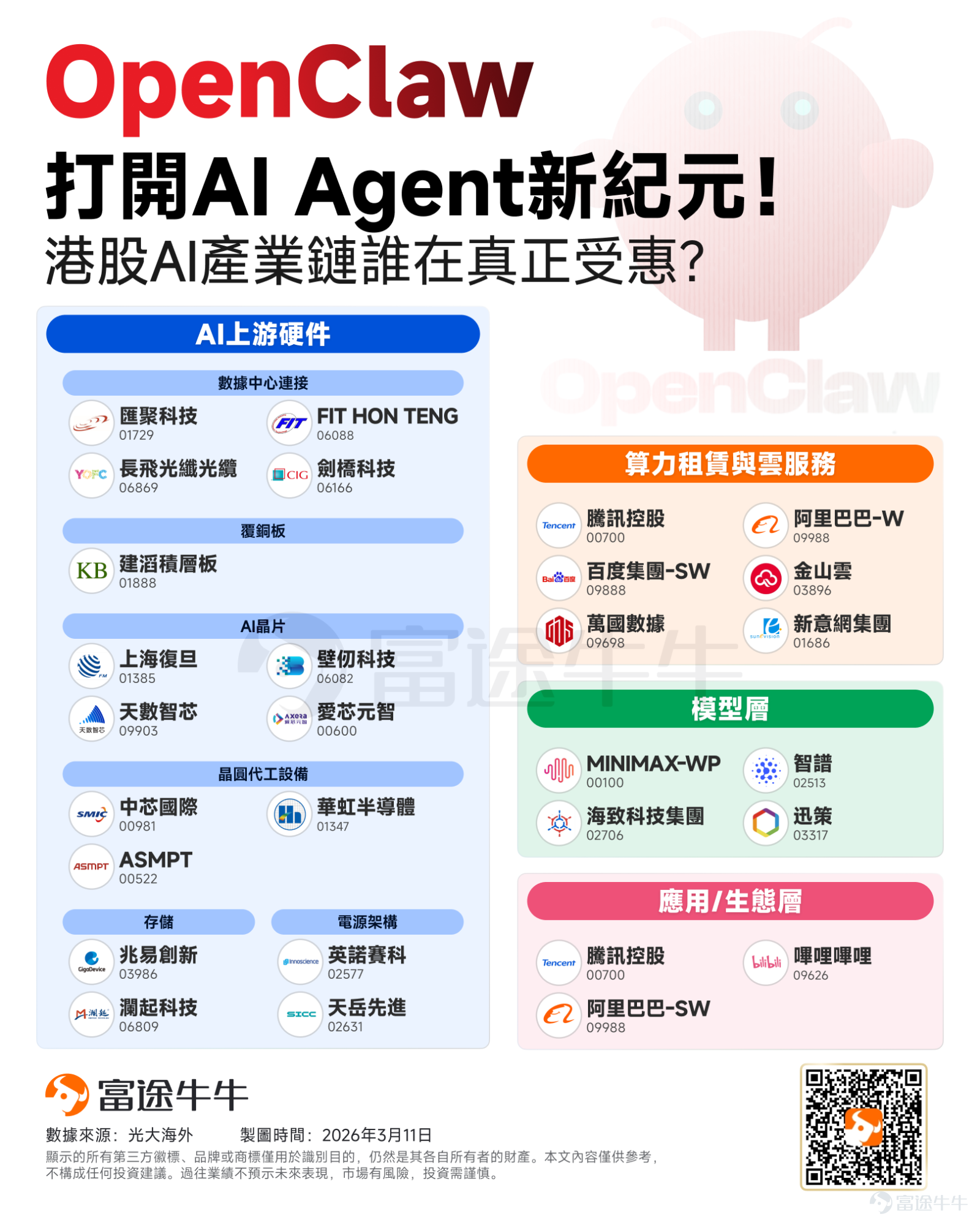
Meanwhile, Everbright Overseas has also compiled a list of companies in the Hong Kong stock market that are expected to benefit under the OpenClaw trend, as follows:

Specifically:
1. Upstream AI hardware:
Everbright Overseas Research noted that traditional AI applications are mainly 'request-response' models, whereas the core value of Agent frameworks like OpenClaw lies in 'continuous operation' and 'autonomous cycles.' Once users deploy the Agent in the cloud (referred to as 'cloud shrimp farming'), it becomes more than just a temporarily invoked tool. The '7x24 residency' mode implies ongoing context maintenance and frequent self-correction. A complex task breakdown might involve multiple rounds of model calls and Tool calling, consuming far more tokens than traditional chatbots and continuously increasing GPU cluster utilization in the cloud.
Therefore, OpenClaw is expected to drive demand for computing power infrastructure construction and further extend to upstream segments of the AI industry chain such as data center computing chips, high-speed cables, optical fibers, optical modules, copper-clad laminates, wafer foundries, and equipment.
1) Data Center Connectivity:The exponential data traffic generated by the massive concurrent operation of Agents places higher demands on transmission bandwidth within data centers and between data centers and users. Optical communication, with its advantages of high speed, low loss, and low power consumption, can effectively carry high-frequency token exchanges and data return transmissions, continuously benefiting from AI computing infrastructure. Additionally, recent tight supply of optical rods and rising fiber prices are allowing companies with an integrated 'rod-fiber-cable' industrial chain advantage to further benefit from improved profit margins due to price increases.
Everbright Overseas Recommendation:
$TIME INTERCON (01729.HK)$ : A core MPO supplier for Google in the 'Luxshare system,' its fiber optic connectivity products are evolving towards 'higher core counts and higher density' (LC-MPO-SNMT), with continuously increasing product added value, and it is expected to continue benefiting from customer resource integration from its parent company.
$FIT HON TENG (06088.HK)$ : A 'Foxconn system' computing asset with capabilities in high-speed data connections, high-power power supply, and cooling solutions for AI data centers, and continuous layout of optical communication products.
Suggested Attention:
$YOFC (06869.HK)$ : With an integrated 'rod-fiber-cable' layout, its performance in 2026 is expected to deeply benefit from the rise in fiber prices driven by DCI demand; its high-value-added product — leading hollow-core fiber technology — is expected to benefit long-term from the demand brought by data center scale expansion.
$CIG (06166.HK)$ : 1.6T optical module shipments are imminent, actively deploying packaged lasers and silicon photonics module engines.
2) Copper Clad Laminates (CCL):The sustained high demand for inference is driving up shipments of AI servers and high-performance switches. This places higher performance demands on upstream PCBs (Printed Circuit Boards), such as 'multi-layer, high-frequency and high-speed, and high heat dissipation.' Currently, the supply of upstream high-end CCL (Copper Clad Laminate) is relatively tight. CCL suppliers with forward-looking capacity layouts will deeply benefit from the wave of hardware iteration brought about by the deepening of AI applications.
Everbright Overseas Recommendation:
$KB LAMINATES (01888.HK)$ : Smooth price increase transmission for copper clad laminate, further opening up growth space with upstream high value-added glass fiber yarn business.
3) AI Chips:OpenClaw and other AI Agents have significantly increased token consumption, prompting cloud service providers to ramp up procurement of AI chips as the computing power foundation, forming a positive cycle of 'OpenClaw stimulating demand → increased token consumption → accelerated computing power absorption.' Domestic chips, on one hand, are being optimized for domestic large models, while also benefiting from support by cloud vendors and operators, showing potential for higher growth elasticity.
Recommended focus:
$SHANGHAI FUDAN (01385.HK)$ : Developing reconfigurable FPAI (FPGA+AI) chips tailored for AI applications, with strong demand in high reliability and storage sectors.
$BIREN TECH (06082.HK)$ : Independently developed high-end GPGPU, commercialization process has begun.
$ILUVATAR COREX (09903.HK)$ : A pioneer in mass production of general GPUs, unveiled a roadmap of four generations of chip architectures, continuously iterating products.
$AXERA (00600.HK)$ : An edge computing AI chip manufacturer that independently develops mixed-precision NPUs and AI-ISPs, targeting three high-growth tracks: visual endpoint computing, smart vehicles, and edge AI inference, with ongoing deployment and shipments.
4) Wafer foundry and equipment:External sanctions and domestic substitution form a positive cycle, with the penetration rate of domestic computing power shifting from an 'optional' to a 'must-have' choice. Wafer foundries and equipment have become strategic assets supporting the supply of domestic AI chips. OpenClaw accelerates the demand for AI chips, thereby promoting wafer shipments and capacity expansion. Capital expenditures by wafer, memory, and packaging/testing vendors further benefit equipment manufacturers.
Everbright Overseas Recommendation:
$SMIC (00981.HK)$ Advanced process products accompany domestic chip shipments; capacity expansion and technological process iteration are expected to improve the company's wafer pricing and profitability.
$HUA HONG SEMI (01347.HK)$ Capacity expansion and process iteration upgrades drive both volume and price increases, which in turn support fundamentals moving consistently upward. Future high-quality asset injections will boost long-term performance and valuation.
$ASMPT (00522.HK)$ Mainstream business recovery, with accelerated shipments of key AI expansion equipment TCB.
5) Memory:The popularity of applications like AI Agent will drive the demand for AI inference, thereby boosting the shipment of AI servers. Strong demand for AI computing power has caused structural supply-demand imbalances in memory, with high demand for AI-related memory such as HBM further tightening the supply of general-purpose memory for consumer electronics, leading to rapid increases in memory prices. At the same time, new scenarios such as AI inference also drive new demands for large-capacity, customized memory solutions.
Everbright Overseas suggests paying attention to:
$GIGADEVICE (03986.HK)$ AI and memory cycles resonate, with endpoint AI development opportunities driving demand in industrial, automotive, consumer electronics, and robotics fields. Progress in customized memory solutions is proceeding smoothly.
$MONTAGE TECH (06809.HK)$ Continuous penetration and sub-generational iteration of DDR5 MRCD/MDB chips; release of PCIe6.x/CXL3.x Retimer chips with samples awaiting delivery.
6) Power architecture:The application of AI Agents is driving rapid growth in computing power demand, also increasing the need for electrical energy in AI infrastructures such as data centers. NVIDIA has introduced a next-generation power system designed for future high-efficiency megawatt-level computing infrastructure: the 800 VDC architecture. This offers significant advantages in system efficiency, thermal loss, and reliability. The system considers adopting new semiconductor materials like gallium nitride (GaN) and silicon carbide (SiC) to handle higher voltages and frequencies.
Everbright Overseas suggests paying attention to:
$INNOSCIENCE (02577.HK)$ Its gallium nitride (GaN) devices are expected to be adopted in NVIDIA’s Rubin-related 800V HVDC power system solution, with GaN progressively moving towards 'large-scale supply.'
$SICC (02631.HK)$ The core product, silicon carbide (SiC) single-crystal substrate, has been widely applied in AI glasses' light waveguide technology. In terms of AI, it has joined NVIDIA's ecosystem, and its products have already been widely used in data center power systems of industry leaders like NVIDIA. The 12-inch SiC substrate is expected to become a key selection for the advanced CoWoS packaging interposer in NVIDIA's next-generation Rubin GPU.
2. Computing power rental/cloud services:
OpenClaw’s features of being online 24/7, plugin stacking, and high-frequency interaction are likely to continuously drive up the demand for computing power and cloud resources. Combined with the upward pricing cycle of global high-end computing power and cloud services expected by 2026, the AIDC/cloud service industry is set to enjoy triple benefits: volume growth, price increases, and structural upgrades, with performance potentially materializing first.
1) The demand for stable 24/7 operation has become prominent, with cloud deployment becoming the mainstream choice:As a stateful daemon, OpenClaw needs to continuously monitor message interfaces across multiple platforms like Feishu and DingTalk. Local deployment is limited by device stability and performance load, with service interruption occurring upon shutdown. Cloud deployment has thus become the mainstream choice for individual developers and enterprises. Additionally, OpenClaw’s relatively complex deployment has led major cloud providers to offer one-click image/deployment services, lowering the threshold for enterprise and developer adoption and accelerating the migration of workloads to the cloud.
2) Plug-in overlay + multitasking parallelism, driving IDC order increases and cloud service upgrades:OpenClaw requires dozens to hundreds of API interactions with the underlying large model to complete a single task, significantly increasing token consumption and computing power demand compared to traditional conversational AI. This 24/7, high-concurrency computing power consumption model imposes higher requirements on the stability and scale of data centers, potentially driving a significant increase in enterprises' demand for IDC cabinet, network bandwidth, and related services leasing, thereby boosting IDC service providers' order volume and business scale growth. To adapt to the OpenClaw ecosystem, cloud vendors are expected to achieve one-stop services for 'deployment + computing power + AI capabilities,' shifting from merely providing resources to offering end-to-end solutions, enhancing scenario implementation and commercialization potential.
3) Rising rents for high-end computing power flow into IDC/cloud service costs, leading to a price hike cycle for cloud/CDN by 2026:By 2026, the global cloud service market will break its long-standing price-cutting tradition. Overseas, Amazon AWS raised prices for EC2 machine learning instances by about 15% in January, and Google Cloud announced that global data transfer service prices will increase starting in May, with North American rates doubling. Domestically, UCloud announced price increases across all cloud products starting in March, while Wangsu Tech announced CDN and object storage product price hikes of 35%-40%. The alignment between cloud vendor pricing adjustments and rising high-end computing costs has created resonance. Scarce AIDC data center resources in first-tier cities are likely to drive further increases in IDC order volumes and rental prices.
Everbright Overseas recommends companies with synergies in 'cloud + entry point + large model/ecosystem' $TENCENT (00700.HK)$ 、 $BABA-W (09988.HK)$ 、 $BIDU-SW (09888.HK)$ 、 $KINGSOFT CLOUD (03896.HK)$ , suggesting attention to high-quality AIDC carriers capable of supporting public/private cloud expansion and AI deployment $GDS-SW (09698.HK)$ 、 $SUNEVISION (01686.HK)$ 。
1) Tencent: Tencent Cloud offers exclusive deployment for OpenClaw/Moltbot, providing one-click imaging/on-site installation services, directly addressing the 24/7 Agent cloud needs of C-end users and developers; WeChat/QQ’s high-frequency internet entry points and IM channel advantages help direct traffic to cloud + model APIs, benefiting marginally from token inflation and the cloud/edge service price hike cycle.
2) Alibaba-SW: Alibaba Cloud enables one-click OpenClaw/Moltbot deployment, coupled with Qwen as the model entry point, showcasing synergy in 'cloud + model + enterprise scenarios'; OpenClaw drives reasoning and API consumption, aiding cloud IaaS/PaaS subscriptions and model invocation monetization.
3) Baidu Group-SW: Baidu Intelligent Cloud leads in PaaS, with strong 'cloud + chip (Kunlun chip)' self-developed synergy, having powered up China's first fully self-developed 30,000-card Kunlun chip cluster. The M100 for inference is expected to launch in 2026, while the M300 for ultra-large-scale multimodal training/inference is anticipated in 2027; amid the agent-driven inference wave, it holds cost and supply chain synergy advantages.
4) Kingsoft Cloud: The sole ecological cloud provider for Xiaomi & Kingsoft systems, its core products include cloud hosting (ECS), lightweight application servers, computing power leasing, object storage, etc., comprehensively meeting OpenClaw deployment needs from individual developers to enterprise-level setups, poised to benefit significantly from MiClaw release and the cloud service price hike trend.
5) GDS Holdings: Abundant resource reserves in first-tier cities, accelerating expansion into the Southeast Asian market. The company has about 900MW of resource reserves in domestic first-tier cities, which can be quickly converted into high-power cabinets required for AI inference operations. Combined with its high-density data center layout in first-tier cities, it effectively meets order demands brought by OpenClaw deployments.
6) Sun e-Business Group: Backed by Sun Hung Kai Properties, tied to Hong Kong’s international network hub status. It currently operates eight data centers in Hong Kong, with approximately 15,000 fiber-optic internet connections. Its network ecosystem is well-positioned to meet the massive Token transmission needs brought by OpenClaw. Leading cloud providers like Tencent Cloud and Alibaba Cloud fully support OpenClaw deployment services. As a leading IDC service provider in Hong Kong, the company is well-placed to handle cloud vendors' localized deployment needs.
3. Model Layer:
OpenClaw represents a paradigm shift from 'AI dialogue' to 'Agent execution,' with application scenarios transitioning from linear conversations to exponential task execution, driving explosive growth in Token usage. The core foundation stems from: 1) Large models’ long context, intent understanding, and tool invocation capabilities; 2) Agents having sufficient tools and execution permissions; 3) Skills application layer defining a new APP format through encapsulation.
According to the latest weekly data from OpenRouter, from March 2 to 8, 2026, the total weekly Token usage of large Chinese models reached 4.19 trillion Tokens, a significant increase of 34.9% compared to the previous week; U.S. large models had a weekly usage of 3.63 trillion Tokens, down 8.5% week-over-week. In rankings, the MiniMaxM2.5 model topped the global list with 1.87 trillion Tokens weekly usage, up 15% week-over-week. DeepSeekV3.2 ranked third with 0.83 trillion Tokens, with a slight weekly increase of 4%.
The surge in Token usage is driving rapid revenue growth for leading large model companies through Token usage fees.Suggested Attention: $MINIMAX-W (00100.HK)$ 、 $KNOWLEDGE ATLAS (02513.HK)$ 、 $HAIZHI TECH GP (02706.HK)$ 、 $XUNCE (03317.HK)$ 。
1) Minimax-WP: A provider of general multimodal large models and AI-native applications, building a unified model foundation around text, speech, and image capabilities. Leveraging cost advantages and model capabilities as the top choice for OpenClaw users configuring large models, native support plus MaxClaw proprietary product encapsulation lowers user barriers. Its MiniMaxM2.5 model outputs 50 tokens per second at a price that's only 1/10 to 1/20 of mainstream models like Claude Opus, Gemini 3 Pro, and GPT-5; core programming and multilingual tasks are on par with Claude Opus.
2) Zhipu: A provider of general multimodal large models and AI-native applications, focusing on commercialization through model capabilities. On March 10, AutoClaw was officially launched, leveraging low-threshold local deployment + built-in Pony-Alpha-2 exclusive model enhancements + open ecosystem compatibility to capture the OpenClaw entry point.
3) HaiZhi Technology Group: The first Chinese enterprise in the industry to effectively reduce large model hallucinations through knowledge graphs, with a core positioning. A beneficiary of OpenClaw's scarce ecosystem in terms of 'hallucination reduction + graph models + privatization.' With HaiZhi CollyClaw, a knowledge graph-based hallucination reduction engine, its core positioning is as an infrastructure provider of 'trustworthy' OpenClaw solutions for government and enterprise use.
4) XunCe: XunCe focuses on real-time data infrastructure and analytical solutions, building an AI Data Agent platform with millisecond-level processing. As a beneficiary of OpenClaw's data infrastructure + Data Agent framework, the company’s VOne platform boasts millisecond-level data processing capabilities, can connect to over 1,000 external data sources simultaneously, ensuring 100% data consistency and traceability, and enables rapid integration with the OpenClaw framework.
4. Application/Ecosystem Layer:
OpenClaw, as an open-source, local-first AI Agent framework, is driving major internet companies to transition from 'traffic distribution' to becoming 'intelligent agent gateways':
Alibaba Cloud's Tongyi team officially released CoPaw (CoPersonalAgentWorkstation) on February 14, 2026, which supports both local and cloud deployment modes and integrates with mainstream domestic platforms such as DingTalk, Feishu, and QQ; On February 15, MoonShot launched the browser-native version KimiClaw, migrating complex Agent runtime environments to the cloud; Xiaomi officially released its mobile Agent product Xiaomimiclaw on March 6, initiating closed beta testing for the Xiaomi 17 series, encapsulating more than 50 system tools and enabling integration with Mijia devices; On March 9, Tencent internally tested QClaw, a one-click startup product based on OpenClaw, linking WeChat and QQ entry points, and also opened QQ robot access to individual users during the same period, while announcing that its full-scenario AI agent WorkBuddy was officially online; Also on March 9, ByteDance’s Volcano Engine launched the cloud-based SaaS version ArkClaw, deeply integrating with Feishu plugins.
From the perspective of major tech companies’ monetization paths, OpenClaw's commercialization strategy covers both B-end enterprises and C-end consumers.
1) For B-end enterprises:MoonShot’s cloud-based OpenClaw one-click deployment product KimiClaw was one of the earliest commercialized products, where users need to subscribe to Allegretto or higher membership tiers to activate it. Currently, other major internet firms primarily generate revenue around the OpenClaw ecosystem not by directly pricing Agent functions but through cloud services, model invocation, and subscription packages.
For example, Volcano Engine's ArkClaw, as a cloud-based intelligent agent service, is tied to its 'Ark Coding Plan' subscription package, requiring users to subscribe in order to deploy and run Agents, generating revenue through package sales and computing power usage; Alibaba Cloud’s CoPaw is itself an open-source, free personal intelligent agent framework, but cloud deployment requires the use of cloud resources and large model invocations, and the multi-step task decomposition mechanism consumes a high amount of tokens, allowing Alibaba to generate income through API calls and cloud resource sales. In the future, as it matures, tiered subscriptions, pay-per-use billing, professional managed services, and industry-customized integrations may be introduced, incorporating OpenClaw and its derivative capabilities into the cloud product portfolio and enterprise AI services charging system.
For enterprise customers, collaborative office suites, CRM/ERP/ITSM platforms will embed Agents as default workflows, internalizing value through data semantics and permission audits; low-stickiness tools are likely to be replaced, while high-frequency entry points and governance platforms expand in value.
2) For C-end consumers:Various vendors are launching mobile or desktop products based on OpenClaw, such as Xiaomi's internal testing product Xiaomimiclaw, Tencent's QClaw, and ByteDance's ArkClaw. These products encapsulate hundreds of system tools for individual users, offering smart assistant functions like calendar reminders, email processing, and home control. They drive hardware sales and individual subscriptions through pre-installation or subscription models. After C-end users pay for the model and cloud services, their willingness to pay for third-party software APIs/tools increases. The rise in API calls fosters the gradual formation of a domestic software/SaaS payment habit.
Moreover, the Agent tools represented by OpenClaw modularize creative workflows (automatic editing/material organization/batch distribution/script execution/cross-application orchestration). Compared with 'pure visual clicks,' its API/tool-first and MCP-standardized 'engineering' approach is more conducive to scalability, low latency, and auditable implementation, which could further reduce the unit cost and time of high-quality video production, benefiting the creator ecosystem of PUGC content platforms like Bilibili.
Leveraging scenario and user advantages, internet platforms quickly adapt to the OpenClaw ecosystem. C-end payment habits are cultivated while B-end cost reduction and efficiency improvement become quantifiable. Overseas China Everbright recommends. $TENCENT (00700.HK)$ 、 $BABA-W (09988.HK)$ 、 $BILIBILI-W (09626.HK)$ 。
Summary
Overall, the focus of competition in the AI industry is gradually shifting from model capability to computing power and Agent ecosystem competition. Various segments of the industrial chain are accelerating integration and implementation. Hong Kong-listed tech companies occupy a key position in the AI ecosystem. Hong Kong stocks gather core technology enterprises including Chinese internet platforms, cloud computing service providers, and AI tech companies, covering critical links such as computing infrastructure, AI model capabilities, application scenarios, and commercial monetization.This forms a complete 'technology-scenario-monetization' closed loop.
However, according to Southern Finance reporting, Luo Jiaming, International Hong Kong Stock Investment Director at Zhongou Fund, stated,From a value investing perspective, the birth of a great technology does not equate to an immediately profitable business.'The market currently favoring newcomers while relatively neglecting established players is a very common phenomenon in the stock market. However, we believe it may still be too early to discuss the long-term artificial intelligence landscape. Both new and old players in the industry have their strengths and weaknesses. Established players, with sufficient funding, large user bases, and robust B-end and C-end development channels, combined with AI’s shift towards 'application-side commercial monetization,' could potentially allow them to catch up later.'
Finally, under the wave of technological enthusiasm, security risks should not be overlooked.
Risk Disclaimer: The above content only represents the author's view. It does not represent any position or investment advice of Futu. Futu makes no representation or warranty.Read more


Comments (7)
to post a comment
80
297