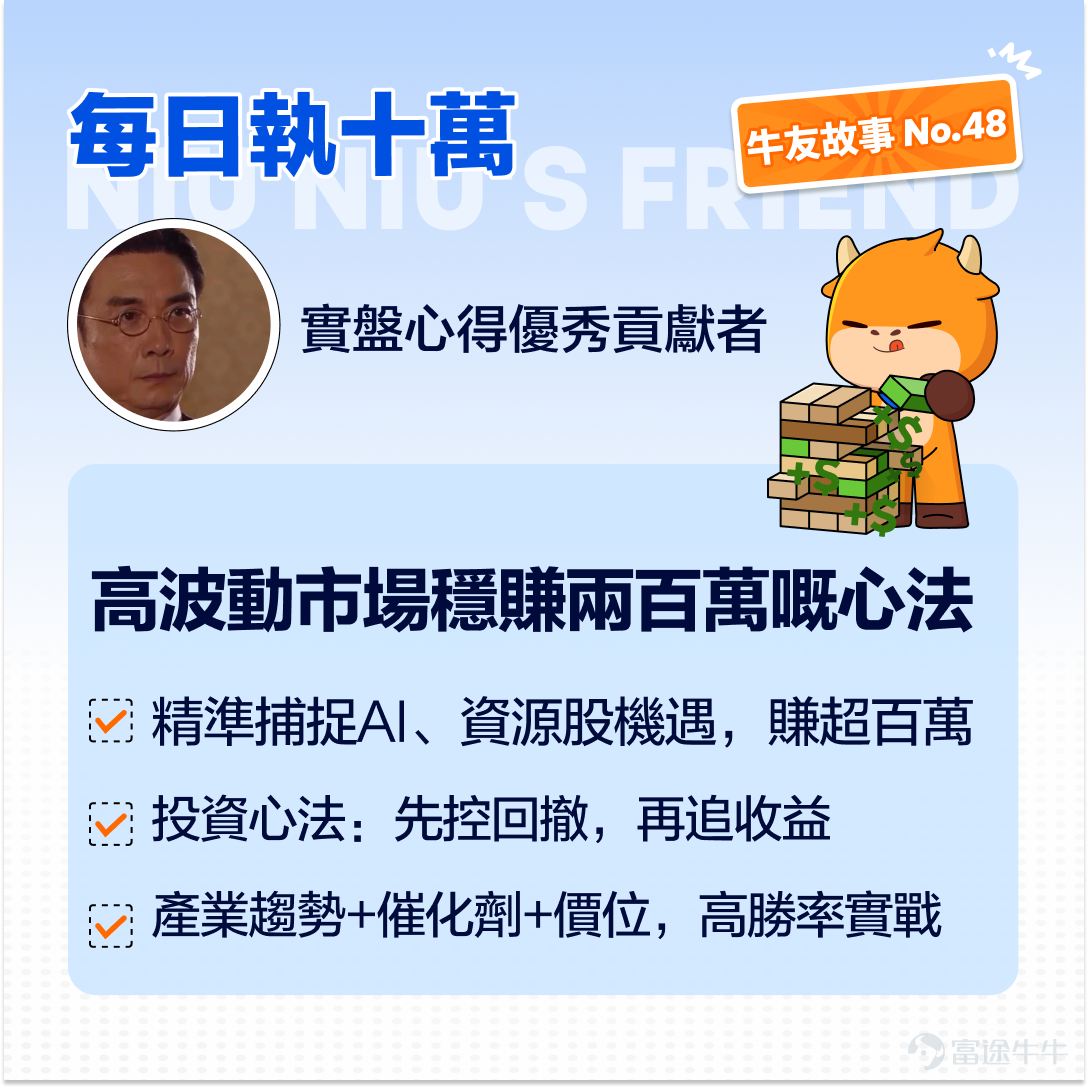

[Investor Story] From the AI wave to the rise of resources, how to steadily earn two million in a highly volatile market?
"Control drawdowns first, then chase returns."In this Investor Story, we invited an active fellow investor from the Futu investment community.@每日執十萬An in-depth conversation with him.With eleven years of Hong Kong and US stock investment experience, he relies on a trading system of "industry chain mining + extreme risk control."Precisely positioning in AI computing power, internet, and resource stocks,achieving a portfolio profit of over 2 million Hong Kong dollars!How did he discover winning stocks through the "industry chain map"? And how did he avoid significant drawdowns amidst extreme market volatility? This issue will share detailed insights~
Friendly reminder: This article contains a lot of practical content, it's recommended to like, save, and share! Leave a comment at the end for a surprise~

I. From Development to Investment | Building a "Replicable" High-Win-Rate Program
Q: Hello, Jack, could you give us a brief introduction?
A: Hello, fellow investors. I mainly work on mobile application development, and my daily investments focus on Hong Kong stocks and US stocks. I have been investing since 2015, with about eleven years of experience. My strength lies in strategies that combine "Theme/Industry Trend + Catalysts + Price Level", where I engage in both medium-term holdings and event-driven swing trading.
My recent investment focus has been on two main themes: one is AI-related "Infrastructure Chain", covering key areas such as computing power, interconnection, electricity, and heat dissipation; the other is focused on "Resource and Supply Chain Security", such as rare earths and magnetic materials. Additionally, I also participate in IPO subscriptions.

Q: What is your investment style? How do you allocate assets/positions?
A: My investment style leans more towards "Control drawdowns first, then pursue returns".」。Before entering the market, I set the maximum drawdown I can tolerate and the risk per trade.Then, I control the pace by buying in batches and selling in tranches,avoiding heavy positions all at once that could disrupt my strategy due to market volatility.
In terms of asset allocation, I usually divide my portfolio into two parts:
Part of it isthe core position for long-term holding, such as using index ETFs (e.g., $SPDR S&P 500 ETF (SPY.US)$ 、 $Invesco QQQ Trust (QQQ.US)$ ) as the base position;
another part is used foraggressive thematic or stock swing tradingin operation.
In position management, I divide my portfolio into three levels:
1) Core position: Long-term holding, low turnover;
2) Thematic position: Adjustments based on market trends or industry themes;
3) Trading position: Operations targeting short-term catalysts or swing opportunities.
Each trade sets a maximum loss limit to avoid a single mistake causing a setback in overall returns.
2. Control drawdown first, then pursue gains | The steady investment philosophy of an eleven-year trading veteran
Q: How do you discover investment potential stocks?
A: My stock selection logic can be summarized into four key aspects:
Trend — whether the industry has long-term growth momentum;
Company — whether it occupies a key position in the supply chain and if its products have room for significant growth;
Catalysts — including order fulfillment, product certification, policy promotion, or better-than-expected performance as potential driving factors;
Valuation — whether the market has already fully priced in the positive factors.
When searching for potential stocks, I usually start with the "industry chain map". For example, when researching AI data centers, Inot only focus on the popular GPU sector but also extend upstream to areas like high-speed interconnects, connectors and cables, power systems, and liquid cooling solutions.Although these sectors are relatively low-profile, they often benefit more directly during periods of demand expansion. Based on this logic, I pay special attention tocompanies that possess technological advantages and hold key positions, $FIT HON TENG (06088.HK)$such as firms with strong technical expertise and strategic roles in the supply chain,。

Q: How do you choose buy and sell points?
In terms of buying opportunities, I mainly consider two factors:
1) whether key catalysts are currently developing or about to materialize;
2) Whether the stock price offers an ideal risk-reward ratio. This means that if the judgment is wrong, the stop-loss point should be very close; and if the direction is correct, the potential upside should be large enough.
As for the selling strategy, the logic is reversed—When valuations are overextended, positive catalysts have materialized, or technical indicators show structural breakdowns, I will choose to take partial profits or cut losses, rather than being fixated on 'selling at the peak.' More importantly,ensuring that profits are converted into cash flow while continuously accumulating replicable win rates.。
Q: How do you manage risks in trading?
A: In terms of risk management, I prefer the principle of 'placing an order equals risk control'—Setting a stop-loss simultaneously upon entry (sometimes also setting a take-profit order)., and duringextreme market volatility, proactively reduce leverage and adjust overall positions(such as the current uncertainty between the US and Iran), to ensure that you are not forced to exit at the moment of poorest liquidity.
III. Industry Chain Opportunities | Precisely Capture AI and Resource Investment Opportunities
Q: Current AI valuations are generally not low. Which parts of the industry chain and individual stocks do you favor?
A: Within the AI industry,the most attention is on the structural investment opportunities brought by 'continuously expanding computing power demands'。focusing on key bottleneck areas such as high-speed data connectivity, power supply architecture, and liquid cooling technologies.These are the core foundations for whether data centers can further increase power density and operational stability.
Take Hon Hai Precision, for example. It has repeatedly demonstrated in public information its high-speed connectors, high-power supply systems, and liquid cooling solutions, positioning itself as a beneficiary of 'AI data center infrastructure connectivity and cooling solutions.'
Aside from that, I'm most optimistic about the electricity and energy infrastructure theme. Keep an eye on US stocks $Energy Select Sector SPDR Fund (XLE.US)$The component stocks of$Exxon Mobil (XOM.US)$ , $Chevron (CVX.US)$ ), $Utilities Select Sector SPDR Fund (XLU.US)$ etc. After all, wherever the bottleneck is in the future, that’s where the capital will flow.
AI investment falls more into the category of 'growth and penetration rate,' with a focus on product iteration speed, changes in demand curves, and evolution of competitive dynamics. Due to high valuation volatility and greater fluctuations, these types of assets require a phased investment approach, using events or catalyst progress as validation criteria.

Q: Asset-based stocks have been very popular this year; how do you view the prospects moving forward?
A: Take rare earths as an example,Rare earths are more like a configuration for 'supply chain security and strategic resources' rather than just commodities for speculation.rather than simply being used for commodity speculation.$USA Rare Earth (USAR.US)$For example, this company is clearly positioned to establish a domestic supply chain for rare earth magnetic materials in the United States.Its development path includes building magnet manufacturing plants and upstream resource deployment. The underlying logic behind its benefits comes from supply chain rebuilding and industrial policy support.However, I will also remind myself:Stocks related to rare earths are highly volatile and sensitive to news; therefore, I prefer to participate with a smaller position, focusing on events and milestones (e.g., factory construction progress, cooperative projects, supply agreements) rather than using high leverage to bet on short-term price fluctuations.
Asset-based stocks lean more towards the logic of 'discounted cash flow and risk pricing,' with the core being asset quality and debt cost. This type of investment is suitable for long-term holding and regular rebalancing strategies, focusing on stable returns rather than short-term valuation changes.
IV. Future Outlook | Heartfelt Advice for Fellow Investors
Q: Where do you think the next golden track will be?
Chips and semiconductors have been on the rise from 2023 to 2026. Flash memory semiconductors and optical communication sectors have already seen significant increases. I believe the next explosive growth area will beElectric power and energy infrastructure themes。
Q: How to avoid large drawdowns during extreme market volatility?
I prioritize risk control:First, reduce leverage and position size, then apply disciplined stop-loss/take-profit strategies and trade in batches, controlling the impact of a single mistake within an acceptable range.
Additionally, it is recommended thatevery time you buy, immediately set a corresponding conditional stop-loss order (based on your acceptable loss, such as 3% / 5%, or setting the stop-loss at the previous support level, etc.).Futu offers a conditional stop-loss order feature that can be utilized effectively.

Q: What investment advice would you share with new users?
1)Survive first: The most important thing for beginners is not to chase returns immediately,but to first establish a process that is 'repeatable and controls risk'.No matter how confident you are in the related assets you're about to buy,it's essential to manage risk and set stop-losses.Consider this: if you lose 50%, you'll need a 100% gain just to get back to your original capital. But if you cut losses at 5%, you only need a 5.3% gain to return to your initial investment.
2)At the beginning, you can choose ETFs from different sectors,rather than directly buying individual stocks, which can reduce the impact of large fluctuations in a single asset on your mood and returns, minimizing the risk of significant losses.
3)Avoid using leverage right away:Margin trading requires understanding the risks of margin calls and amplified losses; new investors should wait until their strategy is mature before engaging.
4)Make good use of Futu’s paper trading account for practice,and test your strategies.
Q: What are some favorite features of Futu?
Looking at my ID (7213611), you should already know that I started using Futu relatively early. I have been using Futu as my main stock trading platform since 2018.
Primarily because of the simple UI operations and multiple functions (placing conditional orders, building your own stock screener, supporting buying and selling across different markets/exchanges), stable and fast app performance, and alsothe 'Investor Story' community feature, which makes the overall investment experience more comprehensive and interactive,The recently added Futubull AI allows me to quickly get the information I need in a targeted way。

That’s about it for this sharing session~ I’m very happy to have interviewed Jack! Once again, thank you to our loyal user Jack for taking the time to participate in this interview. Looking forward to sharing more exciting trading stories and investment methods in the Investor Story community~
[Interactive Giveaway] The AI wave is in full swing, have fellow investors discovered any lesser-known good related assets? Any wealth-jumping investment stories?
Share insights and experiences in the comment section. Fellow investors who write over 30 words and make a reasonable argument can receive 66 points~
If you find this article inspiring for your investment journey, feel free to @ your friends to read it together~
Event deadline: 24:00 on March 17, 2026
*Disclaimer: Interview date: February 28, 2025. The content of this article was compiled from an interview with @每日執十萬 by @Investor Story . Images in the article were provided and authorized for use by @每日執十萬 . The views expressed by the guest in this program are personal opinions and do not represent the position of Futu, nor do they constitute professional advice. Information related to the article does not constitute any industry or index recommendation; information and introductions of individual stocks mentioned only represent the user’s personal opinion and do not constitute a stock recommendation. Past performance of individual stocks is not indicative of future results. The stock market involves risks, and investment should be made with caution.
Risk Disclaimer: The above content only represents the author's view. It does not represent any position or investment advice of Futu. Futu makes no representation or warranty.Read more


Comments (209)
to post a comment
316
124