
The US-Iran peace talks present conflicting narratives! What’s next for oil prices?

Essential Gold Investment Course (3): Escalation in the US-Israel-Iran Situation: Observations on the Gold Market Amid Geopolitical Risks
Recently, tensions in the Middle East have escalated once again. On February 28, Israel and the United States jointly carried out a military strike against Iran, after which Iran retaliated, drawing widespread market attention to further developments in the regional situation. International gold prices showed significant fluctuations, with spot gold closing up 1.88% at $5,278.33 per ounce as of February 27.
I. Event Background: Rising Regional Tensions
On February 28, 2026, the US and Israel jointly carried out airstrikes on multiple targets within Iran. In retaliation, Iran launched strikes against Israel and US military bases in related areas. The conflict has raised the risk of disruptions to energy transportation through the Strait of Hormuz, leading several international oil companies to suspend operations on relevant shipping routes. As of the time of writing, neither side has shown any willingness to cease fire, and the situation continues to evolve.
II. Historical Performance and Current Reaction in the Gold Market
Historical experience shows that gold prices tend to demonstrate resilience during periods of heightened geopolitical risks. Whether regional conflicts or global突发事件,黄金作为传统的避险资产,其价格在事件初期通常会迅速反应,随后进入震荡调整阶段。这一现象的背后,是黄金作为一种无主权信用背书的实物资产,在市场不确定性上升时,部分资金会选择将其作为风险对冲工具。
Before this round of conflict erupted, gold prices had already shown some reaction. On February 27, spot gold surged by 1.88% in a single day, breaking through the $5,250 per ounce mark. From a capital flow perspective, global gold ETFs saw a net inflow of over $2 billion that day, indicating that some investors are adjusting their asset allocation structures.
III. The Logic Behind Gold Prices Amid Multiple Interwoven Factors
The impact of geopolitical conflicts on gold is not isolated but manifests through multiple transmission mechanisms:
1. The interconnection between energy supply and inflation expectations
As a major oil-producing country, Iran's surrounding Strait of Hormuz is a critical channel for global energy transportation. Data shows that about 30% of the world’s seaborne crude oil passes through this strait daily. If the conflict disrupts passage through this channel, oil supplies could be affected, thereby pushing up oil prices. Historical data indicates a certain positive correlation between oil prices and gold prices, with rising oil prices often affecting the gold market via inflation expectations. $Crude Oil Futures (JUL6) (CLmain.US)$$Gold Futures (JUN6) (GCmain.US)$
2. Long-term support from monetary policy and central bank gold purchases
Apart from geopolitical factors, the gold market is also continuously influenced by the global monetary policy cycle and central bank gold purchasing behavior. As of the end of January 2026, the People's Bank of China has been consecutively increasing its gold reserves for 15 months, while central banks across various countries continue to push forward with diversified reserve asset allocation. This structural trend provides long-term support for gold demand. Additionally, market expectations regarding the Federal Reserve’s interest rate cuts also influence the cost of holding gold to some extent.
IV. Characteristics and Volatility Logic of Gold Mining ETFs
For investors focusing on the gold market, gold mining ETFs are an instrument worth understanding. Unlike gold ETFs that directly track gold prices, gold mining ETFs invest in stocks of companies engaged in gold mining. The pricing logic of these assets is related to the gold price but has its own characteristics.
From a business model perspective, mining companies' profitability is highly correlated with the gold price. When the price of gold rises, the sales revenue and profit margins of mining companies often expand simultaneously; conversely, a drop in the gold price may squeeze their profitability. The presence of this operating leverage means that gold mining ETFs may exhibit stronger elasticity than gold prices during bullish cycles, but their volatility tends to be more pronounced during periods of gold price adjustments.
In terms of risk characteristics, mining ETFs are influenced not only by movements in the gold price but also by factors such as the operational conditions of individual mining stocks, extraction costs, and regional political risks. Therefore, the volatility of these assets is typically higher than direct investments in physical gold or gold ETFs.
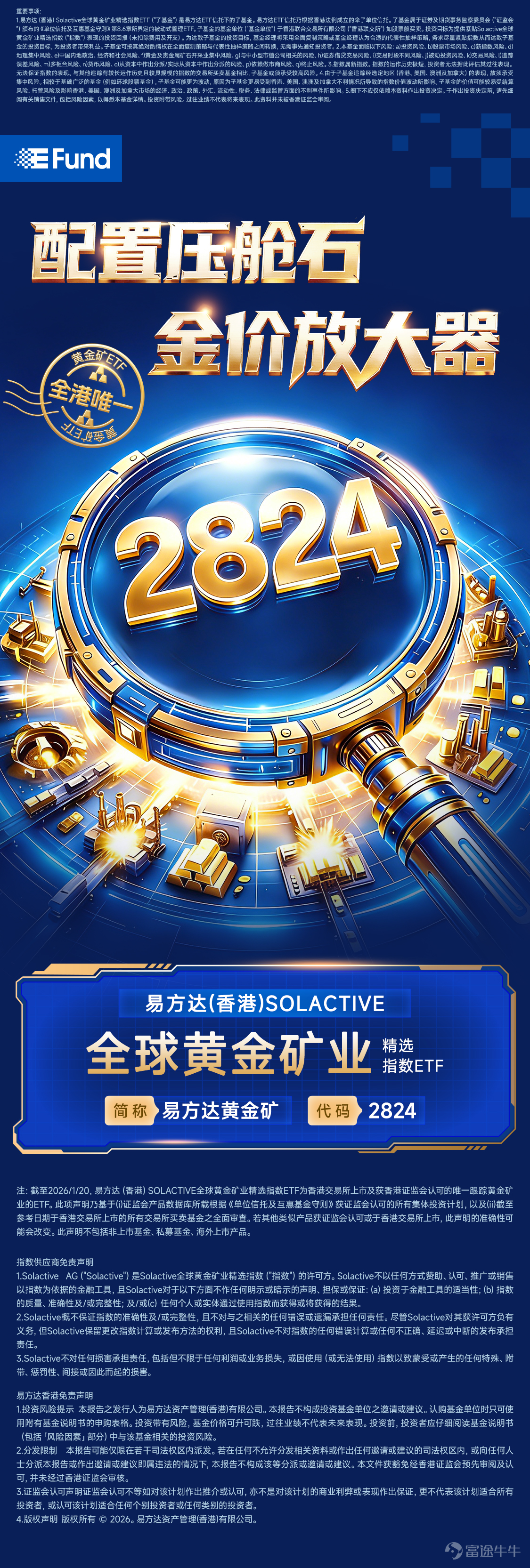
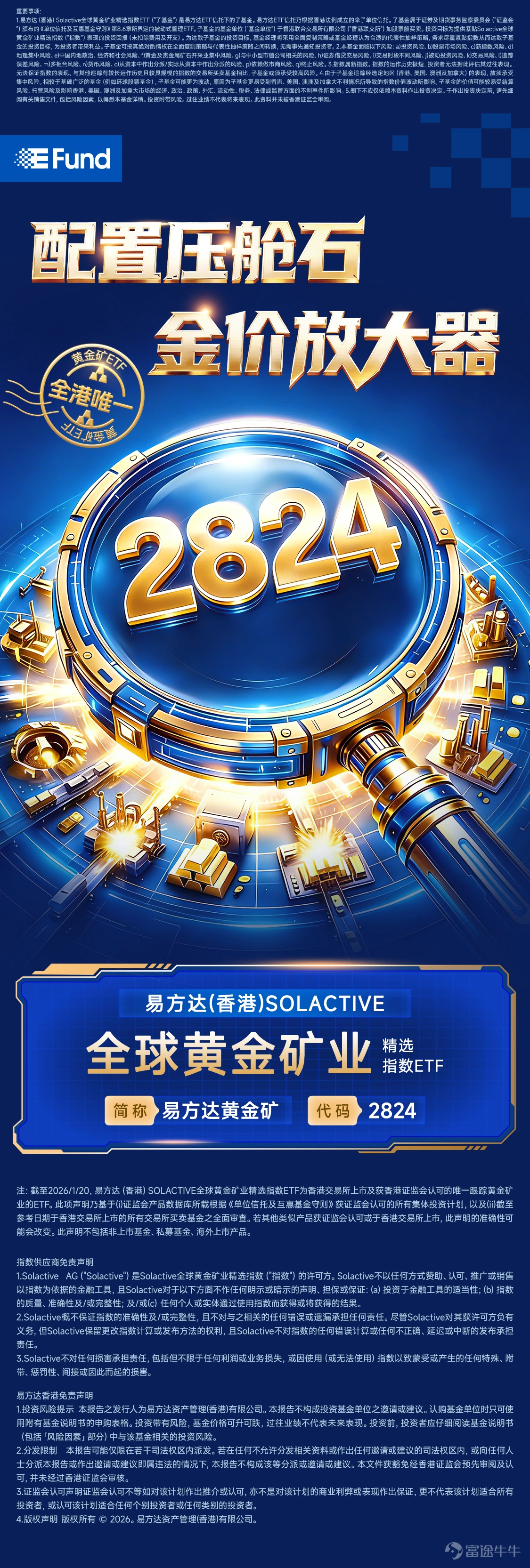
As the only gold mining ETF currently available in Hong Kong, the E Fund Gold Mining ETF (2824) aims to closely track the Solactive Global Gold Mining Select Index, covering 30 leading stocks across four major gold-producing regions in China, Canada, the US, and Australia, including giants like Zijin Mining,$ZIJIN MINING (02899.HK)$Zhaojin Mining Industry$ZHAOJIN MINING (01818.HK)$Wait for domestic gold giants, also covering Newmont.$Newmont (NEM.US)$Barrick Gold Corporation$Barrick Mining (B.US)$, as well as overseas quality entities such as Newmont and Barrick Mining, balancing geographical diversification with leadership concentration advantages.$Hang Seng Index (800000.HK)$$NASDAQ (NASDAQ.US)$
Data source: Wind, as of March 1, 2026
Important Information: The issuer of this content is E Fund Management (Hong Kong) Co., Ltd. This content does not constitute an invitation or recommendation to invest in fund units. Investment involves risks, and fund prices can go up or down. Past performance is not indicative of future results. Before investing, investors should carefully read the fund prospectus (including the "Risk Factors" section) for investment risks associated with the fund. This content has not been reviewed by the Hong Kong Securities and Futures Commission. For detailed important notices and disclaimers regarding the E Fund (Hong Kong) Solactive Global Gold Mining Select Index ETF (2824), please visit the E Fund (Hong Kong) website:https://www.efunds.com.hk/tc/products/51/important/ 。
Risk Disclaimer: The above content only represents the author's view. It does not represent any position or investment advice of Futu. Futu makes no representation or warranty.Read more


Comments
to post a comment
6
2