English
Back
Open Account
The US-Iran peace talks present conflicting narratives! What’s next for oil prices?

牛牛課堂
joined discussion · Mar 4 20:20 ·

[Opportunity Express] Global attention on Hormuz! Oil prices soar, Trump speaks to suppress; how to respond?

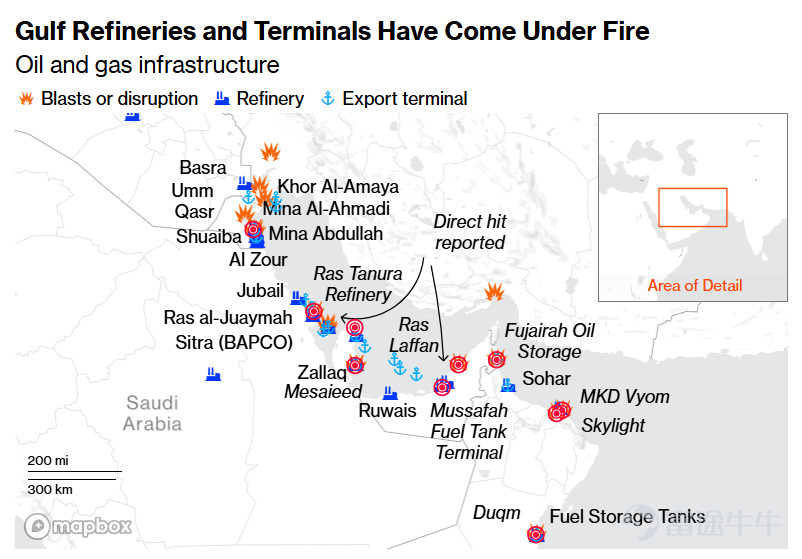
The US and Israel launched military strikes against Iran, causing Middle East geopolitical risks to escalate sharply. The Strait of Hormuz, the narrow waterway between the Persian Gulf and the Gulf of Oman, overnight became the focus of global attention.
About 20 million barrels of crude oil pass through this 'maritime lifeline' every day to be shipped around the world.Crude oil transported via this strait accounts for approximately one-fifth of the total volume of global oil transportation, with an average of one supertanker passing through every ten minutes.
On the evening of February 28, the Iranian Islamic Revolutionary Guard announced a ban on any vessels passing through the Strait of Hormuz. The following day, an oil tanker attempting to pass through was struck. This directly triggered panic in the global energy market.
In response to soaring oil prices and market panic, US President Trump also responded on the 3rd. He stated thatif necessary, the US Navy will begin escorting oil tankers passing through the Strait of Hormuz.
The US and Israel launched a military strike against Iran, sharply escalating geopolitical risks in the Middle East. The Strait of Hormuz, the narrow waterway between the Persian Gulf and the Gulf of Oman, has overnight become the focus of global attention. About 20 million barrels of crude oil pass through this 'maritime lifeline' every day,Crude oil transported through this strait accounts for about one-fifth of the total global oil transportation, with a giant oil tanker passing through approximately every 10 minutes. On the evening of February 28, Iran’s Islamic Revolutionary Guard Corps announced a ban on any vessels passing through the Strait of Hormuz. The next day, an oil tanker attempting to pass through was struck. This directly triggered panic in the global energy market. In response to soaring oil prices and market panic, US President Trump also responded on the 3rd. He stated,If necessary, the US Navy will begin escorting oil tankers through the Strait of Hormuz. How will this crisis reshape the energy landscape and asset prices, and how should investors respond? The 'chokepoint' of crude oil Although the Revolutionary Guard has not yet implemented a full military blockade, the extremely high risk of attack and skyrocketing war risk premiums have led shipowners to voluntarily suspend operations and adopt a wait-and-see approach. This has caused traffic in the strait to drop to near zero. Many of the world's top shipping companies (such as $A.P. Moller - Maersk A/S Unsponsored ADR (AMKBY.US)$ , Mediterranean Shipping, $COSCO SHIP HOLD (01919.HK)$ , etc.) have suspended route services or new booking operations. The sudden disruption of a key physical channel...
How will this crisis reshape the energy landscape and asset prices, and how should investors respond?
The 'chokepoint' of crude oil
Although the Revolutionary Guard has not yet achieved a complete military blockade, the extremely high risk of attacks and skyrocketing war risk insurance premiums have led shipowners to voluntarily suspend operations, causing traffic in the strait to drop to near zero. Many of the world's top shipping companies (such as$A.P. Moller - Maersk A/S Unsponsored ADR (AMKBY.US)$Mediterranean Shipping$COSCO SHIP HOLD (01919.HK)$) have suspended route services or new booking operations.
The sudden closure of a key physical channel instantly triggered a 'cardiac arrest' in the global crude oil supply chain. Once the Strait of Hormuz is closed, limited by storage capacity, Persian Gulf oil-producing countries will have to halt production after at most 25 consecutive days of production. The vulnerability of the global energy system has been suddenly magnified, with impacts rapidly spreading along the supply chain.
Major Asian energy importers are the first to be hit. About 90% of Japan’s imported crude oil comes from the Middle East, with most transported through the Strait of Hormuz; around 70%-73% of South Korea’s imported crude oil also originates from the Middle East.The recent sharp adjustments in the Japanese and Korean stock markets, aside from structural trading factors (especially South Korea’s heavy reliance on two memory giants), cannot ignore the impact of the energy crisis.
A physical cutoff of an average daily supply of 20 million barrels will push oil prices into extreme levels. Market consensus predicts that if the blockade lasts over a month, oil prices could quickly rise above $100 per barrel, potentially reaching $150 under extreme scenarios. The OPEC+ announced daily increase of 206,000 barrels (only about 1% of normal shipping volume) and Saudi Arabia and the UAE’s limited alternative pipelines are completely unable to fill the gap.
Before the conflict erupted, Iran’s crude oil production was approximately 3.3 million barrels per day, with exports at about 1.6 million barrels per day. Its production and exports face immediate and profound impacts in the short term.The market previously estimated a global oil surplus of about 2.55 million barrels per day in the first half of 2026, but Iran's supply issues alone could offset most of the surplus, leading to a fundamental shift in the supply-demand balance.
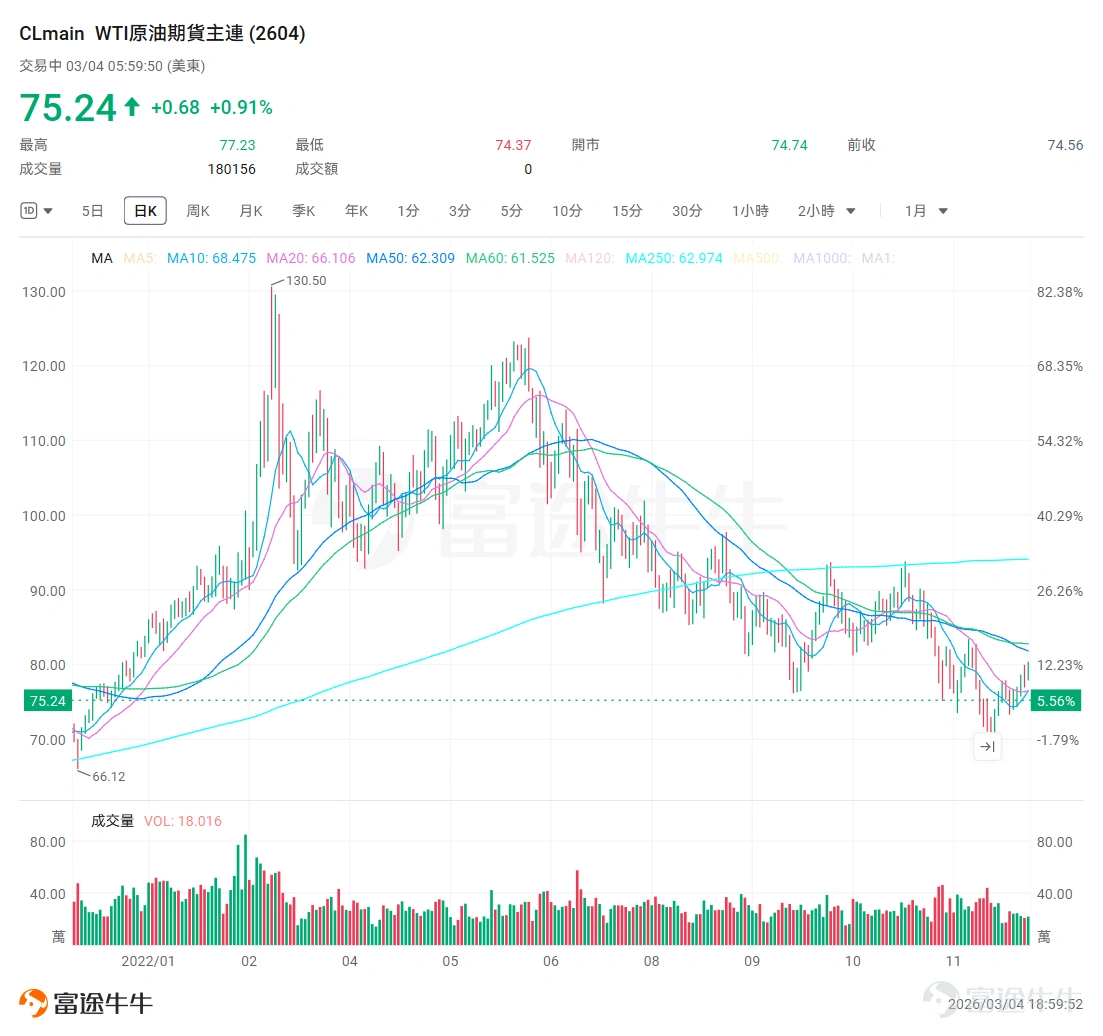
If passage through the strait is obstructed for an extended period, its impact would be analogous to the panic seen in the early stages of the Russia-Ukraine conflict in 2022.At that time, oil prices remained above $90 for more than half a year and experienced two spikes before gradually cooling under the Fed’s aggressive rate hikes.
The US and Israel launched a military strike against Iran, sharply escalating geopolitical risks in the Middle East. The Strait of Hormuz, the narrow waterway between the Persian Gulf and the Gulf of Oman, has overnight become the focus of global attention. About 20 million barrels of crude oil pass through this 'maritime lifeline' every day,Crude oil transported through this strait accounts for about one-fifth of the total global oil transportation, with a giant oil tanker passing through approximately every 10 minutes. On the evening of February 28, Iran’s Islamic Revolutionary Guard Corps announced a ban on any vessels passing through the Strait of Hormuz. The next day, an oil tanker attempting to pass through was struck. This directly triggered panic in the global energy market. In response to soaring oil prices and market panic, US President Trump also responded on the 3rd. He stated,If necessary, the US Navy will begin escorting oil tankers through the Strait of Hormuz. How will this crisis reshape the energy landscape and asset prices, and how should investors respond? The 'chokepoint' of crude oil Although the Revolutionary Guard has not yet implemented a full military blockade, the extremely high risk of attack and skyrocketing war risk premiums have led shipowners to voluntarily suspend operations and adopt a wait-and-see approach. This has caused traffic in the strait to drop to near zero. Many of the world's top shipping companies (such as $A.P. Moller - Maersk A/S Unsponsored ADR (AMKBY.US)$ , Mediterranean Shipping, $COSCO SHIP HOLD (01919.HK)$ , etc.) have suspended route services or new booking operations. The sudden disruption of a key physical channel...
However, it is also important to note that about 90% of Iran's own oil exports rely on this route, and a long-term blockade would amount to 'economic suicide,' drawing collective opposition from global consumer nations and stronger military retaliation from the US.This makes a full and permanent blockade unsustainable, but incremental, high-intensity disruptions are enough to keep global markets paying a hefty risk premium.
The strategic importance of the Strait of Hormuz, as of March 2026, has crystallized into an intuitive fact: it is not only a geographic chokepoint but also a stress test for the global energy system. Its passability directly influences the numbers on trading screens in Tokyo, London, and New York, while indirectly gauging the resilience of the global economy.
Is the commitment to safeguarding oil prices becoming part of the 'TACO' trade?
Trump yesterday delivered a 'combination punch' aimed at addressing the current dilemma:
First, he announced that the US government, through agencies such as the US International Development Finance Corporation (DFC), will provide insurance for international trade passing through the Strait of Hormuz.This is equivalent to using US national credit to insure shipping voyages, with the goal of replacing the now-defunct commercial insurance market, reducing shipowners’ economic risks, and encouraging them to resume navigation.This is an attempt to break the deadlock of the 'shipping freeze' at the economic level.
At the same time, a deterrent military signal was sent: 'If necessary, the US military may escort merchant ships,' emphasizing that 'no matter what, the US will ensure the free flow of global energy.'This directly positions the US as the 'ultimate guarantor' of the global shipping order, responding to the most pressing physical security needs following the de facto closure of the strait.
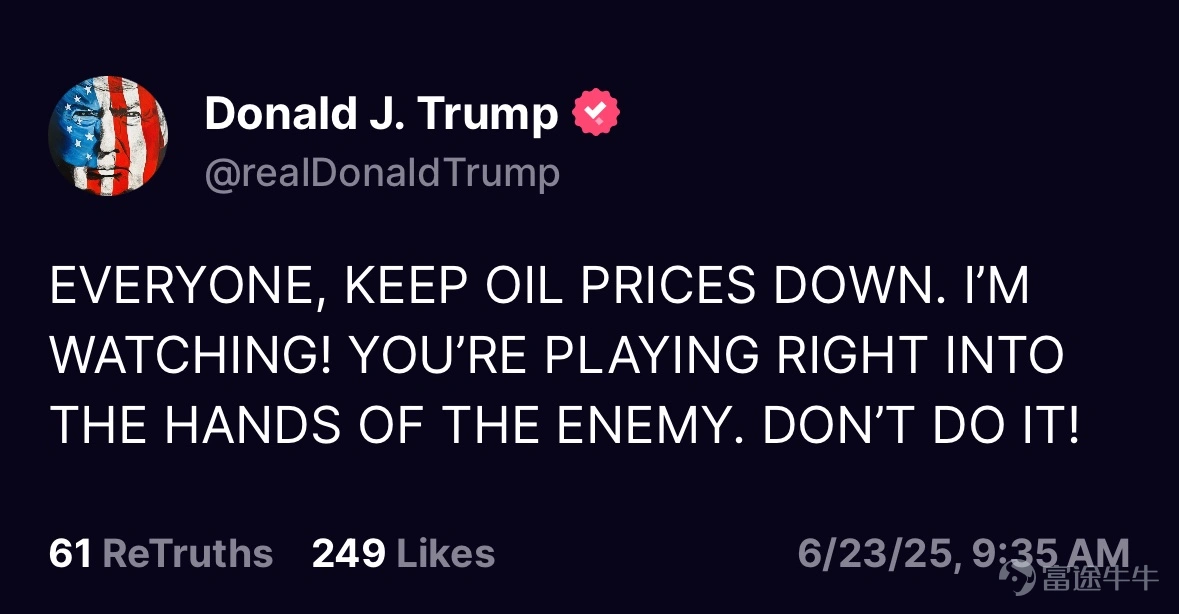
In fact, after the bombing of Iran's nuclear facilities in June last year, Trump also made it clear that 'oil prices must fall.' At that time, the market was briefly panicked, with oil prices quickly surging to the 78-79 dollar range, but gradually retreated as tensions eased. However, the scale and intensity of this conflict far exceed those of June last year.
The US and Israel launched a military strike against Iran, sharply escalating geopolitical risks in the Middle East. The Strait of Hormuz, the narrow waterway between the Persian Gulf and the Gulf of Oman, has overnight become the focus of global attention. About 20 million barrels of crude oil pass through this 'maritime lifeline' every day,Crude oil transported through this strait accounts for about one-fifth of the total global oil transportation, with a giant oil tanker passing through approximately every 10 minutes. On the evening of February 28, Iran’s Islamic Revolutionary Guard Corps announced a ban on any vessels passing through the Strait of Hormuz. The next day, an oil tanker attempting to pass through was struck. This directly triggered panic in the global energy market. In response to soaring oil prices and market panic, US President Trump also responded on the 3rd. He stated,If necessary, the US Navy will begin escorting oil tankers through the Strait of Hormuz. How will this crisis reshape the energy landscape and asset prices, and how should investors respond? The 'chokepoint' of crude oil Although the Revolutionary Guard has not yet implemented a full military blockade, the extremely high risk of attack and skyrocketing war risk premiums have led shipowners to voluntarily suspend operations and adopt a wait-and-see approach. This has caused traffic in the strait to drop to near zero. Many of the world's top shipping companies (such as $A.P. Moller - Maersk A/S Unsponsored ADR (AMKBY.US)$ , Mediterranean Shipping, $COSCO SHIP HOLD (01919.HK)$ , etc.) have suspended route services or new booking operations. The sudden disruption of a key physical channel...
Why does Trump value oil prices so much?Crude oil, known as the 'mother of all commodities,' is not only a crucial energy source but also a raw material for various industries, playing a vital role in inflation as the upstream of many industrial chains.When oil prices rise, it’s not just the price of gasoline at the pump that is affected; the costs of plastics, synthetic fibers, fertilizers, pesticides, and even cosmetics will also go up.
Keeping oil prices low is a core strategy for Trump to consolidate his governing foundation and fulfill his campaign promises,especially as the midterm elections are approaching. Any spike in oil prices due to an energy crisis would be a direct blow to his political credibility.He must prove to the market that the US has the ability to control the situation and prevent an energy crisis and economic instability.
Since returning to the White House, Trump's policies have frequently swung between radical proposals and practical feedback, giving rise to the TACO trade (Trump Always Chicken Out), which was particularly evident during last year’s 'Tariff Day' shock.This statement by Trump also reflects his shift from initially pushing for regime change to focusing more on the spillover effects of the conflict, especially its economic impact.
Bloomberg expects oil prices to likely remain in the $65-80 range, with the probability of a significant surge being 'moderately low.'
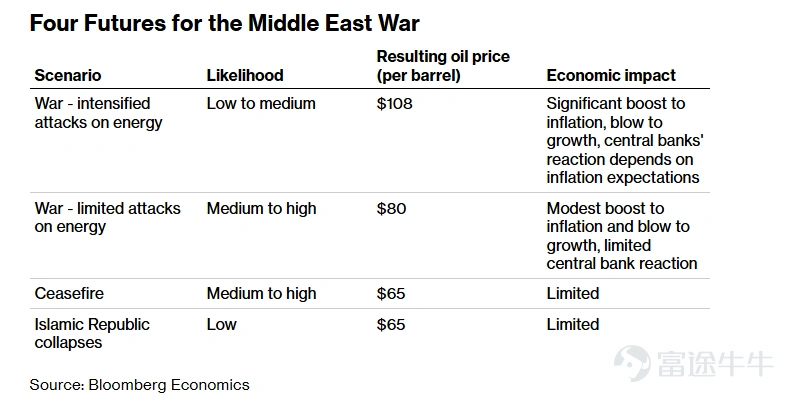
The US and Israel launched a military strike against Iran, sharply escalating geopolitical risks in the Middle East. The Strait of Hormuz, the narrow waterway between the Persian Gulf and the Gulf of Oman, has overnight become the focus of global attention. About 20 million barrels of crude oil pass through this 'maritime lifeline' every day,Crude oil transported through this strait accounts for about one-fifth of the total global oil transportation, with a giant oil tanker passing through approximately every 10 minutes. On the evening of February 28, Iran’s Islamic Revolutionary Guard Corps announced a ban on any vessels passing through the Strait of Hormuz. The next day, an oil tanker attempting to pass through was struck. This directly triggered panic in the global energy market. In response to soaring oil prices and market panic, US President Trump also responded on the 3rd. He stated,If necessary, the US Navy will begin escorting oil tankers through the Strait of Hormuz. How will this crisis reshape the energy landscape and asset prices, and how should investors respond? The 'chokepoint' of crude oil Although the Revolutionary Guard has not yet implemented a full military blockade, the extremely high risk of attack and skyrocketing war risk premiums have led shipowners to voluntarily suspend operations and adopt a wait-and-see approach. This has caused traffic in the strait to drop to near zero. Many of the world's top shipping companies (such as $A.P. Moller - Maersk A/S Unsponsored ADR (AMKBY.US)$ , Mediterranean Shipping, $COSCO SHIP HOLD (01919.HK)$ , etc.) have suspended route services or new booking operations. The sudden disruption of a key physical channel...
How to deploy options strategies
At the current stage, the most benefited sub-sector is undoubtedly upstream companies in the oil and gas field, particularly producers focused on US domestic shale oil.These companies enjoy the benefits of rising oil prices while avoiding operational risks in the Middle East. Additionally, the US's position as a net energy exporter gives it strategic value as an 'alternative supply' source during times of tight global supply.
$Occidental Petroleum (OXY.US)$ As the leading shale oil company long favored by Buffett, this firm has drawn significant attention during this round of conflict. The implied volatility (IV) of its options has recently risen, with the current IV Percentile reaching 93%, indicating that its IV is at an extremely high level over the past year, typically advantageous for option sellers.
Recently, call option trading volumes have been significantly higher than put option volumes, with the Put/Call Ratio at a low of 0.2, reflecting optimistic market sentiment.However, large-scale call option selling transactions have been detected over the past two trading days.
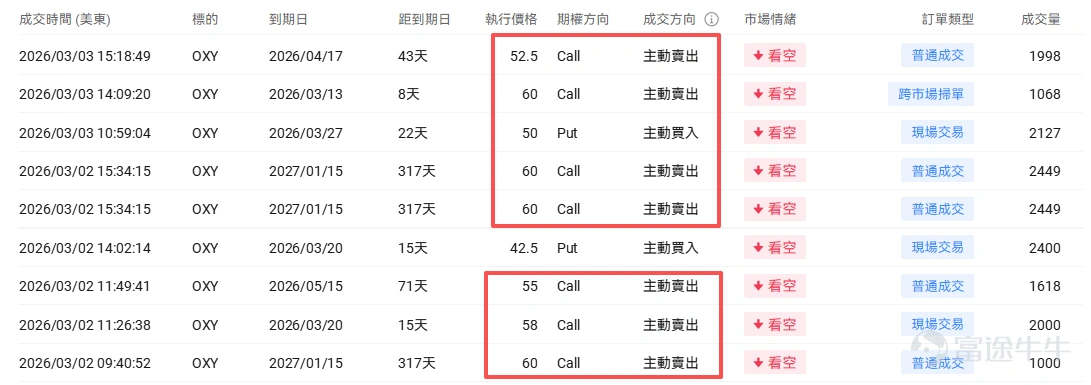
The US and Israel launched a military strike against Iran, sharply escalating geopolitical risks in the Middle East. The Strait of Hormuz, the narrow waterway between the Persian Gulf and the Gulf of Oman, has overnight become the focus of global attention. About 20 million barrels of crude oil pass through this 'maritime lifeline' every day,Crude oil transported through this strait accounts for about one-fifth of the total global oil transportation, with a giant oil tanker passing through approximately every 10 minutes. On the evening of February 28, Iran’s Islamic Revolutionary Guard Corps announced a ban on any vessels passing through the Strait of Hormuz. The next day, an oil tanker attempting to pass through was struck. This directly triggered panic in the global energy market. In response to soaring oil prices and market panic, US President Trump also responded on the 3rd. He stated,If necessary, the US Navy will begin escorting oil tankers through the Strait of Hormuz. How will this crisis reshape the energy landscape and asset prices, and how should investors respond? The 'chokepoint' of crude oil Although the Revolutionary Guard has not yet implemented a full military blockade, the extremely high risk of attack and skyrocketing war risk premiums have led shipowners to voluntarily suspend operations and adopt a wait-and-see approach. This has caused traffic in the strait to drop to near zero. Many of the world's top shipping companies (such as $A.P. Moller - Maersk A/S Unsponsored ADR (AMKBY.US)$ , Mediterranean Shipping, $COSCO SHIP HOLD (01919.HK)$ , etc.) have suspended route services or new booking operations. The sudden disruption of a key physical channel...
(1) For those already holding positions, it is judged that oil prices will consolidate at high levels.
This could be the source of the recent frequent large sell orders for call options. This strategy generates premium income while holding the underlying stock, enhancing returns. With the current share price at a recent high, selling call options can lock in some profits, and high implied volatility (IV) provides a thicker premium. However, the risk is that if the stock price rises significantly beyond the strike price, the stocks may be forced to sell at a lower price, missing out on potential gains.
The US and Israel launched a military strike against Iran, sharply escalating geopolitical risks in the Middle East. The Strait of Hormuz, the narrow waterway between the Persian Gulf and the Gulf of Oman, has overnight become the focus of global attention. About 20 million barrels of crude oil pass through this 'maritime lifeline' every day,Crude oil transported through this strait accounts for about one-fifth of the total global oil transportation, with a giant oil tanker passing through approximately every 10 minutes. On the evening of February 28, Iran’s Islamic Revolutionary Guard Corps announced a ban on any vessels passing through the Strait of Hormuz. The next day, an oil tanker attempting to pass through was struck. This directly triggered panic in the global energy market. In response to soaring oil prices and market panic, US President Trump also responded on the 3rd. He stated,If necessary, the US Navy will begin escorting oil tankers through the Strait of Hormuz. How will this crisis reshape the energy landscape and asset prices, and how should investors respond? The 'chokepoint' of crude oil Although the Revolutionary Guard has not yet implemented a full military blockade, the extremely high risk of attack and skyrocketing war risk premiums have led shipowners to voluntarily suspend operations and adopt a wait-and-see approach. This has caused traffic in the strait to drop to near zero. Many of the world's top shipping companies (such as $A.P. Moller - Maersk A/S Unsponsored ADR (AMKBY.US)$ , Mediterranean Shipping, $COSCO SHIP HOLD (01919.HK)$ , etc.) have suspended route services or new booking operations. The sudden disruption of a key physical channel...
(The design images displayed on screen are for illustrative purposes only and do not constitute any investment advice or guarantees; market conditions fluctuate frequently, and the option prices shown do not represent real-world values.)
(2) Moderately bullish on oil prices
Simultaneously buying call options with a lower strike price and selling call options with a higher strike price reduces premium costs in a high volatility environment but also caps maximum gains.
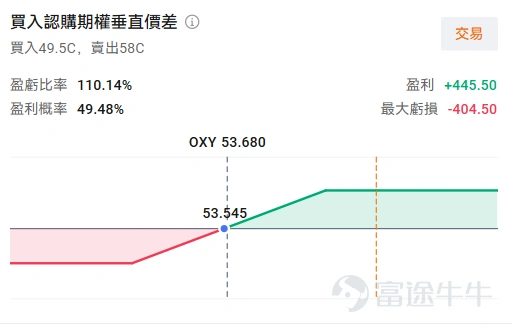
The US and Israel launched a military strike against Iran, sharply escalating geopolitical risks in the Middle East. The Strait of Hormuz, the narrow waterway between the Persian Gulf and the Gulf of Oman, has overnight become the focus of global attention. About 20 million barrels of crude oil pass through this 'maritime lifeline' every day,Crude oil transported through this strait accounts for about one-fifth of the total global oil transportation, with a giant oil tanker passing through approximately every 10 minutes. On the evening of February 28, Iran’s Islamic Revolutionary Guard Corps announced a ban on any vessels passing through the Strait of Hormuz. The next day, an oil tanker attempting to pass through was struck. This directly triggered panic in the global energy market. In response to soaring oil prices and market panic, US President Trump also responded on the 3rd. He stated,If necessary, the US Navy will begin escorting oil tankers through the Strait of Hormuz. How will this crisis reshape the energy landscape and asset prices, and how should investors respond? The 'chokepoint' of crude oil Although the Revolutionary Guard has not yet implemented a full military blockade, the extremely high risk of attack and skyrocketing war risk premiums have led shipowners to voluntarily suspend operations and adopt a wait-and-see approach. This has caused traffic in the strait to drop to near zero. Many of the world's top shipping companies (such as $A.P. Moller - Maersk A/S Unsponsored ADR (AMKBY.US)$ , Mediterranean Shipping, $COSCO SHIP HOLD (01919.HK)$ , etc.) have suspended route services or new booking operations. The sudden disruption of a key physical channel...
(The design images displayed on screen are for illustrative purposes only and do not constitute any investment advice or guarantees; market conditions fluctuate frequently, and the option prices shown do not represent real-world values.)
Risk Disclosure: This content does not constitute a research report and is for reference only. It is not intended as a basis for any investment decision. The information provided herein does not comprehensively describe the securities, markets, or developments mentioned. While the sources of information are considered reliable, no guarantee is made regarding the accuracy or completeness of the content above. Additionally, no assurance is given regarding the accuracy of any statements, opinions, or forecasts provided herein.
Risk Disclaimer: The above content only represents the author's view. It does not represent any position or investment advice of Futu. Futu makes no representation or warranty.Read more
Emm
3
Thumbs Up
13
285K Views
Report
Comments (3)
Write a Comment...
3
16
16