
NVIDIA's Q4 earnings report was impressive, but why is the market not responding positively?

Breaking Down NVIDIA's Q4 Earnings Report
NVIDIA’s latest earnings report has once again become a piece of news capable of moving global markets. The artificial intelligence chip giant announced Q4 results that surpassed Wall Street's previous expectations in both revenue and profits. At the same time, the company’s guidance for the next quarter is stronger than the market consensus, reinforcing its dominant position at the core of the AI boom.
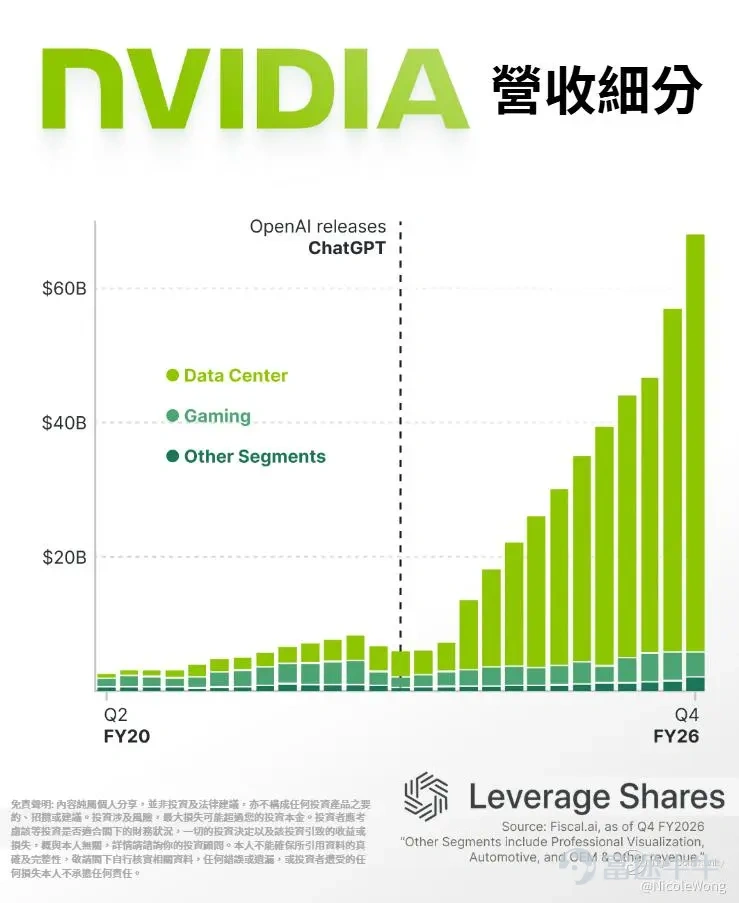
According to the Q4 earnings report, NVIDIA’s revenue reached $68.1 billion, up 73% from the same period last year and 20% higher than the previous quarter. Earnings per share were $1.62, surpassing analysts' average estimate of $1.53.
However, following the release of NVIDIA’s earnings report, the initial market reaction was relatively muted. The stock price rose by about 3% in after-hours trading but then stabilized, possibly indicating that market expectations were already extremely high.
NVIDIA Sets New Benchmark with Q1 Outlook
The focus of the market may not only be on the excellent performance in Q4 but also on future earnings guidance.
NVIDIA forecasts Q1 revenue of approximately $78 billion, which is higher than Wall Street’s previous estimates of $72-73 billion. Notably, this forecast does not include data center computing revenue from China, likely incorporating geopolitical uncertainties into public assumptions, but it also implies potential upside not yet factored into models.
In a market environment accustomed to expecting high figures, NVIDIA’s performance not only met existing benchmarks but could potentially raise them further.
Data Center Revenue Drives AI Boom
As expected, the data center segment remains NVIDIA's growth engine. Revenue from this division reached $62.3 billion, exceeding analyst expectations and showing a 75% year-over-year growth. Hyperscale cloud service providers such as Amazon, Microsoft, Alphabet, and Meta account for more than half of data center revenue. However, NVIDIA also noted that revenue contributions are becoming increasingly diversified, indicating that the construction of artificial intelligence infrastructure is gradually expanding beyond just a few tech giants.
Detailed data shows that computing revenue grew 58% year-over-year, while networking revenue surged 263% to nearly $11 billion. This might reflect that NVIDIA's role has evolved beyond being merely a chip supplier to shipping complete AI systems, network infrastructures, and highly integrated platforms.
Gross Margin Highlights Pricing Power
Gross margin remains a key focus for investors. NVIDIA reported a gross margin of 75% for the quarter under Generally Accepted Accounting Principles (GAAP), which may indicate that despite the company's large-scale hardware transition to its Blackwell architecture, its pricing power remains relatively strong.
The full-year gross margin declined compared to fiscal 2025 as the company expanded capacity and absorbed transition costs, but the stability in quarterly figures may give investors relatively high confidence in its profitability.
Another noteworthy move is that NVIDIA announced it will begin including stock-based compensation in its non-GAAP financial reporting starting in fiscal 2027. Adjusting its reporting standards while raising revenue guidance might reflect management’s confidence in the sustainability of future growth.
AI Capital Expenditure and 2026 Build-Out
Discussions around artificial intelligence spending continue. Some investors may question whether the current pace of capital expenditure can be maintained, while others believe the AI infrastructure build-out cycle may still be in its early stages.
Market expectations are that major hyperscale cloud service providers could invest tens of billions of dollars in AI infrastructure in a single year, 2026 alone, with a significant portion of that spending—ranging from advanced GPUs to networking and end-to-end systems—expected to flow into NVIDIA’s ecosystem.
The key question the market is focused on is: Are we still in the early stages of AI infrastructure development, or are we approaching the midpoint of the cycle? If it’s still early, NVIDIA’s growth runway could extend for several more years; if the cycle is maturing, the pace of expansion may gradually slow down.
Gaming and CPU Business
Outside its core data center segment, NVIDIA’s gaming revenue came in at $3.7 billion, slightly below market expectations. However, reports suggest that the company may soon launch its own laptop CPU, which could put it in more direct competition with Intel, AMD, and Qualcomm. While the profitability of PC chips may not match that of data centers, such a move, if realized, could further solidify NVIDIA’s ecosystem layout, spanning from AI supercomputing clusters to consumer gaming laptops.
NVIDIA Stock Performance and Market Sentiment
Against this backdrop, the key question for investors may no longer be whether NVIDIA can deliver strong results again, but rather if it can continue to provide surprises that exceed expectations. It could be said that the release of NVIDIA's earnings report has gradually taken on the characteristics of a macro event, with its market impact potentially rivaling that of employment reports or inflation data. With a market cap exceeding $4 trillion, even small percentage movements in price could have significant effects on major indices and global equity flows.
The AI boom revealed by NVIDIA’s earnings report?
A central discussion surrounding this earnings season is whether large-scale spending in the artificial intelligence sector can generate tangible economic returns. NVIDIA's performance may indicate that demand for AI infrastructure remains relatively robust. Its inventory levels and supply chain commitments could suggest that the company is preparing for sustained demand over the coming quarters.

$CoreWeave (CRWV.US)$$NVIDIA (NVDA.US)$$ASML Holding (ASML.US)$$Circle (CRCL.US)$$Futu Holdings Ltd (FUTU.US)$$Coinbase (COIN.US)$$BigBear.ai Holdings (BBAI.US)$$Tesla (TSLA.US)$$Palantir (PLTR.US)$$Advanced Micro Devices (AMD.US)$$Arm Holdings (ARM.US)$$Webull (BULL.US)$$Robinhood (HOOD.US)$$PayPal (PYPL.US)$$Costco (COST.US)$$Palantir (PLTR.US)$$Futu Holdings Ltd (FUTU.US)$$NEBIUS (NBIS.US)$$Bitmine Immersion Technologies (BMNR.US)$$Baidu (BIDU.US)$$NIO Inc (NIO.US)$$Meta Platforms (META.US)$$Apple (AAPL.US)$$Microsoft (MSFT.US)$
Disclaimer: The content is purely personal sharing and does not constitute any offer, solicitation, recommendation, opinion, or guarantee regarding securities, financial products, or tools. Investment involves risks, and maximum losses may exceed your investment principal. Investors should consider whether such investments are suitable for their financial situation. All investment decisions and their consequences are solely the responsibility of the investor, and consulting a professional investment advisor is recommended. I do not guarantee the accuracy or completeness of the referenced information; please verify it yourself. I am not responsible for any errors, omissions, or losses caused by reliance on this data.
Risk Disclaimer: The above content only represents the author's view. It does not represent any position or investment advice of Futu. Futu makes no representation or warranty.Read more


Comments
to post a comment
3
1