
[Publishing orders] The market is ups and downs, did your options make or lose?

Journey of a New Options Trader | Thousand-fold Myths, Contrarian Bets, and Smart Money Movements: Dissecting Three Big Options Trades!
Hello fellow investor! I've noticed that many investors face bottlenecks when investing in stocks and feel lost when considering a move to options. Therefore, to help option beginners cultivate the right mindset, enhance their understanding, and seize opportunities through hands-on practice, I have created the 'Option Newbie Gold Rush Companion' column. I hope to accompany you on a path of continuous improvement. If you're interested, you're welcome to join.Click hereUpon joining the learning platform, you will receive notifications when subsequent columns are updated.
*The following content is for investment education purposes only and does not represent any investment advice. Data is as of the US stock market opening on February 26, 2026.
The options market is never short of stories. But while it’s easy to watch the spectacle, understanding the nuances is much harder. When you see news like 'a certain stock’s last-minute options surged a hundredfold or even a thousandfold' or notice unusual option trades showing up in large volumes, you might struggle to interpret what it means.
Today, we will usethree real-life examples of different types from recent timesto cut through the surface noise, understand the logic behind them, and reflect on how we, as beginners, can apply these insights to our own trading strategies.
Case One: Netflix — Betting on 'failed acquisition' becoming a contrarian positive
Recently, $Netflix (NFLX.US)$ there was an imaginative and substantial strategic trade worth nearly $14 million, executed by a mysterious trader who built a position.
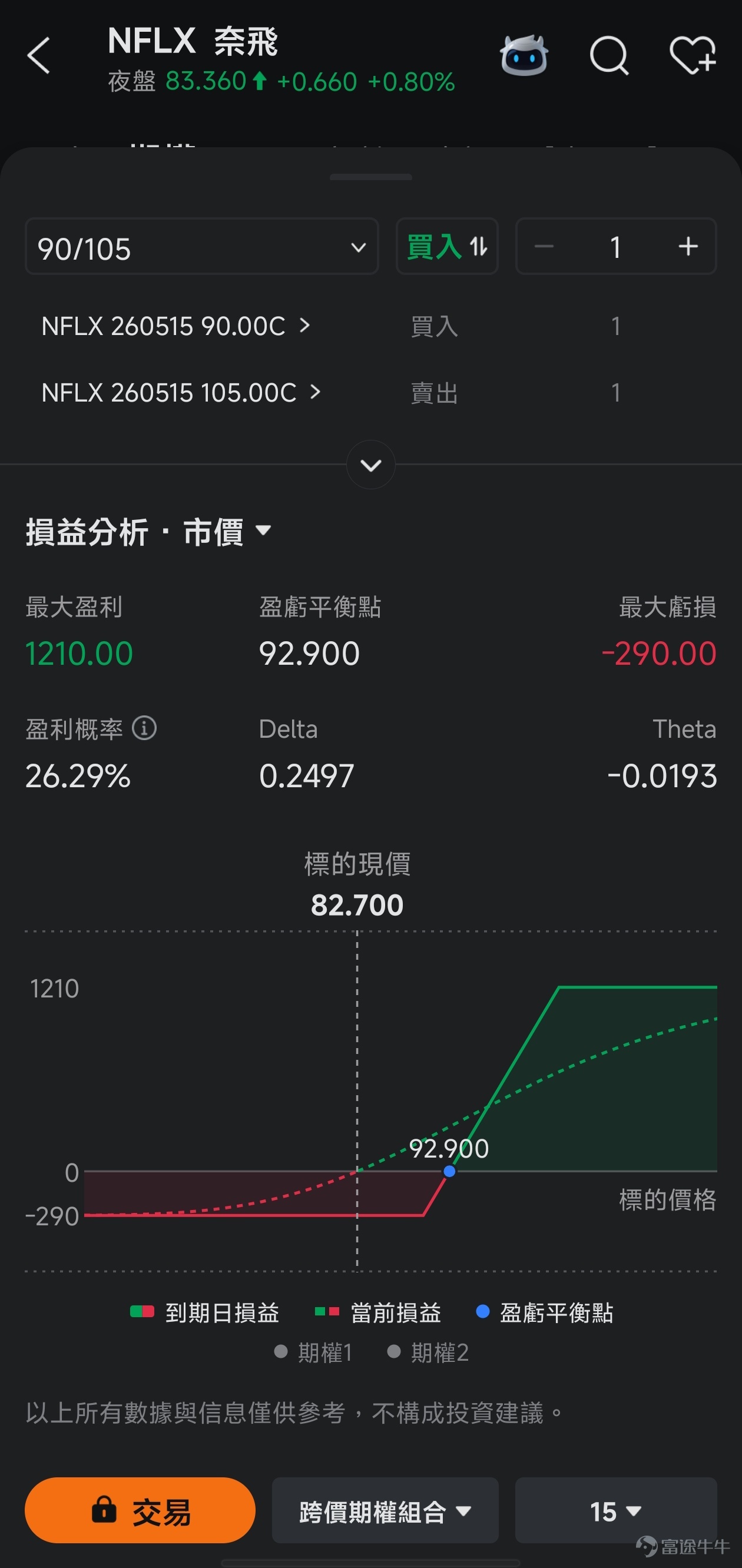
1. Specifically, how does it work?He bought 55,000 Netflix May-expiry call options with a strike price of $90 and simultaneously sold the same number of May-expiry call options with a strike price of $105, forming a Bull Call Spread strategy (a bullish vertical spread). The contract unit price was approximately $2.51, resulting in a total options premium expenditure of $13.8 million, corresponding to 5.5 million Netflix shares.
2. What is he expressing with this move?This operation reflects his view that Netflix's stock price will rise, but not excessively—just moderately. Specifically, there are three points:
By purchasing the $90 call option, he is indicating his belief that Netflix’s stock price will rise from around $83 at the time.
Selling the $105 call option means he is willingly giving up profit potential above $105. He doesn't believe (or need) the stock price to skyrocket, just to rise into the $90-$105 range, which would be sufficient.
He is using the income from selling the higher-strike call to offset the cost of buying the lower-strike call. If he had simply bought 55,000 $90 calls, the premium would have been more expensive. However, by also selling the $105 calls, he recouped part of the premium, significantly lowering the net cost per contract.
The expiration profit and loss characteristics of his operation can be referenced in the following chart. This image is for investment education purposes only and does not represent any investment advice.
The breakeven point occurs roughly when the stock price reaches about $92.51 (with $2.51 being the contract unit price, while the chart shows $92.9 due to differences between the strategy cost at the time of the screenshot and his actual order cost).
The maximum loss is the net premium expenditure for the combination, which for him amounts to $13.8 million, or $251 per contract in his portfolio, compared to $290 per contract as shown in the chart below.
The maximum profit occurs when the stock price is at $105. Theoretically, excluding fees, it can reach ($105-$90)*55 million - $138 million = $687 million.
![Hello fellow investor! I've noticed that many investors face bottlenecks when investing in stocks and feel lost when considering a move to options. Therefore, to help option beginners cultivate the right mindset, enhance their understanding, and seize opportunities through hands-on practice, I have created the 'Option Newbie Gold Rush Companion' column. I hope to accompany you on a path of continuous improvement. If you're interested, you're welcome to join.[Share Link: Click here]Upon joining the learning platform, you will receive notifications when subsequent columns are updated. *The following content is for investment education purposes only and does not constitute any investment advice. Data is as of the US stock market opening on February 26, 2026. The options market never lacks stories. But while it’s easy to enjoy the spectacle, understanding the deeper dynamics is much harder. When you see headlines like 'a thousand-fold surge in end-of-life options for a certain stock' or spot massive trades showing up on options activity lists, you may struggle to grasp what this actually means. Today, we will usethree real-life cases of different types from recent timesto cut through the surface noise, understand the logic behind them, and consider how we, as beginners, can apply these insights to our own trading. Case One: Netflix — Contrarian Thinking Where Betting on a 'Failed Takeover' Turns Out to Be Positive Recently, $Netflix (NFLX.US)$ there was an imaginative and high-value strategic trade where a mysterious trader established a position worth nearly $14 million. 1. Specifically, how does it work?He purchased 55,000 Netflix May-expiry call options with a strike price of $90 (C...](https://nnqimage.futunn.com/sns_client_feed/999908/20260226/web-1772099654951-Z3qikjE2En.jpeg/big?area=2&is_public=true&imageMogr2/ignore-error/1/format/webp)
3. What market background and judgment is his viewpoint based on?
At the time, the market's focus was: Netflix had reached a $27.75 per share acquisition agreement with Warner Bros., but Paramount Global (PSKY.US) suddenly entered the scene with a higher bid of $31 per share, directly posing a competitive threat.
According to the agreement, if Netflix fails in its bidding attempt, it will be entitled to a breakup fee of $2.8 billion. This sum not only compensates for the opportunity cost but also allows Netflix to maintain financial discipline in an environment of high capital costs.
This trader’s judgment might be that the bidding will fail, and this would constitute positive news.
Because a successful bid could mean spending a huge amount of cash, taking on integration risks, diverting management’s attention, and possibly not gaining market approval, while a failed bid means preserving cash, eliminating uncertainty, receiving a $2.8 billion breakup fee, and refocusing on core business.
Reports suggest that Netflix’s CEO plans to visit the White House for talks. The market speculates that political pressure may provide Netflix with a graceful exit from the bidding process — terminating the deal citing regulatory or policy risks, which might lead the market to quickly remove any risk discount.
With options expiring in May, there is a defined window for potential decision-making regarding the bidding process. In other words, he isn’t betting on an immediate rise tomorrow but rather wagering on a specific event outcome, allowing himself enough time for it to unfold.
4. What insights does this offer to beginners in options trading?
It is evident that this trade expresses a relatively clear viewpoint — “Netflix is likely to rise to the $90-$105 range within the next three months because a failed bid actually unlocks value,” as opposed to a vague idea like “Netflix will rise.” In other words, compared to stocks, options allow you to express your market judgment more precisely at a lower cost.
The Bull Call Spread strategy has limited losses, and your maximum loss is determined the moment you open the position — essentially the net premium you pay. This is equivalent to setting a stop-loss line from the start. This teaches us that risk control can be built into the structure of the strategy rather than relying solely on willpower, as beginners often lack strong determination.
Returning to this strategy,If you're just starting to learn options, the Bull Call Spread might be a good starting point with controllable risks, clear logic, and frequent practical use.
Moreover, while many people were discussing 'what happens if the acquisition succeeds,' this trader had already begun positioning for 'what happens if the acquisition fails.' This kind of contrarian thinking is extremely important in options trading.You can also learn to think the opposite way in trading. Since option pricing reflects market consensus, excess returns often come from possibilities outside that consensus.
Case Study Two: Amazon — The Myth Behind the 1,199x Surge, Truth About End-of-Term Options
As$Amazon (AMZN.US)$ With nine core underlying assets now offering options contracts expiring on Mondays and Wednesdays, short-term speculation has become unprecedentedly active, and small-capital investments betting on short-term volatility at extremely low costs have become even more prominent.
![Hello fellow investor! I've noticed that many investors face bottlenecks when investing in stocks and feel lost when considering a move to options. Therefore, to help option beginners cultivate the right mindset, enhance their understanding, and seize opportunities through hands-on practice, I have created the 'Option Newbie Gold Rush Companion' column. I hope to accompany you on a path of continuous improvement. If you're interested, you're welcome to join.[Share Link: Click here]Upon joining the learning platform, you will receive notifications when subsequent columns are updated. *The following content is for investment education purposes only and does not constitute any investment advice. Data is as of the US stock market opening on February 26, 2026. The options market never lacks stories. But while it’s easy to enjoy the spectacle, understanding the deeper dynamics is much harder. When you see headlines like 'a thousand-fold surge in end-of-life options for a certain stock' or spot massive trades showing up on options activity lists, you may struggle to grasp what this actually means. Today, we will usethree real-life cases of different types from recent timesto cut through the surface noise, understand the logic behind them, and consider how we, as beginners, can apply these insights to our own trading. Case One: Netflix — Contrarian Thinking Where Betting on a 'Failed Takeover' Turns Out to Be Positive Recently, $Netflix (NFLX.US)$ there was an imaginative and high-value strategic trade where a mysterious trader established a position worth nearly $14 million. 1. Specifically, how does it work?He purchased 55,000 Netflix May-expiry call options with a strike price of $90 (C...](https://nnqimage.futunn.com/sns_client_feed/999908/20260226/web-1772099656324-f6jeP9wex2.png/big?area=2&is_public=true&imageMogr2/ignore-error/1/format/webp)
1. What are noteworthy options targets?
Using the criteria of 'nine key underlyings, latest option price between $0.1-$1 (implying a single options contract price between $10-$100), and expiration within three days,' yesterday’s most eye-catching option was Amazon's call option with a strike price of $260, expiring on February 25, 2026, which performed a 'thousand-fold miracle.'
![Hello fellow investor! I've noticed that many investors face bottlenecks when investing in stocks and feel lost when considering a move to options. Therefore, to help option beginners cultivate the right mindset, enhance their understanding, and seize opportunities through hands-on practice, I have created the 'Option Newbie Gold Rush Companion' column. I hope to accompany you on a path of continuous improvement. If you're interested, you're welcome to join.[Share Link: Click here]Upon joining the learning platform, you will receive notifications when subsequent columns are updated. *The following content is for investment education purposes only and does not constitute any investment advice. Data is as of the US stock market opening on February 26, 2026. The options market never lacks stories. But while it’s easy to enjoy the spectacle, understanding the deeper dynamics is much harder. When you see headlines like 'a thousand-fold surge in end-of-life options for a certain stock' or spot massive trades showing up on options activity lists, you may struggle to grasp what this actually means. Today, we will usethree real-life cases of different types from recent timesto cut through the surface noise, understand the logic behind them, and consider how we, as beginners, can apply these insights to our own trading. Case One: Netflix — Contrarian Thinking Where Betting on a 'Failed Takeover' Turns Out to Be Positive Recently, $Netflix (NFLX.US)$ there was an imaginative and high-value strategic trade where a mysterious trader established a position worth nearly $14 million. 1. Specifically, how does it work?He purchased 55,000 Netflix May-expiry call options with a strike price of $90 (C...](https://nnqimage.futunn.com/sns_client_feed/999908/20260226/web-1772099654822-QDiRbDnTk2.webp/big?area=2&is_public=true&imageMogr2/ignore-error/1/format/webp)
2. What is the logic behind this?
It's actually similar to a doomsday gamble. The buyer bets on a sharp and directional movement in the stock price within an extremely short period of time. Because the option price (premium) is very low, if the bet is correct, the leverage effect can be amplified to an astonishing degree, resulting in returns of hundreds or even thousands of times. This is the ultimate manifestation of the magical power of options.
Why does this leverage effect exist? It comes down to the huge gap between the 'premium' and the 'notional value' in option pricing.
When a Call option that is only a few days from expiration is deep out-of-the-money (with the strike price far higher than the current stock price), its premium is extremely cheap. However, the notional value of the stock underlying this contract could be dozens or even hundreds of times the premium.
If the price of the underlying stock experiences a sharp move beyond market expectations before expiration—turning this originally almost worthless contract into an in-the-money one (where the strike price is lower than the current stock price)—its intrinsic value will skyrocket from zero to a level matching the in-the-money status.
Due to the initially low cost, this absolute increase in value, when magnified by leverage, translates into returns of several hundred or even thousands of percent.
*Note: You can think of the intrinsic value of an option as the value obtained if exercised immediately, which is greater than or equal to zero. The intrinsic value of a Call = stock market price - strike price, and the intrinsic value of a Put = strike price - stock market price. In addition to intrinsic value, options also have a time value component, which decays as time decreases, and is related to implied volatility (IV) — an indicator reflecting expectations of future price fluctuations of the underlying asset.
However, it’s important to note that behind this incredible leverage lies an extremely asymmetric risk structure.
The buyer is essentially using a very small cost to purchase a tail event with a statistically low probability of occurring (usually less than 5%). Statistically speaking, the probability of exercising this option is only about 1.23%—in other words, it’s a bet with just over a 1% chance of winning.
![Hello fellow investor! I've noticed that many investors face bottlenecks when investing in stocks and feel lost when considering a move to options. Therefore, to help option beginners cultivate the right mindset, enhance their understanding, and seize opportunities through hands-on practice, I have created the 'Option Newbie Gold Rush Companion' column. I hope to accompany you on a path of continuous improvement. If you're interested, you're welcome to join.[Share Link: Click here]Upon joining the learning platform, you will receive notifications when subsequent columns are updated. *The following content is for investment education purposes only and does not constitute any investment advice. Data is as of the US stock market opening on February 26, 2026. The options market never lacks stories. But while it’s easy to enjoy the spectacle, understanding the deeper dynamics is much harder. When you see headlines like 'a thousand-fold surge in end-of-life options for a certain stock' or spot massive trades showing up on options activity lists, you may struggle to grasp what this actually means. Today, we will usethree real-life cases of different types from recent timesto cut through the surface noise, understand the logic behind them, and consider how we, as beginners, can apply these insights to our own trading. Case One: Netflix — Contrarian Thinking Where Betting on a 'Failed Takeover' Turns Out to Be Positive Recently, $Netflix (NFLX.US)$ there was an imaginative and high-value strategic trade where a mysterious trader established a position worth nearly $14 million. 1. Specifically, how does it work?He purchased 55,000 Netflix May-expiry call options with a strike price of $90 (C...](https://nnqimage.futunn.com/sns_client_feed/999908/20260226/web-1772099654882-y856x9gfCa.webp/big?area=2&is_public=true&imageMogr2/ignore-error/1/format/webp)
In the vast majority of cases, this premium will expire worthless, leaving the buyer facing a total loss of their principal. Therefore, this type of trade is essentially a bet on a 'low-probability, high-payoff' event. Its leverage effect stems from the high-risk, high-reward payout structure and precise betting on extreme market volatility.
3. What are the implications for option beginners?
More often than not, the market will celebrate the one...Exploding contracts, but they won’t tell you that at the same time, tens of thousands of similar options expire worthless. Its educational significance far outweighs its wealth-building potential — it vividly teaches you what option leverage is and what zeroing risk entails. Additionally, purchasing options close to expiration not only speeds up capital turnover but also accelerates the decay of time value.
If this attracts you, strictly adhere to the 'small-capital trial and error' principle. Treat it as a ticket, using an amount you can fully afford to lose (such as 1% of your total capital) to experience market volatility, and absolutely do not go all in.
Lastly, if you wish to learn more about options from similar cases, you canClick here, follow Futu's Options Unusual Activity Bull for daily updates on“Play Options with Hundreds”section content.
Case Three: Coinbase — What Signals Lie Behind the Large Put Option Trade
Recently, $Coinbase (COIN.US)$ 's options market saw a notable large trade worth paying attention to:
![Hello fellow investor! I've noticed that many investors face bottlenecks when investing in stocks and feel lost when considering a move to options. Therefore, to help option beginners cultivate the right mindset, enhance their understanding, and seize opportunities through hands-on practice, I have created the 'Option Newbie Gold Rush Companion' column. I hope to accompany you on a path of continuous improvement. If you're interested, you're welcome to join.[Share Link: Click here]Upon joining the learning platform, you will receive notifications when subsequent columns are updated. *The following content is for investment education purposes only and does not constitute any investment advice. Data is as of the US stock market opening on February 26, 2026. The options market never lacks stories. But while it’s easy to enjoy the spectacle, understanding the deeper dynamics is much harder. When you see headlines like 'a thousand-fold surge in end-of-life options for a certain stock' or spot massive trades showing up on options activity lists, you may struggle to grasp what this actually means. Today, we will usethree real-life cases of different types from recent timesto cut through the surface noise, understand the logic behind them, and consider how we, as beginners, can apply these insights to our own trading. Case One: Netflix — Contrarian Thinking Where Betting on a 'Failed Takeover' Turns Out to Be Positive Recently, $Netflix (NFLX.US)$ there was an imaginative and high-value strategic trade where a mysterious trader established a position worth nearly $14 million. 1. Specifically, how does it work?He purchased 55,000 Netflix May-expiry call options with a strike price of $90 (C...](https://nnqimage.futunn.com/sns_client_feed/999908/20260226/web-1772099654895-RPyC3WR2cl.png/big?area=2&is_public=true&imageMogr2/ignore-error/1/format/webp)
Someone sold approximately 46,200 put options yesterday (February 25th), with an expiration date of February 27, 2026 (almost immediately expiring), at a strike price of $190 for COIN. Notably, the figure of 46,200 is far higher than the open interest of 216 for this particular options contract, resulting in a V/OI (Volume / Open Interest) ratio as high as approximately 214.
![Hello fellow investor! I've noticed that many investors face bottlenecks when investing in stocks and feel lost when considering a move to options. Therefore, to help option beginners cultivate the right mindset, enhance their understanding, and seize opportunities through hands-on practice, I have created the 'Option Newbie Gold Rush Companion' column. I hope to accompany you on a path of continuous improvement. If you're interested, you're welcome to join.[Share Link: Click here]Upon joining the learning platform, you will receive notifications when subsequent columns are updated. *The following content is for investment education purposes only and does not constitute any investment advice. Data is as of the US stock market opening on February 26, 2026. The options market never lacks stories. But while it’s easy to enjoy the spectacle, understanding the deeper dynamics is much harder. When you see headlines like 'a thousand-fold surge in end-of-life options for a certain stock' or spot massive trades showing up on options activity lists, you may struggle to grasp what this actually means. Today, we will usethree real-life cases of different types from recent timesto cut through the surface noise, understand the logic behind them, and consider how we, as beginners, can apply these insights to our own trading. Case One: Netflix — Contrarian Thinking Where Betting on a 'Failed Takeover' Turns Out to Be Positive Recently, $Netflix (NFLX.US)$ there was an imaginative and high-value strategic trade where a mysterious trader established a position worth nearly $14 million. 1. Specifically, how does it work?He purchased 55,000 Netflix May-expiry call options with a strike price of $90 (C...](https://nnqimage.futunn.com/sns_client_feed/999908/20260226/web-1772099654798-4pOKd2Q2KA.png/big?area=2&is_public=true&imageMogr2/ignore-error/1/format/webp)
When the V/OI ratio is abnormally high(typically a screening criterion of ≥10), it indicates that a trader is establishing an entirely new, large position rather than adjusting an existing one.thisThis is an important 'smart money' signal.。
However, it’s worth noting that the order type for this trade is a cross trade, which refers to a transaction completed internally within the same brokerage firm (or broker), matching both the buyer and seller simultaneously. The buying and selling brokers belong to the same person or company, and after agreeing on the price, they push the trade to the market to complete the execution.
1. What are the possibilities behind this large order?
It could be an institution shifting positions internally; it might be a trade between two institutions privately negotiated off-exchange;
It could also be a market maker rebalancing (market makers passively accumulate large option positions daily—whatever clients buy, the market maker must sell; whatever clients sell, the market maker must take—and when inventory deviates from targets, the market maker needs to rebalance);
Or it could be structured products linked to COIN triggering maturity conditions at this point in time, prompting the issuing institution to handle the underlying hedging positions of the product...
Of course, we cannot completely rule out the possibility that even with a cross trade, there may still be genuine directional intent behind it. In such cases: the Put seller expresses the view that 'COIN’s stock price will be above $190 at expiration.' However, even if there’s directional intent, the strength of the cross-trade signal is much weaker than active sweeping orders on the open market.
2. What lessons does this hold for options beginners?
First of all, you canClick here, follow the 'Daily Options Tracker' column,to discover market signals from daily options movements.。
You can pay attention to the V/OI indicator to observe the direction of 'smart money.' However,when you see unusually large orders and abnormal V/OI values, be sure to confirm the order type., which can be verified throughStock Details > Options > Options Movement. If the trade type is a cross trade, then its directional significance may be greatly reduced.
This actually also tells us that there is a lot of noise in the daily trading data of the options market,and one needs to learn to distinguish the noise and find truly valuable trading signals.This also illustrates that, in the options market, the information you see might just be the tip of the iceberg. Do not make trading decisions based solely on a single piece of information.You need to integrate various sources of information, such as fundamental analysis of individual stocks, technical analysis, and more options data, to form a comprehensive judgment.。
Conclusion
Three cases, three perspectives, respectively showcase three facets of the options world:
The Netflix trade tells us that options can help you precisely express a viewpoint and lock in risk at the moment of opening a position; the Amazon 1,000x myth reminds us that behind astonishing leverage lies an extremely low probability of success—respecting the market is more important than chasing huge profits; Coinbase’s cross-trade teaches us that not all market information is a signal, learning to distinguish noise and understand the structure behind trades is an essential lesson in options trading.
For beginners, instead of rushing to place orders and chase every seemingly opportune chance, it's better to first focus on these three practices: using strategies to express viewpoints, managing risk control, testing with small capital rather than going 'all in,' and discerning market information to form independent judgments.
In the world of options, moving slower and steadier can actually take you further. This journey may be long, but you’re not walking it alone. 'The Novice Options Trader's Journey' will continue to update, accompanying you as you refine your mindset, enhance your understanding, and seize opportunities through hands-on practice.Click hereJoin the learning journey, and you’ll receive notifications when new updates are posted in subsequent columns. If you have specific content suggestions, your input is highly welcomed!
Finally, here's a small perk for everyone. If you're planning to trade options soon, feel free to claim it.Options Beginner's Package(*This event is only open to invited HK users, click to learn more)Event Details Rules >>). If you're still hesitant to trade, you canClick hereparticipate in the simulated trading challenge, with zero cost and zero risk, plus there are stock cash vouchers waiting for you!
Poll: Understand Bull Call Spread; Understand Last-Minute Options Long Call; Understand Short Put; Don’t understand any
Risk Disclaimer: The above content only represents the author's view. It does not represent any position or investment advice of Futu. Futu makes no representation or warranty.Read more


Comments (210)
to post a comment
486
200