
AMD and Meta have joined forces to secure a major chip order

Option Sir Breaks Down Hot Topics | AMD Secures Another Massive Order from Meta Worth Billions — Expectations Fulfilled, Turning Point Approaching?
Boosted by news of AMD’s strategic partnership with Meta,$Advanced Micro Devices (AMD.US)$last night, its stock price surged by 8.77%. This agreement marks another major order secured by AMD in the AI chip breakthrough battle through a non-traditional business model.
However, there are also skeptical voices in the market. Other suppliers received large contracts without similar concessions.$NVIDIA (NVDA.US)$Not given.$Meta Platforms (META.US)$ Providing equity, $Corning (GLW.US)$ Nor does it have any. Why is AMD doing this?
First, almost replicating the OpenAI partnership model—a deeply tied 'gamble' on mutual interests.
The main highlights of this agreement are as follows:
1. A massive foundational scale of 6GW:
Meta will procure up to 6 gigawatts of GPUs from AMD, with the first batch of orders delivered in the second half of 2026. The cooperation period will extend until around 2030.
The target of Meta’s procurement in this deal is AMD's next-generation MI450 series. The company plans to tightly integrate it into the Helios rack platform, enabling delivery from a 'single chip' level to a 'rack-level cluster'.Directly competing with NVIDIA’s Rubin architecture.。
Currently, neither party has disclosed the value of the collaboration.However, according to Bloomberg analysis, the MI450 and Helios rack systems are priced at approximately $15 to $20 billion per gigawatt. This means the total value of the 6-gigawatt deal could reach approximately one trillion dollars.
2. Stringent 'warrant' unlocking conditions:
As part of the agreement, AMD agreed to grant Meta warrants, allowing it to purchase up to 160 million shares of AMD stock (approximately 10% of the company's shares) at a price of $0.01 per share.
This is contingent upon meeting milestone conditions and unlocking in batches. The first milestone condition is the completion of the first gigawatt data center deployment. The final milestone is the completion of the full six gigawatts of data center deployment, with AMD’s stock price reaching $600 per share or higher by 2030 for the warrants to be exercisable.
In other words, the issuance of all equity rewards depends on the rise of AMD’s stock price.Meta will only receive the final batch of shares if AMD’s stock price reaches $600. What does $600 mean? It's 200% higher than the current $200, so the difficulty is evident.
Investors following AMD may find this collaboration model very familiar. Indeed, after OpenAI, AMD has once again raised the banner of 'compute power for equity.'
In October 2025, OpenAI committed to purchasing and deploying a total of 6 gigawatts (GW) of AMD Instinct series GPU computing power over the coming years. The first 1 gigawatt is planned to be launched in the second half of 2026. As consideration and for deep integration, AMD issued OpenAI warrants for up to 160 million shares of AMD common stock at an exercise price of just $0.01 per share.
If fully exercised, OpenAI would hold approximately 10% of AMD’s shares. The vesting of the warrants is tied to dual milestones: one being OpenAI completing specific chip deployment progress (such as the first gigawatt deployment), and the other being AMD’s stock price reaching certain targets (e.g., $600).
The latest agreement reached between Meta and AMD mirrors the core terms seen in the OpenAI deal, including procurement scale (6 gigawatts), the number of warrants (up to 160 million shares, approximately 10% of shares), exercise price ($0.01 per share), and unlocking conditions (deployment milestones linked to stock price targets).It is almost identical to the agreement with OpenAI.
Second, risk diversification remains the main reason as AMD has made significant progress in the competition
Behind the cooperation lies the strategic consideration of major companies trying to reshape the supply chain and diversify risks. By exchanging future procurement commitments for equity stakes in suppliers, they reduce current cash outflows while forming a community of shared interests with chip suppliers.
In 2026, global tech giants will kick off a new round of 'arms race'. According to disclosed data, tech giants are pushing capital expenditures from the 'tens of billions' range toward the 'trillions' level. $Amazon (AMZN.US)$ 、 $Alphabet-C (GOOG.US)$$Alphabet-A (GOOGL.US)$ 、 $Meta Platforms (META.US)$ Capital expenditures have risen significantly.
Take Meta as an example; its expected CAPEX for 2026 is as high as $115 billion–$135 billion (a year-over-year surge of 59%–87%), significantly higher than $72.22 billion in 2025, representing an increase of 59%–87%. Despite Meta's clear indication that it will continue purchasing NVIDIA products,the risk of solely relying on NVIDIA (even though it still holds a 90% market share) is extremely high given such enormous computing demands.
Not long ago, Arista's CEO Ullal stated during an earnings call: 'A year ago, it was basically 99% NVIDIA, right? But today, when we look at deployments, about 20%, or even slightly higher, around 20% to 25% of projects now prefer AMD as the accelerator.'
This partnership is a significant positive for AMD,as it provides greater certainty for the company’s market share position among Tier-1 hyperscale cloud service providers. Due to increased competitive intensity from key clients,This represents a major positive development or even a turning point for $NVIDIA (NVDA.US)$ and $Broadcom (AVGO.US)$ this represents a slight negative impact.
Third, AMD vs NVIDIA, trading price for market share
Securing a large order from Meta, does this mean that AMD's MI450 is sufficient to replace NVIDIA?
The MI450 purchased this time showscomputing power, memory, and clustering.improvements in three aspects. Among them,computing power has roughly doubled (starting with the 2nm process);the memory upgrade brought improvements in bandwidth and capacity(upgrading from HBM3E to HBM4), the Helios platform highlights 31TB of HBM4 memory as its core selling point, surpassing NVIDIA’s Rubin NVL72, directly addressing pain points in memory-intensive scenarios during large model training.
However, in terms of total bandwidth and computing power (3.6 vs. 2.9 exaFLOPS), NVIDIA still maintains the lead.
According to Bloomberg analysis, the MI450 and Helios rack system are priced at approximately $150-200 billion per gigawatt. In comparison, Jensen Huang mentioned in the August 2025 earnings call that building a 1-gigawatt (GW) AI data center requires a total investment of about$500-600 billion., of which the cost for purchasing NVIDIA GPUs and related network equipment is approximatelyUSD 350 billion.
A simple calculation shows that AMD's revenue generation per GW is only about half that of NVIDIA. This reflects that AMD still needs to rely on a 'price advantage' to gain market share at this stage.
Fourth, the long-term outlook is positive, but there are also many risk points
The market’s AI expectations for AMD remain high,The market is in a phase of 'positive long-term logic but unproven short-term performance.'
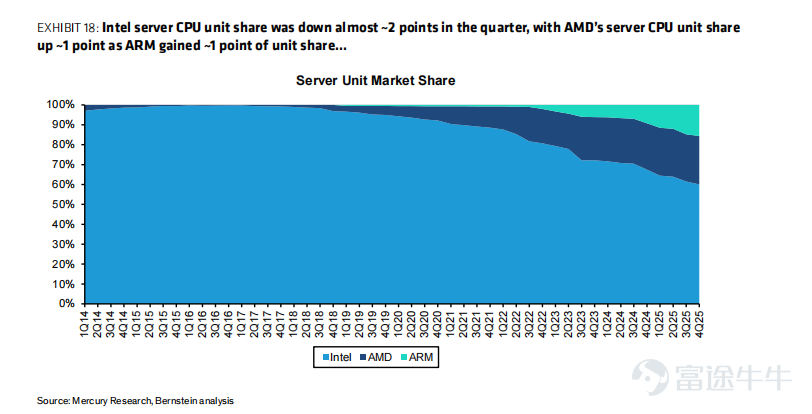
In the long run, the trend for server CPUs continues to be favorable,AMD recognized its potential early on and secured supply, continuously gaining significant market share.
According to Bernstein's research, both ARM and AMD increased their server CPU market share by nearly one percentage point this quarter, while Intel, due to missteps in capacity deployment, lost nearly two percentage points of market share, with its share further declining.

The main concerns and risks lie in:
1. There is a vacuum period for business growth:
Apart from the Chinese market, AI GPU sales have not seen a significant turning point in recent quarters.AMD's current shipment focus is the MI355. According to AMD’s previous earnings report, MI355 production fell short of expectations, with hopes now pinned on the 'rack-level' solution offered by MI450 in the second half of the year.
The MI450 series will only enter mass production in the second half of the year.Although cooperation with OpenAI and Meta is expected to drive growth, there remains debate over the pace and trajectory of its volume ramp-up.Substantial growth may not be seen until the fourth quarter of 2026.
2. Customer concentration and performance risk
Large orders are highly tied to OpenAI and Meta,with revenue sources overly concentrated. OpenAI itself may face substantial additional funding needs, bringing uncertainty to the smooth execution and timeline of this transaction.If customers subsequently face financial pressure, delivery timelines could be subject to change.
3. High operating expenses are eroding profits
Persistently high operating expenses are eating into profits, causing the company to exceed guidance for multiple consecutive quarters under a high valuation while continuously revising upwardManagement's execution in cost control has been lacking
Compared to peers, AMD is one of the higher-valued AI-related stocks, with a forward P/E ratio of approximately 44x, higher than peers such as MRVL, NVDA, and AVGO. Under this high valuation, stronger 'pure AI' growth evidence will be required to drive further stock price appreciationIf a clearer deployment timeline can be provided later, market confidence is expected to strengthen

The technical picture shows a pattern of short-term oversold rebound alongside medium-term pressureAfter the recent decline, there is a technical rebound demand. The current share price is below major moving averages, and the sustainability of the rebound faces a test. The medium-term trend still faces pressure, and confirmation of a trend reversal would require observing whether it can effectively break through and stabilize above the 20-day moving average
In the options market, the latest implied volatility (IV) is 62.23%, which is at a relatively high historical level (78th percentile). High IV indicates more expensive option prices, reflecting market expectations of significant future share price fluctuationsThe put/call ratio (volume-based) is 1.12. Large purchases of put options and the elevated put/call ratio suggest that some capital is hedging risks or expressing bearish views
1. Buy covered call options
– Suitable for: If you already hold AMD's common stock and have a risk preference that isPrudent/Conservative. Given that there is still a 'validation vacuum period' in terms of fundamentals, and the technical resistance level above is strong, it will be difficult to see a major upward trend in the short term. You can take advantage of the current high implied volatility (IV) by selling call options to collect substantial premiums, thereby reducing your holding costs and providing downside protection.
– Expected Outcome: If the stock price does not break through this resistance level, you will earn the expensive option premium for free; if the stock price reverses strongly and breaks through, although your upside on the common stock will be capped, it still counts as profit-taking at a high point, avoiding long-term uncertainty risks.
(The design images displayed on screen are for illustrative purposes only and do not constitute any investment advice or guarantees; market conditions fluctuate frequently, and the option prices shown do not represent real-world values.)

2. Selling Cash-Secured Put Options
– Suitable for: If you are currently not holding any position but recognize AMD's long-term logic of eroding Intel's market share in server CPUs and replacing NVIDIA, hoping to build a position at a lower price, with a risk preference that isMedium. The long-term logic for AMD remains intact, but buying directly after a big rally could expose you to the risk of being trapped in the short term. At this time, selling Puts is equivalent to 'earning income while waiting' for a better entry point.
– Expected Outcome: If AMD falls below the strike price afterward, you will acquire the common stock at your desired discounted price (strike price), and the collected premium further reduces your cost; if AMD consolidates or rebounds from here, you will earn the full premium, generating stable cash flow.
(The design images displayed on screen are for illustrative purposes only and do not constitute any investment advice or guarantees; market conditions fluctuate frequently, and the option prices shown do not represent real-world values.)

3. Bear Call Spread
– Suitable for: If you have no position or hold a very small position and are bearish/neutral on AMD's short-term movement,Bearish/Neutral, with an appetite for risk,Aggressive investors. Large block trades buying put options indicate that smart money is hedging risks. However, directly buying puts (put options) is too costly, and if AMD moves sideways, the decline in high implied volatility (IV Crush) and time decay will lead to losses. Using a bear call spread allows one to express a bearish/pressure view while benefiting from the rich premiums brought by high implied volatility.
– Expected Outcome: Expecting limited downside in the underlying stock price. Suitable to construct when implied volatility is high; it can still generate profits even if the stock price moves sideways, consolidates, or oscillates. If the underlying stock rises, the maximum loss remains limited.
(The design images displayed on screen are for illustrative purposes only and do not constitute any investment advice or guarantees; market conditions fluctuate frequently, and the option prices shown do not represent real-world values.)

Risk Disclaimer: The above content only represents the author's view. It does not represent any position or investment advice of Futu. Futu makes no representation or warranty.Read more


Comments (2)
to post a comment
53
43