English
Back
Open Account
Stock markets in Japan and South Korea hit new record highs! Have you made your move yet?

牛牛課堂
joined discussion · ·

New highs in Japanese and Korean stock markets! Related ETFs have surged over 2x, how can Hong Kong and US stock investors leverage this to position themselves?

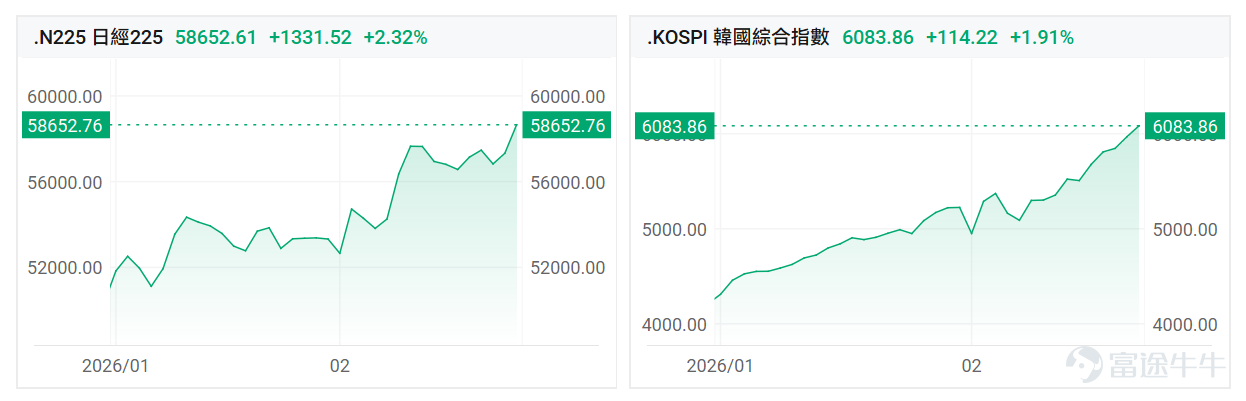
This year’s spotlight in the global stock market has undoubtedly been on the Japanese and Korean markets, $Nikkei 225 Index (.NKY.US)$ officially breaking through 58,000 points, $Korea Composite Index (.KOSPI.KR)$ and surpassing the 6,000-point mark for the first time, both hitting record highs.
According to Bloomberg data, the market capitalization of South Korea's stock market has risen to $3.76 trillion, surpassing France, making South Korea the world’s ninth-largest stock market.
This year’s spotlight in the global stock market has undoubtedly been on the Japanese and Korean markets, $Nikkei 225 Index (.NKY.US)$ officially breaking through 58,000 points, $Korea Composite Index (.KOSPI.KR)$ and surpassing the 6,000-point mark for the first time, both hitting record highs. According to Bloomberg data, the market capitalization of South Korea's stock market has risen to $3.76 trillion, surpassing France, making South Korea the world’s ninth-largest stock market. The driving force behind these astonishing gains is no coincidence! What exactly ignited momentum in these two markets? This article explains the underlying logic to fellow investors and unlocks participation opportunities. Why are Japanese and Korean stock markets continuously reaching new highs? Breaking down the underlying logic of this strong upward movement, it mainly boils down to the following four core drivers: 1. AI computing power infrastructure and semiconductor super cycle The weight structures of the Japanese and Korean stock markets perfectly align with the global expansion wave of AI infrastructure. This is a hardware boom driven by computing power demand: South Korea (HBM and Memory Hegemony): The surge in the KOSPI index has largely been driven by the earnings double whammy of SK Hynix and Samsung Electronics. The demand for high-bandwidth memory (HBM), DRAM, and large-capacity NAND from AI servers has skyrocketed. As memory prices continue to rise and AI investments increase, South Korean semiconductor giants have become the most certain beneficiaries in this wave of computing power competition. Japan (Equipment and Materials ‘Water Sellers’):The text appears to be incomplete and does not provide enough context for translation. Please provide the full text for accurate translation.
The driving force behind these astonishing gains is no coincidence! What exactly ignited momentum in these two markets? This article explains the underlying logic to fellow investors and unlocks participation opportunities.
Why are Japanese and Korean stock markets continuously reaching new highs?
Breaking down the underlying logic of this strong upward movement, it mainly boils down to the following four core drivers:
1. AI computing power infrastructure and semiconductor super cycle
The weight structures of the Japanese and Korean stock markets perfectly align with the global expansion wave of AI infrastructure. This is a hardware boom driven by computing power demand:
South Korea (HBM and Memory Hegemony): The surge in the KOSPI index has largely been driven by the earnings double whammy of SK Hynix and Samsung Electronics. The demand for high-bandwidth memory (HBM), DRAM, and large-capacity NAND from AI servers has skyrocketed. As memory prices continue to rise and AI investments increase, South Korean semiconductor giants have become the most certain beneficiaries in this wave of computing power competition.
Japan (Equipment and Materials ‘Water Sellers’): Amid the aggressive expansion of advanced packaging capacities (such as 2.5D, CoWoS) by wafer foundries, Japan holds irreplaceable pricing power in semiconductor equipment (e.g., Tokyo Electron, Advantest, Disco) and key chemical materials. The market’s reassessment of the global semiconductor supply chain is enabling Japan's 'hidden champions' to experience an unprecedented valuation reshaping.
2. Physical AI value explosion
As AI evolves from purely software-based 'brains' to extending into the physical world's 'bodies,' market capital is strategically positioning itself along a clear main thread:Core components, whole machines as carriers, and embodied intelligence seen as long-term competitive barriers
Japan, as the absolute leader in global robotics and automation equipment (e.g., Fanuc, Yaskawa Electric, and key reducer leaders), is perfectly positioned to capitalize on this wave of dividends. Market expectations are that breakthroughs in embodied intelligence will bring exponential growth potential to Japan's precision machinery and industrial automation sectors, serving as a powerful engine driving the Nikkei Index to new highs repeatedly.
3. The Institutional Reforms of 'Japan’s Special Valuation' and 'Korea’s Special Valuation' Have Borne Fruit
The strength of fundamentals requires institutional support to translate into a long-term bull market for indices. The 'value enhancement' initiatives by the regulators of both countries have shown significant results this year:
Persistent Pressure from the Tokyo Stock Exchange: Companies were urged to improve capital efficiency, unwind cross-shareholdings, and significantly increase stock buybacks and dividend payouts, successfully transforming Japan's low ROE quagmire into a value opportunity in the eyes of foreign investors.
South Korea’s Determination to Eliminate the 'Korea Discount': The South Korean government has vigorously promoted a 'Corporate Value Enhancement Program,' attracting domestic investors and international funds through tax incentives, enhanced corporate governance (protecting minority shareholders), and launching relevant ETFs, significantly alleviating the longstanding 'Korea Discount' issue and driving a substantial rise in the KOSPI index between 2025-2026 with a continued bullish outlook. Notably,South Korea’s National Assembly recently passed amendments to commercial laws aimed at boosting stock valuations.
4. AI-Driven Resource Supercycle
The endpoint of AI infrastructure is enormous power and physical resource consumption. In this supercycle of industrial metals and strategic resources driven by emerging technologies, Japan's five major trading houses continue to attract long-term capital due to their deep involvement in global mineral, energy, and commodity supply chains, providing strong defensive and offensive attributes to Japanese stocks.
Additionally,Another contributing factor to this rally in the Japanese stock market is partly due to 'high-priced trading'.Sanae Takai has consistently pledged to implement proactive fiscal policies and accommodative monetary policies to stimulate economic growth.
In summary,The strong performance of Japan and South Korea's stock markets this year is a perfect chemical reaction between the industrial dividend of being 'AI hardware enablers' and the policy dividend of 'capital efficiency improvement'.
How can investors participate in Japan and South Korea’s stock markets?
Faced with both Japan and South Korea's stock markets breaking historical highs, investors can efficiently position themselves through ETFs. Fellow investors have compiled a list of the strongest performing Japan- and South Korea-related ETFs in the Hong Kong and US markets this year. Data shows that some leveraged or precisely AI-computing-focused products have even surged over 200% year-to-date!
This year’s spotlight in the global stock market has undoubtedly been on the Japanese and Korean markets, $Nikkei 225 Index (.NKY.US)$ officially breaking through 58,000 points, $Korea Composite Index (.KOSPI.KR)$ and surpassing the 6,000-point mark for the first time, both hitting record highs. According to Bloomberg data, the market capitalization of South Korea's stock market has risen to $3.76 trillion, surpassing France, making South Korea the world’s ninth-largest stock market. The driving force behind these astonishing gains is no coincidence! What exactly ignited momentum in these two markets? This article explains the underlying logic to fellow investors and unlocks participation opportunities. Why are Japanese and Korean stock markets continuously reaching new highs? Breaking down the underlying logic of this strong upward movement, it mainly boils down to the following four core drivers: 1. AI computing power infrastructure and semiconductor super cycle The weight structures of the Japanese and Korean stock markets perfectly align with the global expansion wave of AI infrastructure. This is a hardware boom driven by computing power demand: South Korea (HBM and Memory Hegemony): The surge in the KOSPI index has largely been driven by the earnings double whammy of SK Hynix and Samsung Electronics. The demand for high-bandwidth memory (HBM), DRAM, and large-capacity NAND from AI servers has skyrocketed. As memory prices continue to rise and AI investments increase, South Korean semiconductor giants have become the most certain beneficiaries in this wave of computing power competition. Japan (Equipment and Materials ‘Water Sellers’):The text appears to be incomplete and does not provide enough context for translation. Please provide the full text for accurate translation.
Below, we break down the investment logic and highlighted products behind this list:
South Korea: Driven by AI memory supremacy, leveraged ETFs deliver astonishing performance
The core driver of South Korea’s stock market surge is undoubtedly the super semiconductor cycle driven by booming demand for HBM (High Bandwidth Memory) and DRAM. In the list, South Korean ETFs with concentrated holdings or leverage attributes demonstrated extremely strong momentum:
The "King of Gains" in the US stock market:$Direxion Shares Etf Trust Direxion Daily So Korea Bull 3X Shs (KORU.US)$As a leveraged broad-market South Korean ETF, KORU has maximized Beta returns during this bull market, skyrocketing since the beginning of the year.204.39%It is the top choice for funds seeking short-term explosive growth. This ETF tracks the MSCI Korea 25/50 Index and amplifies returns threefold through derivative instruments, with its portfolio heavily concentrated in global semiconductor and memory leaders such as Samsung Electronics and SK Hynix.
This year’s spotlight in the global stock market has undoubtedly been on the Japanese and Korean markets, $Nikkei 225 Index (.NKY.US)$ officially breaking through 58,000 points, $Korea Composite Index (.KOSPI.KR)$ and surpassing the 6,000-point mark for the first time, both hitting record highs. According to Bloomberg data, the market capitalization of South Korea's stock market has risen to $3.76 trillion, surpassing France, making South Korea the world’s ninth-largest stock market. The driving force behind these astonishing gains is no coincidence! What exactly ignited momentum in these two markets? This article explains the underlying logic to fellow investors and unlocks participation opportunities. Why are Japanese and Korean stock markets continuously reaching new highs? Breaking down the underlying logic of this strong upward movement, it mainly boils down to the following four core drivers: 1. AI computing power infrastructure and semiconductor super cycle The weight structures of the Japanese and Korean stock markets perfectly align with the global expansion wave of AI infrastructure. This is a hardware boom driven by computing power demand: South Korea (HBM and Memory Hegemony): The surge in the KOSPI index has largely been driven by the earnings double whammy of SK Hynix and Samsung Electronics. The demand for high-bandwidth memory (HBM), DRAM, and large-capacity NAND from AI servers has skyrocketed. As memory prices continue to rise and AI investments increase, South Korean semiconductor giants have become the most certain beneficiaries in this wave of computing power competition. Japan (Equipment and Materials ‘Water Sellers’):The text appears to be incomplete and does not provide enough context for translation. Please provide the full text for accurate translation.
Accurate Shot in Hong Kong Stocks: $CSOP Samsung Electronics Daily (2x) Leveraged Product (07747.HK)$and $CSOP SK Hynix Daily (2x) Leveraged Product (07709.HK)$If you’re confident about the strong demand for memory driven by AI servers, leveraged ETFs on these two individual stocks provide excellent tools. Samsung Electronics 2x Long has surged significantly year-to-date 163.52%, while SK Hynix 2x Long also shows 118.70%remarkable returns.
Stable Broad-Based Allocation: For investors who do not wish to take on leverage risk, U.S. equities $iShares MSCI South Korea ETF (EWY.US)$ and Hong Kong stocks $Xtrackers MSCI Korea UCITS ETF (02848.HK)$ have also delivered 48.68%and47.56% impressive performance year-to-date, making them suitable as long-term core holdings. Notably, both ETFs allocate approximately 50% of their holdings to Samsung Electronics and SK Hynix.
This year’s spotlight in the global stock market has undoubtedly been on the Japanese and Korean markets, $Nikkei 225 Index (.NKY.US)$ officially breaking through 58,000 points, $Korea Composite Index (.KOSPI.KR)$ and surpassing the 6,000-point mark for the first time, both hitting record highs. According to Bloomberg data, the market capitalization of South Korea's stock market has risen to $3.76 trillion, surpassing France, making South Korea the world’s ninth-largest stock market. The driving force behind these astonishing gains is no coincidence! What exactly ignited momentum in these two markets? This article explains the underlying logic to fellow investors and unlocks participation opportunities. Why are Japanese and Korean stock markets continuously reaching new highs? Breaking down the underlying logic of this strong upward movement, it mainly boils down to the following four core drivers: 1. AI computing power infrastructure and semiconductor super cycle The weight structures of the Japanese and Korean stock markets perfectly align with the global expansion wave of AI infrastructure. This is a hardware boom driven by computing power demand: South Korea (HBM and Memory Hegemony): The surge in the KOSPI index has largely been driven by the earnings double whammy of SK Hynix and Samsung Electronics. The demand for high-bandwidth memory (HBM), DRAM, and large-capacity NAND from AI servers has skyrocketed. As memory prices continue to rise and AI investments increase, South Korean semiconductor giants have become the most certain beneficiaries in this wave of computing power competition. Japan (Equipment and Materials ‘Water Sellers’):The text appears to be incomplete and does not provide enough context for translation. Please provide the full text for accurate translation.
Japan Sector: Dual Impact of Policy Catalysts and Currency Hedge
The logic behind Japan's stock market lies in the Tokyo Stock Exchange’s 'value enhancement' policy, compounded by Japan’s strong competitive advantages in global semiconductor equipment, materials, and automation robotics sectors:
US Stock Hedging and Selection Strategies: $WisdomTree Japan Hedged SmallCap Equity Fund (OPPJ.US)$ and $Japan Alphadex First Trust (FJP.US)$ OPPJ has risen this year 22.08%topping the list of US-listed Japanese stocks. It adopts a 'currency-hedged' strategy, allowing investors to benefit from the growth of Japan's domestic small-cap stocks without being affected by fluctuations in the yen exchange rate; FJP, on the other hand, uses quantitative factor stock selection, with both outperforming traditional broad market indices.
Hong Kong Classic Large Caps: $CSOP Nikkei 225 Index ETF (03153.HK)$and $ChinaAMC MSCI Japan Hedged to USD ETF (03160.HK)$ In the Hong Kong stock market, the CSOP Nikkei 225 ETF that tracks core indices has steadily increased 15.46%, $CSOP Nikkei 225 Daily (2x) Leveraged Product (07262.HK)$Increase exceeds 30%. The China Asset Management Japan Hedged ETF, equipped with a currency hedging mechanism, also saw 12.86% The increase is suitable for investors parking their funds in Hong Kong stocks.
🌏 Cross-Regional Technology Focus: One-Click Access to Asian Semiconductor Giants
If you don’t want to bet solely on Japan or Korea but prefer to invest across the entire 'Asian AI Hardware and Semiconductor Supply Chain,' two Hong Kong-listed ETFs spanning both countries’ sectors are worth paying close attention to:
Such ETFs typically include leading global wafer foundries, memory makers, and semiconductor equipment giants, offering a high-quality, hands-off way to capture the current wave of AI infrastructure expansion.
This year’s spotlight in the global stock market has undoubtedly been on the Japanese and Korean markets, $Nikkei 225 Index (.NKY.US)$ officially breaking through 58,000 points, $Korea Composite Index (.KOSPI.KR)$ and surpassing the 6,000-point mark for the first time, both hitting record highs. According to Bloomberg data, the market capitalization of South Korea's stock market has risen to $3.76 trillion, surpassing France, making South Korea the world’s ninth-largest stock market. The driving force behind these astonishing gains is no coincidence! What exactly ignited momentum in these two markets? This article explains the underlying logic to fellow investors and unlocks participation opportunities. Why are Japanese and Korean stock markets continuously reaching new highs? Breaking down the underlying logic of this strong upward movement, it mainly boils down to the following four core drivers: 1. AI computing power infrastructure and semiconductor super cycle The weight structures of the Japanese and Korean stock markets perfectly align with the global expansion wave of AI infrastructure. This is a hardware boom driven by computing power demand: South Korea (HBM and Memory Hegemony): The surge in the KOSPI index has largely been driven by the earnings double whammy of SK Hynix and Samsung Electronics. The demand for high-bandwidth memory (HBM), DRAM, and large-capacity NAND from AI servers has skyrocketed. As memory prices continue to rise and AI investments increase, South Korean semiconductor giants have become the most certain beneficiaries in this wave of computing power competition. Japan (Equipment and Materials ‘Water Sellers’):The text appears to be incomplete and does not provide enough context for translation. Please provide the full text for accurate translation.
Unlock the power of Futubull's product offerings
Want to be the first to capture rotation opportunities in global core assets? Futubull is your go-to choice!
👉 Open the Futubull app > Market > ETF Gainers > US/Hong Kong > Featured Lists - Gainers,and easily discover more strong thematic investments with one-click access to participate in the global bull market!
This year’s spotlight in the global stock market has undoubtedly been on the Japanese and Korean markets, $Nikkei 225 Index (.NKY.US)$ officially breaking through 58,000 points, $Korea Composite Index (.KOSPI.KR)$ and surpassing the 6,000-point mark for the first time, both hitting record highs. According to Bloomberg data, the market capitalization of South Korea's stock market has risen to $3.76 trillion, surpassing France, making South Korea the world’s ninth-largest stock market. The driving force behind these astonishing gains is no coincidence! What exactly ignited momentum in these two markets? This article explains the underlying logic to fellow investors and unlocks participation opportunities. Why are Japanese and Korean stock markets continuously reaching new highs? Breaking down the underlying logic of this strong upward movement, it mainly boils down to the following four core drivers: 1. AI computing power infrastructure and semiconductor super cycle The weight structures of the Japanese and Korean stock markets perfectly align with the global expansion wave of AI infrastructure. This is a hardware boom driven by computing power demand: South Korea (HBM and Memory Hegemony): The surge in the KOSPI index has largely been driven by the earnings double whammy of SK Hynix and Samsung Electronics. The demand for high-bandwidth memory (HBM), DRAM, and large-capacity NAND from AI servers has skyrocketed. As memory prices continue to rise and AI investments increase, South Korean semiconductor giants have become the most certain beneficiaries in this wave of computing power competition. Japan (Equipment and Materials ‘Water Sellers’):The text appears to be incomplete and does not provide enough context for translation. Please provide the full text for accurate translation.
Risk Disclaimer: The above content only represents the author's view. It does not represent any position or investment advice of Futu. Futu makes no representation or warranty.Read more
Thumbs Up
174
Heart
10
Respect
3
Emm
2
1.4M Views
Report
Comments (23)
Write a Comment...
23
189
396