
How to view the post-holiday market trend in Hong Kong stocks?

#Learn Warrants and Bull/Bear Certificates with Jenny: Analyzing Actual Leverage and Product Selection Using Xiaomi as an Example
$XIAOMI-W (01810.HK)$ #Learn Warrants and Bull/Bear Certificates with Jenny: Analyzing Actual Leverage and Product Selection Using Xiaomi as an Example
As of February 24, 2026, Xiaomi Group (01810) was trading at HKD 35.6. Amid the current intertwined bullish and bearish signals, which direction will the stock price take? This article combines recent market dynamics with key insights from [HK Stocks Podcast] to outline short-term critical price levels and corresponding warrant strategies.
From a market news perspective, positive factors for Xiaomi have been accumulating recently. First, southbound funds are showing active inflows, with a single-day increase of 33,021,700 shares in Xiaomi Group on February 23, and a cumulative net increase of 75,381,000 shares over the past five trading days, reflecting mainland investors' confidence in its medium- to long-term prospects. Second, the company's buyback activities continue, spending another HKD 152 million to repurchase 4,282,400 shares on February 20. Since the start of the year, it has conducted 24 buybacks, with a cumulative amount reaching HKD 3.532 billion, representing a significant year-on-year increase of 1469%, fully demonstrating management's confidence in the stock price. Fundamentally, Huatai Securities’ recent research report pointed out that Xiaomi’s car deliveries exceeded expectations, potentially reaching 650,000 units by 2026. Additionally, R&D investments in AI and robotics are strengthening the company’s long-term technological barriers. These factors collectively provide support for the stock price.
According to Simon’s view on [HK Stocks Podcast] on February 11, after Xiaomi’s share price rebounded, it faced two key resistances when approaching the HKD 40 mark: the first at HKD 38.8, and once successfully broken through, it could further rise to HKD 39.7, moving closer to HKD 40. Meanwhile, some investors chose to deploy put warrants for bearish operations, believing that the recent gains posed a risk of pullback. Regarding the selection of put warrant terms, Simon specifically reminded that products expiring in April with a strike price around HKD 35 suffer from high time decay and should be avoided; products expiring in June with strike prices between HKD 32-33 offer more choices in the market but are already out-of-the-money by 10%-13%, requiring careful consideration by investors.
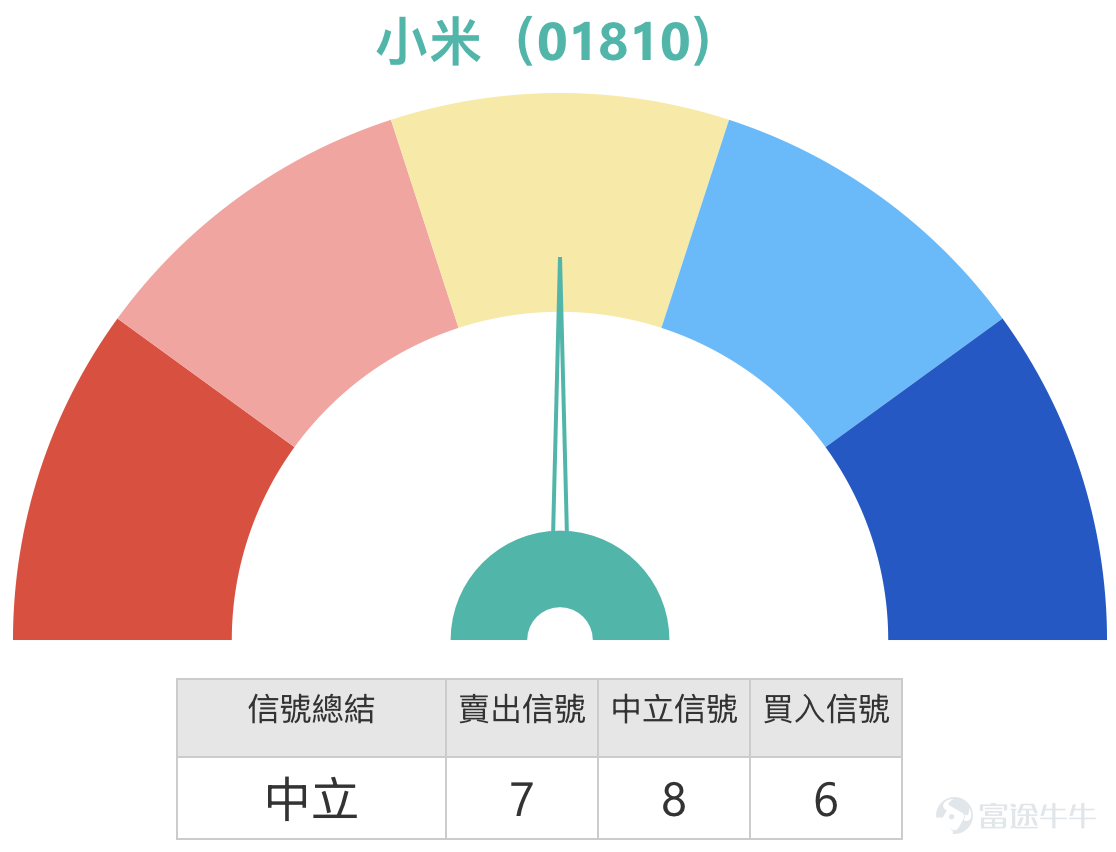
Based on the latest technical data analysis, Xiaomi closed at HKD 36.32 today, slightly down by 0.66% for the day, with a turnover of HKD 1.337 billion. From a technical indicator perspective, the short-term trend shows a balance between bulls and bears. In terms of moving averages, the stock price is slightly above the 10-day moving average (HKD 36.13), nearly equal to the 30-day moving average (HKD 36.17), but constrained by the pressure of the 60-day moving average (HKD 38.32). Multiple oscillation indicators are issuing 'neutral' signals, with the Relative Strength Index (RSI) at 49, within the neutral zone, indicating that the market has yet to form a clear one-sided direction. Notably, the VR volume ratio indicator is signaling 'buy', while the stochastic oscillator and CCI indicators suggest 'sell', and the MACD indicator signals 'buy'. Overall, although there are discrepancies among short-term indicators, the support at lower price levels is relatively clear, providing a certain margin of safety for short-term trading.
![$XIAOMI-W (01810.HK)$ #Learn Warrants and Bull/Bear Certificates with Jenny: Analyzing Actual Leverage and Product Selection Using Xiaomi as an Example As of February 24, 2026, Xiaomi Group (01810) was trading at HKD 35.6. Amid the current intertwined bullish and bearish signals, which direction will the stock price take? This article combines recent market dynamics with key insights from [HK Stocks Podcast] to outline short-term critical price levels and corresponding warrant strategies. From a market news perspective, positive factors for Xiaomi have been accumulating recently. First, southbound funds are showing active inflows, with a single-day increase of 33,021,700 shares in Xiaomi Group on February 23, and a cumulative net increase of 75,381,000 shares over the past five trading days, reflecting mainland investors' confidence in its medium- to long-term prospects. Second, the company's buyback activities continue, spending another HKD 152 million to repurchase 4,282,400 shares on February 20. Since the start of the year, it has conducted 24 buybacks, with a cumulative amount reaching HKD 3.532 billion, representing a significant year-on-year increase of 1469%, fully demonstrating management's confidence in the stock price. Fundamentally, Huatai Securities’ recent research report pointed out that Xiaomi’s car deliveries exceeded expectations, potentially reaching 650,000 units by 2026. Additionally, R&D investments in AI and robotics are strengthening the company’s long-term technological barriers. These factors collectively provide support for the stock price. [Share Link: February 11 [HKEX Podcast] Hang Seng Index, Xiaomi, BYD, Ping An, COSL, Trip.Com] ...](https://nnqimage.futunn.com/sns_client_feed/1162342/20260224/web-1771913745914-d2a8bUAdPY.png/big?area=1&is_public=true&imageMogr2/ignore-error/1/format/webp)
In terms of support and resistance levels, according to the latest data, the primary support level for Xiaomi Group below is at HKD 35.1, with stronger support located at the HKD 33.7 mark. The short-term resistance level above is at HKD 37.1, and if it can effectively break through, the next resistance will be at HKD 38.9, which closely aligns with the HKD 38.8 resistance mentioned in the podcast. When formulating short-term strategies, investors should focus on the rebound momentum of the stock price above the HKD 35.1 support level and whether it can break through the HKD 37.1 resistance level with increased volume.
Regarding warrant products, let's first review the performance of the products mentioned earlier. On February 20, we monitored four Xiaomi-related products, all of which recorded significant gains over the following two trading days (up to February 22), fully demonstrating the characteristics of derivative instruments capturing fluctuations in the underlying stock. Among them, BOC Bull Certificate (59188) $BI#XIAMIRC2612F.C (59188.HK)$ rose 36% over two days, UBS Bull Certificate rose 32%, HSBC Call Warrant (22791) $HSXIAMI@EC2612C.C (22791.HK)$ rose 23%, and BOC Call Warrant (13186) $BIXIAMI@EC2612A.C (13186.HK)$ rose 12%. During the same period, the underlying stock fluctuated by 5.43% and 2.71% respectively over two days, with bull certificate products achieving higher return elasticity due to their leverage characteristics.
![$XIAOMI-W (01810.HK)$ #Learn Warrants and Bull/Bear Certificates with Jenny: Analyzing Actual Leverage and Product Selection Using Xiaomi as an Example As of February 24, 2026, Xiaomi Group (01810) was trading at HKD 35.6. Amid the current intertwined bullish and bearish signals, which direction will the stock price take? This article combines recent market dynamics with key insights from [HK Stocks Podcast] to outline short-term critical price levels and corresponding warrant strategies. From a market news perspective, positive factors for Xiaomi have been accumulating recently. First, southbound funds are showing active inflows, with a single-day increase of 33,021,700 shares in Xiaomi Group on February 23, and a cumulative net increase of 75,381,000 shares over the past five trading days, reflecting mainland investors' confidence in its medium- to long-term prospects. Second, the company's buyback activities continue, spending another HKD 152 million to repurchase 4,282,400 shares on February 20. Since the start of the year, it has conducted 24 buybacks, with a cumulative amount reaching HKD 3.532 billion, representing a significant year-on-year increase of 1469%, fully demonstrating management's confidence in the stock price. Fundamentally, Huatai Securities’ recent research report pointed out that Xiaomi’s car deliveries exceeded expectations, potentially reaching 650,000 units by 2026. Additionally, R&D investments in AI and robotics are strengthening the company’s long-term technological barriers. These factors collectively provide support for the stock price. [Share Link: February 11 [HKEX Podcast] Hang Seng Index, Xiaomi, BYD, Ping An, COSL, Trip.Com] ...](https://nnqimage.futunn.com/sns_client_feed/1162342/20260224/web-1771913788094-WCPyQfr38h.png/big?area=1&is_public=true&imageMogr2/ignore-error/1/format/webp)
Considering the current support and resistance levels, we further analyze the products worth monitoring at this price stage. For investors expecting Xiaomi Group to hold above the HKD 35.1 support level and challenge the HKD 37.1 or even HKD 38.9 resistance levels, call warrants and bull certificates are worth watching. In terms of call warrants, BOC Call Warrant (22824) $BIXIAMI@EC2605C.C (22824.HK)$ and HSBC Call Warrant (24943) have exercise prices of HKD 40, closely related to the second resistance level at HKD 38.9 and the round number barrier at HKD 40, offering approximately 8.5 times actual leverage. Among these, (24943) has the lowest premium, with implied volatility and leverage showing relatively ideal performance. Regarding bull certificates, UBS Bull Certificate (59492) and HSBC Bull Certificate (58127) have recovery prices at HKD 34, below the primary support level of HKD 35.1, providing an effective buffer, with actual leverage of approximately 11.4 times and 11.9 times respectively, and (58127) $HS#XIAMIRC26077.C (58127.HK)$ having the lowest premium, making it suitable for investors who anticipate a rebound in the underlying stock.
For investors expecting Xiaomi Group to face resistance at HKD 37.1 or retrace to test the HKD 35.1 support level, put warrants and bear certificates are worth watching. In terms of put warrants, HSBC Put Warrant (22196) and UBS Put Warrant (22136) $UBXIAMI@EP2604A.P (22136.HK)$ have exercise prices of HKD 35.16, closely aligned with the primary support level at HKD 35.1, offering approximately 8.6 times and 8.3 times actual leverage respectively. Among these, (22196) has the lowest premium and implied volatility, making it more cost-effective. Regarding bear certificates, UBS Bear Certificate (69732) has a recovery price at HKD 40, while Morgan Bear Certificate (68998) has a recovery price at HKD 40.5, both above the second resistance level at HKD 38.9 and the round number barrier at HKD 40, offering approximately 10.7 times and 9.1 times actual leverage respectively, with (68998) having the highest actual leverage, making it suitable for investors who expect a pullback in the underlying stock.
![$XIAOMI-W (01810.HK)$ #Learn Warrants and Bull/Bear Certificates with Jenny: Analyzing Actual Leverage and Product Selection Using Xiaomi as an Example As of February 24, 2026, Xiaomi Group (01810) was trading at HKD 35.6. Amid the current intertwined bullish and bearish signals, which direction will the stock price take? This article combines recent market dynamics with key insights from [HK Stocks Podcast] to outline short-term critical price levels and corresponding warrant strategies. From a market news perspective, positive factors for Xiaomi have been accumulating recently. First, southbound funds are showing active inflows, with a single-day increase of 33,021,700 shares in Xiaomi Group on February 23, and a cumulative net increase of 75,381,000 shares over the past five trading days, reflecting mainland investors' confidence in its medium- to long-term prospects. Second, the company's buyback activities continue, spending another HKD 152 million to repurchase 4,282,400 shares on February 20. Since the start of the year, it has conducted 24 buybacks, with a cumulative amount reaching HKD 3.532 billion, representing a significant year-on-year increase of 1469%, fully demonstrating management's confidence in the stock price. Fundamentally, Huatai Securities’ recent research report pointed out that Xiaomi’s car deliveries exceeded expectations, potentially reaching 650,000 units by 2026. Additionally, R&D investments in AI and robotics are strengthening the company’s long-term technological barriers. These factors collectively provide support for the stock price. [Share Link: February 11 [HKEX Podcast] Hang Seng Index, Xiaomi, BYD, Ping An, COSL, Trip.Com] ...](https://nnqimage.futunn.com/sns_client_feed/1162342/20260224/web-1771913756409-sjC6RyjNkV.png/big?area=1&is_public=true&imageMogr2/ignore-error/1/format/webp)
#Learn Warrants and Callable Bull/Bear Contracts with Jenny#, this episode focuses on the difference between 'Leverage Ratio and Effective Leverage Ratio.' The leverage ratio refers to the multiple of the warrant price relative to the underlying stock price, calculated as 'Underlying Stock Price / (Warrant Price × Conversion Ratio),' reflecting the nominal capital input for the underlying stock versus the warrant. However, this is only a theoretical value and does not consider factors such as the time value and implied volatility of the warrant. The effective leverage ratio is based on the leverage ratio multiplied by the 'Delta,' showing the percentage change in the warrant price when the underlying stock price changes by 1%, providing a more accurate measure of the warrant's price sensitivity. For example, the recommended HSBC call warrant (24943) has both a leverage ratio and an effective leverage of approximately 8.5 times, meaning that if the underlying stock price increases by 1%, the theoretical warrant price will rise by about 8.5%. Investors should focus on the effective leverage when comparing products because it better reflects the potential return capability of the warrant.
Derivative products like warrants and callable bull/bear contracts offer the core advantage of allowing investors to establish positions equivalent to holding a certain amount of underlying stock with relatively less capital, thereby enhancing the potential efficiency of fund utilization. At the same time, investors can flexibly choose products with different terms based on their judgment of market direction, volatility, and time value, executing more refined trading strategies. For instance, using call warrants or bull contracts to capture rebound opportunities when short-term support levels are identified, or employing put warrants or bear contracts for hedging near resistance levels. The advantages of warrants and callable bull/bear contracts lie in their flexibility and leverage characteristics, enabling investors to capture potential returns from underlying stock movements while defining their maximum risk (the premium paid).
Interactive Question:
What do readers think about Xiaomi Group’s (01810) short-term outlook?
A) Holding above the HKD 36 mark, testing upward resistance at HKD 37.1
B) Facing resistance at HKD 37.1, retesting support at HKD 35.1
Feel free to share your views in the comment section!
Please follow Jenny's Warrants and Callable Bull/Bear Contracts column for more in-depth analysis of the market!
Reminder: This article does not constitute any investment advice.
This article is for reference only and does not constitute any investment advice. The market data, opinions, and analysis contained herein may change at any time without prior notice. We are not responsible for any loss or damage caused by reliance on the information in this article. Technical analysis only shows whether certain technical conditions are met; a comprehensive assessment of asset performance should combine other data and should not solely rely on this article to make trading decisions. Please note that past performance is not indicative of future results. Follow Jenny's insights on Hong Kong stock warrants for more professional analysis.
#Xiaomi Group# #Hong Kong Stocks# #Technical Analysis# #Support Level# #Resistance Level# #Warrants# #Bull and Bear Certificates# #Actual Leverage# #Call Warrants# #Put Warrants#
Risk Disclaimer: The above content only represents the author's view. It does not represent any position or investment advice of Futu. Futu makes no representation or warranty.Read more

Comments
to post a comment
1
12