
[Publishing orders] The market is ups and downs, did your options make or lose?

Journey of a New Options Trader: Prominent Sector Rotation Since 2026! How to Use Options for Low-Cost Returns?
Hello fellow investor! I've noticed that many investors face bottlenecks when investing in stocks and feel lost when considering a move to options. Therefore, to help option beginners cultivate the right mindset, enhance their understanding, and seize opportunities through hands-on practice, I have created the 'Option Newbie Gold Rush Companion' column. I hope to accompany you on a path of continuous improvement. If you're interested, you're welcome to join.Click hereUpon joining the learning platform, you will receive notifications when subsequent columns are updated.
*The following content is for investment education purposes only and does not represent any investment advice. Data is as of before the US stock market opening on February 12, 2026.
Since the beginning of 2026, the US stock market has seen a noticeable sector rotation.
Tech stocks, which have led the market over the past two years, started showing signs of fatigue and also diverged internally:
Software-related stocks have plummeted sharply due to the impact of AI agents on the traditional SaaS business model and rating downgrades by institutions, with representative $iShares Expanded Tech-Software Sector ETF (IGV.US)$ having fallen more than 20% year-to-date;
Funds flowed into hardware-related stocks such as storage and semiconductor equipment, $Micron Technology (MU.US)$ 、 $SanDisk (SNDK.US)$ with storage chip names like performing strongly since the start of the year, even experiencing single-day surges of 10%, forming a stark contrast of 'weak software, strong hardware' within the tech sector.
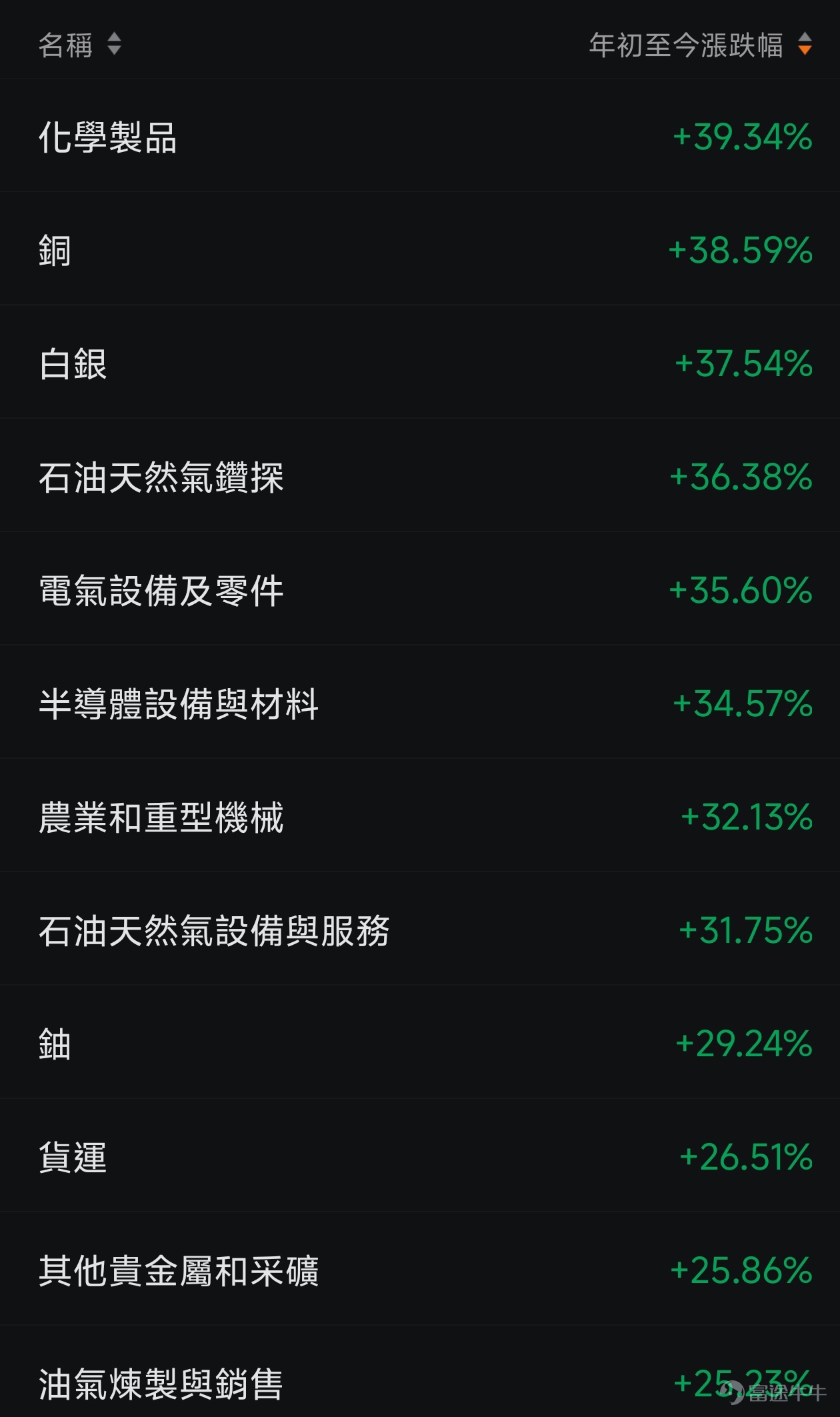
At the same time, traditional cyclical sectors such as energy, materials, and industrials have emerged strongly with significant gains. The energy sector, in particular, has risen approximately 19% in just over a month since the start of the year, showing relative strength.
![Hello fellow investor! I've noticed that many investors face bottlenecks when investing in stocks and feel lost when considering a move to options. Therefore, to help option beginners cultivate the right mindset, enhance their understanding, and seize opportunities through hands-on practice, I have created the 'Option Newbie Gold Rush Companion' column. I hope to accompany you on a path of continuous improvement. If you're interested, you're welcome to join.[Share Link: Click here]Upon joining the learning platform, you will receive notifications when subsequent columns are updated. *The following content is for investment education purposes only and does not represent any investment advice. Data is as of before the US stock market opening on February 12, 2026. Since the beginning of 2026, the US stock market has seen a noticeable sector rotation. Tech stocks, which have led the market over the past two years, started showing signs of fatigue and also diverged internally: Software-related stocks have plummeted sharply due to the impact of AI agents on the traditional SaaS business model and rating downgrades by institutions, with representative $iShares Expanded Tech-Software Sector ETF (IGV.US)$ having fallen more than 20% year-to-date; Funds flowed into hardware-related stocks such as storage and semiconductor equipment, $Micron Technology (MU.US)$ 、 $SanDisk (SNDK.US)$ with storage chip names like performing strongly since the start of the year, even experiencing single-day surges of 10%, forming a stark contrast of 'weak software, strong hardware' within the tech sector. At the same time, traditional cyclical sectors such as energy, materials, and industrials have unexpectedly risen significantly,...](https://nnqimage.futunn.com/sns_client_feed/999908/20260212/web-1770891151400-s1lZ5pRSW1.jpeg/big?area=2&is_public=true&imageMogr2/ignore-error/1/format/webp)
![Hello fellow investor! I've noticed that many investors face bottlenecks when investing in stocks and feel lost when considering a move to options. Therefore, to help option beginners cultivate the right mindset, enhance their understanding, and seize opportunities through hands-on practice, I have created the 'Option Newbie Gold Rush Companion' column. I hope to accompany you on a path of continuous improvement. If you're interested, you're welcome to join.[Share Link: Click here]Upon joining the learning platform, you will receive notifications when subsequent columns are updated. *The following content is for investment education purposes only and does not represent any investment advice. Data is as of before the US stock market opening on February 12, 2026. Since the beginning of 2026, the US stock market has seen a noticeable sector rotation. Tech stocks, which have led the market over the past two years, started showing signs of fatigue and also diverged internally: Software-related stocks have plummeted sharply due to the impact of AI agents on the traditional SaaS business model and rating downgrades by institutions, with representative $iShares Expanded Tech-Software Sector ETF (IGV.US)$ having fallen more than 20% year-to-date; Funds flowed into hardware-related stocks such as storage and semiconductor equipment, $Micron Technology (MU.US)$ 、 $SanDisk (SNDK.US)$ with storage chip names like performing strongly since the start of the year, even experiencing single-day surges of 10%, forming a stark contrast of 'weak software, strong hardware' within the tech sector. At the same time, traditional cyclical sectors such as energy, materials, and industrials have unexpectedly risen significantly,...](https://nnqimage.futunn.com/sns_client_feed/999908/20260212/web-1770891151334-Pf4Y6PGogU.png/big?area=2&is_public=true&imageMogr2/ignore-error/1/format/webp)
Small-cap indices have also started to outperform large-cap tech stocks, $Russell 2000 Index (.RUT.US)$ rising about 7.6% year-to-date, far exceeding the marginal gains of $S&P 500 Index (.SPX.US)$ , reflecting that capital is beginning to tilt towards small- and mid-cap value stocks.
![Hello fellow investor! I've noticed that many investors face bottlenecks when investing in stocks and feel lost when considering a move to options. Therefore, to help option beginners cultivate the right mindset, enhance their understanding, and seize opportunities through hands-on practice, I have created the 'Option Newbie Gold Rush Companion' column. I hope to accompany you on a path of continuous improvement. If you're interested, you're welcome to join.[Share Link: Click here]Upon joining the learning platform, you will receive notifications when subsequent columns are updated. *The following content is for investment education purposes only and does not represent any investment advice. Data is as of before the US stock market opening on February 12, 2026. Since the beginning of 2026, the US stock market has seen a noticeable sector rotation. Tech stocks, which have led the market over the past two years, started showing signs of fatigue and also diverged internally: Software-related stocks have plummeted sharply due to the impact of AI agents on the traditional SaaS business model and rating downgrades by institutions, with representative $iShares Expanded Tech-Software Sector ETF (IGV.US)$ having fallen more than 20% year-to-date; Funds flowed into hardware-related stocks such as storage and semiconductor equipment, $Micron Technology (MU.US)$ 、 $SanDisk (SNDK.US)$ with storage chip names like performing strongly since the start of the year, even experiencing single-day surges of 10%, forming a stark contrast of 'weak software, strong hardware' within the tech sector. At the same time, traditional cyclical sectors such as energy, materials, and industrials have unexpectedly risen significantly,...](https://nnqimage.futunn.com/sns_client_feed/999908/20260212/web-1770891151298-rh2Gm9BTJf.png/big?area=2&is_public=true&imageMogr2/ignore-error/1/format/webp)
The strong performance of the precious metals sector since the second half of last year has continued, becoming another major highlight against the backdrop of market volatility and sector rotation. Gold and silver have risen by approximately 17% each since the start of the year, while copper's performance has been even more impressive, with cumulative gains exceeding 30% despite relatively minor pullbacks.
Overall, capital is rapidly flowing between sectors such as technology, energy, industrials, materials, and precious metals, with the volatility of individual sectors significantly amplified. This year, the US stock market no longer appears to be experiencing a broad-based rally; instead, it has entered a phase where investors need to be more selective in choosing industries and stocks.
In the face of increased market volatility, sector rotation, and unclear direction, how can one participate in this rotational market trend at a relatively low cost? When it comes to low-cost strategies, we must mention the Long Call options strategy. Compared to trading stocks directly, this approach might allow you to take advantage of larger movements with a smaller investment, capturing profit opportunities from sector rotation while managing risk.
1. Basic Understanding of the Long Call Strategy
![Hello fellow investor! I've noticed that many investors face bottlenecks when investing in stocks and feel lost when considering a move to options. Therefore, to help option beginners cultivate the right mindset, enhance their understanding, and seize opportunities through hands-on practice, I have created the 'Option Newbie Gold Rush Companion' column. I hope to accompany you on a path of continuous improvement. If you're interested, you're welcome to join.[Share Link: Click here]Upon joining the learning platform, you will receive notifications when subsequent columns are updated. *The following content is for investment education purposes only and does not represent any investment advice. Data is as of before the US stock market opening on February 12, 2026. Since the beginning of 2026, the US stock market has seen a noticeable sector rotation. Tech stocks, which have led the market over the past two years, started showing signs of fatigue and also diverged internally: Software-related stocks have plummeted sharply due to the impact of AI agents on the traditional SaaS business model and rating downgrades by institutions, with representative $iShares Expanded Tech-Software Sector ETF (IGV.US)$ having fallen more than 20% year-to-date; Funds flowed into hardware-related stocks such as storage and semiconductor equipment, $Micron Technology (MU.US)$ 、 $SanDisk (SNDK.US)$ with storage chip names like performing strongly since the start of the year, even experiencing single-day surges of 10%, forming a stark contrast of 'weak software, strong hardware' within the tech sector. At the same time, traditional cyclical sectors such as energy, materials, and industrials have unexpectedly risen significantly,...](https://nnqimage.futunn.com/sns_client_feed/999908/20260212/web-1770891114129-sRCPHOXJ30.png/big?area=2&is_public=true&imageMogr2/ignore-error/1/format/webp)
Simply put, a Long Call involves buying a call option contract, which grants you the right to purchase the underlying asset at an agreed-upon price (the strike price) before expiration. As the stock price rises, the value of the call typically increases because you hold the right to buy the stock at a lower price.
Here’s a relatable analogy:
You really want to attend a popular concert, but the tickets are sold out, and prices are expected to soar. You're still unsure whether to buy from a scalper. At this point, the scalper tells you that by paying a deposit of HK$100, he guarantees to sell you the ticket for HK$2,000 after a week.
One week later, if the ticket price rises to HKD 3,000, you can buy the ticket for HKD 2,000, far below the market price at that time, so you profit. Additionally, at this point, the deposit representing your rights may rise to HKD 1,000. If you decide not to buy the ticket, you could sell this right and still make a profit. If the price falls to HKD 1,000, you simply abandon the purchase, losing only the HKD 100 deposit.
![Hello fellow investor! I've noticed that many investors face bottlenecks when investing in stocks and feel lost when considering a move to options. Therefore, to help option beginners cultivate the right mindset, enhance their understanding, and seize opportunities through hands-on practice, I have created the 'Option Newbie Gold Rush Companion' column. I hope to accompany you on a path of continuous improvement. If you're interested, you're welcome to join.[Share Link: Click here]Upon joining the learning platform, you will receive notifications when subsequent columns are updated. *The following content is for investment education purposes only and does not represent any investment advice. Data is as of before the US stock market opening on February 12, 2026. Since the beginning of 2026, the US stock market has seen a noticeable sector rotation. Tech stocks, which have led the market over the past two years, started showing signs of fatigue and also diverged internally: Software-related stocks have plummeted sharply due to the impact of AI agents on the traditional SaaS business model and rating downgrades by institutions, with representative $iShares Expanded Tech-Software Sector ETF (IGV.US)$ having fallen more than 20% year-to-date; Funds flowed into hardware-related stocks such as storage and semiconductor equipment, $Micron Technology (MU.US)$ 、 $SanDisk (SNDK.US)$ with storage chip names like performing strongly since the start of the year, even experiencing single-day surges of 10%, forming a stark contrast of 'weak software, strong hardware' within the tech sector. At the same time, traditional cyclical sectors such as energy, materials, and industrials have unexpectedly risen significantly,...](https://nnqimage.futunn.com/sns_client_feed/999908/20260212/web-1770891105162-fYnUnDAQL8.png/big?area=2&is_public=true&imageMogr2/ignore-error/1/format/webp)
The main characteristics of this strategy are:
● Limited Risk: Maximum loss = premium paid when purchasing the option
● Unlimited Profit Potential: Theoretically, the higher the stock price rises, the greater the profit
● Leverage Effect: With a small amount of capital (the premium), you can control a much higher-valued stock. For example, NVIDIA’s at-the-money (strike price equals current stock price) option expiring in eight days costs $2.33. That means with $233 ($2.33 x 100), you can tie yourself to the movement of 100 shares of NVIDIA stock (worth about $19,000 in total).
● Time value decay: As the expiration date approaches, if the stock price does not rise as expected, the option price will gradually decline, meaning your premium expenditure will steadily approach zero.
In what situations is it suitable to use a Long Call?
When you are optimistic about a particular stock or sector and believe it will rise but are uncertain about when the movement will start, or if you anticipate short-term catalysts for a stock price increase (e.g., earnings releases, favorable policies, positive industry events, etc.), and you want to participate in the upward trend with less capital while controlling risk and avoiding the full loss of direct shareholding, this situation is suitable for using this strategy.
On the other hand, if you have no clear forecast, or if the stock price is in a sideways consolidation phase with low volatility and difficulty breaking out, or if you cannot tolerate the risk of losing the entire premium paid for buying the option, these scenarios are unsuitable for using this strategy.
The profit and loss situation at expiration for this strategy can be seen directly in the diagram below:
![Hello fellow investor! I've noticed that many investors face bottlenecks when investing in stocks and feel lost when considering a move to options. Therefore, to help option beginners cultivate the right mindset, enhance their understanding, and seize opportunities through hands-on practice, I have created the 'Option Newbie Gold Rush Companion' column. I hope to accompany you on a path of continuous improvement. If you're interested, you're welcome to join.[Share Link: Click here]Upon joining the learning platform, you will receive notifications when subsequent columns are updated. *The following content is for investment education purposes only and does not represent any investment advice. Data is as of before the US stock market opening on February 12, 2026. Since the beginning of 2026, the US stock market has seen a noticeable sector rotation. Tech stocks, which have led the market over the past two years, started showing signs of fatigue and also diverged internally: Software-related stocks have plummeted sharply due to the impact of AI agents on the traditional SaaS business model and rating downgrades by institutions, with representative $iShares Expanded Tech-Software Sector ETF (IGV.US)$ having fallen more than 20% year-to-date; Funds flowed into hardware-related stocks such as storage and semiconductor equipment, $Micron Technology (MU.US)$ 、 $SanDisk (SNDK.US)$ with storage chip names like performing strongly since the start of the year, even experiencing single-day surges of 10%, forming a stark contrast of 'weak software, strong hardware' within the tech sector. At the same time, traditional cyclical sectors such as energy, materials, and industrials have unexpectedly risen significantly,...](https://nnqimage.futunn.com/sns_client_feed/999908/20260212/web-1770891093847-7JBoljrYEO.png/big?area=2&is_public=true&imageMogr2/ignore-error/1/format/webp)
2. Five Key Techniques for Implementing a Long Call
Through the path Individual Stock Details > Options > Option Chain, you can view all option contracts related to the target stock. This includes information such as expiration dates, strike prices, premiums (including bid price, ask price, last price, etc.), changes in price, trading volume, and various other key data points. The area to the left of the strike price represents call options, while the area to the right represents put options.
![Hello fellow investor! I've noticed that many investors face bottlenecks when investing in stocks and feel lost when considering a move to options. Therefore, to help option beginners cultivate the right mindset, enhance their understanding, and seize opportunities through hands-on practice, I have created the 'Option Newbie Gold Rush Companion' column. I hope to accompany you on a path of continuous improvement. If you're interested, you're welcome to join.[Share Link: Click here]Upon joining the learning platform, you will receive notifications when subsequent columns are updated. *The following content is for investment education purposes only and does not represent any investment advice. Data is as of before the US stock market opening on February 12, 2026. Since the beginning of 2026, the US stock market has seen a noticeable sector rotation. Tech stocks, which have led the market over the past two years, started showing signs of fatigue and also diverged internally: Software-related stocks have plummeted sharply due to the impact of AI agents on the traditional SaaS business model and rating downgrades by institutions, with representative $iShares Expanded Tech-Software Sector ETF (IGV.US)$ having fallen more than 20% year-to-date; Funds flowed into hardware-related stocks such as storage and semiconductor equipment, $Micron Technology (MU.US)$ 、 $SanDisk (SNDK.US)$ with storage chip names like performing strongly since the start of the year, even experiencing single-day surges of 10%, forming a stark contrast of 'weak software, strong hardware' within the tech sector. At the same time, traditional cyclical sectors such as energy, materials, and industrials have unexpectedly risen significantly,...](https://nnqimage.futunn.com/sns_client_feed/999908/20260212/web-1770891203732-RVV4cKV09v.jpeg/big?area=2&is_public=true&imageMogr2/ignore-error/1/format/webp)
To execute a successful Long Call trade, keep the following six tips in mind.
1) Choose the Right Strike Price: Balance Cost and Probability of Success
In-the-money (strike price below the current stock price): Expensive premium, but high Delta (Delta represents how much the option price changes when the stock price moves by one unit), so stock price movements significantly affect the premium. Suitable for higher certainty market conditions.
In-the-money (strike price below the current stock price): Expensive premium, but high Delta (Delta represents how much the option price changes when the stock price moves by one unit), so stock price movements significantly affect the premium. Suitable for higher certainty market conditions.
At-the-money (strike price equals current stock price): A balanced choice with moderate cost, Delta around 0.5
Out-of-the-money (strike price higher than current stock price): Low premium, high leverage, but requires a significant increase to be profitable, suitable for 'high-risk, high-reward' goals
Recommendation: Beginners should prioritize at-the-money or slightly out-of-the-money options (e.g., strike price 5-10% higher than the current stock price) to balance cost and probability of success
2) Choose the right expiration date: Allow sufficient time for market movement
As an option buyer, as the expiration date approaches, the value of the options you hold will depreciate faster
Short-term (within 1 month): Suitable when there are clear catalyst events or obvious upward signals in technical patterns
Medium-term (2-3 months): Ideal for sector rotation, when trends are established but timing is uncertain
Long-term (over 6 months): Higher premium, but ample time, suitable for long-term bullish targets
Recommendation: For sector rotation scenarios, choose contracts of 2-3 months to balance cost and time
3) Control position size: Do not exceed 10% of total capital
Although the maximum loss of a Long Call is limited to the premium, if the position size is too large, an unexpected market move could still lead to significant losses.
Therefore, the position size for a single Long Call should preferably not exceed 2-5% of total capital, and the combined position size for all Long Calls should not exceed 10% of total capital. Alternatively, you can adjust these position ratios based on your own risk tolerance.
Position sizing is the first line of defense in risk control, and effective risk management is one of the key principles to long-term profitability in investing; therefore, it's highly recommended that you adhere to this rule.
![Hello fellow investor! I've noticed that many investors face bottlenecks when investing in stocks and feel lost when considering a move to options. Therefore, to help option beginners cultivate the right mindset, enhance their understanding, and seize opportunities through hands-on practice, I have created the 'Option Newbie Gold Rush Companion' column. I hope to accompany you on a path of continuous improvement. If you're interested, you're welcome to join.[Share Link: Click here]Upon joining the learning platform, you will receive notifications when subsequent columns are updated. *The following content is for investment education purposes only and does not represent any investment advice. Data is as of before the US stock market opening on February 12, 2026. Since the beginning of 2026, the US stock market has seen a noticeable sector rotation. Tech stocks, which have led the market over the past two years, started showing signs of fatigue and also diverged internally: Software-related stocks have plummeted sharply due to the impact of AI agents on the traditional SaaS business model and rating downgrades by institutions, with representative $iShares Expanded Tech-Software Sector ETF (IGV.US)$ having fallen more than 20% year-to-date; Funds flowed into hardware-related stocks such as storage and semiconductor equipment, $Micron Technology (MU.US)$ 、 $SanDisk (SNDK.US)$ with storage chip names like performing strongly since the start of the year, even experiencing single-day surges of 10%, forming a stark contrast of 'weak software, strong hardware' within the tech sector. At the same time, traditional cyclical sectors such as energy, materials, and industrials have unexpectedly risen significantly,...](https://nnqimage.futunn.com/sns_client_feed/999908/20260212/web-1770891117511-FUU0gyJC5I.png/big?area=2&is_public=true&imageMogr2/ignore-error/1/format/webp)
4) Set profit targets and stop-losses: Execute them with discipline
When buying options, it’s advisable to set profit-taking and stop-loss levels and strictly follow through with them.
Otherwise, you may experience a rollercoaster of emotions like this: “The option price surges — joy from profits, confidence and hope skyrocketing — oh no, why did it suddenly drop, bring it back up — oh no, how did I end up with losses, so frustrating when I was previously in profit — oh no, I lost everything, what a letdown,” due to the high volatility of options.
For instance, you might consider exiting when your losses reach 50%, to prevent losing everything, and when your profits reach 50%-100%, think about selling half of your position while setting a trailing stop for the remaining position. Or you can customize your profit-taking and stop-loss levels based on your personal risk preference.
But regardless, it's strongly suggested that you have such a setup in place, combining your market forecast to plan and prepare in advance, rather than becoming a passive follower of market fluctuations (in which case your profit-and-loss results are unlikely to be satisfactory).
5) Pay attention to Implied Volatility (IV): Avoid chasing overpriced options
When buying options, you must pay attention to IV, which reflects expectations for future price volatility of the underlying asset.
Here, let's explain the components of an option's price. The price of an option consists of two parts: intrinsic value and time value.
The intrinsic value of an option can be understood as the value obtained if exercised immediately, with intrinsic value being greater than or equal to zero. The intrinsic value of a call option = stock market price - strike price; for a put option, it is strike price - stock market price. Time value decays as time decreases and is also related to implied volatility (IV). All else being equal, higher IV typically results in a higher option price.
When the market panics or becomes excited, expecting significant future price fluctuations, IV may spike, making options more expensive. If you buy options at this time, even if your directional judgment is correct, a pullback in IV could still lead to losses.
Therefore, it’s recommended to buy options when IV is relatively low and avoid purchasing them the day before major events, as uncertainty usually diminishes afterward, leading to a sharp drop in IV.
To extend the discussion, entering options is similar to entering stocks, as both emphasize choosing the right timing for entry. Therefore, you can integrate fundamental analysis, technical indicators, and capital flow assessments to select a better entry point, which will increase your chances of trading success.
6) Pay attention to liquidity: check trading volume and open interest.
Success in options trading depends not only on correctly predicting direction but also on liquidity, which is key to efficient entry and exit.
Contracts with insufficient liquidity often have wide bid-ask spreads, causing implicit losses right after entering a position. Worse still, when trying to cut losses or take profits, you may be unable to close the position smoothly due to a lack of counterparties, forcing your position to lose time value entirely.
Therefore, before placing an order, be sure to review two core metrics of the options chain: trading volume reflects daily activity levels, while open interest shows the total number of contracts currently circulating in the market. Higher values for both typically indicate better liquidity. (Path: Details page for a specific stock > Options > Options chain > Details page for a specific option contract)

(Design images displayed on the screen are for illustrative purposes only and do not constitute any investment advice or guarantee.)
Moreover, the bid-ask spread is a more intuitive criterion for judgment. Ideally, it should be less than $0.10; a large spread indicates low trading activity for that contract. For beginners, the safest approach is to prioritize relatively near-term, at-the-money or slightly out-of-the-money options with actively traded underlying assets. These contracts have ample liquidity and transparent pricing, allowing you to focus on executing your strategy rather than worrying about being unable to exit.
If you already have a clear intention to buy a specific option, you can directly refer to the steps in the image below:
![Hello fellow investor! I've noticed that many investors face bottlenecks when investing in stocks and feel lost when considering a move to options. Therefore, to help option beginners cultivate the right mindset, enhance their understanding, and seize opportunities through hands-on practice, I have created the 'Option Newbie Gold Rush Companion' column. I hope to accompany you on a path of continuous improvement. If you're interested, you're welcome to join.[Share Link: Click here]Upon joining the learning platform, you will receive notifications when subsequent columns are updated. *The following content is for investment education purposes only and does not represent any investment advice. Data is as of before the US stock market opening on February 12, 2026. Since the beginning of 2026, the US stock market has seen a noticeable sector rotation. Tech stocks, which have led the market over the past two years, started showing signs of fatigue and also diverged internally: Software-related stocks have plummeted sharply due to the impact of AI agents on the traditional SaaS business model and rating downgrades by institutions, with representative $iShares Expanded Tech-Software Sector ETF (IGV.US)$ having fallen more than 20% year-to-date; Funds flowed into hardware-related stocks such as storage and semiconductor equipment, $Micron Technology (MU.US)$ 、 $SanDisk (SNDK.US)$ with storage chip names like performing strongly since the start of the year, even experiencing single-day surges of 10%, forming a stark contrast of 'weak software, strong hardware' within the tech sector. At the same time, traditional cyclical sectors such as energy, materials, and industrials have unexpectedly risen significantly,...](https://nnqimage.futunn.com/sns_client_feed/999908/20260212/web-1770891095753-1szFlOcL6X.png/big?area=2&is_public=true&imageMogr2/ignore-error/1/format/webp)
3. Application of Long Call in Sector Rotation in 2026
Based on the previous discussion, the market in 2026 will exhibit distinct sector rotation characteristics. Combining insights from major institutions, the following three directions may be worth watching.
Direction 1: Opportunities in AI hardware, semiconductors, optical communications, power sectors, as well as AI model layers and application layers.
Although AI software stocks face earnings verification pressures, AI hardware and related supporting fields remain the core focus of the market. As AI applications continue to deepen, demand for underlying computing power, storage, data transmission, and the electricity required for operations continues to surge, presenting clear profit prospects for related industries.
If the foundational layer is the power plant enabling AI to function, then the model layer is the intelligent brain of AI. It is responsible for enabling machines to understand, reason, and generate content, forming the core of AI capabilities. This part may not be as intuitive as hardware, but it is the engine driving all applications. Key areas to track include progress in multimodal technologies (capable of processing text, images, and videos simultaneously) and commercialization developments, avoiding investments in companies that only burn cash without profits or lack actual orders.
The application layer represents the frontline where AI technology generates value and directly interacts with users. Relying on the foundational layer’s hardware and the model layer’s technology, it integrates AI into daily life and various industries, generating tangible profits. This is the area in 2026 with the most room for imagination and diverse opportunities, prioritizing familiar scenarios with strong practical implementation. Track trends such as the AI PC upgrade cycle, the deployment of humanoid robots, and the penetration rate of industry applications, focusing on companies with core products and verifiable earnings.
![Hello fellow investor! I've noticed that many investors face bottlenecks when investing in stocks and feel lost when considering a move to options. Therefore, to help option beginners cultivate the right mindset, enhance their understanding, and seize opportunities through hands-on practice, I have created the 'Option Newbie Gold Rush Companion' column. I hope to accompany you on a path of continuous improvement. If you're interested, you're welcome to join.[Share Link: Click here]Upon joining the learning platform, you will receive notifications when subsequent columns are updated. *The following content is for investment education purposes only and does not represent any investment advice. Data is as of before the US stock market opening on February 12, 2026. Since the beginning of 2026, the US stock market has seen a noticeable sector rotation. Tech stocks, which have led the market over the past two years, started showing signs of fatigue and also diverged internally: Software-related stocks have plummeted sharply due to the impact of AI agents on the traditional SaaS business model and rating downgrades by institutions, with representative $iShares Expanded Tech-Software Sector ETF (IGV.US)$ having fallen more than 20% year-to-date; Funds flowed into hardware-related stocks such as storage and semiconductor equipment, $Micron Technology (MU.US)$ 、 $SanDisk (SNDK.US)$ with storage chip names like performing strongly since the start of the year, even experiencing single-day surges of 10%, forming a stark contrast of 'weak software, strong hardware' within the tech sector. At the same time, traditional cyclical sectors such as energy, materials, and industrials have unexpectedly risen significantly,...](https://nnqimage.futunn.com/sns_client_feed/999908/20260212/web-1770891093850-WvLixqIb0E.png/big?area=2&is_public=true&imageMogr2/ignore-error/1/format/webp)
![Hello fellow investor! I've noticed that many investors face bottlenecks when investing in stocks and feel lost when considering a move to options. Therefore, to help option beginners cultivate the right mindset, enhance their understanding, and seize opportunities through hands-on practice, I have created the 'Option Newbie Gold Rush Companion' column. I hope to accompany you on a path of continuous improvement. If you're interested, you're welcome to join.[Share Link: Click here]Upon joining the learning platform, you will receive notifications when subsequent columns are updated. *The following content is for investment education purposes only and does not represent any investment advice. Data is as of before the US stock market opening on February 12, 2026. Since the beginning of 2026, the US stock market has seen a noticeable sector rotation. Tech stocks, which have led the market over the past two years, started showing signs of fatigue and also diverged internally: Software-related stocks have plummeted sharply due to the impact of AI agents on the traditional SaaS business model and rating downgrades by institutions, with representative $iShares Expanded Tech-Software Sector ETF (IGV.US)$ having fallen more than 20% year-to-date; Funds flowed into hardware-related stocks such as storage and semiconductor equipment, $Micron Technology (MU.US)$ 、 $SanDisk (SNDK.US)$ with storage chip names like performing strongly since the start of the year, even experiencing single-day surges of 10%, forming a stark contrast of 'weak software, strong hardware' within the tech sector. At the same time, traditional cyclical sectors such as energy, materials, and industrials have unexpectedly risen significantly,...](https://nnqimage.futunn.com/sns_client_feed/999908/20260212/web-1770891268593-3sHHzV6nwa.png/big?area=2&is_public=true&imageMogr2/ignore-error/1/format/webp)
![Hello fellow investor! I've noticed that many investors face bottlenecks when investing in stocks and feel lost when considering a move to options. Therefore, to help option beginners cultivate the right mindset, enhance their understanding, and seize opportunities through hands-on practice, I have created the 'Option Newbie Gold Rush Companion' column. I hope to accompany you on a path of continuous improvement. If you're interested, you're welcome to join.[Share Link: Click here]Upon joining the learning platform, you will receive notifications when subsequent columns are updated. *The following content is for investment education purposes only and does not represent any investment advice. Data is as of before the US stock market opening on February 12, 2026. Since the beginning of 2026, the US stock market has seen a noticeable sector rotation. Tech stocks, which have led the market over the past two years, started showing signs of fatigue and also diverged internally: Software-related stocks have plummeted sharply due to the impact of AI agents on the traditional SaaS business model and rating downgrades by institutions, with representative $iShares Expanded Tech-Software Sector ETF (IGV.US)$ having fallen more than 20% year-to-date; Funds flowed into hardware-related stocks such as storage and semiconductor equipment, $Micron Technology (MU.US)$ 、 $SanDisk (SNDK.US)$ with storage chip names like performing strongly since the start of the year, even experiencing single-day surges of 10%, forming a stark contrast of 'weak software, strong hardware' within the tech sector. At the same time, traditional cyclical sectors such as energy, materials, and industrials have unexpectedly risen significantly,...](https://nnqimage.futunn.com/sns_client_feed/999908/20260212/web-1770891267392-f7ApxjXC8U.png/big?area=2&is_public=true&imageMogr2/ignore-error/1/format/webp)
![Hello fellow investor! I've noticed that many investors face bottlenecks when investing in stocks and feel lost when considering a move to options. Therefore, to help option beginners cultivate the right mindset, enhance their understanding, and seize opportunities through hands-on practice, I have created the 'Option Newbie Gold Rush Companion' column. I hope to accompany you on a path of continuous improvement. If you're interested, you're welcome to join.[Share Link: Click here]Upon joining the learning platform, you will receive notifications when subsequent columns are updated. *The following content is for investment education purposes only and does not represent any investment advice. Data is as of before the US stock market opening on February 12, 2026. Since the beginning of 2026, the US stock market has seen a noticeable sector rotation. Tech stocks, which have led the market over the past two years, started showing signs of fatigue and also diverged internally: Software-related stocks have plummeted sharply due to the impact of AI agents on the traditional SaaS business model and rating downgrades by institutions, with representative $iShares Expanded Tech-Software Sector ETF (IGV.US)$ having fallen more than 20% year-to-date; Funds flowed into hardware-related stocks such as storage and semiconductor equipment, $Micron Technology (MU.US)$ 、 $SanDisk (SNDK.US)$ with storage chip names like performing strongly since the start of the year, even experiencing single-day surges of 10%, forming a stark contrast of 'weak software, strong hardware' within the tech sector. At the same time, traditional cyclical sectors such as energy, materials, and industrials have unexpectedly risen significantly,...](https://nnqimage.futunn.com/sns_client_feed/999908/20260212/web-1770891270454-fXRaciZ28U.png/big?area=2&is_public=true&imageMogr2/ignore-error/1/format/webp)
![Hello fellow investor! I've noticed that many investors face bottlenecks when investing in stocks and feel lost when considering a move to options. Therefore, to help option beginners cultivate the right mindset, enhance their understanding, and seize opportunities through hands-on practice, I have created the 'Option Newbie Gold Rush Companion' column. I hope to accompany you on a path of continuous improvement. If you're interested, you're welcome to join.[Share Link: Click here]Upon joining the learning platform, you will receive notifications when subsequent columns are updated. *The following content is for investment education purposes only and does not represent any investment advice. Data is as of before the US stock market opening on February 12, 2026. Since the beginning of 2026, the US stock market has seen a noticeable sector rotation. Tech stocks, which have led the market over the past two years, started showing signs of fatigue and also diverged internally: Software-related stocks have plummeted sharply due to the impact of AI agents on the traditional SaaS business model and rating downgrades by institutions, with representative $iShares Expanded Tech-Software Sector ETF (IGV.US)$ having fallen more than 20% year-to-date; Funds flowed into hardware-related stocks such as storage and semiconductor equipment, $Micron Technology (MU.US)$ 、 $SanDisk (SNDK.US)$ with storage chip names like performing strongly since the start of the year, even experiencing single-day surges of 10%, forming a stark contrast of 'weak software, strong hardware' within the tech sector. At the same time, traditional cyclical sectors such as energy, materials, and industrials have unexpectedly risen significantly,...](https://nnqimage.futunn.com/sns_client_feed/999908/20260212/web-1770891269112-Ln7gCEgP4n.png/big?area=2&is_public=true&imageMogr2/ignore-error/1/format/webp)
Direction 2: Cyclical sectors (energy, industrials, materials)
Amidst a resilient global economy and ongoing geopolitical uncertainty, traditional cyclical sectors are supported by solid fundamentals. The energy sector is bolstered not only by geopolitical premiums and OPEC+ production cut expectations but also serves as the underlying foundation for AI-related power consumption. Industrial and materials sectors benefit directly from infrastructure investments, equipment upgrades, and the massive physical demand driven by the transition to new energy sources. Their pricing power and earnings stability are steadily improving.
The following example uses the Energy Index ETF (XLE) to explain how the Long Call strategy works. The images and explanations below are for illustrative purposes only and do not constitute any investment advice or guarantees.
After selecting a specific option target, pulling up will reveal the profit and loss situation at expiration after purchasing that target. The chart clearly marks key information such as maximum loss, maximum profit, and breakeven points at expiration.
![Hello fellow investor! I've noticed that many investors face bottlenecks when investing in stocks and feel lost when considering a move to options. Therefore, to help option beginners cultivate the right mindset, enhance their understanding, and seize opportunities through hands-on practice, I have created the 'Option Newbie Gold Rush Companion' column. I hope to accompany you on a path of continuous improvement. If you're interested, you're welcome to join.[Share Link: Click here]Upon joining the learning platform, you will receive notifications when subsequent columns are updated. *The following content is for investment education purposes only and does not represent any investment advice. Data is as of before the US stock market opening on February 12, 2026. Since the beginning of 2026, the US stock market has seen a noticeable sector rotation. Tech stocks, which have led the market over the past two years, started showing signs of fatigue and also diverged internally: Software-related stocks have plummeted sharply due to the impact of AI agents on the traditional SaaS business model and rating downgrades by institutions, with representative $iShares Expanded Tech-Software Sector ETF (IGV.US)$ having fallen more than 20% year-to-date; Funds flowed into hardware-related stocks such as storage and semiconductor equipment, $Micron Technology (MU.US)$ 、 $SanDisk (SNDK.US)$ with storage chip names like performing strongly since the start of the year, even experiencing single-day surges of 10%, forming a stark contrast of 'weak software, strong hardware' within the tech sector. At the same time, traditional cyclical sectors such as energy, materials, and industrials have unexpectedly risen significantly,...](https://nnqimage.futunn.com/sns_client_feed/999908/20260212/web-1770891097154-0awwuOcJBP.jpeg/big?area=2&is_public=true&imageMogr2/ignore-error/1/format/webp)
Before expiration, the option price will fluctuate due to factors like stock price volatility, time decay, and changes in implied volatility (IV). As a result, the profit and loss situation may differ from what is shown in the chart. However, if there’s no significant change in time value, the option price typically rises with an increase in the stock price. Still, be aware that large changes in IV and time can cause significant fluctuations in the option price.
Therefore, during the holding period, it's essential to dynamically monitor market conditions, profit-taking, and stop-loss levels to make decisions more advantageous to you.
Direction Three: Precious Metals Sector (with special attention to copper)
Precious metals have allocation value amid market volatility and inflation expectations. Copper, in particular, has a strong investment thesis and is known as "Dr. Copper." Its price not only reflects economic cycles but is also closely tied to growth-driven construction needs in electric vehicles, renewable energy, and AI data centers. Insufficient capital expenditure on the supply side limits capacity expansion, while structural demand growth remains robust, making it a key area to track.
![Hello fellow investor! I've noticed that many investors face bottlenecks when investing in stocks and feel lost when considering a move to options. Therefore, to help option beginners cultivate the right mindset, enhance their understanding, and seize opportunities through hands-on practice, I have created the 'Option Newbie Gold Rush Companion' column. I hope to accompany you on a path of continuous improvement. If you're interested, you're welcome to join.[Share Link: Click here]Upon joining the learning platform, you will receive notifications when subsequent columns are updated. *The following content is for investment education purposes only and does not represent any investment advice. Data is as of before the US stock market opening on February 12, 2026. Since the beginning of 2026, the US stock market has seen a noticeable sector rotation. Tech stocks, which have led the market over the past two years, started showing signs of fatigue and also diverged internally: Software-related stocks have plummeted sharply due to the impact of AI agents on the traditional SaaS business model and rating downgrades by institutions, with representative $iShares Expanded Tech-Software Sector ETF (IGV.US)$ having fallen more than 20% year-to-date; Funds flowed into hardware-related stocks such as storage and semiconductor equipment, $Micron Technology (MU.US)$ 、 $SanDisk (SNDK.US)$ with storage chip names like performing strongly since the start of the year, even experiencing single-day surges of 10%, forming a stark contrast of 'weak software, strong hardware' within the tech sector. At the same time, traditional cyclical sectors such as energy, materials, and industrials have unexpectedly risen significantly,...](https://nnqimage.futunn.com/sns_client_feed/999908/20260212/web-1770891105208-M9lpTg987n.png/big?area=2&is_public=true&imageMogr2/ignore-error/1/format/webp)
4. Conclusion: Mastering Rotation and Responding Flexibly
The current U.S. stock market has moved past the era of "blindly buying tech stocks to make money" and entered a phase requiring more refined selection of industries and individual stocks. Accelerated sector rotation and heightened market volatility present both challenges and opportunities.
The Long Call strategy offers investors a tool to participate in sector rotation with relatively small capital, allowing them to leverage their positions effectively. Its advantages lie in controlled risk (maximum loss is limited to the premium paid) and significant leverage effects, making it particularly suitable when the direction is clear, but timing is uncertain.
However, remember that options are a double-edged sword. Factors like time decay, changes in IV, and stock price movements themselves can all impact your profit and loss. Therefore, mastering six key techniques—choosing appropriate strike prices and expiration dates, managing position size, setting and strictly adhering to profit-taking and stop-loss levels, monitoring IV levels, and selecting optimal entry timing while paying attention to liquidity—is crucial.
There are no shortcuts in investing; options trading, in particular, requires continuous learning and hands-on practice. It is recommended that beginners start with small positions and gradually accumulate experience in real-world operations to understand options. In a rapidly changing market environment, staying calm, adhering to discipline, and focusing on fundamentals often lead to more consistent long-term returns than frequently chasing gains or cutting losses.
The market is always evolving, and only through constant learning and adaptability can one stay grounded during this wave of sector rotation and create profit opportunities. Hopefully, this article helps you better understand and apply the Long Call strategy to navigate the 2026 sector rotation with clarity on direction, controlled risks, and the ability to seize your share of the trend.
If you want to dive deeper into various options strategies and practical techniques, feel free to keep following the 'Options Beginner's Road to Profit' column, where we will regularly share more useful content.Click hereJoin the learning journey, and you’ll receive notifications when new updates are posted in subsequent columns. If you have specific content suggestions, your input is highly welcomed!
Finally, here's a small perk for everyone. If you're planning to trade options soon, feel free to claim it.Options Beginner's Package(*This event is only open to invited HK users, click to learn more)Detailed event rules>>). If you're still hesitant to trade, you canClick hereparticipate in the simulated trading challenge, with zero cost and zero risk, plus there are stock cash vouchers waiting for you!
Risk Disclaimer: The above content only represents the author's view. It does not represent any position or investment advice of Futu. Futu makes no representation or warranty.Read more


Comments (194)
to post a comment
429
168