
Anthropic launches enterprise AI plugin, could this mark a turning point for the software sector?

Original Content | Misaligned Battle: While Silicon Valley is focused on 'brains', why are Chinese tech giants competing over 'bubble tea'?
This article was first published on February 8, 2026, on the AceCamp official website, offering fresh information faster than ever!
Summary
The phenomenon of the 'misalignment' in AI development between the US and China (the US focusing on technical parameters, while China emphasizes red packet marketing) does not represent technological regression. Instead, it reflects an inevitable commercial decision based on differences in B-end payment willingness. Alibaba's '3 billion red packets' might seem like a C-end subsidy, but it is essentially a strategic breakthrough aimed at the era of AI agents: on one hand, by 'forcefully educating through scenarios,' breaking users’ perception that AI is only useful for chatting, completing a cognitive leap from Chat (conversation) to Action (action), and capturing the next-generation OS entry point; on the other hand, using millions of concurrent 'bubble tea orders' as a stress test to demonstrate its unique 'cloud + endpoint + fulfillment' infrastructure moat to major B-end clients. Fundamentally, this is a 'land grab' war that leverages C-end traffic to force B-end ecosystem integration, preemptively locking in developers and future cloud budgets.
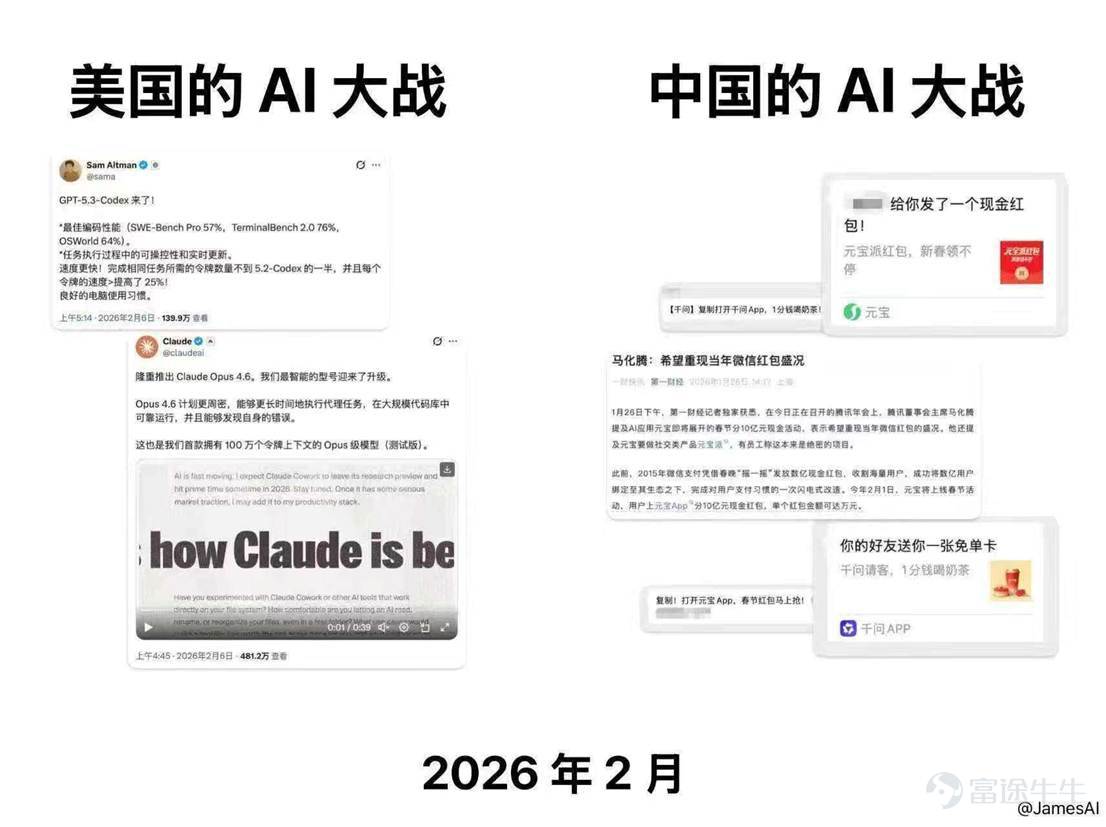
A comparison image has recently gone viral in both AI and investment circles: On the left, American tech giants showcase hardcore upgrades through technical parameters, with OpenAI and Claude piling up parameters and pushing performance in labs, demonstrating impressive code generation and physical world simulation capabilities. On the right, Chinese players engage in 'exciting user acquisition' by giving away red packets and benefits. Tencent's Treasure Box distributed 1 billion red packets, while Alibaba’s Qwen teamed up with Taobao to give away 3 billion worth of bubble tea, filling the screen with 'freebie grabs,' evoking memories of PDD Holdings' 'slash one more' period. $Alphabet-C (GOOG.US)$$NVIDIA (NVDA.US)$$Microsoft (MSFT.US)$
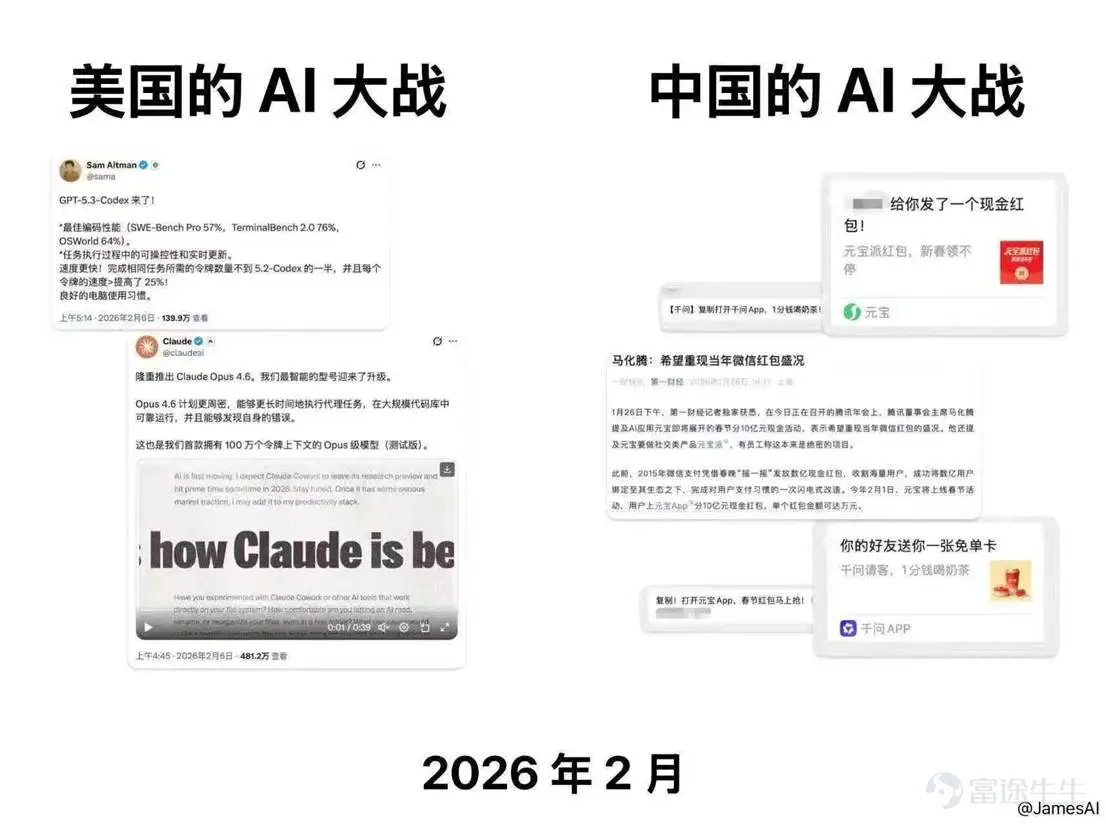
Data Source: Internet
This strong visual contrast has fueled widespread criticism that 'Chinese AI only knows how to do marketing.' However, I believe this represents a strategic breakthrough based on China's unique business environment. In the Chinese market, where B-end payment willingness is lacking, domestic internet giants are attempting to attract C-end traffic to force B-end ecosystem integration.
1. The Root of the Divide: Lack of B-End Payment Willingness
The divergence in AI paths between the US and China is fundamentally rooted not in technology but in 'who the customers are.'
The US operates on an 'efficiency-for-pay' market: it has a mature enterprise software market and established payment habits. From the government to large corporations, there is a willingness to pay high costs for productivity tools that significantly enhance efficiency. Additionally, its technology ecosystem is robust, forming a complete closed loop from chips (NVIDIA), cloud services (AWS, Azure) to open-source frameworks (PyTorch). Statistics show that by 2024, the US SaaS market size will be approximately $187 billion, while China’s will be around $14.5 billion, creating a gap of over 10 times. Therefore, American AI giants (OpenAI, Anthropic) must compete fiercely on parameters and coding capabilities because their clients base payments on 'productivity metrics'.
China operates on a 'traffic monetization' market: in China, B-end enterprises have low willingness to pay, while C-end users are accustomed to 'free' services. On the other hand, China boasts the world's largest consumer internet market with an abundance of application scenarios (e.g., e-commerce and short videos). For tech giants, the primary mission of AI is to consolidate and expand the moat of their core businesses. By creating a super AI gateway, they can lock users firmly within their ecosystems, forming a positive cycle of 'data-model optimization-experience.' Simultaneously, by controlling the C-end entry points and experience, they can convert user scale and data advantages into irrefutable value propositions for B-end enterprises, ultimately using C-end to drive B-end.
2. The overt strategy of red packet showers: Not just 'throwing money,' but 'scenario education'
Looking back at the history of China’s mobile internet, during the Spring Festival of 2014, WeChat Pay completed in one night what took Alipay ten years to achieve in terms of card binding through the 'shake for red packets' feature. This was dubbed Tencent's 'Pearl Harbor attack.' $TENCENT (00700.HK)$
Today in 2026, Alibaba is attempting to replicate this miracle with 3 billion red packets, addressing the biggest pain point in the AI industry: users only know how to 'chat' but not 'use.'
The perilous leap from Chat to Action: currently, most Chinese users perceive AI merely as a 'chatbot.' Alibaba giving out red packets and free milk tea aims to break this perception and forcefully implant the concept of 'Agent (intelligent entity),' making users realize: 'AI can not only chat with me but also help run errands, place orders, and save money.' Once users form the muscle memory of turning to Qwen (instead of opening Taobao/Ele.me) when needing assistance, AI Agents may replace apps as the OS (operating system) of the next-generation internet.
3. Showing off muscles to C-end users is, in reality, a roadshow targeting B-end audiences
In my view, Alibaba’s nationwide milk tea giveaway marketing campaign appears to focus on acquiring new users for Qwen, but in essence, it serves as an 'extreme stress test' for Alibaba Cloud’s B-end capabilities. $Alibaba (BABA.US)$
Extremely high technical barriers (Agent complexity): The process we see of 'ordering milk tea' is much more challenging for AI than writing a poem. It requires going through several steps: intent recognition -> invoking Taobao Flash Purchase API -> locking inventory -> redeeming coupons -> generating orders -> providing feedback. This constitutes a full end-to-end Agent invocation chain. If Alibaba can handle millions of simultaneous online users ordering milk tea, it will demonstrate to all major B-end clients (banks, logistics, public services): 'Alibaba Cloud’s AI Agent architecture can withstand real-world tests, and you can trust us with your business.'
Data substantiation: According to statistics, on the day the event started, the Qwen app received over 30 million 'help me buy' user commands, and within nine hours after the event began, milk tea order volume exceeded 10 million. Such instantaneous high-concurrency surges are impossible for any model-focused venture to handle. Although Qwen temporarily crashed, such large-scale practical drills precisely prove that Alibaba possesses unparalleled comprehensive strength in 'cloud+endpoint+scenario.' This is an extremely powerful demonstration of infrastructure moats. For companies worried about AI 'hallucinations' causing operational errors, Alibaba’s showcased ability to execute 'Model-to-Action' is far more appealing than mere benchmark rankings.
4. Final Act: The Winner-Takes-All Cloud War
Finally, we need to return to Alibaba Cloud's core business—cloud computing. Cloud computing is an industry with extremely strong economies of scale (the top player usually takes away 80% of the industry's profits). In the AI Agent era, user migration costs will increase exponentially (because prompts need to be rewritten and vector databases need to be rebuilt).
Alibaba’s 3 billion yuan subsidy is essentially about rapidly completing 'developer land grabbing' before other pure model manufacturers establish a mature B2B ecosystem.
The current 3 billion yuan: represents customer acquisition cost (CAC).
The next three years: whoever locks developers’ Agents onto their own cloud platform now will lock in that company’s IT budget for the next decade (LTV).
Conclusion: Do not mock China’s AI “red packet rain.” In the U.S., AI is a technical competition about “IQ”; in China, AI is an ecosystem integration about “EQ.” Alibaba is attempting to reshape the foundation of its commercial empire in the AI Agent era using the most down-to-earth, even somewhat aggressive approach. This mismatched war has only just begun.
Risk Disclaimer: The above content only represents the author's view. It does not represent any position or investment advice of Futu. Futu makes no representation or warranty.Read more


Comments (4)
to post a comment
7
2