
English
Back
Open Account
Futubull Options Sir
wrote a column · Feb 10 18:00 ·

Earnings and Options Strategy | After a Deep Correction in the Crypto Market, Can Coinbase Tell a New Story? How to Position Ahead of the Earnings Report

After experiencing sharp volatility at the beginning of 2026, the cryptocurrency market found some relief in early February, with the US stock crypto sector rebounding after a plunge.After market close on February 12, $Coinbase (COIN.US)$will release its Q4 and full-year results for the fiscal year 2025.As a publicly-listed major cryptocurrency exchange, its stock price and performance are often seen as a 'barometer' for observing the overall health of the crypto industry and investor sentiment.
The start of 2026 was far from calm for the cryptocurrency market. In the first half of January, the market attempted to recover from the weakness seen at the end of 2025. The Bitcoin price successfully broke through the key resistance level of $94,000 and hit a high of around $98,000 in mid-January. Ethereum also managed to rise above the 200-day moving average, with prices briefly surpassing $3,400.
However, this optimism was completely reversed by the end of the month. Global risk assets faced synchronized selling, with cryptocurrencies being hit the hardest.A more destructive flash crash occurred in early February, triggering a vicious cycle of 'decline-liquidation-further decline.'After extreme overselling and deleveraging, the market saw a violent rebound on February 6, and has since been in a volatile recovery phase. $Strategy (MSTR.US)$$Coinbase (COIN.US)$$Circle (CRCL.US)$ Popular crypto-related stocks also underwent sustained pullbacks, showing signs of stabilization only in recent trading sessions.
After a deep adjustment in the crypto market, what kind of earnings will Coinbase deliver, and what options strategies can be deployed?
After experiencing intense volatility at the start of 2026, the crypto market saw some relief in early February, with the US stock crypto sector also rebounding after a sharp decline.After the market close on February 12,$Coinbase (COIN.US)$will release its Q4 and full-year earnings for the fiscal year 2025.As a publicly listed major cryptocurrency exchange, its stock price and performance are often seen as a 'barometer' for gauging the overall health of the crypto industry and investor sentiment. The start of 2026 was anything but calm for the cryptocurrency market. In the first half of January, the market attempted to recover from the weakness seen at the end of 2025. The price of Bitcoin successfully broke through the key resistance level of $94,000 and reached a high of around $98,000 in mid-January. Ethereum also managed to climb above its 200-day moving average, with prices briefly surpassing $3,400. However, optimism was completely reversed by the end of the month. A synchronized sell-off hit global risk assets, with cryptocurrencies being hit the hardest.An even more destructive flash crash occurred in early February, triggering a vicious cycle of 'decline-liquidation-further decline.'After an extremely oversold condition and deleveraging, the market experienced a violent rebound on February 6, and it remains in a volatile recovery phase.$Strategy (MSTR.US)$ 、 $Coinbase (COIN.US)$ 、 $Circle (CRCL.US)$ Popular crypto-related stocks also experienced continuous pullbacks and have only shown signs of stabilization in recent trading sessions.
What are the key areas of focus for the upcoming earnings report?
$Coinbase (COIN.US)$ As the largest and first publicly listed compliant cryptocurrency exchange in the US, its core business is to provide trading services for digital currencies such as Bitcoin and Ethereum. Currently, the company is transforming from a pure trading platform into a multi-dimensional platform encompassing trading, asset custody, and staking services.
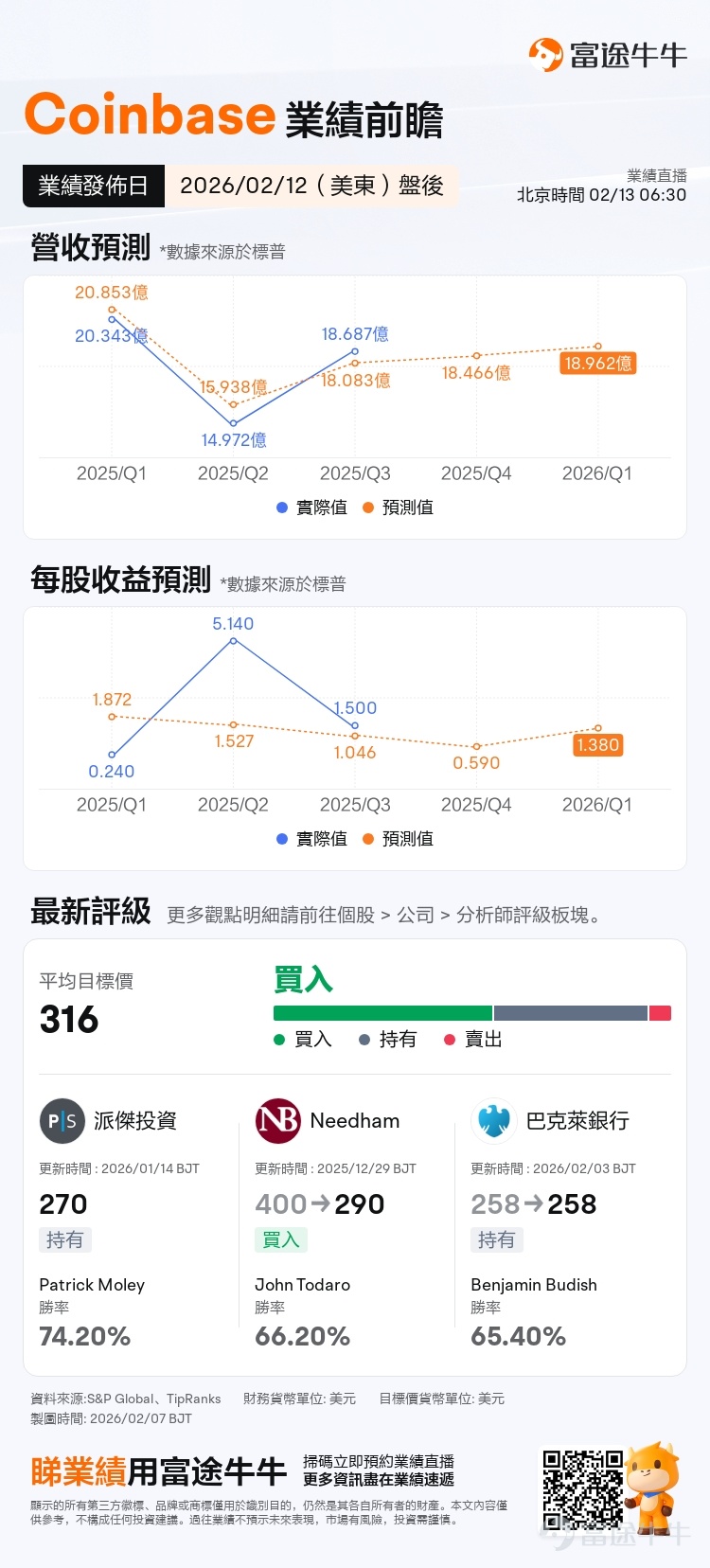
The market expects revenue for Q4 2025 to reach $1.846 billion, down 18.7% year-over-year; net profit is projected at $289 million, a decline of 77.63% year-over-year.
The fourth quarter of 2024 occurred during a strong crypto bull market, with Bitcoin prices driven higher by multiple positive catalysts, pushing trading volumes to record highs and resulting in an exceptionally high base for revenue and profits for that quarter.In comparison, although Q4 2025 did not experience the extreme sell-off seen earlier this year, market enthusiasm has cooled somewhat, with reduced trading activity, directly causing its core and largest source of revenue—trading income—to shrink year-over-year.
At the same time, several costs for the company exhibit 'rigid' characteristics, not decreasing proportionally but instead potentially increasing due to strategic expansion. This includes increased sales and marketing expenses for promoting USDC and derivatives businesses, as well as rising general administrative costs due to heightened compliance requirements.
According to Block data, Coinbase's spot trading volume for Q4 2025 is projected at $254.5 billion, down 11% quarter-over-quarter and 42% year-over-year; December saw a sharp drop in trading volume, with retail trading falling by 20% and institutional trading declining by 12%.
After experiencing intense volatility at the start of 2026, the crypto market saw some relief in early February, with the US stock crypto sector also rebounding after a sharp decline.After the market close on February 12,$Coinbase (COIN.US)$will release its Q4 and full-year earnings for the fiscal year 2025.As a publicly listed major cryptocurrency exchange, its stock price and performance are often seen as a 'barometer' for gauging the overall health of the crypto industry and investor sentiment. The start of 2026 was anything but calm for the cryptocurrency market. In the first half of January, the market attempted to recover from the weakness seen at the end of 2025. The price of Bitcoin successfully broke through the key resistance level of $94,000 and reached a high of around $98,000 in mid-January. Ethereum also managed to climb above its 200-day moving average, with prices briefly surpassing $3,400. However, optimism was completely reversed by the end of the month. A synchronized sell-off hit global risk assets, with cryptocurrencies being hit the hardest.An even more destructive flash crash occurred in early February, triggering a vicious cycle of 'decline-liquidation-further decline.'After an extremely oversold condition and deleveraging, the market experienced a violent rebound on February 6, and it remains in a volatile recovery phase.$Strategy (MSTR.US)$ 、 $Coinbase (COIN.US)$ 、 $Circle (CRCL.US)$ Popular crypto-related stocks also experienced continuous pullbacks and have only shown signs of stabilization in recent trading sessions.
Amid increased volatility in the crypto market, the market already has relatively full expectations for its earnings decline and will likely pay closer attention to whether its diversified business model in the 'down cycle' can demonstrate sufficient resilience.
(1) Revenue structure transformation: Can it reduce its 'commission dependency'?
In Q3 2025, its subscription and service revenue reached $747 million, a 14% increase quarter-over-quarter, with stablecoin revenue contributing $355 million. The market will closely watch whether the revenue from this segment reaches the upper limit of the management's guidance range of $710-$790 million in Q4 and whether its proportion of total revenue further increases.
Although there may be short-term deviations, Coinbase's stock price movement has long been following Bitcoin.If the proportion of this revenue further increases, the company’s transition from a highly cyclical 'trading casino' to a 'bank-like' model earning stable service fees will be further confirmed, creating room for its valuation to be reassessed.
After experiencing intense volatility at the start of 2026, the crypto market saw some relief in early February, with the US stock crypto sector also rebounding after a sharp decline.After the market close on February 12,$Coinbase (COIN.US)$will release its Q4 and full-year earnings for the fiscal year 2025.As a publicly listed major cryptocurrency exchange, its stock price and performance are often seen as a 'barometer' for gauging the overall health of the crypto industry and investor sentiment. The start of 2026 was anything but calm for the cryptocurrency market. In the first half of January, the market attempted to recover from the weakness seen at the end of 2025. The price of Bitcoin successfully broke through the key resistance level of $94,000 and reached a high of around $98,000 in mid-January. Ethereum also managed to climb above its 200-day moving average, with prices briefly surpassing $3,400. However, optimism was completely reversed by the end of the month. A synchronized sell-off hit global risk assets, with cryptocurrencies being hit the hardest.An even more destructive flash crash occurred in early February, triggering a vicious cycle of 'decline-liquidation-further decline.'After an extremely oversold condition and deleveraging, the market experienced a violent rebound on February 6, and it remains in a volatile recovery phase.$Strategy (MSTR.US)$ 、 $Coinbase (COIN.US)$ 、 $Circle (CRCL.US)$ Popular crypto-related stocks also experienced continuous pullbacks and have only shown signs of stabilization in recent trading sessions.
(2) Growth of the Base Chain Ecosystem
The Base chain is an Ethereum scaling solution launched by Coinbase in 2023. Its core value lies in significantly reducing transaction costs and improving transaction speed, providing developers and users with an efficient, low-cost on-chain environment.
As the core vehicle for Coinbase to capture Web3.0 ecosystem dividends, the monetization capability of the Base chain represents a new growth narrative. In Q3 2025, the revenue generated by the Base chain reached $68 million, marking a 26% increase quarter-over-quarter. The earnings report will focus on disclosing the activity level of the Base ecosystem in Q4 (e.g., transaction volume, developer activity) and its direct revenue contribution. Meanwhile, expectations remain for Base to potentially issue a native token, and any related statements from management could influence long-term expectations.
(3) Progress of the "All-in-One Exchange" Strategy
Coinbase's ultimate vision is to build a global all-in-one exchange (Global Everything Exchange), breaking down barriers between asset classes to trade 'all assets,' includingstocks, options, ETFs, commodities, cryptocurrencies, prediction markets, and tokenized products of real-world assets (RWA).
One of the most notable developments in Q3 2025 was the completion of the acquisition of Deribit, the world's leading options exchange. The Q4 earnings report will fully reflect for the first time the synergies post-consolidation of Deribit and the growth of the CFTC-regulated perpetual futures products launched by the company in the United States.
In December 2025, Coinbase announced the launch of a prediction market service in collaboration with Kalshi. As event contracts continue to develop, this initiative is also expected to significantly boost the platform's activity and retention rate.
(4) Cash flow health
Despite being in a phase of expansion, investors are equally concerned about the quality of growth. Amidst revenue fluctuations caused by market volatility, the company’s gross margin, operating expense control, and free cash flow levels are critical. The market wants to see whether the company can maintain robust profitability while increasing investment in the Base ecosystem and expansion efforts, demonstrating the sustainability of its business model.
In summary, a Q4 earnings report that meets or even exceeds guidance, particularly one that showcases resilience in subscription service revenues and momentum in new business growth, will strongly reinforce Coinbase's long-term investment thesis as 'infrastructure for the crypto economy' and further distinguish it from companies solely reliant on asset price volatility.
Although Coinbase's transformation narrative is compelling, it still faces competitive pressures. Its retail trading business is under continuous pressure from global platforms like Binance, which attract price-sensitive users through higher leverage, more lenient verification requirements, and a vast ecosystem. Last August, a newly listed crypto exchange $Bullish (BLSH.US)$ has gained recognition for its focus on institutional business and compliance depth. These competitors are also challenging Coinbase's moat in different areas.
Technical Analysis & Options Strategies
Since hitting a high in November 2025, Coinbase's stock price has undergone a deep correction, reaching a recent low on February 5, 2026. After a sharp decline, significant short-term technical overselling has emerged, with recent signs of capital inflows and price rebounds. However, the current stock price remains below all major moving averages, and the medium-to-long-term downtrend has yet to show a clear reversal.
The stock price has strong support near $145,corresponding to the lows formed before the start of the crypto bull market in September 2024 and during the tariff storm in April 2025. In February this year, a rebound was initiated after touching this level.
After experiencing intense volatility at the start of 2026, the crypto market saw some relief in early February, with the US stock crypto sector also rebounding after a sharp decline.After the market close on February 12,$Coinbase (COIN.US)$will release its Q4 and full-year earnings for the fiscal year 2025.As a publicly listed major cryptocurrency exchange, its stock price and performance are often seen as a 'barometer' for gauging the overall health of the crypto industry and investor sentiment. The start of 2026 was anything but calm for the cryptocurrency market. In the first half of January, the market attempted to recover from the weakness seen at the end of 2025. The price of Bitcoin successfully broke through the key resistance level of $94,000 and reached a high of around $98,000 in mid-January. Ethereum also managed to climb above its 200-day moving average, with prices briefly surpassing $3,400. However, optimism was completely reversed by the end of the month. A synchronized sell-off hit global risk assets, with cryptocurrencies being hit the hardest.An even more destructive flash crash occurred in early February, triggering a vicious cycle of 'decline-liquidation-further decline.'After an extremely oversold condition and deleveraging, the market experienced a violent rebound on February 6, and it remains in a volatile recovery phase.$Strategy (MSTR.US)$ 、 $Coinbase (COIN.US)$ 、 $Circle (CRCL.US)$ Popular crypto-related stocks also experienced continuous pullbacks and have only shown signs of stabilization in recent trading sessions.
The current implied volatility (IV) stands at 78.81%, placing it at the 88th percentile historically. For most investors, selling options becomes a more advantageous strategy when IV is at historical highs, aiming to 'harvest' elevated volatility premiums and time value.
Market pricing indicates an expected earnings fluctuation exceeding 12%. Over the past two years, there have been two instances—Q3 2024 and Q2 2025—where fluctuations exceeded the range priced by the options market.
After experiencing intense volatility at the start of 2026, the crypto market saw some relief in early February, with the US stock crypto sector also rebounding after a sharp decline.After the market close on February 12,$Coinbase (COIN.US)$will release its Q4 and full-year earnings for the fiscal year 2025.As a publicly listed major cryptocurrency exchange, its stock price and performance are often seen as a 'barometer' for gauging the overall health of the crypto industry and investor sentiment. The start of 2026 was anything but calm for the cryptocurrency market. In the first half of January, the market attempted to recover from the weakness seen at the end of 2025. The price of Bitcoin successfully broke through the key resistance level of $94,000 and reached a high of around $98,000 in mid-January. Ethereum also managed to climb above its 200-day moving average, with prices briefly surpassing $3,400. However, optimism was completely reversed by the end of the month. A synchronized sell-off hit global risk assets, with cryptocurrencies being hit the hardest.An even more destructive flash crash occurred in early February, triggering a vicious cycle of 'decline-liquidation-further decline.'After an extremely oversold condition and deleveraging, the market experienced a violent rebound on February 6, and it remains in a volatile recovery phase.$Strategy (MSTR.US)$ 、 $Coinbase (COIN.US)$ 、 $Circle (CRCL.US)$ Popular crypto-related stocks also experienced continuous pullbacks and have only shown signs of stabilization in recent trading sessions.
(1) Covered Call Strategy
If an investor holds COIN shares but does not expect a significant rise in the stock price after earnings, or believes that the price may consolidate post-earnings, they can sell a corresponding number of out-of-the-money call options to create a Covered Call.
Selling call options before earnings when implied volatility (IV) is elevated allows the investor to capture higher time value.This essentially exchanges limited upside potential (the portion of the stock price exceeding the strike price) for guaranteed cash income. However, if the stock price rises significantly after earnings and surpasses the strike price, the shares may be assigned through exercise, causing the investor to miss out on subsequent gains.
After experiencing intense volatility at the start of 2026, the crypto market saw some relief in early February, with the US stock crypto sector also rebounding after a sharp decline.After the market close on February 12,$Coinbase (COIN.US)$will release its Q4 and full-year earnings for the fiscal year 2025.As a publicly listed major cryptocurrency exchange, its stock price and performance are often seen as a 'barometer' for gauging the overall health of the crypto industry and investor sentiment. The start of 2026 was anything but calm for the cryptocurrency market. In the first half of January, the market attempted to recover from the weakness seen at the end of 2025. The price of Bitcoin successfully broke through the key resistance level of $94,000 and reached a high of around $98,000 in mid-January. Ethereum also managed to climb above its 200-day moving average, with prices briefly surpassing $3,400. However, optimism was completely reversed by the end of the month. A synchronized sell-off hit global risk assets, with cryptocurrencies being hit the hardest.An even more destructive flash crash occurred in early February, triggering a vicious cycle of 'decline-liquidation-further decline.'After an extremely oversold condition and deleveraging, the market experienced a violent rebound on February 6, and it remains in a volatile recovery phase.$Strategy (MSTR.US)$ 、 $Coinbase (COIN.US)$ 、 $Circle (CRCL.US)$ Popular crypto-related stocks also experienced continuous pullbacks and have only shown signs of stabilization in recent trading sessions.
(The design images displayed on screen are for illustrative purposes only and do not constitute any investment advice or guarantees; market conditions fluctuate frequently, and the option prices shown do not represent real-world values.)
(2) Bull Call Spread Strategy
An investor buys a call option with a lower strike price and simultaneously sells a call option with a higher strike price and the same expiration date. This strategy is suitable for investors who have a mildly bullish outlook on earnings results and want to participate at a lower cost while limiting risk.
The strategy directly reduces the premium cost of buying the call option by selling the higher strike price option.In a high implied volatility environment, the income from selling options is particularly substantial, effectively offsetting the cost of purchasing the option.Both the profit and loss of this strategy are locked within a clearly defined range.
After experiencing intense volatility at the start of 2026, the crypto market saw some relief in early February, with the US stock crypto sector also rebounding after a sharp decline.After the market close on February 12,$Coinbase (COIN.US)$will release its Q4 and full-year earnings for the fiscal year 2025.As a publicly listed major cryptocurrency exchange, its stock price and performance are often seen as a 'barometer' for gauging the overall health of the crypto industry and investor sentiment. The start of 2026 was anything but calm for the cryptocurrency market. In the first half of January, the market attempted to recover from the weakness seen at the end of 2025. The price of Bitcoin successfully broke through the key resistance level of $94,000 and reached a high of around $98,000 in mid-January. Ethereum also managed to climb above its 200-day moving average, with prices briefly surpassing $3,400. However, optimism was completely reversed by the end of the month. A synchronized sell-off hit global risk assets, with cryptocurrencies being hit the hardest.An even more destructive flash crash occurred in early February, triggering a vicious cycle of 'decline-liquidation-further decline.'After an extremely oversold condition and deleveraging, the market experienced a violent rebound on February 6, and it remains in a volatile recovery phase.$Strategy (MSTR.US)$ 、 $Coinbase (COIN.US)$ 、 $Circle (CRCL.US)$ Popular crypto-related stocks also experienced continuous pullbacks and have only shown signs of stabilization in recent trading sessions.
(The design images displayed on screen are for illustrative purposes only and do not constitute any investment advice or guarantees; market conditions fluctuate frequently, and the option prices shown do not represent real-world values.)
(3) Iron Condor Strategy
The short volatility strategy generally expects that the stock price will not experience extreme fluctuations after earnings (i.e., the actual volatility will be lower than the volatility implied by the current high IV in the market). The profit of this strategy comes from the post-earnings IV collapse and time decay.
The Iron Condor is an advanced version of the short strangle strategy, offering 'limited risk.' It involves four trades to create a 'double-insurance' structure: selling a put option with a lower strike price and buying another put option with an even lower strike price, while also selling a call option with a higher strike price and buying another call option with an even higher strike price, all with the same expiration date.
After experiencing intense volatility at the start of 2026, the crypto market saw some relief in early February, with the US stock crypto sector also rebounding after a sharp decline.After the market close on February 12,$Coinbase (COIN.US)$will release its Q4 and full-year earnings for the fiscal year 2025.As a publicly listed major cryptocurrency exchange, its stock price and performance are often seen as a 'barometer' for gauging the overall health of the crypto industry and investor sentiment. The start of 2026 was anything but calm for the cryptocurrency market. In the first half of January, the market attempted to recover from the weakness seen at the end of 2025. The price of Bitcoin successfully broke through the key resistance level of $94,000 and reached a high of around $98,000 in mid-January. Ethereum also managed to climb above its 200-day moving average, with prices briefly surpassing $3,400. However, optimism was completely reversed by the end of the month. A synchronized sell-off hit global risk assets, with cryptocurrencies being hit the hardest.An even more destructive flash crash occurred in early February, triggering a vicious cycle of 'decline-liquidation-further decline.'After an extremely oversold condition and deleveraging, the market experienced a violent rebound on February 6, and it remains in a volatile recovery phase.$Strategy (MSTR.US)$ 、 $Coinbase (COIN.US)$ 、 $Circle (CRCL.US)$ Popular crypto-related stocks also experienced continuous pullbacks and have only shown signs of stabilization in recent trading sessions.
(The design images displayed on screen are for illustrative purposes only and do not constitute any investment advice or guarantees; market conditions fluctuate frequently, and the option prices shown do not represent real-world values.)
This strategy replaces the 'unlimited risk' of a short strangle with 'limited risk,' but at the cost of reduced theoretical profitability. The biggest fear for short volatility strategies is a sharp one-sided move in the stock price, breaking through the preset range and causing significant losses.
Finally, here's a small perk for fellow investors—welcome to claim it!Options Beginner Pack
This event is exclusively for invited HK users, click to learn moreDetailed event rules >>
Futu's simulated trading challenge is now open for registration! Zero cost, zero risk, and you could win stock cash vouchers!
After experiencing intense volatility at the start of 2026, the crypto market saw some relief in early February, with the US stock crypto sector also rebounding after a sharp decline.After the market close on February 12,$Coinbase (COIN.US)$will release its Q4 and full-year earnings for the fiscal year 2025.As a publicly listed major cryptocurrency exchange, its stock price and performance are often seen as a 'barometer' for gauging the overall health of the crypto industry and investor sentiment. The start of 2026 was anything but calm for the cryptocurrency market. In the first half of January, the market attempted to recover from the weakness seen at the end of 2025. The price of Bitcoin successfully broke through the key resistance level of $94,000 and reached a high of around $98,000 in mid-January. Ethereum also managed to climb above its 200-day moving average, with prices briefly surpassing $3,400. However, optimism was completely reversed by the end of the month. A synchronized sell-off hit global risk assets, with cryptocurrencies being hit the hardest.An even more destructive flash crash occurred in early February, triggering a vicious cycle of 'decline-liquidation-further decline.'After an extremely oversold condition and deleveraging, the market experienced a violent rebound on February 6, and it remains in a volatile recovery phase.$Strategy (MSTR.US)$ 、 $Coinbase (COIN.US)$ 、 $Circle (CRCL.US)$ Popular crypto-related stocks also experienced continuous pullbacks and have only shown signs of stabilization in recent trading sessions.
Major upgrade to the US options mechanism! Monday and Wednesday options added for nine major symbols including Tesla and NVIDIA. A step-by-step guide on using Futu tools to capitalize on end-of-term options.
After experiencing intense volatility at the start of 2026, the crypto market saw some relief in early February, with the US stock crypto sector also rebounding after a sharp decline.After the market close on February 12,$Coinbase (COIN.US)$will release its Q4 and full-year earnings for the fiscal year 2025.As a publicly listed major cryptocurrency exchange, its stock price and performance are often seen as a 'barometer' for gauging the overall health of the crypto industry and investor sentiment. The start of 2026 was anything but calm for the cryptocurrency market. In the first half of January, the market attempted to recover from the weakness seen at the end of 2025. The price of Bitcoin successfully broke through the key resistance level of $94,000 and reached a high of around $98,000 in mid-January. Ethereum also managed to climb above its 200-day moving average, with prices briefly surpassing $3,400. However, optimism was completely reversed by the end of the month. A synchronized sell-off hit global risk assets, with cryptocurrencies being hit the hardest.An even more destructive flash crash occurred in early February, triggering a vicious cycle of 'decline-liquidation-further decline.'After an extremely oversold condition and deleveraging, the market experienced a violent rebound on February 6, and it remains in a volatile recovery phase.$Strategy (MSTR.US)$ 、 $Coinbase (COIN.US)$ 、 $Circle (CRCL.US)$ Popular crypto-related stocks also experienced continuous pullbacks and have only shown signs of stabilization in recent trading sessions.
Disclaimer
This content does not constitute any offer, solicitation, recommendation, opinion, or guarantee of any securities, financial products, or tools. The risk of loss in buying and selling options can be substantial. In some cases, your losses may exceed the initial margin amount deposited. Even if you set contingent orders, such as 'stop-loss' or 'limit' orders, these may not necessarily prevent losses. Market conditions may make these orders unexecutable. You might be required to deposit additional margin within a short period. If you fail to provide the required amount within the specified time, your open positions may be liquidated. However, you will still be responsible for any account deficit arising from this. Therefore, before trading, you should study and understand options and carefully consider whether such trading suits you based on your financial situation and investment objectives. If you trade options, you should be familiar with the procedures upon exercising options and at expiration, as well as your rights and obligations when exercising options and at expiration.
Risk Disclaimer: The above content only represents the author's view. It does not represent any position or investment advice of Futu. Futu makes no representation or warranty.Read more
Thumbs Up
15
Emm
1
196K Views
Report
Comments
Write a Comment...
16
48