
How to view the post-holiday market trend in Hong Kong stocks?
Net profit attributable to shareholders excluding non-recurring items fell by more than 40%. Why has Tigermed (03347) seen rising volume and price in the secondary market?
Recently, Tigermed (03347) $TIGERMED (03347.HK)$ The stock price has shown a clear trend of stopping its decline and rebounding.
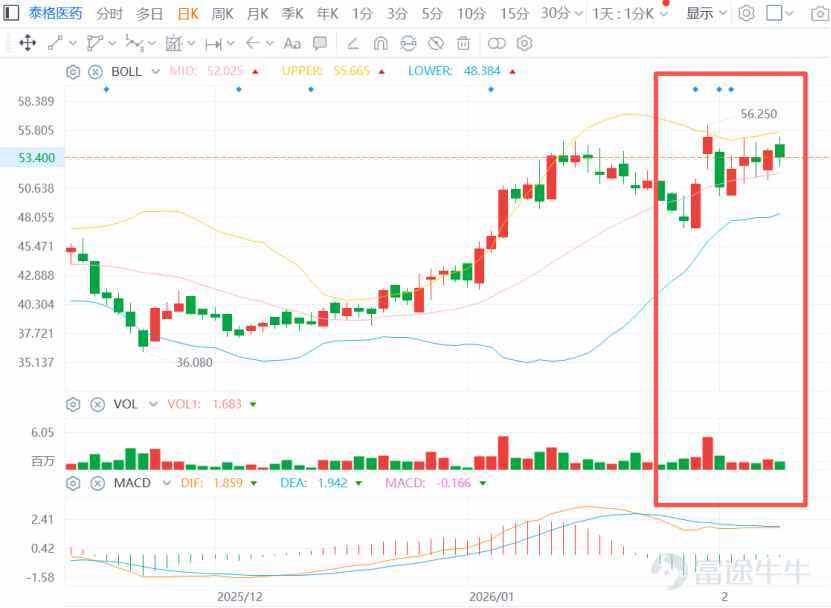
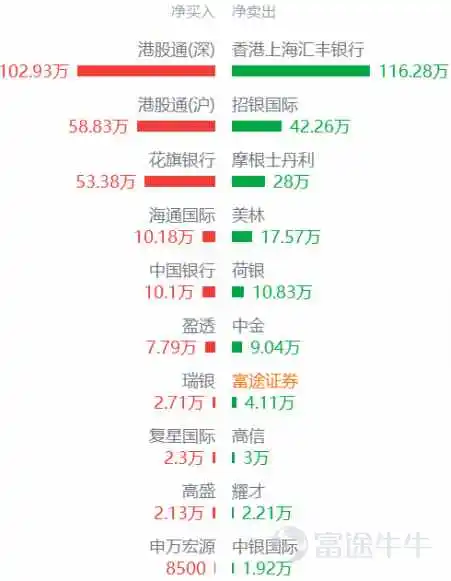
Zhitong Finance APP observed that after hitting a low of HKD 36.08 during trading on November 21 last year, the share price of Tigermed continued to recover, experiencing a nearly two-month upward trend. On January 15 this year, the share price reached a high of HKD 54.85, with the maximum increase in this range reaching 52.02%.
However, afterwards, Tigermed's share price experienced a technical decline lasting nearly half a month, falling below HKD 50 on January 28. At this point, the company’s share price had touched the middle BOLL line on the technical chart and was showing a trend of further dropping towards the lower rail. However, this trend was interrupted by a strong rise over January 29 and 30, which forcefully 'shifted' the company's stock price back into a stable recovery pattern. The fundamental reason behind this market change might be Tigermed's disclosure of its 2025 annual earnings forecast.
Behind the 'profit warning,' an investment-driven R&D strategy gains market recognition
After the market closed on January 29, Tigermed disclosed its 2025 annual earnings forecast.
In this 'profit warning' announcement, Tigermed stated that it expects to achieve revenue of RMB 6.66 billion to 7.68 billion in 2025, representing a year-on-year increase of 1% to 16%. Net profit attributable to shareholders is expected to be RMB 830 million to 1.23 billion, reflecting a year-on-year increase of 105% to 204%. Net profit attributable to shareholders excluding non-recurring gains and losses is expected to be approximately RMB 330 million to 490 million, reflecting a year-on-year decrease of 61% to 43%.
In the announcement, Tigermed indicated that although net profit attributable to shareholders increased by 105%-204% compared to the same period last year, this was mainly due to a substantial increase in non-recurring gains during the reporting period. Non-recurring gains attributable to shareholders for the current period reached RMB 500 million to 740 million, reflecting an increase of RMB 950 million to 1.19 billion year-on-year.
It was precisely this non-recurring gain exceeding RMB 500 million that allowed Tigermed to ultimately double its net profit for the reporting period in 2025. In short, Tigermed's earnings growth for the current period was primarily driven by investment income from financial assets and changes in fair value, rather than being driven by the company's core clinical CRO business.
Although net profit growth was not driven by core operations, institutional research reports and secondary market performance reflected investor sentiment.
Zhitong Finance APP observed that after Tigermed disclosed its earnings forecast, Goldman Sachs issued a research report stating that it lowered Tigermed's (03347) 2025-2027 profit forecasts by 29%, raised them by 2%, and raised them by 2%, respectively. It slightly increased Tigermed's H-share target price from HKD 63.4 to HKD 66.4, and increased Tigermed's A-share (300347.SZ) target price from RMB 78.7 to RMB 82.5, maintaining a 'buy' rating for both. Meanwhile, UBS Group issued a research report stating that it currently assigns a target price of HKD 57.1 and a 'buy' rating to Tigermed (03347), adding that it will monitor signals of price recovery in new orders signed by Tigermed in 2026, as well as management's guidance on revenue and profit for 2026.
In the secondary market, the day after TPG Medical's earnings forecast was released, the company’s H-share price opened with a gap up and broke through the previous high in January this year to reach HKD 56.25 during trading. Moreover, it was a typical 'price and volume surge' trend that day, with TPG Medical’s stock trading volume reaching 7.0477 million shares, showing strong buying interest from investors holding cash outside the market. The subsequent stock price consolidation with reduced volume between the upper and middle BOLL lines reflected short-term consensus among shareholders within the market.
Stock Connect prefers 'right-side trading'
Recently, Stock Connect funds have remained a relatively active force in TPG Medical’s trading activities.
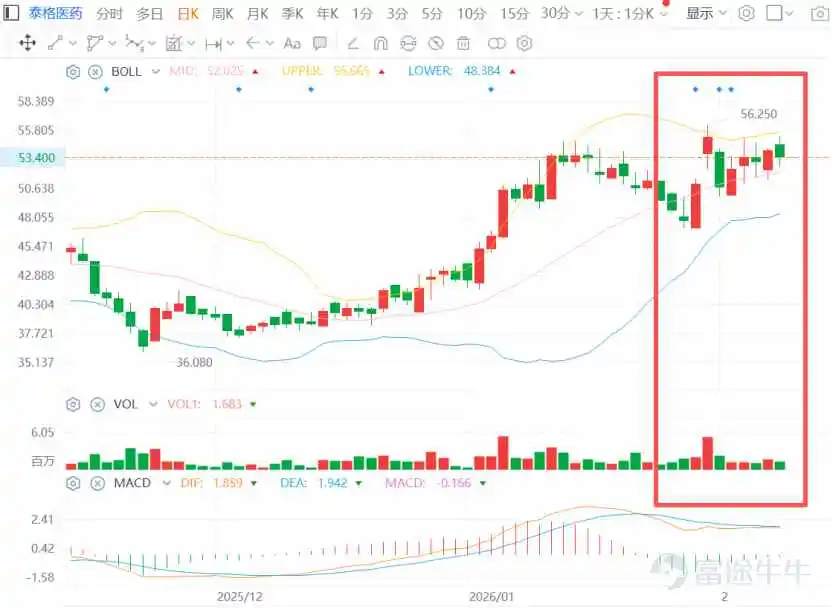
According to broker transaction data over the past five days, the top five sellers of TPG Medical were HSBC Hong Kong, CMB International, Morgan Stanley, Merrill Lynch, and ABN AMRO, selling 1.1628 million shares, 422,600 shares, 280,000 shares, 175,700 shares, and 108,300 shares respectively. On the buy side, the top five buyers were Stock Connect (Shenzhen), Stock Connect (Shanghai), Citi Bank, Haitong International, and Bank of China, purchasing 1.0293 million shares, 588,300 shares, 533,800 shares, 101,800 shares, and 101,000 shares respectively.
However, when extending the timeframe to the past 20 days, the top two net sellers of TPG Medical were precisely the two major Stock Connect channels, with Stock Connect (Shenzhen) net selling 3.3184 million shares and Stock Connect (Shanghai) net selling 2.3335 million shares.
Since November last year, Stock Connect has tended towards right-side trading on TPG Medical, and the turning point for the recent shift in trading strategy by Stock Connect occurred the day after the company announced its earnings forecast.
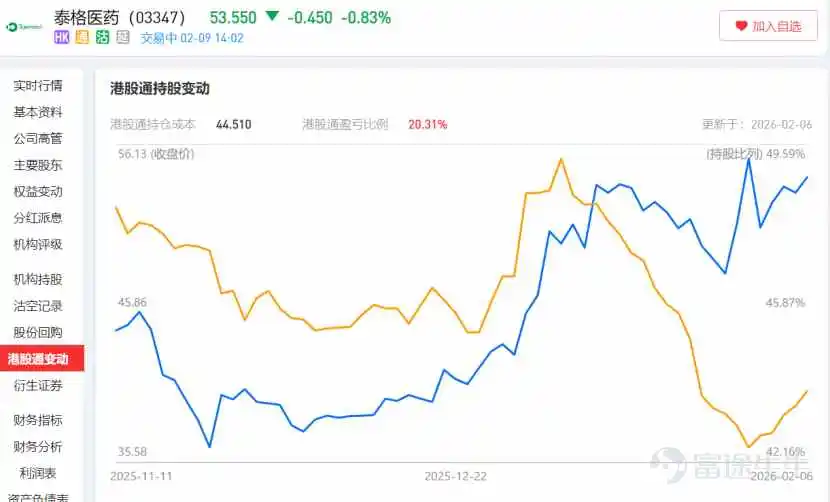
In fact, the underlying logic behind this round of Stock Connect’s shift in buying and selling strategies is the 'double confirmation' of 'industry trends + company performance.'
According to a Guotai Haitong report, since 2025, financing amounts in the domestic medical health primary market have rebounded first, with total financing in Q1-Q3 2025 reaching approximately CNY 79.5 billion, a year-on-year increase of 22%. Investment focus has shifted from 'early-stage and small-scale investments' to 'clinical investment and certainty-driven investments'; at the same time, the scale of outbound BD deals for domestic innovative drugs has reached a new record high, with a total annual transaction value of about USD 135.7 billion and upfront payments of approximately USD 7 billion.
On one hand, as financing and BD repayments recover, pharmaceutical companies are increasing their clinical trial investments again, and outsourcing demands for clinical CRO, SMO, and registration services are simultaneously recovering, providing direct funding sources and project bases for an industry recovery. On the other hand, the overall regulatory mindset at home and abroad is shifting from passive approval to emphasizing value orientation and speed, which helps shorten the overall cycle of new drugs from clinical trials to market launch and accelerates clinical project progress.
Data shows that the number of IND applications for domestic innovative drugs continues to rise, with CDE accepting 1,878 INDs in 2025, a year-on-year increase of 13.3%, and the proportion of Class 1 innovative drugs rising to 1,517 varieties, indicating that R&D resources are concentrating from generic and low-value projects to high-clinical-value innovation projects; meanwhile, review efficiency and approval rates are also improving synchronously, with the approval rate for domestic Class 1 innovative drug INDs being approximately 96.5% and the NDA approval rate around 86.9% during the same period.
As both the number of projects and the approval process show synchronized improvement, the cycle for clinical projects from 'initiation - launch - advancement' has shortened, creating a more stable and sustainable source of CRO orders. Meanwhile, downstream market demands for CROs have expanded from simple execution to areas such as data collection, quality control, statistical analysis, and IT system capabilities, as clinical trials evolve towards digitization and continuity, which theoretically benefits leading companies.
This is already preliminarily reflected in the earnings forecast disclosed by Tigermed this time. The company stated in its announcement that both the number and value of newly signed contracts achieved solid growth compared to the same period last year. In 2025, the company’s net new orders (newly signed orders after deducting canceled ones) are expected to range between 9.5 billion and 10.5 billion yuan, compared to 8.42 billion yuan in net new orders for the same period last year, indirectly reflecting the advantages of Tigermed's 'investment-driven R&D' strategy.
In fact, 'investment-driven R&D' is not exclusive to Tigermed. In recent years, as the growth rate of the CRO industry has slowed and market competition intensified, an increasing number of CRO companies have opted to expand their influence through LP investments. This 'investment-driven R&D' model has brought new growth opportunities to many CRO firms.
However, this business model also carries significant reflexivity: when the industry outlook improves, gains from fair value changes in LP investments, combined with expectations of improved core CRO operations, usually enhance net profits. Conversely, when the industry outlook declines, deteriorating core CRO operations coupled with losses from fair value changes in LP investments can further impact financial performance, amplifying stock volatility. In such cases, secondary market investors adopting a momentum-based strategy aligned with the company's performance will outperform a 'pre-emptive positioning' approach.
Risk Disclaimer: The above content only represents the author's view. It does not represent any position or investment advice of Futu. Futu makes no representation or warranty.Read more
Comments
to post a comment