Hong Kong-listed AI 'twin leaders' see active trading! How to position in the AI sector for the Year

AceCamp Original | In the AI battle royale, why Apple, with the 'stingiest' Capex, might have the last laugh?
This article was first published on February 8, 2026, on the AceCamp official website, offering fresh information faster than ever!
Summary
Apple maintains extremely low capital expenditure in the AI race, outsourcing the costly training of large models to competitors for 'API arbitrage' and leveraging hardware integration to achieve 'on-device computing.'
This allows it to cleverly pass costs onto consumers while avoiding the risk of heavy asset depreciation.
With the highest ROIC and robust FCF, Apple is well-positioned to emerge as the ultimate beneficiary after the AI bubble bursts.
This allows it to cleverly pass costs onto consumers while avoiding the risk of heavy asset depreciation.
With the highest ROIC and robust FCF, Apple is well-positioned to emerge as the ultimate beneficiary after the AI bubble bursts.
When Amazon, Google, Microsoft, and Meta — the 'Big Four cash-burning giants' — disclosed in their recent earnings reports and management calls that they would continue to significantly increase Capex, it not only shook global capital markets but also marked the peak of a 'prisoner's dilemma' phase in the AI arms race. However, amidst this Capex frenzy, Apple, the world's largest company by market cap, appears strikingly out of place. Based on disclosed data, its actual Capex for the 2025 calendar year remains around $12.1 billion, with market consensus expecting its 2026 Capex to fall within$12 billion to $13 billion, a stark contrast to the massive budgets of the 'Big Four cash-burning giants.' $Amazon (AMZN.US)$$Alphabet-C (GOOG.US)$$Microsoft (MSFT.US)$$Meta Platforms (META.US)$
The core argument of this report is:The prevailing market view — that Apple's insufficient investment in AI infrastructure signals falling behind — is not only incorrect but also completely misjudges Apple's strategic positioning. $Apple (AAPL.US)$
In fact, Apple's extremely restrained Capex forms its greatest moat during the AI bubble cycle. By shifting costs through on-device computing and acquiring capabilities via API arbitrage, Apple is executing one of the most efficient 'balance sheet arbitrages' in tech history. As AI computing power increasingly commoditizes in the future, when competitors are mired in heavy asset depreciation, Apple is poised to become the sole winner after the bubble bursts, thanks to its highest ROIC and abundant FCF.
1. The Battle of Seven Trillion Capex and the Sole Spectator
To understand the brilliance of Apple's strategy, one must first confront the near-frantic levels of investment currently underway within the industry. According to the latest guidance released by major tech giants in early February 2026, we are seeing a set of data that defies traditional business logic—this is no longer mere investment but a panic-driven buying spree.
Data Insights: From 'Investment' to 'Survival Tax'
Looking back at the whole of 2025, the combined actual Capex of Amazon, Google, Microsoft, and Meta has already soared above $400 billion (calculated by calendar year, not fiscal year), raising market concerns. However, in the latest 2026 guidance, this growth has spiraled completely out of control:
→ Amazon:According to management guidance, Amazon’s 2026 Capex will reach$200 billion, a roughly 50% increase from 2025.In order to support AWS's global expansion and the Project Kuiper satellite network, Amazon is preparing to burn through an amount close to the entire annual GDP of Greece or Hungary in just one year. Amazon is transforming from a light-asset retail/cloud company into an ultra-heavy asset infrastructure company, heavier than even oil giants.
→ Google:The guidance range is$175 billion - $185 billion, doubling from 2025.To defend its search moat and prevent traffic theft from ChatGPT or Perplexity, the company must deploy TPU v6 clusters and global liquid cooling centers at all costs. This is a 'survival tax' that Google has no choice but to pay.
→ Microsoft:According to management statements and market expectations, the Capex for the 2026 calendar year is expected to be in the range of$155-175 billion, an increase of approximately 50% compared to the 2025 calendar year.In order to support OpenAI's ambitious Stargate supercomputing plan, the company has no choice but to bring forward the cash flow of the next few years.
→ Meta:The guidance range is$115-$135 billion, an increase of about 70% compared to 2025.This could very likely lead to its FCF turning negative in 2026.
Apple’s ‘Frugality’: Smart Capital vs. FOMO Capital
In contrast, Apple's data appears unusually "meager": based on management's statements, the market generally expects its Capex for the 2026 calendar year to be at12 billion - 13 billion US dollarsThe range may even experience zero growth or negative growth after excluding the inflation factor.
The author believes that this "zero growth" is not due to Apple's inability to keep up, but rather a state of extreme calm.Hedging strategyAmong the giants in the "trillion-dollar club," there has emerged1:15Such a disparity in investment is extremely rare. This reveals two distinctly different attributes of capital:
The opponent's capital is FOMO Capital:They are caught in a deadlock of game theory; if they don't buy out the graphics cards for the next three years now, they might be eliminated in the model benchmark tests next quarter.
→ Apple's funding is Smart Capital:Apple refuses to pay for the industry's bubble, choosing instead to sit on the sidelines and wait for the collapse in computing power prices caused by overcapacity once these data centers are built, before entering the market at a low price.
2. The confidence behind Apple's 'lying flat'—fundamental differences in business models
Why does Apple dare to 'lie flat' in this computational power war? The fundamental reason lies in the foundational misalignment of its business model compared to its competitors. Apple has seen through the essence of large AI models:They will eventually become homogenized commodities, much like electricity, tap water, or LCD panels.
Refusing to be a 'miner,' content to be a 'jeweler'
Google, Microsoft, and Meta’s core business models rely on cloud computing rentals, ad distribution, or software subscriptions. Therefore, they must vie for the throne of the 'strongest model,' as it is the foundation for their future API sales or ad distribution. This is an arms race concerning‘computing power and parameters.’In the mining industry analogy, they are the 'mining companies' investing heavily in exploration, purchasing heavy machinery (GPUs), and bearing geological risks.
For Apple, however, AI is not an end but a means. Apple’s core business is selling premium-priced hardware (iPhones, Macs) and ecosystem services. Apple doesn’t need the 'world's strongest general-purpose large model'; what it needs are practical features that allow Siri to understand commands or help you automatically edit photos.
Apple positions itself as a high-end player downstreamThe 'Jeweler'It only sources the finest 'rough stones' (model capabilities), refining them into high-premium 'rings' (iPhone experience) to sell to consumers. A jeweler's ROE is often more stable than that of a mining company, and it does not bear the risk of mine disasters.
Ultimate 'API Arbitrage'
By early 2026, Apple’s deep collaboration with Google Gemini and ongoing integration with OpenAI represent the pinnacle of this strategy. Apple has adopted an extremely capital-efficient approach:Outsourcing the costly training of general large models to competitors.
Apple cleverly shifts the significant costs associated with purchasing hundreds of thousands of NVIDIA graphics cards, building nuclear-powered data centers, and the subsequent massiveasset depreciationrisks entirely onto Google and Microsoft. Apple only needs to pay a 'usage fee' (Opex) without incurring 'infrastructure costs' (Capex). Just as the Safari browser collects approximately $20 billion annually from Google as a 'default search engine fee,' Apple may very well charge AI model vendors in the future. Want access to the pockets of 2 billion global premium users? Pay the 'toll' to Apple.
Moreover, Apple’s strategy comes with extremely low switching costs: if Gemini falls behind tomorrow and Anthropic rises, Apple simply needs to switch API providers in the iOS backend. Users don’t care who is behind it; they only care whether Siri works well. Apple locks in users while turning model vendors into replaceable backend suppliers.
3. Invisible Capex — Hidden Investments in BOM and Private Cloud
To think that Apple is not investing in AI at all would be a misunderstanding of technology hardware. Apple's investments simply do not appear under the prominent 'capital expenditure' category but are instead embedded inBOM costsandPrivate cloud computing architectureMiddle.
On-device computing power: The magic of zero marginal cost
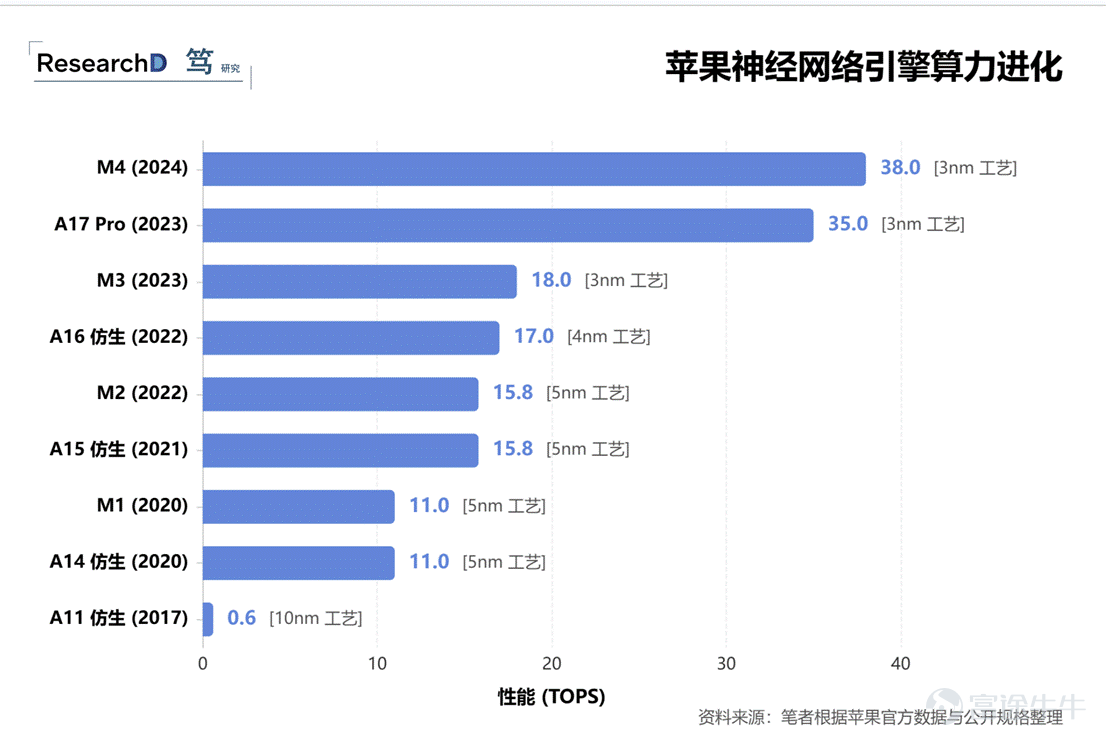
While Amazon and Microsoft are piling up computing power in the cloud, Apple is leveraging Taiwan Semiconductor’s most advanced processes to aggressively build terminal computing power. Starting with the A11 chip in 2017, Apple boldly integrated a dedicated neural engine (NPU) into its SoC.
This is an extremely sophisticated financial maneuver:Apple has converted Capex into BOM costs.Google and Microsoft build data centers, and at this stage, they have to bear the costs themselves. Apple embeds AI chips into iPhones and sells them to users, effectively passing on the costs to consumers (included in the price of the iPhone). Moreover, every time cloud-based AI generates a token, it consumes electricity, incurring positive marginal costs. However, device-based AI runs on the user’s battery, which means for Apple,The marginal cost is zero.。
By 2026, data privacy has become a luxury. Only Apple dares to promise “data stays on the device.” This hardware-based trust is the core factor supporting the high premium of the iPhone.
Private Cloud Compute (PCC): Rejecting the 'NVIDIA Tax'
Even in scenarios where internet connectivity is mandatory, Apple is taking an unconventional approach. Instead of purchasing general NVIDIA H100/B200 servers, it has built its ownM-series chips (Ultra/Extreme versions)to create a 'Private Cloud Computing' cluster. $NVIDIA (NVDA.US)$
This represents an extreme form of cost control. The energy efficiency of the M-series chips far exceeds that of general GPU servers, meaning Apple's unit computing cost (TCO) is much lower than its competitors. Apple doesn’t need to pay NVIDIA’s hefty 75% gross margin premium; it only needs to cover Taiwan Semiconductor's manufacturing fees. This allows Apple to achieve the same computing power with only a fraction of the capital investment compared to its rivals.

4. The Financial Ouroboros - Financial Truths Hidden by Bubbles
When analyzing the tech stock bubble of 2026, we must factor in the unlisted giants (OpenAI, Anthropic, xAI) as variables to see the full picture. This reveals a highly risky 'Financial Ouroboros' structure, with Apple being the only major player outside this dangerous construct.
A game of funds transferring from one hand to another
Take a look at where the hundreds of billions in Capex from Microsoft and Amazon went? A large portion flowed through a method calledRound-Tripping: For example,Microsoftinvesting tens of billions of dollars into OpenAI.OpenAIThe money was received, but it never left Microsoft's system. Instead, it had to be used to purchase Azure cloud services.MicrosoftThis "cloud service revenue" is then recorded on the financial statements to demonstrate strong AI demand, which in turn boosts stock prices, enabling the next round of Capex investment.
This kind of "passing money from one hand to another" cash flow loop, while beautifying cloud business growth rates in the short term, also significantly increases systemic risk. OpenAI is essentially a "dependent" of Microsoft, with most of its expenditures turning into Microsoft’s revenue.
Apple's "self-restraint"
Only Apple stands outside this risky closed loop. First, it does not bear the burden of "investment for cloud volume." Second, its balance sheet is extremely clean, free of massive AI equity investments that could depreciate at any time, or excessive GPU inventories that would become obsolete once technology iterates. When competitors are pressured by huge depreciation costs, Apple still maintains robustFree Cash FlowThis gives it the ability to conduct large-scale stock repurchases in 2026, thereby supporting its stock price.
Once the bubble bursts, the miners (OpenAI/Microsoft) may lose everything, the shovel sellers (NVIDIA) might end up with mountains of inventory, but those sitting at the mine’s entrance selling cold drinks (Apple) usually walk away unscathed.
5. Risk warnings
Of course, Apple's strategy is not foolproof. We must remain vigilant"the operating system being sidelined"tail risk.
If AI evolves from a "feature" to an all-powerful "agent"—where users no longer open apps like "Ctrip" or "Uber" but instead instruct AI to handle everything—the App Store's "walled garden" business model will collapse, and Apple’s most profitable 30% commission will face challenges. Additionally, if future interactions no longer rely on screens (e.g., brain-computer interfaces), the iPhone’s monopoly as a "hardware gateway" will also cease to exist.
However, within the 3-5 year investment horizon, these risks are not enough to shake the iPhone's position as the primary interface between the physical and digital worlds.
Conclusion: In this $700 billion bet, be a smart arbitrageur.
Summarizing the AI landscape of 2026, we can clearly see two distinct philosophies:
→ Camp A (Google, Microsoft, Amazon):believes Brute force leads to flying bricks. Like telecom companies laying fiber optic cables in the past, they are engaging in forward-looking infrastructure, betting that they can monopolize the future. This is not only a high-stakes gamble but also a passive game where falling behind could be fatal. Essentially, they are pursuingVenture capital。
-> Camp B (Apple):Believes in “Experience First”. During a period of rapid technological advancement, computing power may very well depreciate faster than any other asset. Graphics cards purchased for $10 billion today might not even cover electricity costs three years from now. Apple is focused onArbitrage。
As concerns over an AI bubble increasingly weigh on the market, Apple offers an extremely attractiveAsymmetric returns。
-> Downside protection:If the AI bubble bursts, the hardest hit will be the cloud giants burdened with massive infrastructure depreciation. Apple can simply stop API procurement and emerge unscathed.
→ Upward Options:If AI truly changes the world, Apple, with its 2 billion end-user entry points, will remain the largest traffic distributor and experience monetizer.
Ultimately, in this $700 billion AI spending frenzy, the one who has the last laugh may not be the madman who creates the strongest AI agent, but the merchant who packages that strongest AI agent into an elegant box and sells it to you at a 40% gross margin. Apple is precisely the most astute merchant in this AI battle royale.
The above content does not constitute any investment advice. Please bear the risks on your own.
Risk Disclaimer: The above content only represents the author's view. It does not represent any position or investment advice of Futu. Futu makes no representation or warranty.Read more


Comments (2)
to post a comment
5
4