Fresh changes in the fresh e-commerce landscape? Meituan plans to acquire Dingdong

Meituan Short-Term Analysis: Oversold Conditions Meet Key Acquisition, Bull-Bear Battle at the $90 Price Level
$MEITUAN-W (03690.HK)$ Meituan Short-Term Analysis: Oversold Conditions Meet Key Acquisition, Bull-Bear Battle at the $90 Price Level
As the Hong Kong stock market experiences pre-holiday volatility, Meituan’s stock price, as a leading local life services giant, has also fallen into intense competition at key technical levels. As of February 9, Meituan's share price closed at $91.2, with narrowing daily fluctuations, indicating market hesitation before key price levels. Meanwhile, a major acquisition announcement has become the focus of market attention. On February 5, Meituan announced plans to acquire the China business of fresh e-commerce platform 'Dingdong Maicai' for approximately $717 million. Market analysis generally believes that this move aims to quickly expand city coverage and consolidate its moat in the instant retail sector, with clear strategic goals. However, due to fierce competition in the instant retail market and challenges faced by both Meituan's core business and overseas operations, some believe there may be limited room for short-term valuation re-rating.
Technical Analysis: Divergence in Short-Term Indicators, Market Seeks Bottom Formation
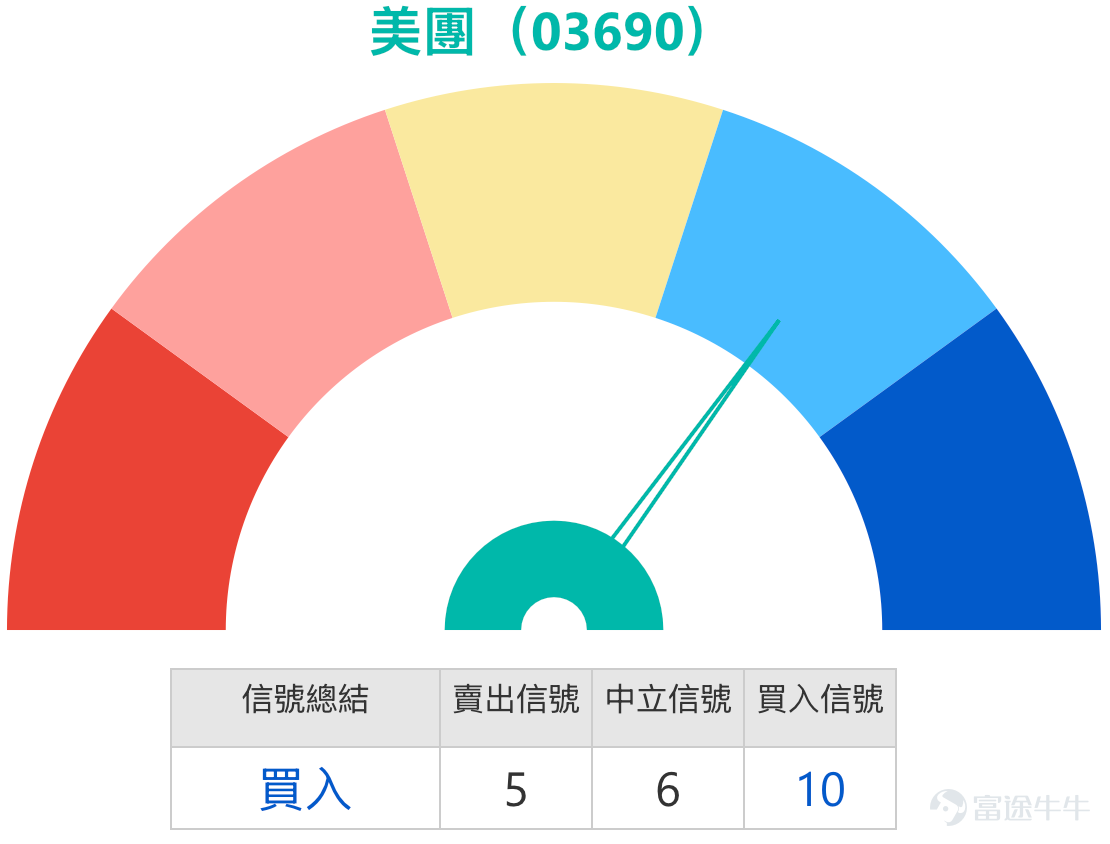
From a technical chart perspective, Meituan’s stock price currently exhibits a typical coexistence of 'trend pressure' and 'indicator oversold' conditions. The stock price has clearly broken below all key short- to medium-term moving averages, including MA10 ($94.66), MA30 ($99.18), and MA60 ($99.67), indicating an overall bearish trend. However, positive signals are gradually accumulating. The 14-day RSI indicator has dropped to near 31, entering the traditionally oversold zone. More notably, divergence is emerging among momentum indicators: while indicators like MACD maintain a bearish outlook, on the other hand, the rate-of-change indicator suggests 'seller exhaustion period, consider buying,' implying weakening downward momentum. This divergence in technical indicators often signals that market sentiment may be nearing a short-term turning point, increasing the likelihood of a technical rebound near key support levels.
Key Support and Resistance Analysis: Focus on the Battle at HKD 87.3 and HKD 95.3
All eyes in the current market are on several key price levels, which will determine the short-term direction of Meituan's stock price. The first critical support is located at HKD 87.3, a defensive bottom line for the bulls in the near term. If this line breaks, the stock price may further drop to an important support area at HKD 84. Notably, based on options market analysis, HKD 90 is a psychological and technical battleground for both bulls and bears, recently becoming a crucial 'battle zone,' with its outcome providing guidance for future trends.
Looking upward, the path to recovery is equally challenging. The first resistance level is at HKD 95.3, which not only represents a previous high-density trading zone but also aligns closely with multiple short-term moving averages, making it difficult to break through. A stronger second resistance lies near HKD 103.4, which will be the litmus test for whether the stock can truly reverse its weakness and regain upward momentum. Therefore, the short-term trading range may be confined between HKD 87.3 and HKD 95.3, awaiting the final breakout direction.

Market View Integration: Balancing Acquisition Benefits with Macroeconomic Conditions
Regarding Meituan’s recent performance, market sentiment is mixed. On the positive side, the significant rebound in the US stock market has improved peripheral sentiment, benefiting overall market confidence including Hong Kong stocks. More importantly, Meituan's acquisition of Dingdong Maicai has gained some recognition. Analysts note that Dingdong Maicai's pre-positioned warehouse network and supply chain capabilities in East China can complement Meituan's Xiaoxiang Supermarket advantages in North and South China, helping Meituan quickly complete its instant retail map.
However, bearish views cannot be overlooked. In addition to the industry competition and valuation pressures mentioned earlier, some institutional shareholders have recently reduced their holdings. For instance, Prosus sold approximately USD 549 million worth of Meituan shares to adjust its emerging market investment portfolio, which somewhat affected market sentiment. Overall, while the market affirms Meituan's long-term strategy, there are differing opinions on short-term profitability pressure and the sustainability of valuation corrections.
Review of Warrants and Bull/Bear Contracts: Capturing Leverage Effects in One-Way Declines
During the recent adjustment phase of Meituan's stock price, derivatives once again demonstrated their role in hedging risks or following trends. Reviewing the put products mentioned on February 5, against the backdrop of Meituan's underlying stock falling by 3.52% over the next two days, related derivatives recorded significant gains due to leverage effects. Among them, UBS Group Bear Certificate (55606) $UB#MTUANRP2812C.P (55606.HK)$ rose 36%, Morgan Bear Certificate (55116) rose 33%, and UBS Group Put Warrant (24595) rose 11%. This performance clearly confirms that in relatively clear one-way movements, utilizing bear certificates or put warrants can provide investors with a pathway to manage downside risks or capture gains. This echoes an expert investment strategy: when bearish on individual stocks, one can reference technical support as targets and use derivatives to capture downward trends.

Product Terms Analysis and Strategic Deployment under Current Market Conditions
Considering Meituan's stock is currently at a key support zone with oversold technical indicators, here’s a summary of product strategies tailored to different market perspectives, with all analyses linking terms to the aforementioned key technical levels.
For investors who believe that the stock price has found support near 87.3 yuan and is expected to rebound technically, they can focus on bullish products. In terms of warrants, consider call warrants with a strike price around 100 yuan, such as BOC Call Warrant (15366). $BIMTUAN@EC2604A.C (15366.HK)$ Or HSBC Call Warrant (23229). $HSMTUAN@EC2604B.C (23229.HK)$ The strike price is slightly higher than the second resistance level at 103.4 yuan. If the stock price can initiate a meaningful rebound and challenge this resistance zone, such products will have high elasticity. Moreover, both have relatively low implied volatility, making their pricing more efficient. In terms of bull contracts, the forced recovery prices for HSBC Bull Contract (56829) and UBS Group Bull Contract (53783) are set at 76 yuan, providing over a 12% safety buffer from the current stock price and the first support level at 87.3 yuan. This setup helps withstand market fluctuations, avoiding forced recovery due to short-term volatility, while offering approximately 4.8 times actual leverage.
For investors who think market sentiment has not yet stabilized and the stock price may continue to drop towards the 84-yuan or even lower support levels, they can focus on bearish products. In terms of warrants, consider put warrants with a strike price near 82.83 yuan, such as J.P. Morgan Put Warrant (22913). $JPMTUAN@EP2607A.P (22913.HK)$ Or UBS Group Put Warrant (21519). $UBMTUAN@EP2607A.P (21519.HK)$ The strike price is close to the key support level below 84 yuan, making it suitable for hedging portfolio risk or executing short-term bearish strategies. In terms of bear contracts, the forced recovery prices for UBS Group Bear Contract (69719) and J.P. Morgan Bear Contract (56593) are set at 106 yuan, maintaining a considerable distance from the current stock price and the first resistance level at 95.3 yuan. This provides ample room for potential stock rebounds, reducing the risk of being unexpectedly 'targeted,' while offering about 6 times actual leverage.

#Learn Warrants and Bull/Bear Contracts with Jenny# Key Analysis: What is 'Bid-Ask Spread'?
When trading warrants or bull/bear contracts, apart from focusing on core terms like strike price and expiration date, the 'bid-ask spread' is a critical detail often overlooked by beginners that directly affects transaction costs. The bid-ask spread refers to the difference between the 'buy price' and 'sell price' displayed on the trading platform at any given moment.
Who sets this spread? Typically, it is quoted by the issuer acting as the liquidity provider. A smaller spread indicates better product liquidity and lower implicit costs for investors during trades. Conversely, a wider spread would require larger stock price movements to cover transaction costs and turn a profit, even if the direction is correctly predicted. For instance, products with thin trading volumes and high street inventory might see widened spreads. Therefore, when selecting products, in addition to comparing leverage levels, attention should be paid to the thickness of the order book and whether the spread is reasonable. Products with narrow spreads and ample liquidity should be prioritized, which is especially crucial for short-term trading.
The relative advantages of warrants and bull/bear contracts compared to underlying stocks.
Compared to directly investing in common stocks, the core advantages of warrants and bull/bear certificates lie in the strategic flexibility and capital efficiency they offer. They allow investors to make precise deployments on specific price directions (upward or downward) or particular volatility ranges without committing a large amount of principal. For instance, given Meituan's current technical pattern, if investors believe that the stock price will fluctuate within a range of HKD 87 to 95, they can flexibly use derivatives for range trading without bearing the long-term uncertainty associated with holding the underlying stock. At the same time, this leverage feature enhances the efficiency of capital usage, enabling even small amounts of capital to participate in stock price volatility strategies.
Interaction and Reminder
Meituan's share price is oscillating around the critical level of HKD 90, with bulls and bears fiercely battling it out. The current price chart is like an exam paper, and your choice is the answer:
A. Rebound Camp: Believes that the stock is severely oversold, with solid support at HKD 87.3, and is preparing to bet on a technical rebound.
B. Wait-and-See Camp: Thinks that neither side has won yet, so it’s better to sit back with a cup of tea and wait until the stock price clearly breaks through HKD 95.3 or falls below HKD 87.3 before taking action.
C. Cautious Camp: Feels that the trend hasn't reversed yet, with significant resistance overhead, and is more focused on potential downside towards HKD 84.
Which camp do you belong to? Let’s discuss it in the comments section! Lastly, a crucial reminder: Warrants and bull/bear certificates are complex derivatives with higher risks, and you may lose your entire investment. Always read the product terms carefully and conduct proper risk assessment before investing.
For more analysis on Hong Kong stock derivatives, stay tuned to Jenny's insights on Hong Kong stock warrants.
Keywords: #Meituan #TechnicalAnalysis #SupportResistanceLevels #Warrants #BullBearCertificates #BuySellSpread #DingdongMaicai #HongKongStocks #Derivatives #Options
Risk Disclaimer: The above content only represents the author's view. It does not represent any position or investment advice of Futu. Futu makes no representation or warranty.Read more

Comments
to post a comment
2