
Waller officially sworn in! How will Fed policy change?

Tengsi | Will the Fed's leadership change trigger market-wide volatility? Should Warsh's nomination take 'full blame' for this turbulence?
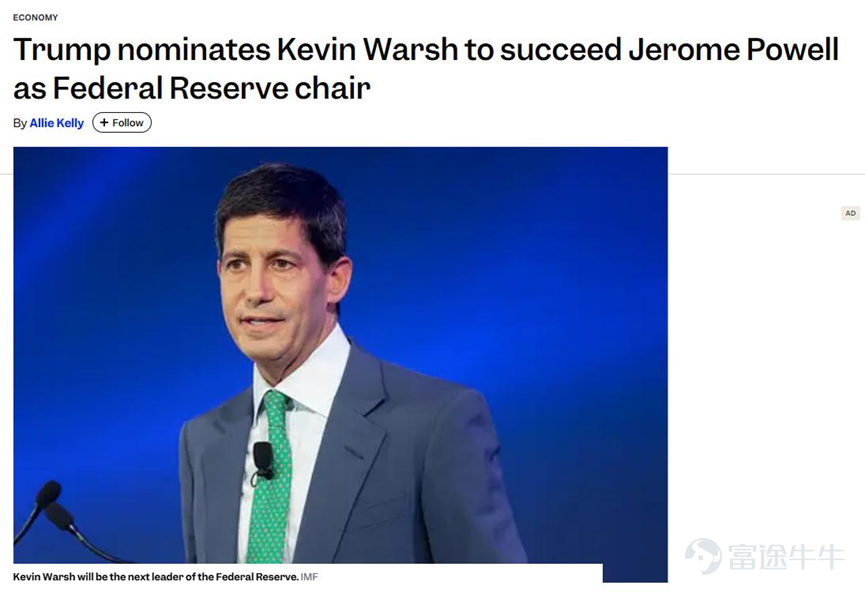
On Friday local time (January 30),The US President announced the new Fed Chair nominee - Kevin Warsh。
Global financial markets immediately entered a volatile mode. By the afternoon, international gold and silver prices had already shown significant fluctuations, and by the next morning, selling pressure in the precious metals market intensified further. Meanwhile, as precious metals plummeted, the US dollar index rebounded, and US bond yields rose in tandem.
Some people attributed the market 'abnormalities' entirely to Trump's nomination of Warsh.Who exactly is this new Fed Chair? Is Warsh really a hawk? Should this nomination bear 'full responsibility' for abnormalities in the US stock, gold, forex, and bond markets?

Screenshot from the US 'Business Insider' website
Warsh: A multi-faceted background with deep roots in politics, business, and academia
Kevin Warsh, currently 55 years old,has a diverse career spanning the political, business, and academic fields,which makes him a "special candidate" in the nomination for Federal Reserve Chair. In terms of educational background, Kevin Warsh graduated from Stanford University in 1992 and served as a research assistant to economist Friedman. In 1995, after graduating from Harvard University, he worked in the mergers and acquisitions department at Morgan Stanley's New York headquarters, where he held positions including vice president and managing director.
In terms of family background, his father-in-law Ronald Lauder, the heir to the Estee Lauder Group, is not only an old classmate of Trump’s from the Wharton School of Business at the University of Pennsylvania but also a core donor to the Republican Party. In 2025, he donated five million dollars to Trump’s super political action committee. Thisnetwork of connections has provided crucial support in bringing Warsh closer to Trump's camp.
In his professional career, in 2002, he joined the economic team of the George W. Bush administration as a Special Assistant to the President for Economic Policy and Executive Secretary of the White House National Economic Council, participating in core economic policy formulation. In 2006, at the age of 35, Kevin Warsh was appointed by Bush as a Federal Reserve Governor,becoming one of the youngest governors in the history of the Federal Reserve.His term spanned the 2008 global financial crisis, during which he was deeply involved in major decisions such as the acquisition of Bear Stearns, the bankruptcy of Lehman Brothers, and the bailout of American International Group (AIG).He was a key liaison between the Federal Reserve and Wall Street.
Warsh's connection with Trump is not a recent development.As early as Trump’s first term when considering candidates for the position of Federal Reserve Chair, Warsh was on the shortlist but ultimately lost out. However, in recent years, his stance has gradually aligned with Trump's. In November 2025, he wrote an article in The Wall Street Journal praising Trump's 'pro-growth' economic policies while criticizing the Federal Reserve’s high-interest-rate policy for stifling economic potential. This statement earned significant approval from Trump. Given the current visible tensions between Trump and Powell, nominating Warsh appears more like a 'correction.'
Hawk or Dove? The Unity of Hawkish Foundations and Dovish Shifts
“Wall Street remains uncertain whether Kevin Warsh is a friend or foe,” The Wall Street Journal aptly summarized the market’s confusion over Warsh’s policy inclinations—he is neither a typical 'hawk' nor 'dove,' but instead exhibitsa contradictory mix of 'hawkish foundations + dovish signals.'The contradictory combination.
From a historical standpoint, Warsh has been labeled as 'hawkish.'During his tenure as a Federal Reserve governor, he consistently prioritized inflation control as the core objective of monetary policy, frequently criticizing accommodative monetary policies such as quantitative easing. He argued that low interest rates and large-scale bond purchases would drive up prices and distort market pricing mechanisms.
However, in recent years, Warsh’s stance has shown a clear 'dovish shift.'Particularly on interest rate policy, his views have aligned closely with Trump's demands. In July 2025, he publicly stated that the Federal Reserve’s refusal to cut interest rates was a 'major mistake,' and commented that it was 'correct' for Trump to openly pressure the Fed. This statement contradicted traditional hawkish positions; thereafter, he repeatedlyvoiced public support for lowering borrowing costs, arguing that cutting interest rates is a key measure to stimulate economic growth and reduce government debt costs.This shift has caused him to gradually shed the label of being a 'pure hawk,' instead sending out pragmatic dovish signals.
The more fundamental contradiction lies in the fact thatWarsh simultaneously advocates for a dual agenda of 'rate cuts + balance sheet reduction.'He supports lowering short-term interest rates (dovish) while also pushing for an accelerated reduction of the balance sheet (hawkish). This unconventional policy mix has completely disrupted market expectations — historically, a rate-cutting cycle is often accompanied by pausing balance sheet reduction or expanding the balance sheet to release liquidity, whereasthe combination of 'both cutting rates and reducing the balance sheet' represents an unusual approach.The logic implies that liquidity will present"an appearance of easing, but an essence of tightening"a complex situation. The uncertainty in this policy logic makes it difficult for the market to price accurately.
Why did the market react so strongly? Inevitable fluctuations driven by multiple factors resonating together
After the nomination news was announced on January 30, the market plunged into violent fluctuations:Spot gold fell by 16% within 48 hours, and on February 2, it even broke below the 4,500-dollar mark; spot silver recorded a single-day maximum drop of over 36%, setting a historical record; South Korean stocks plummeted by 5.26%, triggering a circuit breaker. Behind this cross-asset turmoil was not solely due to a single factor but rather the result ofpolicy uncertainty, imbalanced market positions from earlier periods, concerns about the Fed's independence, and global market fragilityResonance of Multiple Factors.

Chart: London Gold Spot (XAU/USD) Trends from January to Early February 2026 (As of February 3)
First, the uncertainty in policy logic has caused a divergence in market expectations.As mentioned earlier,the unconventional policy mix of 'rate cuts + balance sheet reduction' by Warsh has broken the long-standing market expectation of 'rate cuts accompanied by balance sheet expansion or suspension of reduction'.For the precious metals market, rate cuts should have supported the prices of non-interest-bearing assets like gold and silver. However, the expectation of liquidity tightening brought by balance sheet reduction would suppress the valuation of precious metals. This conflicting expectation left investors at a loss, eventually triggering panic selling. For the stock market, expectations of low interest rates supported financials and cyclical sectors, but the long-term liquidity tightening pressure from balance sheet reduction weighed on high-valuation AI tech stocks, causing significant divergence in the US stock market. To deal with this uncertainty, the market could only achieve repricing through rapid portfolio adjustments, which directly amplified volatility.
Second, the overvaluation of the market earlier became the trigger for the pullback.Before Warsh's nomination, global markets had formed a highly convergent trading logic: based on expectations that the Fed might cut interest rates, large amounts of capital flowed into liquidity-sensitive sectors like precious metals and high-valuation tech stocks, driving gold to rise as much as 30% year-to-date and silver up by 60%. Thesesectors were already overvalued and had strong correction needs.The reversal of policy expectations brought about by Warsh’s nomination became the 'last straw' that broke the camel’s back, triggering a wave of large-scale liquidation, which eventually escalated market fluctuations into 'mega-quakes'.
Third, concerns over the independence of the Federal Reserve intensified market panic.For a long time, the independence of the Federal Reserve has been an important cornerstone of stability in global financial markets. However, the longstanding conflict between Trump and current Chairman Powell, with Trump repeatedly criticizing Powell publicly, pressuring for rate cuts, and even threatening dismissal, has already raised concerns about the independence of the Federal Reserve. Warsh’s close ties with Trump made the market worry that he would become a 'White House spokesperson' after taking office, and monetary policy might prioritize political demands rather than economic principles. This questioning of policy credibilityThis led to a significant decline in market risk appetite, with funds flowing from risky assets into safe-haven assets such as the US dollar and US Treasuries, further exacerbating cross-asset volatility.
Fourth, the amplification of global market vulnerabilities has intensified the severity of volatility.The current global macro environment is already fraught with underlying tensions: heightened volatility in Japanese government bonds, ongoing speculation about yen-dollar exchange rate interventions disrupting global capital flows; the US manufacturing PMI rose to 52.6 in January, surpassing market expectations, with strong economic data supporting a stronger dollar and pressuring precious metal prices. Meanwhile, prolonged global liquidity easing has generated a large number of overvalued assets,significantly increasing market sensitivity to policy changes, combined with the rapid transmission of algorithmic trading, which amplifies the impact of any single piece of news infinitely.
The nomination of Warsh was the core trigger for this market-wide volatility. His complex background and conflicting policy inclinations disrupted the market's original expectation equilibrium, triggering a concentrated repricing of global assets.However, attributing full responsibility for this 'epic-scale upheaval' to Warsh is clearly biased—the intrinsic need for correction due to similar positioning in the market earlier, long-standing concerns about the Federal Reserve's independence, undercurrents in the global macro environment, along with structural fragilities within the market itself, all collectively influenced market fluctuations. Whether the market can stabilize in the future hinges not on Warsh’s nomination itself, but rather on whether it canClearly communicate policy signals, striking a balance between interest rate cuts and balance sheet reduction, Federal Reserve independence and White House demands. This not only tests the professional capabilities of this potential new leader but will also profoundly influence the future direction of global financial markets.
Thank you for reading this Tengsi article!This column will continue to provide in-depth analysis on the Federal Reserve, offering systematic and thorough market insights based on historical patterns and current similarities and differences.
What content would you like to see next? Which indicators or data do you most want us to help interpret? And any other macro themes or investment strategy questions you care about, feel free to leave a comment!
Your feedback will help us deliver more focused and practical content. Looking forward to continuing the discussion with you in the next issue!


Risk Disclaimer: The above content only represents the author's view. It does not represent any position or investment advice of Futu. Futu makes no representation or warranty.Read more


Comments
to post a comment
5
2