
2026 IPO bonanza! Over 90% of new stocks rose on their debut

A couple from Guangdong at the helm, HomeCare Technology is going public
Apply Vitamin C skincare products in the morning for brightening, and use retinol-based skincare at night to combat aging.
If you open the vanity of a beauty blogger, chances are you'll find a water-and-lotion set labeled 'Morning C, Evening A,' long dominating the best-selling skincare lists on Tmall and Douyin. Now, this internet-famous brand, known as HBN, is also heading to an IPO.
According to Investment World - Tian Tian IPO, the parent company of HBN, Shenzhen Hu Family Technology (Group) Co., Ltd. (referred to as 'Hu Family Technology'$Shenzhen HBN Technology (Group) Company Limited (811108.HK)$ ), has submitted its listing application to the Main Board of the Hong Kong Stock Exchange. Morgan Stanley and CICC are the joint sponsors.
This is the youngest player among the top ten domestic skincare brands. In less than seven years, it turned a bottle of glow water and a retinol essence into a catchphrase on social media with its 'Morning C, Evening A.' The brand was created by a couple from Guangdong, who are now leading the company towards becoming the 'first efficacy-focused skincare stock.'
Amid a wave of consumer companies listing in Hong Kong, figures overlap in crowds.
Morning C, Evening A
A couple from Guangdong creates an IPO
The protagonist of the story, Yao Zhe Nan, has been through many trials and tribulations on his entrepreneurial journey.
At the age of 17, Yao Zhe Nan went to the UK for his studies and obtained both undergraduate and master's degrees from the University of Central Lancashire. He once worked at one of the top three advertising companies in the industry. After returning to China, he briefly joined Shenzhen University as a lecturer and graduate supervisor in the Digital Media Arts Department.
Since his student days, Yao Zhe Nan has attempted entrepreneurship multiple times, selling stamps and engaging in car trading. In 2014, he founded the viral sanitary napkin brand Me Ze (formerly known as 'Hu Ni Mei' or HoneyMate), which became an overnight sensation.
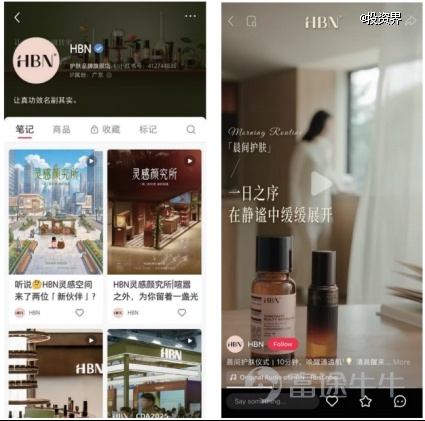
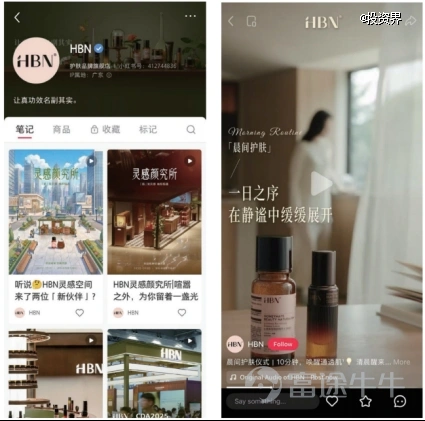
Noticing an opportunity in the domestic functional skincare market, Yao Zhe Nan decided to make a cross-industry move. In 2019, HBN, a functional skincare brand, was born, promoting the 'Morning C, Evening A' skincare philosophy. The same year, its first core product, Alpha-Arbutin Essence Water, was launched.
The so-called 'Morning C, Evening A'refers to using skincare products containing Vitamin C in the morning to brighten the skin and applying products with Retinol in the evening to combat aging.Corresponding skincare sets quickly emerged, leveraging the booming live-stream e-commerce sector, capturing the hearts of many young consumers.
At that time, the domestic industrial environment was not yet mature, with marketing gimmicks and conceptual additives rampant in the market, making it difficult to pursue true efficacy. Recalling this publicly, Yao Zhe Nan mentioned HBN’s decision to focus resources on third-party clinical human trials, building an efficacy evaluation system.
The business rapidly expanded. According to statistics published by Ju Meili in 2022, within just four years of establishment, HBN entered the 2-4 billion revenue tier among domestic skincare brands, becoming one of the youngest brands in the leading group of domestic beauty companies.
In 2025, Hu Jia Technology, through its wholly-owned subsidiary Hangzhou Lokexin Biotechnology, launched its first new skincare brand, Lokexin LOCKSKIN. Not long ago, they officially announced Wang Su Liang as the brand’s first spokesperson, breaking their previous stance of 'zero endorsements.'
With traffic and operational support, Meitu Network and Yinxin Investment became the company's external investors as early as during its sanitary napkin business phase. In November 2025, Wu Zeyuan, Chairman of Meitu, joined HuJia Technology as a director and was reassigned to become a non-executive director in January this year, mainly responsible for providing strategic advice.
Before the IPO, the direct shareholding ratio of Yao ZheNan and Wang Yang couple reached 48.68%, collectively controlling 76.19% of the company’s voting rights. Through its subsidiary Meitu Network, Meitu holds 23.81% of HuJia Technology's equity, making it the largest external shareholder.
Notably, the company has just carried out a large dividend payout before its listing.
In January 2026, HuJia Technology shareholders formally approved a cash dividend distribution of 100 million RMB, with 56 million already paid out, and the remaining amount expected to be distributed before the IPO. According to their shareholding ratio, nearly 50 million RMB will flow back into the founders’ pockets.
20 billion sold in a year
Hidden concerns emerge.
Compared to well-established brands like Proya and Hanzo, which have histories spanning over 20 years, HBN appears quite young in the skincare industry.
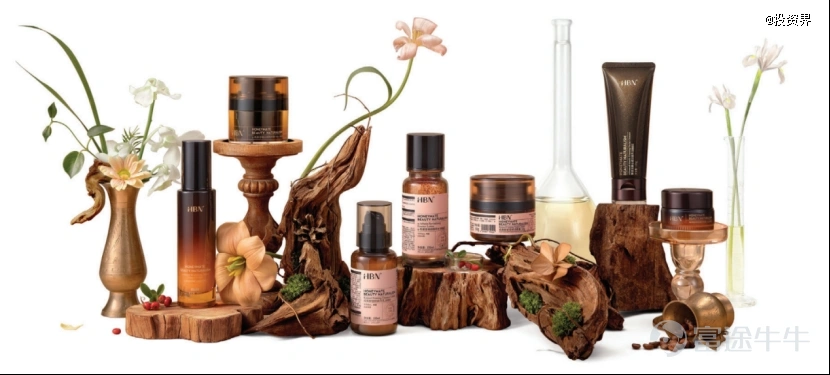
HBN's products are divided intoImprovement-type skincare productsandStabilizing skincare productsTwo main categories: the former primarily targets skin aging and oxidative damage, such as wrinkles, pigmentation, and dullness, while the latter focuses on meeting daily skincare needs, including cleansing, maintaining a healthy skin barrier, and UV protection.
Specifically, the product lines include five major series: Age-Defying Firming, Brightening Radiance, Repairing Hydration, Basic Skincare, and Oil-Control Acne Care. The suggested retail prices range from 129 to 689 yuan. As of September 30, 2025, the brand had 36 SKUs.
According to a report by CIC Consulting, based on 2024 retail sales of skincare products, HBN ranked fourth among mid-to-high-end domestic skincare brands in the country and is the largest dermatological-grade domestic brand in the improvement-oriented skincare market.
In terms of financial data, for the fiscal years 2023, 2024, and the first three quarters of 2025, the company reported revenues of 1.948 billion yuan, 2.08 billion yuan, and 1.514 billion yuan, respectively. Corresponding net profits were 38.8 million yuan, 129 million yuan, and 145 million yuan, with net profit margins increasing from 1.9% to 9.6%.
Among these, improvement-oriented skincare products form the backbone of the business, accounting for approximately 80% of revenue. Revenue from stability-maintaining skincare products has grown, with its share increasing from 18.2% in 2023 to 21.4% in the first three quarters of 2025, contributing a high gross margin of 78.2%.
High sales volumes have also resulted in a significant number of repeat customers. As of September 2025, HBN'saverage repurchase rates on Tmall and Douyin were approximately 35.4% and 44.0%, respectively,with cumulative repurchasing users exceeding 4.6 million.
A review of the prospectus reveals that HuJia Technology’s business structure exhibits some vulnerability. Nearly all revenue comes from the single brand HBN, which, in turn, heavily relies on a few star products. Sales of Alpha-Arbutin Brightening Essence, Retinol Firming Serum, and Retinol Night Cream once accounted for nearly 40% of the brand’s store revenue.
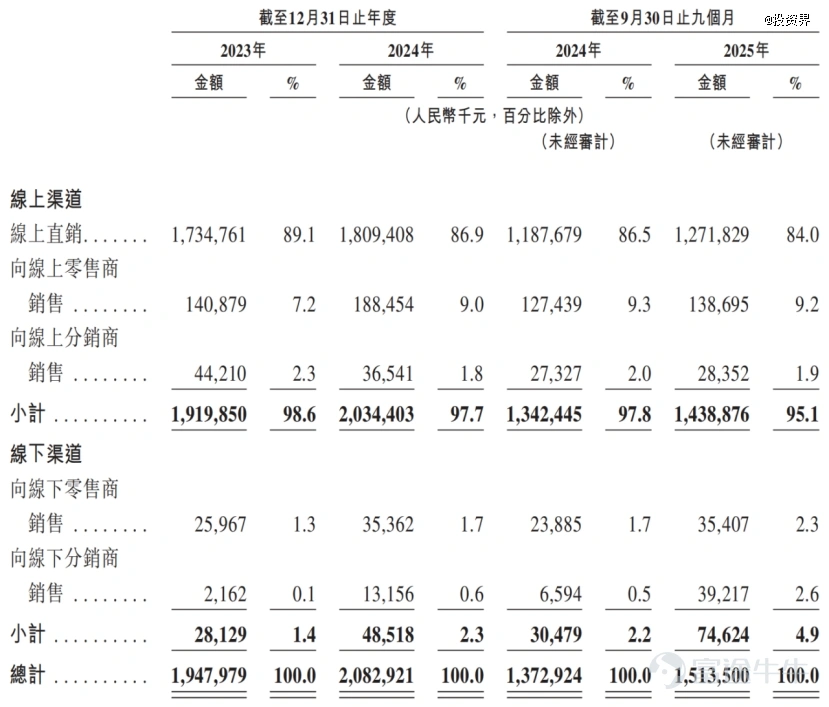
Additionally, the company’s sales channels are highly concentrated online. For the fiscal years 2023, 2024, and the first three quarters of 2025, HuJia Technology’s online revenue accounted for as much as 98.6%, 97.7%, and 95.1%, respectively, with offline revenue remaining below 100 million yuan.
"For every dollar in sales, half is spent on marketing." During the same period, the company's sales and distribution expenses accounted for 65.1%, 59.4%, and 57.6%, while the R&D expense ratio dropped from 3.39% to 2.64%, triggering market concerns over 'marketing-driven research.'
It is important to note that since its inception, HBN has labeled itself as a brand with 'real efficacy.' The prospectus also claims that the number of self-developed cosmetic raw material filings ranks third among domestic skincare brands. However, compared to Huaxi Biotech, Beiteini, L'Oreal, and other cosmetics companies, Hojia Technology's R&D investment remains relatively low.
"Our ability to maintain a competitive position and drive future growth largely depends on our capacity to continuously develop, promote products, and apply advanced technologies." The company frankly admitted in the prospectus.
Racing to secure an IPO window
In 2026, consumer-facing Hong Kong IPOs remain lively.
Not long ago, Mingming was officially listed, becoming the first 'bulk snack stock' on the Hong Kong Stock Exchange. Behind it, more than ten top cornerstone investors gathered, including Tencent, Temasek, Blackrock, and Fidelity. The stock price surged 88% at the opening, with a market capitalization exceeding 90 billion Hong Kong dollars, creating China's largest snack IPO.
People still remember the spectacle of the snack wars when Snack Busy and Zhaoyiming snacks clashed, resulting in six or seven snack shops on one street in county towns. In November 2023, the two announced their merger, giving birth to Mingming. To date, it has opened over 14,000 stores nationwide.
The 'leader' of domestically produced functional beverages, Dongpeng Beverage, entered the mass market with a low-price strategy. It recently went public on the Hong Kong Stock Exchange, establishing an A+H dual-platform structure, with a market value exceeding 150 billion Hong Kong dollars.
The cornerstone lineup was impressive: Qatar Investment Authority, Singapore sovereign fund Temasek, global asset management giant Blackrock, UBS Global Asset Management, JPMorgan Asset Management, Sequoia China, and other top international institutions all participated, subscribing collectively for 6.4 billion US dollars (approximately 49.9 billion Hong Kong dollars), accounting for nearly half of the issuance size.
Shortly before, Qian大妈 with 2,900 stores, Yuanji Cloud Dumplings with over 4,000 outlets, and Big Pizza with over 300 stores almost simultaneously submitted prospectuses to the Hong Kong Stock Exchange. Additionally, COMMUNE Fantasy, a dining bar, Grandpa’s Farm, a baby food company, and Half Mu Flower Field, aiming for the title of the 'first personal care stock in Hong Kong,' are all lining up at the Hong Kong Stock Exchange.
Counting them up, there were 14 consumer companies filing for listing just in January this year. The queue for going public in Hong Kong is growing longer, with consumer companies of all sizes rushing to accelerate the process.
Going to Hong Kong stocks is no longer a matter of choice.
On the hidden side, the cycle of Hong Kong stocks swings back and forth like a pendulum, with everyone scrambling for the final window of opportunity.
Hong Kong Exchanges and Clearing Limited CEO Julia Leung recently disclosed a set of data showing that more than 350 companies (including confidential filings) are in the queue for listing in Hong Kong. She emphasized that the quality of IPOs must be “non-negotiable,” which is the foundation for maintaining market trust, ensuring the quality of each listing application and thorough due diligence.
If you don't submit your application soon, you'll miss this wave of listings.Such sentiment is spreading among companies. According to disclosures by the Hong Kong Securities and Futures Commission, as of the end of 2025, the review process for 16 listing applications has been suspended due to compliance issues.
The alarm bells have already rung.
Risk Disclaimer: The above content only represents the author's view. It does not represent any position or investment advice of Futu. Futu makes no representation or warranty.Read more
Comments
to post a comment