
How to view the post-holiday market trend in Hong Kong stocks?

Short-term Analysis of HKEX: Can the IPO Boom Offset Market Concerns?
Recently, the share price movement of Hong Kong Exchanges and Clearing Limited (00388.HK) has reflected a tug-of-war between 'fundamental positives' and 'macro concerns.' As the 'thermometer' of the Hong Kong stock market, its share price has fallen in tandem with the recent market adjustment, closing at HKD 422.8 on February 2nd, currently testing short-term key technical support. However, in sharp contrast, the HKEX's own 'supply' (new listings) is experiencing a wave of concentrated filings, with new economy companies in sectors such as industrial AI and green technology arriving one after another. This contradiction between 'share price and technical divergence' and 'strong business momentum' forms the core of the current short-term analysis of HKEX.
I. Technical Analysis: The Tug-of-War Between Moving Average Support Zones and Neutral Signals
From a technical chart perspective, after experiencing an earlier rise, HKEX's share price has now retreated to a critical convergence zone of moving averages. Currently, the share price is contending around the 10-day moving average (approximately HKD 429.4) and has dipped near the 30-day (approximately HKD 423.5) and 60-day (approximately HKD 418.9) moving averages. This area contains multiple medium- and short-term cost lines, which are crucial for determining whether the share price can stabilize and stop falling.
Although the short-term adjustment has brought pressure, several technical indicators show complex but not entirely pessimistic neutral signals. The overall technical indicator summary signal is 'neutral,' with a strength of 10. The current 14-day Relative Strength Index (RSI) is at 50, exactly on the dividing line between bullish and bearish sentiment, indicating that market sentiment is balanced and has not fallen into panic. Several oscillation indicators also emit similar neutral signals. A positive sign comes from moving average analysis, where data shows that multiple moving averages present a comprehensive 'strong buy' pattern, suggesting that from a mid-term trend perspective, the share price still receives some support. Overall, the technical picture reveals the current situation of 'coexistence of short-term adjustment pressure and mid-term moving average support, with the market awaiting direction in a key zone.'
II. Key Support and Resistance: Building Short-Term Battle Lines
In a volatile market with unclear direction, clear key price levels serve as important guideposts for short-term traders.
* On the upside resistance, reclaiming HK$435 is the first hurdle to reversing the short-term weakness and regaining upward momentum. If successfully breached, the next target will be HK$444, which is near the previous high and is expected to encounter strong selling pressure.
* On the downside support, HK$414 serves as the first line of defense in the near term. The more critical support lies at HK$405, a level that not only represents an important technical platform but also aligns closely with long-term moving average support, likely attracting significant buying interest.
III. Market Dynamics Integration: IPO 'Spring Uptick' vs Broader Market Environment
Currently, the core logic influencing the Hong Kong Exchanges' stock price lies in the tug-of-war between its own impressive business dynamics and the broader macro sentiment of the overall Hong Kong stock market.
The most direct and ongoing positive catalyst has been the wave of IPO filings at the start of the year. On January 30th, the Hong Kong Exchanges' website received three listing applications in one day, spanning cutting-edge technology and green economy sectors. Industrial Internet platform Haier-owned Cosmos IoT Technology, global leader in green shipping solutions Zhejiang Energy Minglead, and China's largest cloud gaming rendering service provider Haima Cloud Technology all officially filed on this day. Notably, Cosmos, as a crucial expansion in Haier Group’s capital portfolio, exemplifies the market’s recognition of Hong Kong’s financing platform by its move to list in Hong Kong. This batch of high-quality new economy companies collectively pursuing IPOs not only brings direct listing revenue expectations for the Hong Kong Exchanges but also sends a strong signal that it remains an attractive international financing hub.
IV. Warrants and Bull/Bear Certificates: Review, Term Analysis, and Strategy Selection
1. Recent Product Performance Review
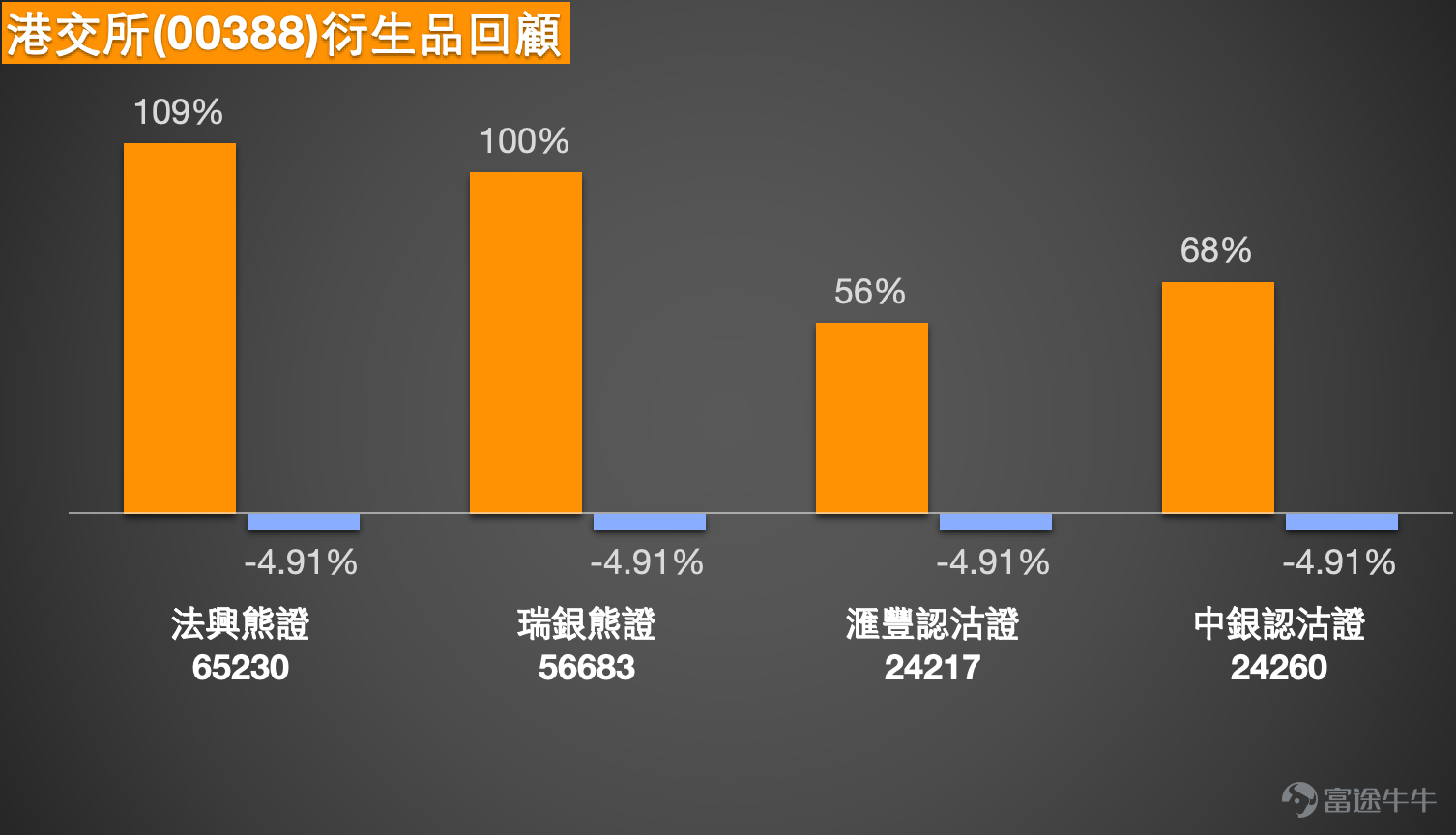
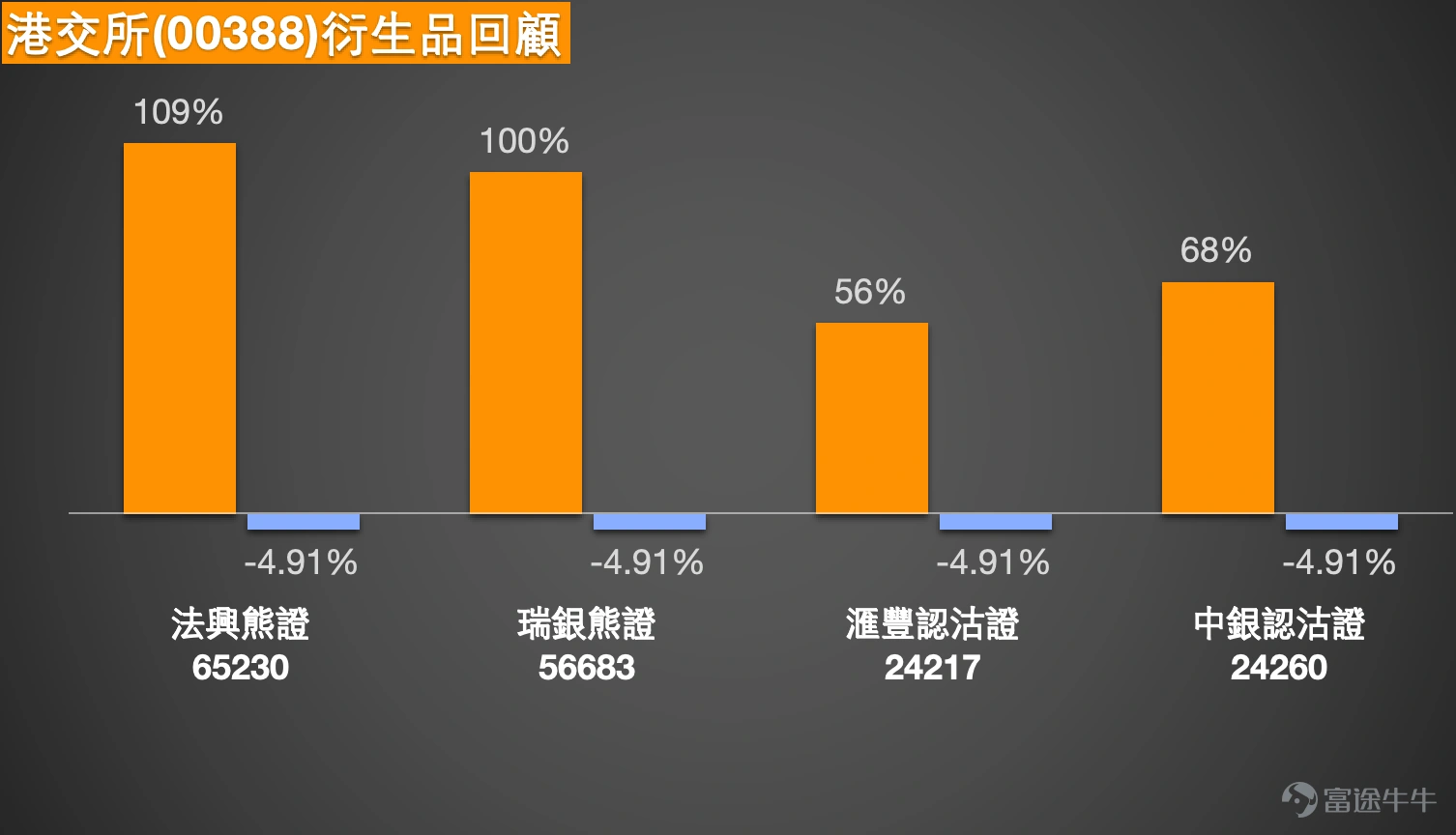
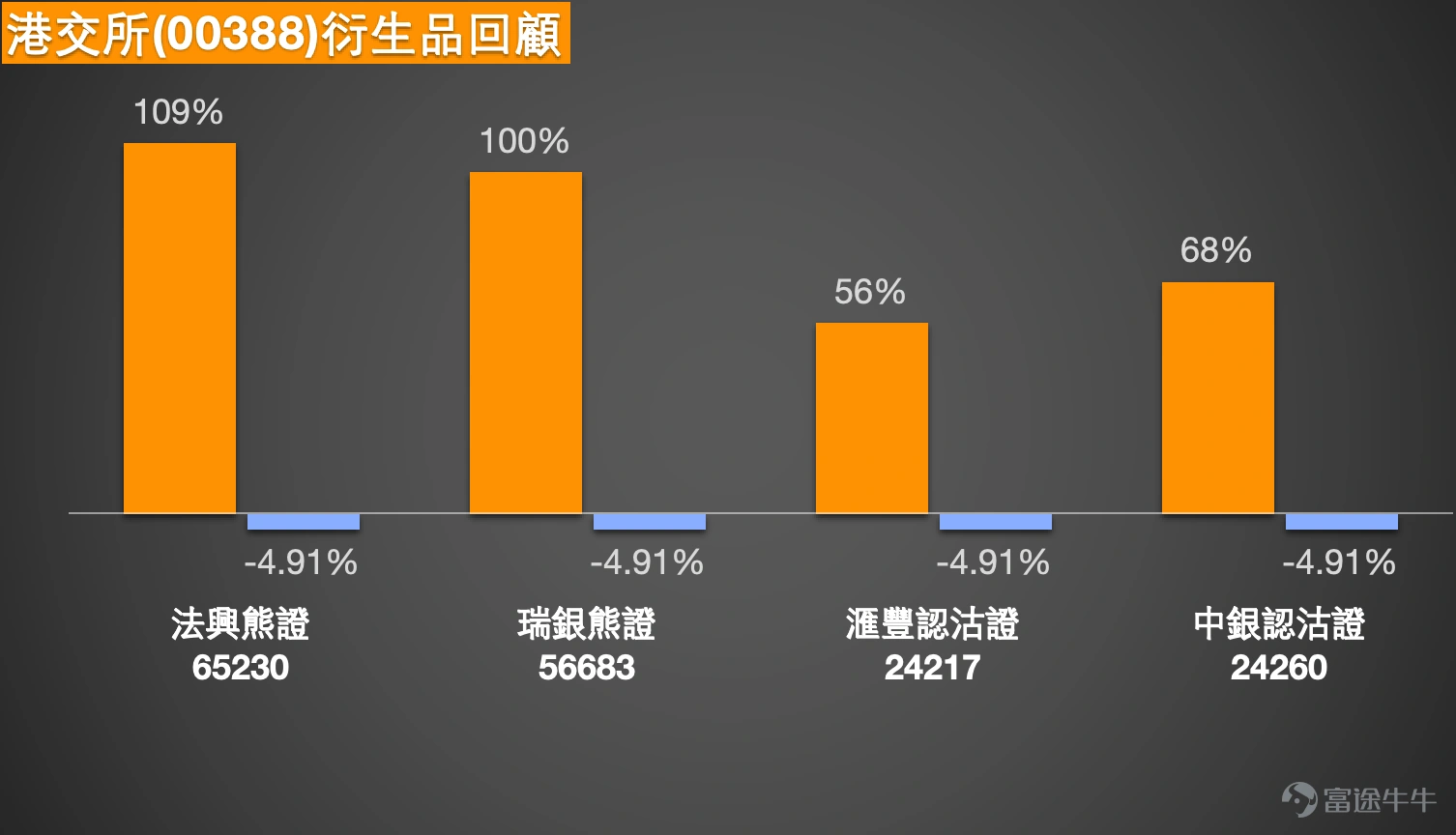
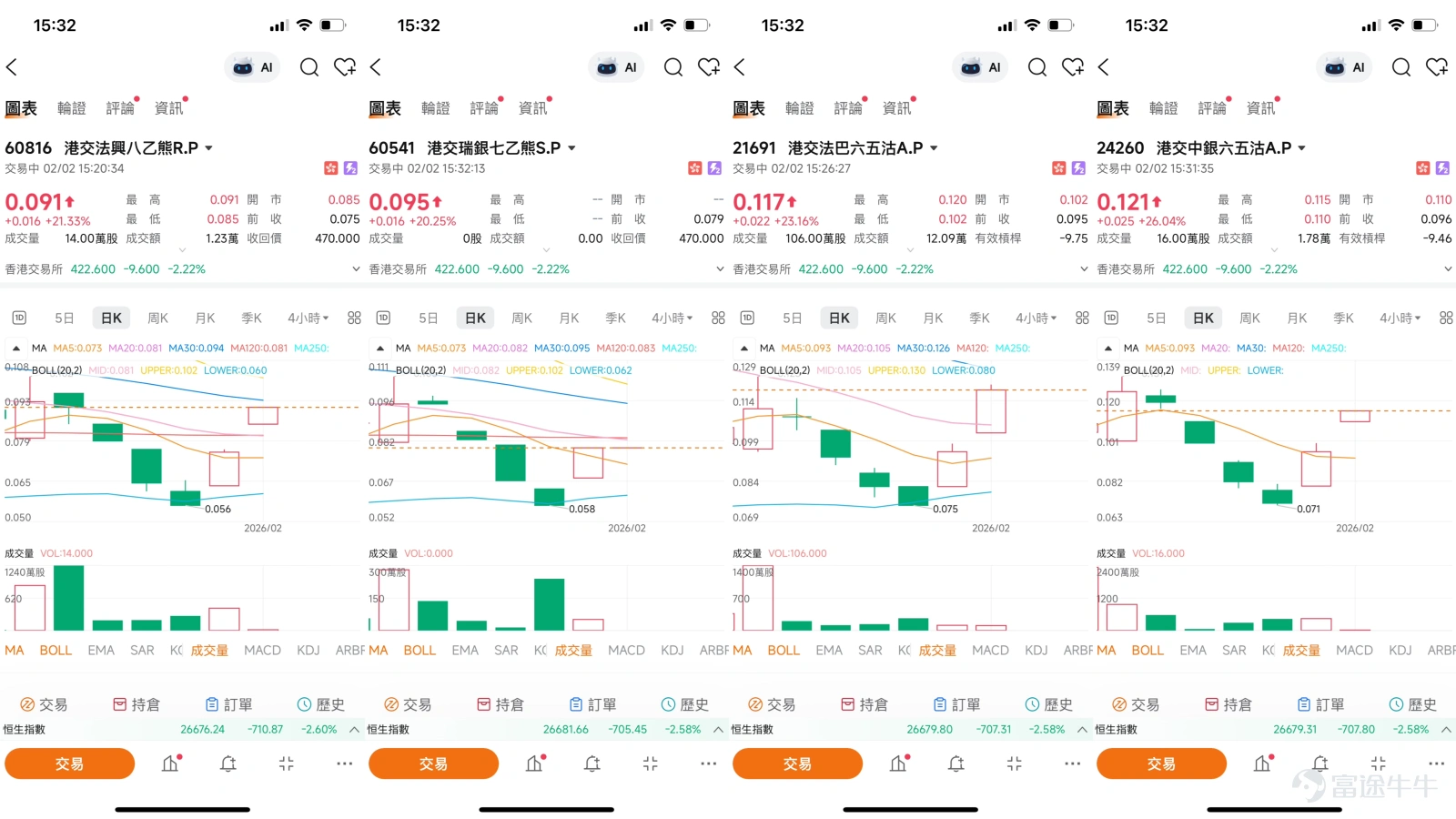
Looking back at the bearish (short) structured products mentioned on January 29, their performance over the following two days serves as a classic example of derivatives amplifying risk hedging or directional returns in trending markets. During those two days, Hong Kong Exchanges' stock fell by 4.91%, while related bearish derivative products delivered significantly outsized returns: Societe Generale Bear Certificate (65230) surged 109%, UBS Group Bear Certificate (56683) rose 100%, and two put warrants (HSBC Put Warrant 24217 $HS-HKEX@EP2605A.P (24217.HK)$ , Bank of China Put Warrant 24260) $BI-HKEX@EP2605A.P (24260.HK)$ also recorded gains of 56% and 68%, respectively. This clearly demonstrates the significant capital efficiency these tools can provide when making correct short-term market directional judgments.
2. In-depth correlation analysis of selected product terms
When selecting warrants, it is essential to precisely correlate their core terms—especially the strike price or call price—with key technical levels of the underlying stock. This forms the cornerstone of an effective strategy.
Bullish options (call warrants and bull contracts):
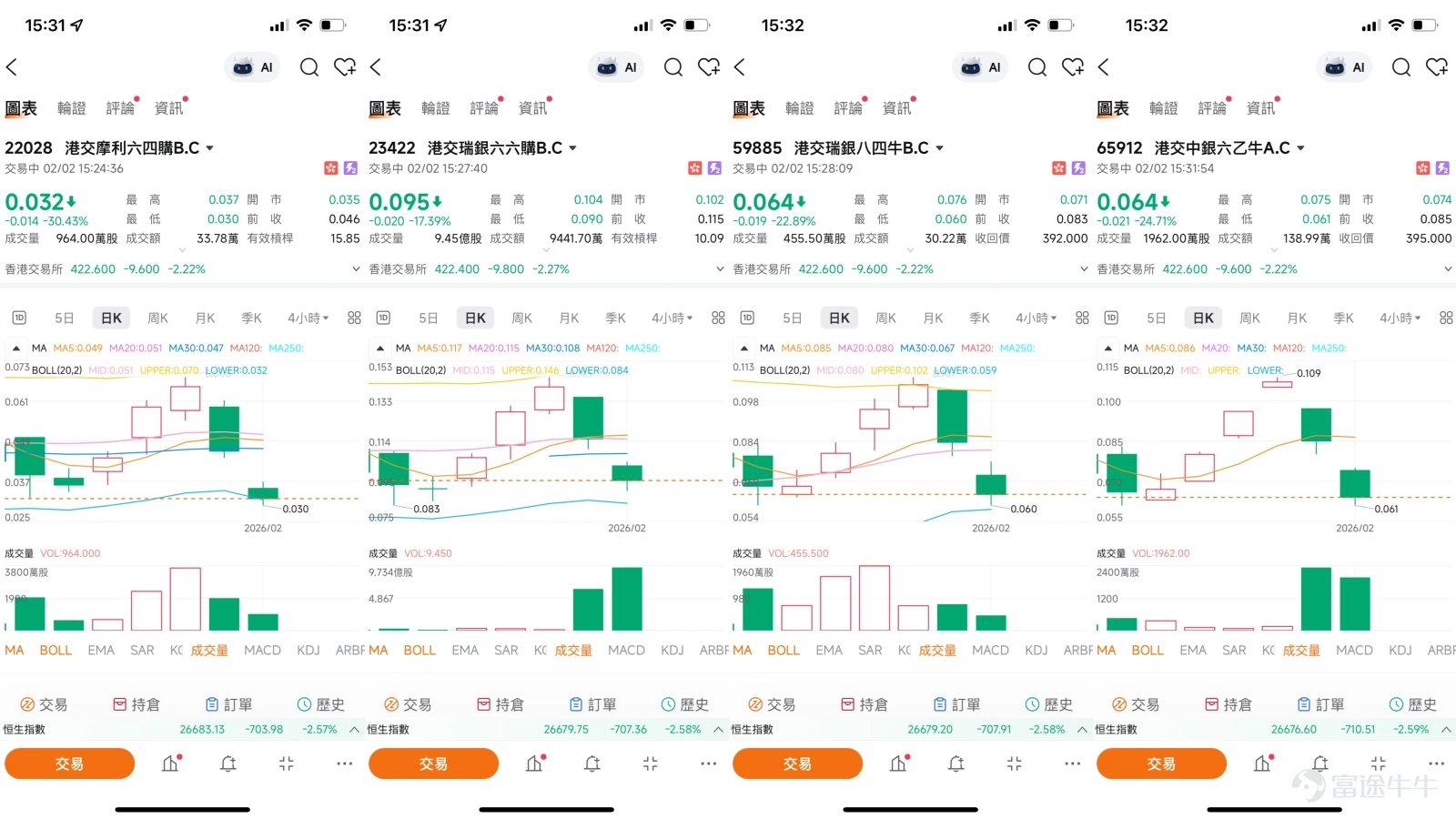
* Morgan Call Warrants (22028) and UBS Group Call Warrants (23422): The strike prices for these two products are 499.99 yuan and 494.38 yuan, respectively. These prices are much higher than the current stock price and significantly exceed the second resistance level of 444 yuan. This implies that they are aggressive tools, suitable for investors extremely optimistic about HKEX reversing its downtrend and initiating a strong upward trend, with actual leverage exceeding 10x or even 15x offering high potential returns.
* UBS Group Bull Contracts (59885) and Bank of China Bull Contracts (65912): The call prices for these two bull contracts are set at 392 yuan and 395 yuan, respectively. This position is notably below the critical second support level of 405 yuan, providing a wide safety buffer for normal fluctuations around the support level. This design aims to minimize forced recalls due to short-term volatility in stock prices, ideal for investors who believe the 405 yuan support is solid and wish to leverage approximately 13x for a rebound.
Bearish/Hedging options (put warrants and bear contracts):
* Societe Generale Bear Contracts (60816) and UBS Group Bear Contracts (60541) $UB#HKEX RP2712S.P (60541.HK)$ : The call prices for these two bear contracts are both set at 470 yuan. This position is far above the current stock price and exceeds all resistance levels. This means they are short-term tools prepared for investors anticipating further market weakness, ineffective stock price rebounds, and significant downside potential. Choosing such products requires high vigilance as their call prices are distant from the current price; if the market stabilizes and rebounds, the products may face dual erosion in price and time value.
* BNP Paribas Put Warrants (21691) $BP-HKEX@EP2605A.P (21691.HK)$ and Bank of China Put Warrants (24260): The strike prices for these two put warrants are 389.08 yuan and 388.68 yuan, respectively. This strike price is below the critical second support level of 405 yuan. This indicates they are not designed for minor adjustments but serve as risk hedging tools for investors expecting a deep market correction, retesting lower support zones.
V. Interactive Session: What's your take before the key support?
Technically, HKEX's stock price is retesting the critical support zone between 414 yuan and 405 yuan. On one side, the bustling IPO application wave showcases business resilience; on the other, there’s technical pressure following the broader market adjustment.
What do you think will be the next move for the Hong Kong Exchanges?
A. Stabilizing and rebounding: Believing that the benefits of IPOs will gradually become evident, and the stock price can stabilize and recover at the support level.
B. Continuing to test lower levels: Market sentiment dominates, with a possible test of HKD 405 or even lower support levels.
C. Range-bound fluctuations: Balanced bullish and bearish forces, with ongoing consolidation between support and resistance levels.
Is your choice A, B, or C? Come to the comment section and share your intuition to see which side of market sentiment prevails.
A final friendly reminder: Warrants and callable bull/bear contracts (CBBCs) are complex leveraged derivative investment products with an expiration date, and their prices can rise or fall. Investors may lose all their capital. Before investing, it is essential to understand the product characteristics, including the mandatory recall mechanism of CBBCs, as well as the time decay and implied volatility risks of warrants. If you have any questions about the product terms, seek professional advice. For more in-depth daily analysis on Hong Kong stocks and derivatives, please follow 'Hong Kong Stock Warrants Jenny'.
Disclaimer: This article does not constitute any investment advice.
This article is for reference only and does not constitute any investment advice. The market data, opinions, and analyses contained herein may change at any time without prior notice. We assume no responsibility for any loss or damage resulting from reliance on the information provided in this article. Technical analysis only indicates whether certain technical conditions are met. A comprehensive evaluation of asset performance should be conducted by integrating additional data. Trading decisions should not be made solely based on this article. Please note that past performance is not indicative of future results.
#HKEX #00388 #TechnicalAnalysis #IPO #Warrants #BullBearCertificates #SupportResistanceLevels #ShortTermSpeculation #NewEconomyCompanies #MarketSentiment
Risk Disclaimer: The above content only represents the author's view. It does not represent any position or investment advice of Futu. Futu makes no representation or warranty.Read more

Comments
to post a comment
2
7