
Tech giants boost Capex again! What's the outlook for future stock prices?

Tesla's Q4 2025 revenue exceeds market expectations, net profit continues to face pressure
Tesla's US shares released its Q4 2025 earnings report after the market closed on Wednesday, surpassing market expectations. The company will increase investment in humanoid robots and artificial intelligence in 2026.
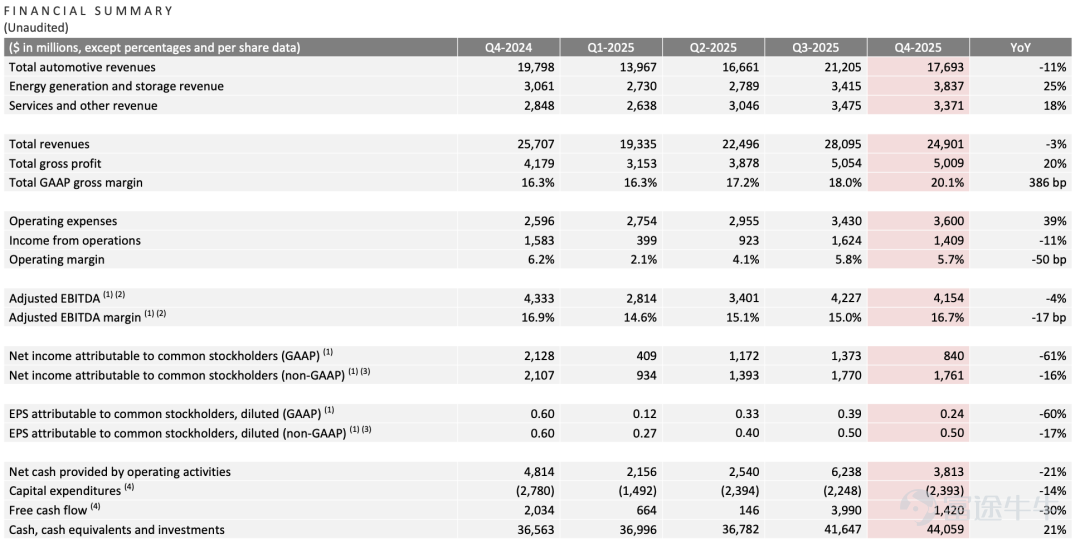
In the fourth quarter, Tesla $Tesla (TSLA.US)$ reported revenue of $24.901 billion, a year-over-year decline of 3%, but surpassing the average analyst estimate of $24.79 billion and the company's compiled consensus revenue of $24.493 billion.
According to the earnings report, the decline in revenue was mainly due to decreases in vehicle deliveries and carbon credit income, partially offset by revenue growth in energy storage and services businesses.

During the reporting period, automotive business revenue fell 11% year-over-year to $17.693 billion, with its revenue share dropping from 77% in the same period last year to 71%; energy storage and services segments contributed $3.837 billion and $3.371 billion respectively, both exceeding $3 billion for two consecutive quarters, with year-over-year growth of 25% and 18%, respectively.
Among this, revenue from vehicle sales declined 10.2% year-over-year to $16.75 billion; income from carbon credits and vehicle leasing fell 21.7% and 10.3% respectively, to $542 million and $401 million.

The impact of the cancellation of the $7,500 electric vehicle tax credit in the US market has started to show. In the fourth quarter, Tesla delivered a total of 418,227 vehicles, a year-over-year decrease of 15.6%. Of these, combined deliveries of Model 3/Y decreased 13.8% year-over-year to 406,585 units, while decreasing 15.5% quarter-over-quarter.

Tesla did not disclose delivery data for the US and other markets. According to a previous forecast by research firm Cox Automotive, Tesla's US market sales in the fourth quarter fell 22.4% year-over-year to 125,937 units, and dropped 29.8% quarter-over-quarter.
The gross margin, one of the core indicators in Tesla’s financial reports, significantly outperformed market expectations. In the fourth quarter, the company's gross margin increased 3.8 percentage points year-over-year to 20.1%, far exceeding market expectations of 17.1%, and returning above 20% after eleven quarters; the automotive gross margin excluding carbon credit income rose 4.3 percentage points year-over-year to 17.9%.
At the profit level, although operating profit in the fourth quarter exceeded analyst expectations, net income attributable to common shareholders continued to face pressure.
During the reporting period, Tesla’s operating profit fell 11% year-over-year to $1.409 billion, higher than the analyst estimate of $1.32 billion; net income attributable to common shareholders dropped 61% year-over-year to $840 million, marking the fifth consecutive quarter of year-over-year declines and falling short of market expectations of $1.361 billion.
Based on the signals from financial reports and company management, Tesla will continue to increase its investment in humanoid robotics and artificial intelligence fields.
In the first quarter of this year, Tesla plans to release the third-generation version of its humanoid robot Optimus, which will include significant upgrades since version 2.5, including the latest hand design. Additionally, the third-generation version will be Tesla’s first humanoid robot product aimed at mass production. Tesla also plans to begin production of humanoid robots by the end of 2026, with an ultimate target annual production capacity of 1 million units.
According to the business outlook provided in the earnings report, the first-generation production line for Optimus is being installed to meet the demands of large-scale production. During the earnings call, Tesla CEO Elon Musk also revealed that the company will gradually phase out the production of Model S/X vehicles next quarter, currently replacing the Model S/X production line with the Optimus production line.
In the artificial intelligence sector, as part of xAI's recently disclosed financing round, Tesla plans to invest approximately $2 billion to acquire Series E preferred shares of xAI.
Undoubtedly, selling cars will remain a key revenue source and pillar business for Tesla for some time in the future. Tesla stated that the right strategy to win the whole vehicle market is to maintain an efficient and streamlined product portfolio while continuing to focus on high-value product capabilities such as long range, industry-leading software, and autonomous driving.
Analysts predict that even with margin pressure, Tesla will continue to attract more price-sensitive consumers in 2026 with lower-priced 'standard' versions of the Model 3/Y, a strategy that will play a crucial role in the growth of deliveries in 2026.
According to Visible Alpha data, Tesla's deliveries in 2026 are expected to return to a growth trajectory, with a projected annual increase of 8.2% to 1.77 million units. This forecast is slightly higher than Tesla's official December summary of the consensus delivery estimate of 1.75 million units from 20 sell-side analysts.
Risk Disclaimer: The above content only represents the author's view. It does not represent any position or investment advice of Futu. Futu makes no representation or warranty.Read more

Comments
to post a comment
1