
[2026 Outlook] Plan Ahead! Share the Investment Opportunities You Are Optimistic About

Market Voice Weekly Call | AI Unearths GEO: Gold as a Hedge Against Black Swans - The Dual-Asset Allocation Key
[Content of This Episode]:[Industry Insights]: How can AI unlock the potential of GEO? In-depth industry analysis and market review by Futu. [Macro Strategy]: Can gold hedge against black swan events? Exploring global allocation opportunities amidst volatile precious metals expectations.
[Special Guests]Joe Yu: Executive Director of Institutional and Private Wealth at Futu Securities, with over 15 years of experience, specializing in industry research and deep-dive analysis of small and mid-cap stocks. Qi Shou: Founding Partner of Xunyi Capital / Investment Director of Timing Capital,with more than 20 years of global asset allocation experience,spanning public and private markets, as well as primary and secondary markets.
[Core Conclusion]:Short-term volatility in the US stock market is expected to increase, but the mid-to-long term outlook remains bullish. GEO, as a new track in AI, shows strong growth potential, while Alibaba and Kuaishou demonstrate investment value. Gold faces a high risk of short-term pullback, with wide-range fluctuations expected in the medium term and a long-term upward bias. For precious metals, silver could be chosen for trading volatility, while also considering product selection based on volume-price relationships.
Analysis of AI and GEO Sectors
Market Environment and Investment Recommendations
Market conditions and investment recommendations: Joe Yu pointed out that the expectation of a soft landing for the US stock market is gradually emerging. On the other hand, the slower pace of interest rate cuts has driven up US Treasury yields, leaving limited room for short-term valuation expansion in the stock market. The overall view is one of increased volatility in the short term but bullishness in the medium to long term. Some companies' Q1 guidance and EPS forecasts were below market expectations. Meanwhile, the risk of a US government shutdown on January 31st has significantly increased as funding from the previous year expires at midnight on January 30th. Additionally, the Minneapolis shooting has prompted demands from the Democratic Party for accountability mechanisms regarding the budgets of the Department of Homeland Security and Immigration and Customs Enforcement. In terms of investment, sectors with full access to ecosystems and AI data are recommended.
GEO (Generative Engine Optimization) Concept Analysis: GEO refers to generative engine optimization, aiming to have brand content referenced, consulted, and synthesized by AI engines, directly providing users with conversational answers and reducing webpage redirections. This differs from traditional SEO, which primarily drives traffic through Google search result rankings, whereas GEO leverages AI-driven traffic, separating it from traditional search entry points. Currently, most companies are in the early stages, with minimal regulatory guidance. Emphasis should be placed on logic rather than storytelling, with strong risk control measures.
Market Size and Development Trends: By 2025, the global GEO market size is expected to reach approximately $20 billion, surpassing $80 billion by 2030. From the current stage of SEO to a combination of SEO, GEO, and AEO, SEO will continue to exist but GEO and AEO will see significant growth, especially as GEO gains more attention from brands.
The significance of technological transformation and platform strategy
Technological Evolution and Changes in User Behavior: User search behavior has shifted from keyword searches and link clicks to conversational queries generating AI-powered responses. AI-native applications like ChatGPT, DouBao, and Qwen will become new entry points, with a significant rise in the frequency of AI model citations. Attention must be paid to authoritative sources such as influencers, academic papers, and government regulations.
Strategic Layout and Advantages of Each Platform
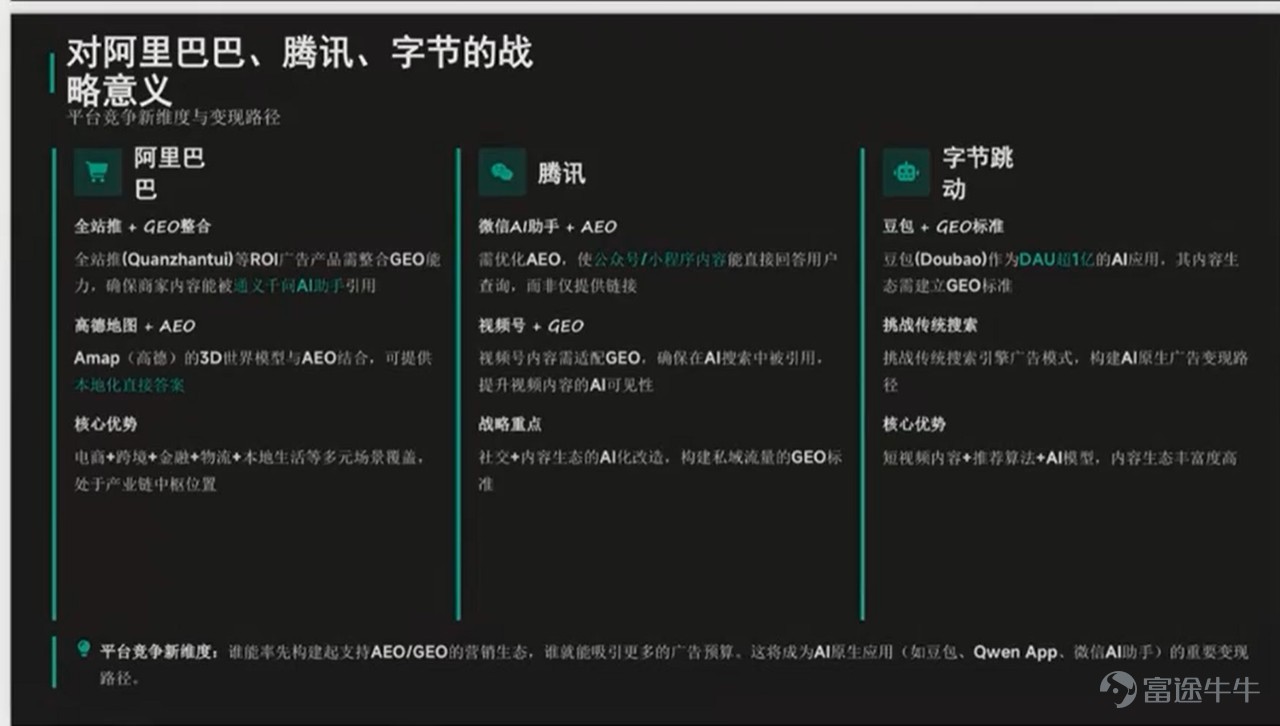
Alibaba: Its full-stack advertising products need to integrate GEO capabilities to ensure merchant content is referenced by the Qwen AI assistant, generating credible data sources with AEO, and providing localized direct answers. Alibaba Cloud has an all-domain advantage in e-commerce, cross-border finance, logistics, and local life scenarios, acting as a custodian for e-commerce closed-loop product graphs and user behavior data. Through Qwen, Alibaba collaborates with other companies in areas such as media, hospitality, and smart transportation, embedding AI capabilities into vertical SaaS and solutions. Currently, Alibaba's TTM PE is around 25x, while Tencent's is about 26x. As Qwen's daily active users, AI advertising, and GEO tool revenues materialize, Alibaba is expected to gain greater valuation space through improved profitability and increased AI revenue contribution.
Tencent: Tencent’s AI assistant needs to optimize AEO, using content from official accounts and mini-programs to directly answer user queries. It tends to build a closed-loop ecosystem, resisting external agent API integration (as Tencent prefers a closed-loop ecosystem rather than interfacing with external parties).
ByteDance: With its massive DAU and high usage frequency and density, ByteDance may have advantages in building ecosystem content and performance standards.
![[Content of This Episode]:[Industry Insights]: How can AI unlock the potential of GEO? In-depth industry analysis and market review by Futu. [Macro Strategy]: Can gold hedge against black swan events? Exploring global allocation opportunities amidst volatile precious metals expectations. [Special Guests]Joe Yu: Executive Director of Institutional and Private Wealth at Futu Securities, with over 15 years of experience, specializing in industry research and deep-dive analysis of small and mid-cap stocks. Qi Shou: Founding Partner of Xunyi Capital / Investment Director of Timing Capital,with more than 20 years of global asset allocation experience,spanning public and private markets, as well as primary and secondary markets. [Core Conclusion]:Short-term volatility in the US stock market is expected to increase, but the mid-to-long term outlook remains bullish. GEO, as a new track in AI, shows strong growth potential, while Alibaba and Kuaishou demonstrate investment value. Gold faces a high risk of short-term pullback, with wide-range fluctuations expected in the medium term and a long-term upward bias. For precious metals, silver could be chosen for trading volatility, while also considering product selection based on volume-price relationships. Analysis of AI and GEO Sectors Market Environment and Investment Recommendations Market Status and Investment Advice: Joe Yu pointed out that expectations of a soft landing in the US stock market are gradually emerging. On the other hand, the slower pace of interest rate cuts has pushed up US Treasury yields, leaving limited room for short-term valuation expansion in the stock market. The overall view is that short-term volatility will increase, while maintaining a bullish outlook in the medium to long term. Some companies' Q1 guidance and EPS forecasts were below market expectations. Meanwhile, the likelihood of a US government shutdown on January 31st has greatly increased as the previous year’s funding expires at midnight on January 30th, compounded by the Minneapolis shooting case triggering concerns among Democrats over homeland security...](https://nnqimage.futunn.com/sns_client_feed/988889/20260126/0eb931e19f5f793cb385900593787395.jpg/big?area=1&is_public=true&imageMogr2/ignore-error/1/format/webp)
Investment Insights and Case Analysis
Investment Insight: In the 2026 AI sub-sector investment theme, enhanced AI inference capabilities through GEO and AEO will drive revenue growth and inventory valuation for Alibaba Cloud, Tencent Cloud, and others. Brands need to offer high-quality, structured, authoritative content; SEO businesses will remain relevant but require stability monitoring.
Alibaba Case Study: Qwen, Alibaba’s large model, features full-scale and multi-modal coverage, spanning voice and visual modalities, applied in e-commerce, government services, and more, with over 170,000 ecosystem models. Alibaba Cloud holds an integrated advantage in e-commerce ecosystems, benefiting from resource consolidation and technological advancements, while acting as a data custodian in the e-commerce loop. By collaborating with other companies via AI capabilities across various fields, Alibaba has significant upside potential at current valuations once related revenues materialize. The investment thesis can be summarized as high-quality growth plus valuation optimization, with key metrics including Qwen DAU, Alibaba’s ad and GEO product revenue share, and Alibaba Cloud’s AI revenue contribution.
Kuaishou Case Study: Although indirectly linked, Kuaishou and Kelin demonstrate strong synergy. While Kuaishou is not a GEO service provider, Kelin plays a tool-oriented role within the GEO framework, ranking among the top global software providers in AI production. Its revenue is projected to grow from $140 million in 2025 to nearly $870 million by 2030 (CAGR of 44%). Compared to overseas peer Runway, if Kelin's ARR exceeds $100 million by March 2025, its valuation could reach $3.6-$4.8 billion, adding approximately HKD 40 billion to Kuaishou’s market cap. Kuaishou’s appeal lies in its AI-driven video production tools and improved digital advertising efficiency. Companies should monitor progress in large platforms’ AEO and GEO strategies, as well as tool-focused players like Kuaishou.
Valuation Transition and Stock Price Catalysts: Q&A
Alibaba Valuation Transition Logic: Joe Yu argues that assessing Alibaba’s AI and GPU premium requires three key indicators: explosive growth in C-end entry daily active users, widespread adoption of ecosystem paradigms, and recognized authority in compliance and security. Currently, some applications resist API integration; if vertical applications later adopt it, those refusing may become marginalized.
Kuaishou Kelin’s Impact on Stock Price: In the short term, the market won’t see a PE or PS shift between Kuaishou and Kelin due to no spin-off news. If spin-off plans emerge, value will reflect in the stock price; otherwise, focus on Kelin’s role in driving traffic to Kuaishou’s e-commerce platform, with mid-term valuation recovery potential.
Precious Metals Market Analysis
Market Outlook and Conclusion
Trend Assessment Across Timeframes: Mr. Shouqi notes that at the $5,000 per ounce level, gold faces significant downside risks in the short term (weeks to one or two months). Mid-term (2026) forecasts predict wide-ranging volatility within 20% above or below the current price. Long-term prospects lean bullish, but investors must weigh the opportunity cost and IRR of holding gold.
Sell-Side Target Prices: By the end of 2025, most investment banks forecast gold prices for late 2026 around $4,500-$5,000 per ounce, with bearish firms projecting $4,300-$4,400. Goldman Sachs raised its target from $4,500 to $5,400 on the 21st. The current market price already exceeds most sell-side targets, and with January’s monthly gold gain reaching 15.5%, a pullback warning is warranted.
Uses of Gold and Growth Trends
Classification of gold uses: The primary uses of mined gold on Earth are divided into jewelry and technology (accounting for 55%, with China and India being major markets for jewelry gold; technology refers to industrial uses, such as consumer electronics which contain significant amounts of precious metals), retail gold bars and coins (widely circulated ones are mostly issued by mints or treasuries, such as Chinese Gold Coins), financial investments (such as gold ETFs, which are backed by physical gold and reached record-high holdings at the end of last year), and central bank reserves (emerging market central banks have been active buyers over the past 12 months, while developed market central banks show little interest in purchasing).
Growth rates by use: From 1970, after the collapse of the gold standard, jewelry and technology have seen the fastest growth. For most of the past 60-70 years, central banks were selling gold reserves; however, recent active purchases by emerging market central banks represent a special case.
![[Content of This Episode]:[Industry Insights]: How can AI unlock the potential of GEO? In-depth industry analysis and market review by Futu. [Macro Strategy]: Can gold hedge against black swan events? Exploring global allocation opportunities amidst volatile precious metals expectations. [Special Guests]Joe Yu: Executive Director of Institutional and Private Wealth at Futu Securities, with over 15 years of experience, specializing in industry research and deep-dive analysis of small and mid-cap stocks. Qi Shou: Founding Partner of Xunyi Capital / Investment Director of Timing Capital,with more than 20 years of global asset allocation experience,spanning public and private markets, as well as primary and secondary markets. [Core Conclusion]:Short-term volatility in the US stock market is expected to increase, but the mid-to-long term outlook remains bullish. GEO, as a new track in AI, shows strong growth potential, while Alibaba and Kuaishou demonstrate investment value. Gold faces a high risk of short-term pullback, with wide-range fluctuations expected in the medium term and a long-term upward bias. For precious metals, silver could be chosen for trading volatility, while also considering product selection based on volume-price relationships. Analysis of AI and GEO Sectors Market Environment and Investment Recommendations Market Status and Investment Advice: Joe Yu pointed out that expectations of a soft landing in the US stock market are gradually emerging. On the other hand, the slower pace of interest rate cuts has pushed up US Treasury yields, leaving limited room for short-term valuation expansion in the stock market. The overall view is that short-term volatility will increase, while maintaining a bullish outlook in the medium to long term. Some companies' Q1 guidance and EPS forecasts were below market expectations. Meanwhile, the likelihood of a US government shutdown on January 31st has greatly increased as the previous year’s funding expires at midnight on January 30th, compounded by the Minneapolis shooting case triggering concerns among Democrats over homeland security...](https://nnqimage.futunn.com/sns_client_feed/988889/20260126/6d66ea2766aec789636b70cc563916b5.png/big?area=1&is_public=true&imageMogr2/ignore-error/1/format/webp)
Gold's Relationship with Other Factors
Relation to global economic growth: Over the long term, the price of gold shows a relatively high correlation with global economic growth, but it is not a 1:1 linear relationship. If one has a positive outlook on the long-term trend of gold, they need to consider whether its IRR can outperform other assets. Over the past two years, gold has experienced significant gains, potentially pre-empting future returns.
Comparison with Performance of Other Assets
Long-term comparison: Over the past 50 years, equities have outperformed gold, gold has outperformed government bonds and debt instruments, and real estate performance has also surpassed that of gold; over the past decade, gold has performed the best among major asset classes.
Role in portfolio allocation: Over the past 50 years, gold has shown relatively low or even no correlation with most other assets, but in the last 20 years, it has become positively correlated with the majority of other assets, offering limited diversification benefits within a portfolio.
Inflation hedging performance: Gold’s ability to hedge inflation is inconsistent and not closely tied to inflation. For instance, despite the current central bank easing cycle exerting minimal inflation pressure, gold still rose 16% in January. Over the long term, gold generally moves in the same direction as inflation, but it should not be solely relied upon as a primary means of hedging inflation. Effectiveness against bear markets in stocks: Gold provides limited help during stock market downturns. In bear market scenarios, gold typically breaks even or rises only slightly, making it of limited utility as a tail-risk hedge against major stock market drawdowns.
Supply and Demand Analysis
Supply situation: Gold supply mainly comes from underground mining and central bank transactions. In recent years, there have been fewer new reserve discoveries, and although miners have low costs, production has not significantly increased. Recycling volumes haven't grown despite rising gold prices, and emerging market central banks have been actively purchasing gold, reducing market supply. The future supply will remain tight and won't increase much from current levels, as some central bank purchases are not fully disclosed.
Demand situation: Jewelry demand for gold is the largest, followed by significant demand for coins and bars, while financial investment demand accounts for a relatively smaller proportion. Currently, investor interest in gold is rebounding, and increasing gold's allocation in an investment portfolio can be meaningful, but overall investment demand remains low. Even if it doubles, it still wouldn't match other forms of demand.
Investment advice and risk factors
Choice of investment products: Investors bullish on gold don't necessarily have to trade only gold; they can also trade other precious metals. For example, silver's volatility is higher than that of gold, similar to small-cap stocks. Over the past year, silver rose over 100%, while gold gained around 60-70%. Investors can choose trading instruments based on their needs; those speculating on volatility may opt for high-volatility assets, which also appeals to investors dealing with derivatives and options.
Risk Factor Analysis
Volume-price relationship: Short-term volume-price relationships may deviate from the mean, and investors can focus on traditional volume-price relationships, technical indicators, and exchange inventory dynamics. Over the past few years, gold has experienced slow bull market fluctuations. This year, investors should pay attention to changes in the volume-price relationship. Regarding US assets, the short-term linear relationship between gold and the dollar isn't significant. This year, attention should be paid to shifts in investor confidence toward US assets, such as Nordic sovereign wealth funds selling US stocks. However, large-scale position adjustments are expected to be limited.
Reasons for silver's rise and investment analysis
Reasons for the rise: Silver's gains have been driven by catch-up growth and industrial demand. Catch-up growth is due to silver lagging behind gold for a long time. As for industrial demand, the use of silver paste in photovoltaics is not a new technology, and US policy changes have minimal impact on global supply and demand. Additionally, low physical inventories in exchange warehouses and volume-price relationships related to delivery also affect silver prices. Investment analysis: Over the long term, gold looks more favorable since nearly three-quarters of silver demand is industrial, making technological substitution obvious. Excessive silver prices could drive alternative technologies, placing a cap on silver prices. Investors looking at silver mining stocks should focus on low-cost producers, but need to evaluate overall company quality rather than just production costs.
Risk Disclaimer: The above content only represents the author's view. It does not represent any position or investment advice of Futu. Futu makes no representation or warranty.Read more
Comments
to post a comment
4