
BOC Guest Perspective on Derivatives Strategy: How to Leverage Street Positioning to Strategize Bull and Bear Certificates?
$Hang Seng Index (800000.HK)$After failing to break through the 27,000-point level, the Hang Seng Index has entered a phase of high-level consolidation. On January 22, the Hang Seng Index slightly dropped by 0.09%, closing at 26,560 points, with fluctuations confined to less than a 200-point range throughout the day, highlighting the market's lack of clear direction. As the index hovers near key technical levels, the market focus has shifted from aggressive moves to defensive strategies, with a quiet but intensifying tug-of-war between bulls and bears in the range of 25,800 to 27,500 points. This article will integrate the latest technical analysis, market fund movements, and expert views from [HK Stocks Podcast] and [BOC Guest], providing an in-depth analysis of the Hang Seng Index’s short-term critical positions and exploring how to use derivatives for strategic deployment in this seesaw market.
[HK Stocks Podcast] and [BOC Guest] Perspectives Converge: Insights into Capital Games and Street Positions Amid Range-Bound Volatility
Regarding the current market deadlock, [HK Stocks Podcast] and [BOC Guest] provide deep insights ranging from market sentiment to practical strategies.
In the January 21 episode of [HK Stocks Podcast], the segment pointed out that short-term technical signals for the Hang Seng Index were slightly biased towards 'buy,' but with significant divergence between bulls and bears. Investors optimistic about future prospects, believing that the Hang Seng Index can again challenge the 27,000-point level, will continue holding bull certificates; while those bearish may choose bear certificates to seek stability. The segment particularly emphasized that regardless of which direction is chosen, product safety (i.e., distance from key price levels) is the primary consideration. For example, when choosing bull certificates, the stop-loss level should be set below technical support levels (e.g., 25,900 points), or even reference the second support level (around 25,600 points), to provide sufficient buffer space and avoid being forced into early liquidation due to short-term fluctuations. This approach of closely linking derivative terms with key technical levels is at the core of refined risk management.
Similarly, in the January 20th episode of [BOC Guest], Niki, a director at BOC International, provided an in-depth analysis of the market. She first observed that after the Hang Seng Index (HSI) surged past 27,000 points, it quickly retreated, indicating a lack of sustained upward momentum. The market is currently in a digestion phase. She pointed out that the index needs to stabilize around 26,400 points; otherwise, it may retreat further. Niki specifically referenced the HSI bull and bear warrants street-level positioning chart on BOC International's website, revealing key battleground areas for both bulls and bears, offering investors valuable insights: the heavy accumulation zone for bull warrants is concentrated around 25,800 points, while the dense area for bear warrants is near 27,500 points. She explicitly reminded investors that 25,800 points is a critical support level; if 26,000 points fail to hold, the index could test this heavy accumulation zone for bull warrants, which might exacerbate market volatility as numerous bull warrants are called back.
Niki further shared her observations on capital flows: over the past five trading days, tens of millions of dollars flowed into bull warrants betting on a rebound, while some funds were allocated to bear warrants to hedge risks, reflecting the market’s general caution and tug-of-war mentality amid uncertainty. She also gave specific examples, noting that aggressive investors would choose high-leverage bull warrants with a call price at 26,250 points, while those seeking safer margins might focus on products with a call price near 26,000 points. Host Simon added that these street-level warrant data align closely with technical analysis support levels (around 25,900 points), showcasing the convergence of market wisdom.
![$Hang Seng Index (800000.HK)$After failing to break through the 27,000-point level, the Hang Seng Index has entered a phase of high-level consolidation. On January 22, the Hang Seng Index slightly dropped by 0.09%, closing at 26,560 points, with fluctuations confined to less than a 200-point range throughout the day, highlighting the market's lack of clear direction. As the index hovers near key technical levels, the market focus has shifted from aggressive moves to defensive strategies, with a quiet but intensifying tug-of-war between bulls and bears in the range of 25,800 to 27,500 points. This article will integrate the latest technical analysis, market fund movements, and expert views from [HK Stocks Podcast] and [BOC Guest], providing an in-depth analysis of the Hang Seng Index’s short-term critical positions and exploring how to use derivatives for strategic deployment in this seesaw market. [HK Stocks Podcast] and [BOC Guest] Perspectives Converge: Insights into Capital Games and Street Positions Amid Range-Bound Volatility Regarding the current market deadlock, [HK Stocks Podcast] and [BOC Guest] provide deep insights ranging from market sentiment to practical strategies. [Share Link: January 21 [Hong Kong Stock Podcast] Hang Seng Index, Bilibili, Sunny Optical, Baidu, Shandong Gold, CNOOC] In the January 21 episode of [HK Stocks Podcast], the segment pointed out that short-term technical signals for the Hang Seng Index were slightly biased towards 'buy,' but with significant divergence between bulls and bears. Investors optimistic about future prospects, believing that the Hang Seng Index can again challenge the 27,000-point level, will continue holding bull certificates; while those bearish may choose bear certificates to hedge their positions...](https://nnqimage.futunn.com/sns_client_feed/1162342/20260122/web-1769064682436-nZV1T2Xq18.png/big?area=1&is_public=true&imageMogr2/ignore-error/1/format/webp)
Technical Perspective: Multi-Air Balance at Key Supports
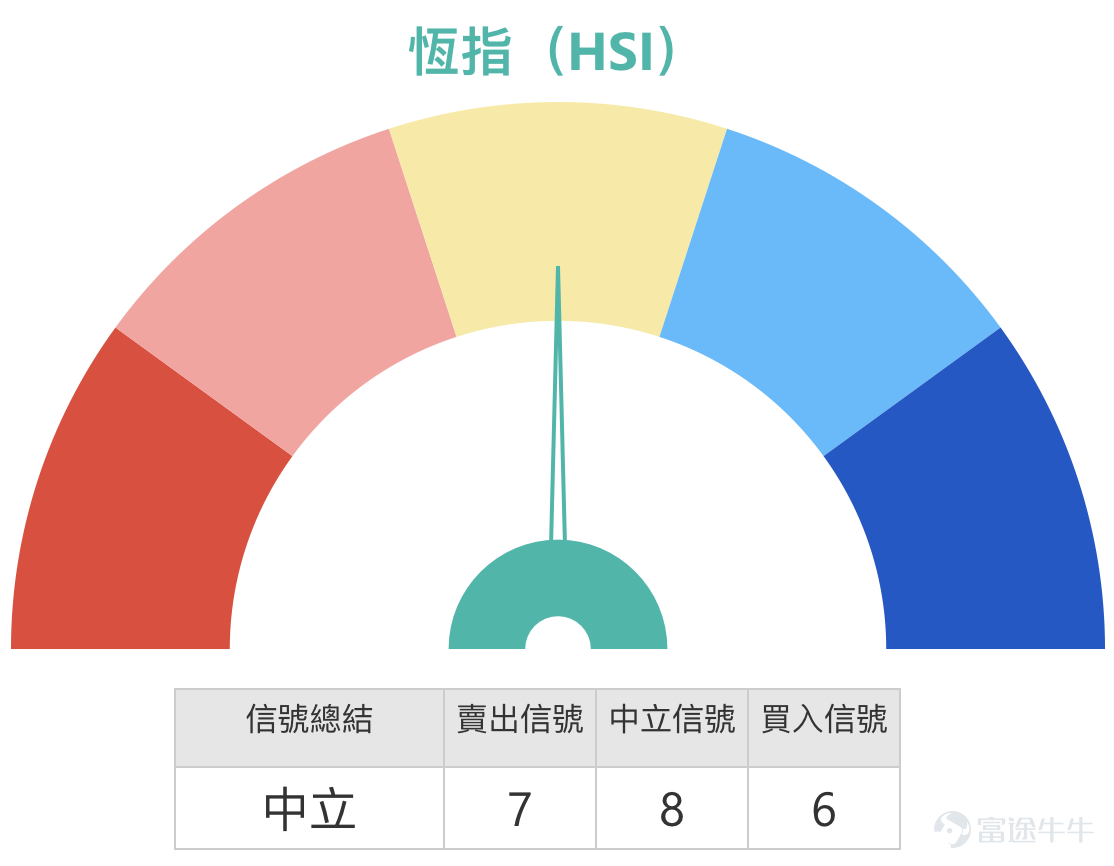
From a technical standpoint, the HSI is currently within a narrow equilibrium range. According to data as of January 22nd, the first resistance level above is at 27,078 points, with the second resistance at 27,329 points; the first support below is at 26,044 points, and the more crucial second support is located at 25,699 points. The current index position is just above the first support level, highlighting the importance of the battle for the 26,000-point region.
Multiple technical indicators confirm the market's consolidation pattern. The 14-day Relative Strength Index (RSI) stands at 58, in a neutral-to-strong zone, suggesting that although there is pressure, the market isn't overbought or oversold. However, the index remains constrained below the 10-day moving average (approximately 26,665 points), showing typical consolidation characteristics. Wing Fung Financial Group's analysis also noted that the HSI finds initial support near the 20-day line (about 26,331 points), but recent reduced trading volumes have offset some downward pressure, leaving the overall trend in a sideways consolidation pattern. Some analysts, judging from patterns, see the 'triple top' formation since October last year, which will be difficult to break through without significant positive developments in the short term. Overall, the technical picture suggests a clear oscillation range, with the 25,800-26,000 point area being the litmus test for short-term strength.
Review of Warrant Products: Leverage Effects in One-Way Volatility
In relatively clear directional trends, the capital efficiency features of derivatives come to the fore. Reviewing the performance of the HSI put products mentioned on January 16th provides a clear example. At that time, against the backdrop of a 1.33% drop in the HSI, relevant bearish products leveraged their positions to achieve gains far exceeding the index's decline: UBS bear warrant 63330 $UB#HSI RP2802F.P (63330.HK)$ rose 28%, BOC bear warrant 57148 $BI#HSI RP28033.P (57148.HK)$ rose 25%, BOC put warrant 21317 rose 13%, and UBS put warrant 21347 rose 11%.
![$Hang Seng Index (800000.HK)$After failing to break through the 27,000-point level, the Hang Seng Index has entered a phase of high-level consolidation. On January 22, the Hang Seng Index slightly dropped by 0.09%, closing at 26,560 points, with fluctuations confined to less than a 200-point range throughout the day, highlighting the market's lack of clear direction. As the index hovers near key technical levels, the market focus has shifted from aggressive moves to defensive strategies, with a quiet but intensifying tug-of-war between bulls and bears in the range of 25,800 to 27,500 points. This article will integrate the latest technical analysis, market fund movements, and expert views from [HK Stocks Podcast] and [BOC Guest], providing an in-depth analysis of the Hang Seng Index’s short-term critical positions and exploring how to use derivatives for strategic deployment in this seesaw market. [HK Stocks Podcast] and [BOC Guest] Perspectives Converge: Insights into Capital Games and Street Positions Amid Range-Bound Volatility Regarding the current market deadlock, [HK Stocks Podcast] and [BOC Guest] provide deep insights ranging from market sentiment to practical strategies. [Share Link: January 21 [Hong Kong Stock Podcast] Hang Seng Index, Bilibili, Sunny Optical, Baidu, Shandong Gold, CNOOC] In the January 21 episode of [HK Stocks Podcast], the segment pointed out that short-term technical signals for the Hang Seng Index were slightly biased towards 'buy,' but with significant divergence between bulls and bears. Investors optimistic about future prospects, believing that the Hang Seng Index can again challenge the 27,000-point level, will continue holding bull certificates; while those bearish may choose bear certificates to hedge their positions...](https://nnqimage.futunn.com/sns_client_feed/1162342/20260122/web-1769064730056-y5Dmdx2olP.png/big?area=1&is_public=true&imageMogr2/ignore-error/1/format/webp)
Product Strategy Choices Under Current Market Conditions
By combining key technical levels, market bullish and bearish views, and street-level analysis, investors can closely align the terms of recommended products with market scenarios based on their own judgment.
Investors who believe that the Hang Seng Index (HSI) can stabilize above 26,000 points and rebound may consider bull contracts. For instance, BOC bull contracts 63488 (forced recall price at 25,595 points) and 63489 (forced recall price at 25,550 points) have forced recall prices significantly below the second support level of 25,699 points and the heavy street-level zone for bull contracts at 25,800 points, offering a larger safety buffer that is suitable for volatile markets to capture rebounds. If optimistic about the index breaking through the 27,000-point resistance, one could consider BOC call warrant 23128 (exercise price at 28,341 points), which has the lowest implied volatility, potentially leading to relatively smaller time value erosion.
For investors who believe that market risks remain unresolved and the index might test lower support levels at 25,800 points or even below, bear contracts or put warrants could be considered. BOC bear contracts 54438 (forced recall price at 27,518 points) and 54158 (forced recall price at 27,538 points) have forced recall prices set above the resistance zone at 27,500 points, making them suitable choices for betting on an unsuccessful index rebound followed by another decline. Meanwhile, BOC put warrant 21317 (exercise price at 25,671 points) provides investors with another tool to hedge against downside risk, with its exercise price near the critical support area.
![$Hang Seng Index (800000.HK)$After failing to break through the 27,000-point level, the Hang Seng Index has entered a phase of high-level consolidation. On January 22, the Hang Seng Index slightly dropped by 0.09%, closing at 26,560 points, with fluctuations confined to less than a 200-point range throughout the day, highlighting the market's lack of clear direction. As the index hovers near key technical levels, the market focus has shifted from aggressive moves to defensive strategies, with a quiet but intensifying tug-of-war between bulls and bears in the range of 25,800 to 27,500 points. This article will integrate the latest technical analysis, market fund movements, and expert views from [HK Stocks Podcast] and [BOC Guest], providing an in-depth analysis of the Hang Seng Index’s short-term critical positions and exploring how to use derivatives for strategic deployment in this seesaw market. [HK Stocks Podcast] and [BOC Guest] Perspectives Converge: Insights into Capital Games and Street Positions Amid Range-Bound Volatility Regarding the current market deadlock, [HK Stocks Podcast] and [BOC Guest] provide deep insights ranging from market sentiment to practical strategies. [Share Link: January 21 [Hong Kong Stock Podcast] Hang Seng Index, Bilibili, Sunny Optical, Baidu, Shandong Gold, CNOOC] In the January 21 episode of [HK Stocks Podcast], the segment pointed out that short-term technical signals for the Hang Seng Index were slightly biased towards 'buy,' but with significant divergence between bulls and bears. Investors optimistic about future prospects, believing that the Hang Seng Index can again challenge the 27,000-point level, will continue holding bull certificates; while those bearish may choose bear certificates to hedge their positions...](https://nnqimage.futunn.com/sns_client_feed/1162342/20260122/web-1769064771882-THlIaPBEPk.jpeg/big?area=1&is_public=true&imageMogr2/ignore-error/1/format/webp)
![$Hang Seng Index (800000.HK)$After failing to break through the 27,000-point level, the Hang Seng Index has entered a phase of high-level consolidation. On January 22, the Hang Seng Index slightly dropped by 0.09%, closing at 26,560 points, with fluctuations confined to less than a 200-point range throughout the day, highlighting the market's lack of clear direction. As the index hovers near key technical levels, the market focus has shifted from aggressive moves to defensive strategies, with a quiet but intensifying tug-of-war between bulls and bears in the range of 25,800 to 27,500 points. This article will integrate the latest technical analysis, market fund movements, and expert views from [HK Stocks Podcast] and [BOC Guest], providing an in-depth analysis of the Hang Seng Index’s short-term critical positions and exploring how to use derivatives for strategic deployment in this seesaw market. [HK Stocks Podcast] and [BOC Guest] Perspectives Converge: Insights into Capital Games and Street Positions Amid Range-Bound Volatility Regarding the current market deadlock, [HK Stocks Podcast] and [BOC Guest] provide deep insights ranging from market sentiment to practical strategies. [Share Link: January 21 [Hong Kong Stock Podcast] Hang Seng Index, Bilibili, Sunny Optical, Baidu, Shandong Gold, CNOOC] In the January 21 episode of [HK Stocks Podcast], the segment pointed out that short-term technical signals for the Hang Seng Index were slightly biased towards 'buy,' but with significant divergence between bulls and bears. Investors optimistic about future prospects, believing that the Hang Seng Index can again challenge the 27,000-point level, will continue holding bull certificates; while those bearish may choose bear certificates to hedge their positions...](https://nnqimage.futunn.com/sns_client_feed/1162342/20260122/web-1769064761209-vCbrqRtSda.jpeg/big?area=1&is_public=true&imageMogr2/ignore-error/1/format/webp)
#Learn Warrants and Bull/Bear Contracts with Jenny#: Why is 'street-level volume' a crucial market sentiment indicator?
When trading HSI bull/bear contracts, in addition to focusing on exercise prices, forced recall prices, and leverage, 'street-level volume' is a highly valuable yet often overlooked market sentiment indicator. Street-level volume refers to the number of bull/bear contracts held by investors rather than hedged by issuers. It can be regarded as a 'thermometer' for retail investor long and short positions.
Taking the current market as an example, both Niki from [BOC Guest] and Zhitong Finance data indicate that the heavy street-level zone for bull contracts is concentrated in the range of 25,800-25,899 points, with street-level volumes reaching up to 1,177 contracts. This means a large number of investors have positioned themselves with bullish bets in this area. This information has two important implications: First, it reveals the general psychological support level of the market; when the index approaches this region, temporary support might be provided due to technical buying and bull contract issuer hedging purchases. Second, it also indicates potential risks—once the index falls below this heavy street-level zone, a large number of bull contracts will be forcibly recalled, prompting issuers to hedge risks by selling index futures inversely, potentially triggering a 'stampede effect' that accelerates the index's decline. Therefore, understanding the distribution of street-level volumes at key points when selecting bull/bear contracts helps investors avoid 'crowded' risky areas, choose safer forced recall prices, and better manage risks.
Overall, the HSI is caught between macro uncertainties and key technical support levels, with bulls and bears fiercely competing within the range of 25,800 to 27,500 points. Investors can refer to insights from [HKEX Podcast] and [BOC Guest] on market sentiment and capital flow, combined with analysis of key support/resistance levels and street-level volumes, to implement range-trading strategies using derivatives with different characteristics. The core lies in correlating the product’s forced recall price and exercise price with key price levels and heavy street-level zones identified through technical analysis, deeply understanding the dual nature of high-leverage tools, and staying defensive in a volatile market.
Interactive Question:
The HSI is oscillating repeatedly around key levels—what do you think the next phase will look like?
A. Bulls Fight Back: Believing that 26,000 points are unbreakable, and the index will reverse upwards to attack 27,000 points again!
B. Bears Dominate: Thinking the rebound is weak, and the index will eventually break down below support to test the heavy street-level zone for bull contracts at 25,800 points.
C. Range Master: Predicting continued fluctuations between 26,000-27,000 points; selling high and buying low remains the best strategy.
Head to the comments section to cast your vote (A, B, or C) and share your thoughts!
For more practical knowledge and market insights on Hong Kong stock warrants and bull/bear certificates, remember to follow @港股窩輪Jenny.
This article does not constitute any investment advice.
This article is for reference only and does not constitute any investment advice. The market data, opinions, and analysis contained herein may change at any time without prior notice. We shall not be liable for any loss or damage arising from reliance on the information in this article. Technical analysis merely indicates whether certain technical conditions are met; a comprehensive evaluation of asset performance should incorporate additional data. Trading decisions should not be based solely on the content of this article. Please note that past performance is not indicative of future results.
Risk Disclaimer: The above content only represents the author's view. It does not represent any position or investment advice of Futu. Futu makes no representation or warranty.Read more
Comments
to post a comment
9