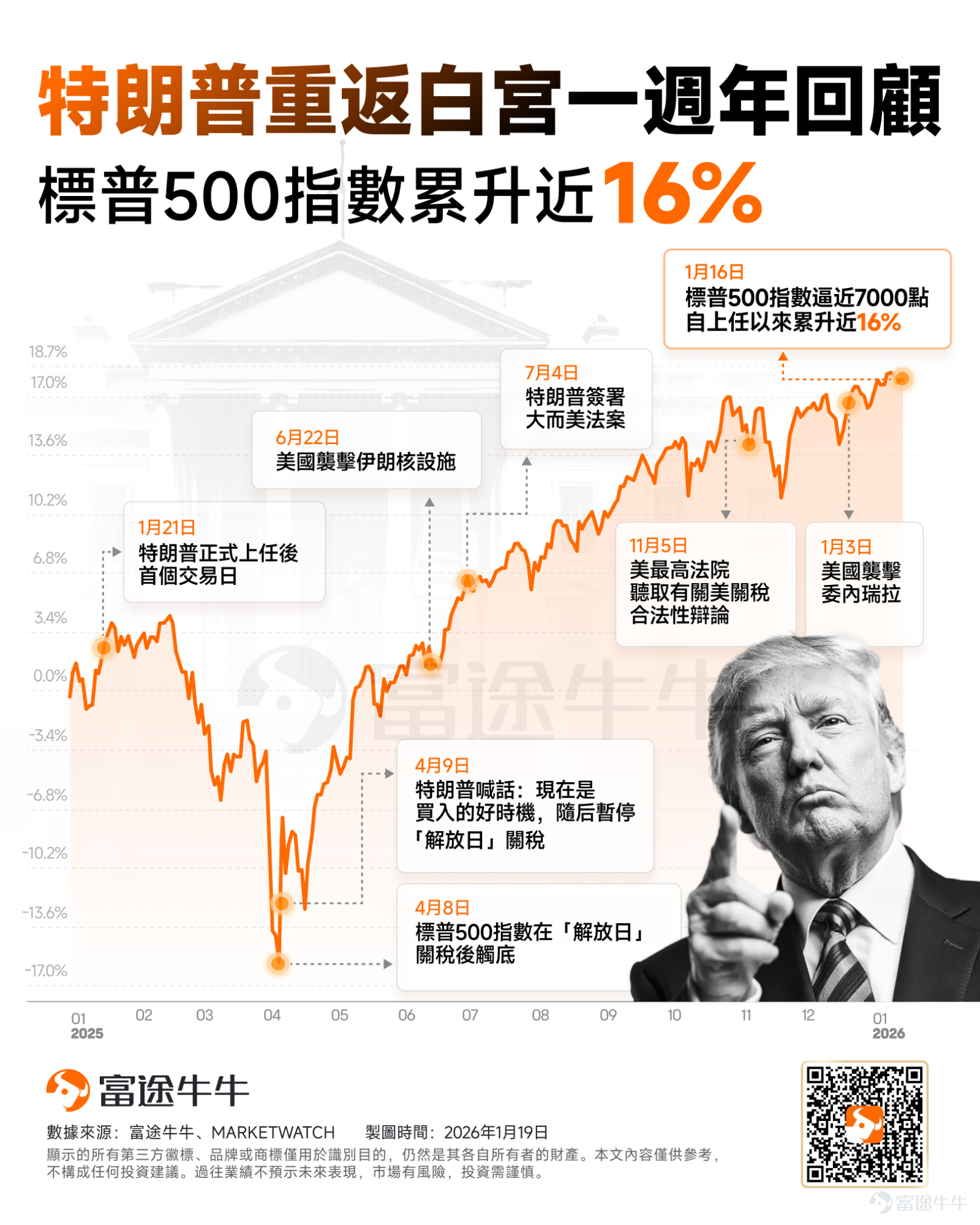

One Year Since Trump's Return to the White House: S&P 500 Up Nearly 16%—How Should Investors Hedge and Position Themselves in This Midterm Election Year?
The first anniversary of Trump’s return to the White House.
Up 16% within one year—this is the gain recorded during President Trump’s first year back in office $S&P 500 Index (.SPX.US)$
However, behind this seemingly impressive figurelies Wall Street’s roller-coaster ride, marked by sharp pullbacks and record highs.
This year has demonstrated one thing to investors: even in the face of sweeping policy shifts, the market retains strong absorption capacity. Yet as we enter the highly uncertain year of 2026, the market’s resilience will face an even sterner test.
At this juncture, with Trump’s second term entering its midterm election year, what should investors watch for? Which sectors stand to benefit? This article breaks it all down.
A Bull Market Amid Volatility: The True Value of a 16% Gain
Since Donald Trump was sworn in as the 47th U.S. president on January 20, 2025, U.S. equities have shown remarkable resilience. Although Trump’s April 2 announcement of tariff policies—dubbed 'Liberation Day'—triggered market turbulence, investors swiftly adopted a 'buy-the-dip' strategy. Dubbed the 'TACO trade' by some market participants, this pattern reflects a new consensus:The current administration’s aggressive policy rhetoric may not necessarily translate into lasting market damage.

Historically, a 16% gain is solid—well above the 9% median return for a president’s first year since 1929. However, it is not the strongest on record. By comparison, the S&P 500 rose 16.4% in President Biden’s first year, and surged 23.7% during Trump’s first year in office in 2017.

Source: DOW JONES MARKET DATA
For those who had expected Trump’s second term to deliver 'extremely bullish' conditions for the market, this year has been full of challenges.
Chris Maxey, Managing Director and Chief Market Strategist at Wealthspire Advisors, described it as follows:"The first year of Trump's return to the White House has delivered a firehose of news headlines."He noted that the most important lesson investors learned over the past year was "to stay patient." Overinterpreting political headlines often leads to portfolio missteps rather than gains.
Markets had widely feared that Trump’s volatile tariff policies would trigger a global trade war, reignite inflation, or push the economy into recession. However, these worst-case scenarios have not materialized to date. Although some tariff measures still await final rulings from the Supreme Court, the S&P 500 has recorded 42 new closing highs since last January, while the Dow Jones and Nasdaq have set new records 23 and 36 times, respectively.
Outlook for 2026: Midterm Elections and Geopolitical Clouds
However, as the calendar turns to 2026, investors may find it difficult to remain especially optimistic. The market is heading into what is traditionally its weakest period—the 'midterm election year.' Historical data shows that since 1948,the S&P 500 has averaged just a 4.6% gain in the second year of a presidential term.
Adding to concerns, 2026 began on a turbulent note. In just the first half of January, markets faced a series of geopolitical and policy shocks:
– Venezuela upheaval: U.S. military action led to the arrest of Venezuelan leader Maduro.
– Greenland Dispute: Trump again threatened to take over or purchase Greenland.
– US-Iran Tensions: Relations between the United States and Iran have become tense once again.
– Federal Reserve Crisis: A criminal investigation into current Federal Reserve Chair Jerome Powell has triggered serious market concerns about the central bank's independence.
Of particular note, Trump’s series of moves last week once again dominated investor discussions, including tariff policies and the selection of the Fed chair.
Tariff Policy:According to CCTV News, on Saturday (January 17, local time), U.S. President Trump announced that starting February 1, 2026, a 10% tariff will be imposed on all goods exported to the U.S. from Denmark, Norway, Sweden, France, Germany, the United Kingdom, the Netherlands, and Finland. Starting June 1, 2026, this tariff rate will increase to 25%.The reason for these additional tariffs is these countries’ opposition to U.S. control over Greenland, further escalating the dispute over Greenland’s future sovereignty.
Variables in the Fed Chair Race:Last Friday, Trump hinted that Hassett might not become the next Federal Reserve chair, after Hassett had repeatedly called for substantial rate cuts. With Hassett likely to remain as Director of the National Economic Council (NEC), the race has effectively narrowed to a 'three-way contest': BlackRock’s Global Chief Investment Officer of Fixed Income, Rick Rieder, versus former Fed governor Kevin Warsh and current Fed governor Christopher Waller. Both Warsh and Waller bring extensive central bank experience, representing more traditional choices compared to Rieder’s market-oriented background.

Source: Polymarket
In fact, according to Dongwu Securities, in 2026 Trump will deploy all available political resources at his disposal—including but not limited to trade policy under White House authority, fiscal policy under congressional authority, and monetary policy under Federal Reserve authority—to prepare for the final 'exam' of his political career—the midterm elections.
Trump’s three-pronged strategy for the midterms is mutually reinforcing and collectively forms the core trading theme for overseas policy in 2026: ① Trade Policy:Trump may escalate tariff conflicts again to deflect domestic tensions, rally voter support, pressure the Fed into cutting rates, and generate fiscal revenue;② Monetary Policy:The new Fed Chair will take office in May 2026, by which time the Fed is expected to launch rate cuts that are both larger than anticipated and exceed economic requirements. The 'Fed Put' will replace TACO to hedge against the shocks from tariffs, with accommodative monetary policy boosting both the economy and equity markets;③ Fiscal Policy:Interest rate cuts and tariffs will fund expansionary fiscal policy. Trump is expected to continue rolling out such policies in H2 2026 to bolster support ahead of the midterm elections.
For capital markets, three policies centered around Trump’s midterm election campaign will intertwine—ongoing tariff volatility and a dual-easing stance on both fiscal and monetary policy—propelling the U.S. economy from a soft landing back into expansion and significantly increasing upside inflation risks toward the end of 2026 and beyond.Implications for the market:
① Persistent tariff fluctuations imply that risk appetite will continue to follow a mean-reversion trading strategy—selling high and buying low.
② Dual easing in both monetary and fiscal policy implies that global equities, commodities, and otherrisk assets will benefit throughout the year from the twin tailwinds of liquidity and fundamentals.
③ Following the Fed leadership transition, monetary policy-drivenrate cuts exceeding both expectations and economic needs will result in lower U.S. interest rates and deteriorating credit quality,supporting higher gold prices, while the U.S. Dollar Index and 2-year Treasury yields decline. Combined with expansionary fiscal policy, 10-year Treasury yields will remain range-bound.
In the Trump era, which opportunities deserve close attention?
Since taking office, Trump's every word and action has deeply influenced the U.S. stock market.
previouslyIs Trump Performing 'Midas Touch' Magic on U.S. Stocks? These Four Core Sectors May See Strategic OpportunitiesAn earlier article also mentioned that after taking office, Trump invested in MP, Intel, U.S. lithium producer Lithium Americas Corp (LAC), and mineral exploration company TMQ—sending shockwaves through the U.S. stock market.For investors, understanding and following the government's investment decision logic is not only a way to capture opportunities but also an essential strategy for risk mitigation.
Market consensus generally holds that the following four sectors—resources, power and energy, space exploration, and semiconductors—may benefit from Trump's potential second term. Niuniu has also compiled relevant concept stocks for investor reference:

Specifically:
SemiconductorsWatch $NVIDIA (NVDA.US)$ 、 $Broadcom (AVGO.US)$ 、 $Advanced Micro Devices (AMD.US)$ 、 $Micron Technology (MU.US)$
rare earth companiesWatch $MP Materials (MP.US)$ 、 $TMC the metals (TMC.US)$ 、 $USA Rare Earth (USAR.US)$ 、 $Critical Metals (CRML.US)$ , etc.;
lithium mining companiesWatch $Rio Tinto (RIO.US)$ 、 $Sociedad Quimica Y Minera De Chile (SQM.US)$ 、 $Albemarle (ALB.US)$ 、 $Lithium Americas (LAC.US)$ , etc.;
Uranium mining companiesWorth watching $Cameco (CCJ.US)$ 、 $Uranium Energy (UEC.US)$ 、 $Centrus Energy (LEU.US)$ 、 $Energy Fuels (UUUU.US)$ , etc.;
Copper mining companiesWorth watching $Southern Copper (SCCO.US)$ 、 $Freeport-McMoRan (FCX.US)$ , etc.;
GraphiteWorth watching $NOVONIX (NVX.US)$ 、 $Nouveau Monde Graphite (NMG.US)$ 、 $Westwater Resources (WWR.US)$ ;
Space stocksWorth watching $Rocket Lab (RKLB.US)$ 、 $AST SpaceMobile (ASTS.US)$$EchoStar (ECHO.US)$ 、 $GE Aerospace (GE.US)$ 、 $RTX Corp (RTX.US)$ 、 $Boeing (BA.US)$ 、 $Lockheed Martin (LMT.US)$ ;
Nuclear powerWorth watching: $Oklo Inc (OKLO.US)$ 、 $BWX Technologies (BWXT.US)$ 、 $NuScale Power (SMR.US)$ 、 $NANO Nuclear Energy (NNE.US)$ ;
BatteriesWorth watching: $Tesla (TSLA.US)$ 、 $Bloom Energy (BE.US)$ 、 $QuantumScape (QS.US)$ 、 $Eos Energy (EOSE.US)$ ;
Power grids and energy storageWorth watching: $GE Vernova (GEV.US)$ 、 $Vistra Energy (VST.US)$ 、 $The AES Corp (AES.US)$ 、 $Fluence Energy (FLNC.US)$
In addition,"Trump Trade vs. Cutting-Edge Tech! Which Winners Is Wall Street Betting On?"An article also mentioned that Morgan Stanley released a report titled 'National Security Index,' which focuses on four key areas:Rare earths and strategic metals, batteries and energy storage, lithium, and nuclear energy and uranium mining.These companies are precisely the ones driving the hot 'Trump Trade' in the U.S. stock market.

Specifically:
Critical resources supporting AI, electric vehicles, and more—rare earths and strategic metalsincluding$Ramaco Resources-A (METC.US)$ 、 $United States Antimony (UAMY.US)$ 、 $USA Rare Earth (USAR.US)$ 、 $NioCorp Developments (NB.US)$ 、 $Critical Metals (CRML.US)$ 、 $MP Materials (MP.US)$ 、 $Idaho Strategic Resources (IDR.US)$ 、 $Ivanhoe Electric (IE.US)$ 、 $Carpenter Technology (CRS.US)$ 、 $Ivanhoe Mines Ltd (IVN.CA)$ 、 $Wheaton Precious Metals (WPM.US)$ 、 $First Quantum Minerals Ltd (FM.CA)$ 、 $Freeport-McMoRan (FCX.US)$ 、 $Gold.com (GOLD.US)$ ;
The 'white oil' of new energy—lithiumincluding$Albemarle (ALB.US)$ 、 $Sigma Lithium (SGML.US)$ 、 $Lithium Americas (LAC.US)$ 、 $Standard Lithium (SLI.US)$ 、 $Lithium Argentina AG (LAR.US)$ ;
The 'remedy' for AI-driven power shortages—nuclear energy and uranium miningincluding$Energy Fuels (UUUU.US)$ 、 $Centrus Energy (LEU.US)$ 、 $Cameco (CCJ.US)$ 、 $BWX Technologies (BWXT.US)$ 、 $Uranium Energy (UEC.US)$ 、 $NANO Nuclear Energy (NNE.US)$ 、 $Mirion (MIR.US)$ 、 $NexGen Energy (NXE.US)$ 、 $Oklo Inc (OKLO.US)$ 、 $Lightbridge (LTBR.US)$ 、 $ASP Isotopes (ASPI.US)$ 、 $Uranium Royalty (UROY.US)$ 、 $Encore Energy (EU.US)$ ;
The 'remedy' for AI-driven power shortages—batteries and energy storageincluding$Eos Energy (EOSE.US)$ 、 $Solaris Energy Infrastructure (SEI.US)$ 、 $Tesla (TSLA.US)$ 、 $Amprius Technologies (AMPX.US)$ 、 $Microvast (MVST.US)$ 、 $Ballard Power Systems Inc (BLDP.US)$ 、 $American Battery Technology (ABAT.US)$ 。
Conclusion: Dancing amid 'chaos and excitement'—precisely capturing policy-driven opportunities
Looking back at the first year of Trump’s return to the White House, the market demonstrated 'resilience' with a 16% gain. However, as we approach the pivotal 2026 midterm elections, investment logic is shifting from simple 'buy-the-dip' strategies toward more nuanced positioning.
Faced with the complex scenario of simultaneous 'tariff threats' and 'monetary easing,' investors must not only stay alert to geopolitical risks—such as the Greenland dispute or a potential Fed leadership change—that could trigger roller-coaster volatility, but also keenly identify structural opportunities emerging from policy shifts.
The market ahead may no longer be a broad-based rally, but rather a battleground of sector divergence. From securing self-reliance in rare earths and strategic metals, to nuclear power-driven energy transformation, and national competition in space exploration and hard-tech innovation, aligning with the core themes of the 'Trump trade' and seeking sector-specific certainty amid macro volatility will be the optimal strategy to navigate this storm of politics and capital. In an age of information overload, understanding the political cards leaders are playing to win the midterms matters far more than predicting index movements.
Risk Disclaimer: The above content only represents the author's view. It does not represent any position or investment advice of Futu. Futu makes no representation or warranty.Read more


Comments (6)
to post a comment
119
195